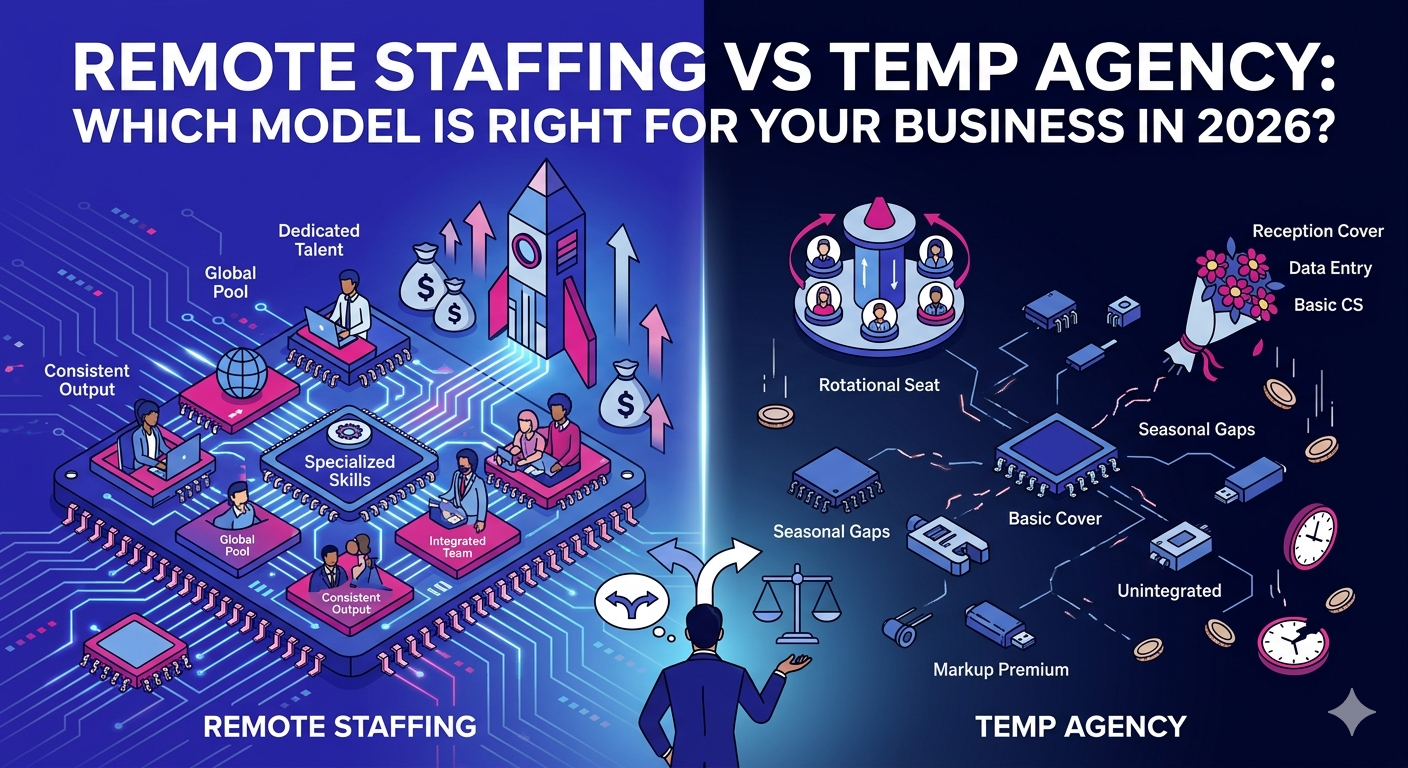
When businesses need to fill roles quickly and cost-effectively, two models dominate the conversation: remote staffing vs temp agency. On the surface, both promise access to talent without the friction of traditional hiring. But the similarities end there. In 2026, the differences between these two approaches have become even more pronounced, and choosing the wrong one can cost your business time, money, and momentum.
This guide breaks down exactly how remote staffing and temp agencies differ, what each model is actually suited for, and why a growing number of businesses are making a clear choice when it comes to building reliable, high-performing teams.
What Is Remote Staffing?
Remote staffing involves hiring full-time or part-time professionals who work exclusively for your business but operate from a remote location, typically through a specialist staffing partner who handles sourcing, vetting, and placement.
Unlike traditional outsourcing, remote staffing gives you dedicated professionals who are fully integrated into your team. They work on your tools, follow your processes, align with your culture, and are accountable to your management structure. The staffing partner facilitates the relationship but your business drives the day-to-day work.
Common roles filled through remote staffing include sales development representatives, digital marketers, customer support professionals, virtual assistants, legal support staff, and a wide range of specialist functions across marketing and operations.
What Is a Temp Agency?
A temp agency, also known as a temporary staffing agency, places workers in short-term roles to cover specific periods of need. These workers are technically employed by the agency, not your business, and they are typically assigned to fill gaps caused by seasonal demand, employee absence, or short project requirements.
Temp workers are not dedicated to your business. They may be placed with multiple clients simultaneously or transition between assignments regularly. The relationship is transactional by design, and the focus is on filling seats quickly rather than building long-term capability.
Remote Staffing vs Temp Agency: The Core Differences
Commitment and Dedication
This is the most fundamental difference in the remote staffing vs temp agency debate. A remote staffing professional works for you and only you. They are invested in your outcomes, embedded in your workflow, and motivated to perform because their role depends on it.
A temp worker, by contrast, has no long-term stake in your business. Their loyalty is to the agency that employs them, and their attention is often split across multiple clients or assignments. For roles that require consistency, relationship-building, or deep process knowledge, this distinction matters enormously.
Skill Level and Specialization
Temp agencies typically focus on filling general or semi-skilled positions at speed. Think data entry, reception cover, light administrative work, or basic customer service during busy periods. The priority is availability, not specialization.
Remote staffing providers, particularly those with a specialist focus, place professionals with specific skill sets aligned to your business needs. Whether you need a dedicated remote cold email expert to drive outbound pipeline, a trained SEO specialist, or an experienced executive assistant, the caliber of candidate available through remote staffing is typically far higher than what a general temp agency can offer.
Cost Structure and Value
At first glance, temp agencies can appear cheaper because the engagement is short-term and there is no long-term commitment. But the real cost calculation is more nuanced.
Temp agency markup rates typically range from 25% to 75% above the worker’s pay rate. You pay that premium for every hour worked, regardless of how long the engagement lasts. And because temp workers take time to get up to speed on your systems and processes, you are often paying for unproductive onboarding periods repeatedly as workers rotate in and out.
Remote staffing involves a placement fee or ongoing service fee, but the professional you hire is fully committed to your business, ramps up once, and builds compounding value over time. For any role requiring more than a few weeks of consistent contribution, the economics strongly favor remote staffing.
Integration and Culture Fit
Because temp workers are short-term and agency-employed, they rarely integrate deeply into your team. They use your tools superficially, attend meetings as observers rather than contributors, and seldom develop the institutional knowledge that drives real performance.
Remote staffing professionals are onboarded like any team member. They attend your standups, contribute to your strategy discussions, build relationships with your clients and colleagues, and develop the kind of contextual knowledge that directly improves their output over time. The difference in quality of contribution becomes significant within the first month.
When a Temp Agency Still Makes Sense
To be fair, temp agencies serve a legitimate purpose in specific situations. If your business needs:
- Short-term cover for a single staff member on leave for two to four weeks
- Seasonal labour for physical or high-volume transactional work
- A one-day or one-week solution for a specific administrative task
- Workers in roles where location and physical presence are essential
In these scenarios, a temp agency is a reasonable tool. The model is optimized for short, defined, low-complexity engagements.
However, if your need involves specialist skills, consistent output, sales or marketing functions, customer-facing roles, or anything requiring more than a few weeks of productive contribution, the remote staffing vs temp agency comparison becomes very one-sided.
Why Remote Staffing Wins for Growth-Focused Businesses in 2026
Access to a Global Talent Pool
One of the most compelling advantages of remote staffing over a temp agency is the scope of available talent. Remote staffing providers source professionals globally, giving you access to specialists who may simply not exist in your local market or who would command a far higher salary if hired domestically.
According to research highlighted by McKinsey’s ongoing research into remote work models and global staffing trends, businesses that embrace remote talent models consistently outperform peers on hiring speed, cost efficiency, and access to specialized skill sets. This dynamic has only strengthened heading into 2026.
Scalability Without Headcount Risk
Remote staffing gives businesses the ability to scale team capacity up or down based on real demand, without the legal and financial risk associated with expanding a domestic headcount or relying on an agency for rotational cover.
For businesses in growth phases, this means you can add a remote sales rep, a digital marketer, or a customer support specialist when the revenue opportunity justifies it, and adjust when conditions change. That agility is a genuine competitive advantage in a market where business conditions shift quickly.
Consistency Drives Compounding Returns
Every time a temp worker rotates out, your business loses accumulated knowledge, relationship equity, and process familiarity. You restart the learning curve with someone new, and the output dips before it recovers.
Remote staffing professionals stay. They learn your product, your clients, your tone of voice, and your internal rhythms. Over six, twelve, or twenty-four months, that accumulated knowledge compounds into substantially higher performance. This is the difference between a team that is always catching up and one that is consistently moving forward.
How to Choose the Right Remote Staffing Partner
The quality of your remote staffing experience depends heavily on your provider. When evaluating options, look for:
- A rigorous candidate vetting process that goes beyond resume screening
- Demonstrated placement history in your industry or function
- Transparent pricing with no hidden markups or ambiguous fee structures
- Ongoing support after placement, not just a handover and goodbye
- A clear onboarding framework to help remote staff integrate with your team
The best remote staffing providers operate as genuine partners, not placement machines. They take time to understand your business goals, team culture, and the specific outcomes you need before recommending a candidate.
Businesses looking to build high-performing remote teams across sales, marketing, and operations can explore the full range of dedicated placement options at The Remote Reps, a specialist remote staffing provider built for growth-focused companies.
The Verdict: Remote Staffing vs Temp Agency
For short-term, low-complexity, location-dependent needs, a temp agency may be a practical option. But for any business serious about building reliable, skilled, and cost-effective teams in 2026, remote staffing is the clear winner.
It delivers better talent, deeper integration, stronger output quality, and far greater long-term value. The remote staffing model is not a workaround. It is the most intelligent way to build a competitive team in the modern economy.
If you are ready to move beyond the limitations of temp agency hiring and build a team that actually grows with your business, start the conversation with a remote staffing specialist today.
FAQ: Remote Staffing vs Temp Agency
What is the main difference between remote staffing and a temp agency?
The core difference in the remote staffing vs temp agency comparison is commitment. Remote staffing professionals are dedicated exclusively to your business, fully integrated into your team, and focused on long-term performance. Temp agency workers are employed by the agency, often juggling multiple clients, and optimized for short-term gap-filling rather than sustained contribution.
Is remote staffing more expensive than using a temp agency?
Not when you calculate the true cost. Temp agencies charge markup rates of 25% to 75% above the worker’s pay for every hour worked, and you absorb repeated onboarding costs as workers rotate. Remote staffing involves a placement or service fee, but the professional ramps up once and builds compounding value. For any engagement lasting more than a few weeks, remote staffing vs temp agency costs almost always favor the remote staffing model.
What types of roles are best suited for remote staffing vs a temp agency?
Remote staffing is ideal for specialist roles requiring consistent output, skill depth, and team integration, including sales development, digital marketing, SEO, customer support, virtual assistance, legal support, and operations roles. Temp agencies are better suited for short-term, low-complexity, or physically location-dependent tasks such as one-week administrative cover or seasonal manual work.
How quickly can I get started with a remote staffing provider compared to a temp agency?
Both models offer relatively fast placements compared to traditional hiring. However, remote staffing providers focused on specialist roles typically deliver vetted, pre-assessed candidates within one to three weeks. The key difference is that a remote staffing professional placed in your business is ready to contribute at a higher level from day one, reducing the ramp time that often hampers temp agency placements.
Can remote staffing replace a temp agency for all my flexible hiring needs?
For most knowledge-based, digital, or office-style roles, remote staffing is a superior alternative to a temp agency in almost every scenario. The remote staffing vs temp agency decision comes down to the nature of the role. If the work can be done digitally and benefits from continuity and specialist knowledge, remote staffing is the better choice. Temp agencies retain relevance only for very short-term or physically present roles where a dedicated professional would be unnecessary.