Hiring remote talent has never been more competitive. Whether you are scaling a sales team, building out your marketing function, or filling operational roles, the way you source talent matters just as much as the talent itself. The remote staffing agency vs recruiter debate is one that growing businesses face constantly, and the wrong choice can cost you significant time, money, and momentum.
This guide breaks down the real differences between a remote staffing agency and an independent recruiter, so you can make the right call for your business goals in 2026.
What Is a Remote Staffing Agency?
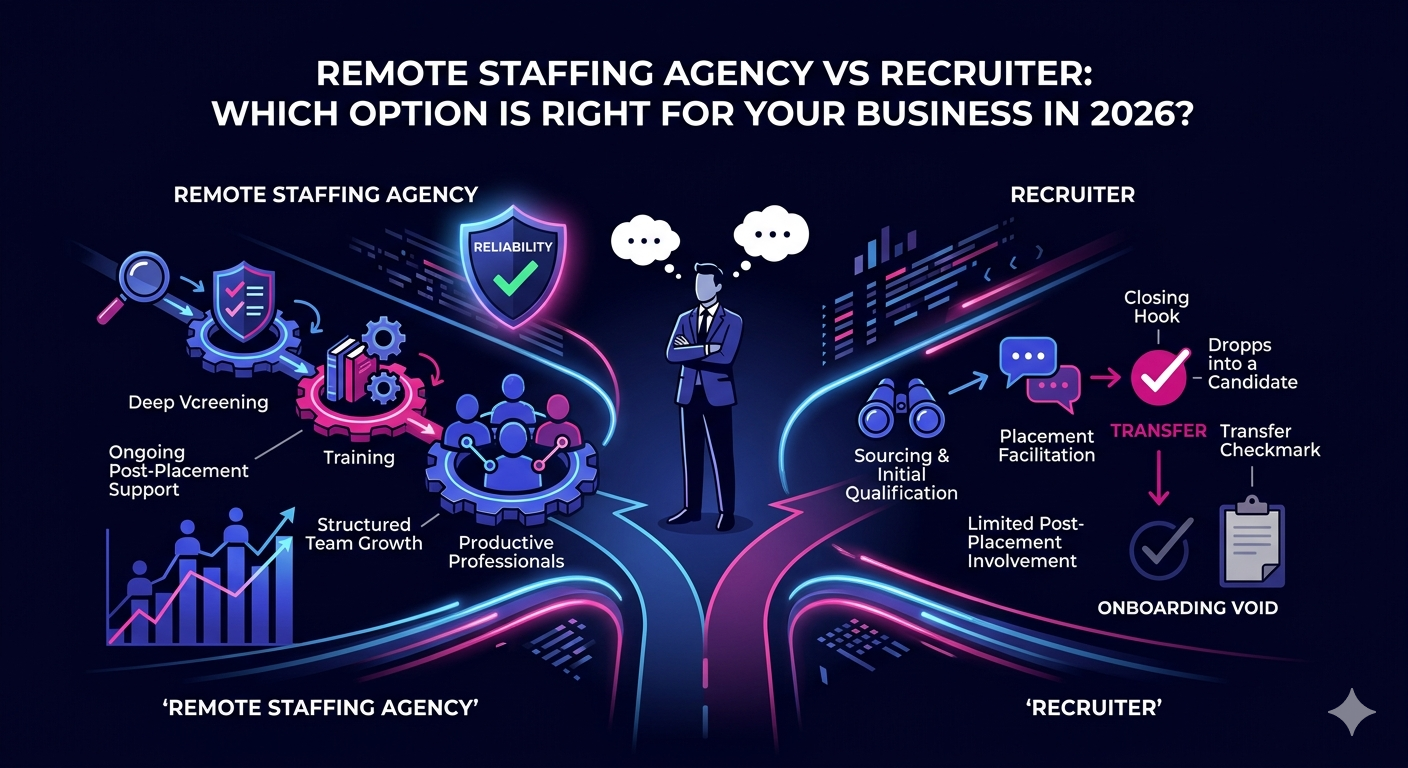
A remote staffing agency is a specialized organization that sources, vets, and places remote professionals in ongoing roles for client businesses. The agency manages the talent pipeline, handles initial screening, and often provides post-placement support to ensure the hire integrates well and performs to expectations.
Unlike generalist hiring firms, remote staffing agencies focus specifically on distributed work models. They understand the nuances of remote communication, time zone alignment, and the specific skills that make a professional effective outside a traditional office environment.
What a Remote Staffing Agency Typically Provides
- A curated pool of pre-vetted remote professionals across multiple specializations
- Screening processes designed for remote-specific competencies
- Ongoing support after placement to help manage performance and retention
- Access to dedicated talent, not shared freelancers
- Transparent, predictable pricing structures for long-term engagements
What Is a Recruiter?
A recruiter, whether independent or part of a larger firm, focuses on the hiring transaction. Their primary job is to identify candidates, facilitate interviews, and close the placement. Once a hire is made, their involvement typically ends and the responsibility for onboarding, management, and retention falls entirely on your team.
Recruiters can be highly effective for specific, senior-level, or niche placements. However, they are generally not structured to provide the ongoing support and remote-specific vetting that businesses need when building distributed teams at scale.
What a Recruiter Typically Provides
- Candidate sourcing and initial qualification
- Interview coordination and reference checks
- Placement facilitation with a one-time fee structure
- Limited post-placement involvement
- Broader focus that is not always specific to remote work requirements
Remote Staffing Agency vs Recruiter: The Key Differences
Understanding the remote staffing agency vs recruiter distinction goes beyond job titles. It comes down to structure, accountability, and what happens after you make the hire.
1. Depth of Vetting
Remote staffing agencies invest heavily in vetting because their business model depends on successful, long-term placements. They assess not just hard skills but also remote readiness, communication style, reliability, and cultural fit. A recruiter’s vetting process is typically faster and less thorough because their incentive ends at placement.
2. Post-Placement Support
This is one of the most significant differences in the remote staffing agency vs recruiter comparison. Agencies provide ongoing support to ensure the professional integrates smoothly into your team and continues to perform well. Recruiters hand off the candidate and move on to the next search.
3. Specialization in Remote Work
Remote work requires a distinct skill set that goes beyond technical qualifications. Remote staffing agencies screen for asynchronous communication skills, self-management, and experience working across time zones. Most generalist recruiters do not have frameworks specifically designed for these remote-specific attributes.
4. Cost Structure
Recruiters commonly charge a one-time placement fee, often a percentage of the hire’s annual salary. This can range from 15 to 25 percent depending on the role and seniority. Remote staffing agencies typically operate on a monthly retainer or flat fee model, which is often more cost-effective for businesses that plan to scale a remote team over time.
5. Speed vs Quality
Recruiters can move quickly and are well-suited for urgent, one-off hires. Remote staffing agencies prioritize quality and fit over speed, which produces better long-term retention and performance outcomes. In the remote staffing agency vs recruiter debate, your time horizon matters greatly.
When Should You Choose a Remote Staffing Agency?
A remote staffing agency is the right choice when:
- You are building a remote team that requires sustained focus and ongoing performance
- You need professionals in specialized roles such as sales, digital marketing, SEO, or customer support
- You want post-placement accountability, not just a candidate delivery service
- You are scaling multiple remote roles simultaneously and need a consistent vetting standard
- You want predictable costs without placement fees that scale with salary levels
Platforms like The Remote Reps, which specializes in dedicated remote staffing for sales and marketing roles, represent the kind of agency model that delivers far more than a recruiter can in terms of depth, accountability, and long-term value.
When Does a Recruiter Make More Sense?
A recruiter may be the better option when:
- You are making a single, senior-level hire that requires a highly customized search
- The role is highly niche and requires deep industry network access
- You have a strong internal HR team capable of handling onboarding, management, and retention independently
- You need to fill a role quickly and have a clear, defined candidate profile
Even in these scenarios, many businesses find that the remote staffing agency vs recruiter comparison still favors the agency model when remote-specific expertise and long-term performance are priorities.
The Hidden Costs of Using a Recruiter for Remote Hiring
The upfront cost of a recruiter may seem competitive, but the true cost of a failed remote hire is far higher. Research cited by SHRM on remote staffing and recruiter cost-per-hire benchmarks consistently shows that the average cost of replacing a failed hire can reach 50 to 200 percent of that employee’s annual salary when you factor in lost productivity, re-hiring fees, and onboarding time.
Remote hires carry additional risk because misalignment in communication styles, work habits, or time zone management often goes undetected until weeks into the role. A remote staffing agency mitigates this risk through specialized screening. A recruiter, focused on closing the placement, is less equipped to flag these warning signs early.
Why Remote Staffing Agencies Are the Preferred Model in 2026
The distributed work model has become a permanent fixture for businesses of all sizes. In 2026, remote teams are no longer a temporary accommodation but a deliberate growth strategy. That shift has elevated the importance of getting remote hiring right the first time.
Remote staffing agencies have evolved to meet this demand. They offer faster access to qualified remote talent, better retention rates, and a structured approach to performance management that standalone recruiters simply cannot match at scale.
Businesses that have shifted from using recruiters to partnering with specialized remote staffing agencies report shorter time-to-productivity for new hires, lower turnover, and stronger alignment between remote team members and company goals. The remote staffing agency vs recruiter choice has become clearer with each passing year.
If you are ready to build a remote team that delivers consistent results, explore the full range of dedicated remote sales and staffing services at The Remote Reps to find the professionals your business needs.
Conclusion: Choose the Model That Matches Your Remote Growth Goals
The remote staffing agency vs recruiter decision ultimately comes down to what you need from the relationship. If you want a quick candidate delivery with no strings attached, a recruiter can get the job done. But if you want vetted, dedicated remote professionals who integrate into your team and perform at a high level over the long term, a remote staffing agency is the clear winner.
In a hiring landscape where remote talent is in high demand and the cost of a bad hire is significant, the right agency partnership is not just a convenience. It is a competitive advantage.
Frequently Asked Questions
What is the main difference between a remote staffing agency and a recruiter?
In the remote staffing agency vs recruiter comparison, the primary difference is scope and ongoing support. A recruiter focuses on sourcing and placing candidates, with limited involvement after the hire is made. A remote staffing agency provides a more comprehensive service that includes specialized vetting for remote roles, placement, and ongoing support to ensure the professional performs well over time.
Is a remote staffing agency more expensive than a recruiter?
Not necessarily. Recruiters typically charge a one-time placement fee of 15 to 25 percent of the hire’s annual salary, which can be a significant upfront cost. Remote staffing agencies usually operate on a flat monthly fee or retainer model, which tends to be more cost-predictable and cost-effective over the long term, especially when building a remote team at scale.
Which is better for scaling a remote team, a staffing agency or a recruiter?
For scaling a remote team, a remote staffing agency is the better option. Agencies are designed to handle multiple placements with consistent vetting standards, and they provide post-placement support that helps new remote hires integrate effectively. A recruiter is better suited to one-off or senior-level placements rather than building an ongoing remote team.
Do remote staffing agencies only place freelancers?
No. Quality remote staffing agencies like The Remote Reps place dedicated professionals who work exclusively for your business on an ongoing basis. This is a key distinction in the remote staffing agency vs recruiter debate. Unlike freelancer marketplaces, dedicated remote staffing agencies provide professionals who are embedded in your team and fully focused on your business goals.
How do I evaluate a remote staffing agency vs a recruiter for my specific needs?
Start by defining whether your need is transactional or ongoing. If you need a single senior hire quickly, a recruiter may suffice. If you need reliable, specialized remote professionals who will grow with your business over time, a remote staffing agency is the better fit. Evaluate each option based on their vetting process, post-placement support, pricing model, and experience with remote-specific roles in your industry.
What types of roles can a remote staffing agency fill that a recruiter might miss?
Remote staffing agencies are particularly strong at filling roles that require both specialized skills and remote-specific competencies, such as sales development reps, digital marketers, SEO specialists, virtual assistants, customer support experts, and lead generation professionals. In the remote staffing agency vs recruiter comparison, agencies have a deeper bench of pre-vetted talent in these categories and understand the nuances of placing professionals who will thrive in a fully remote environment.