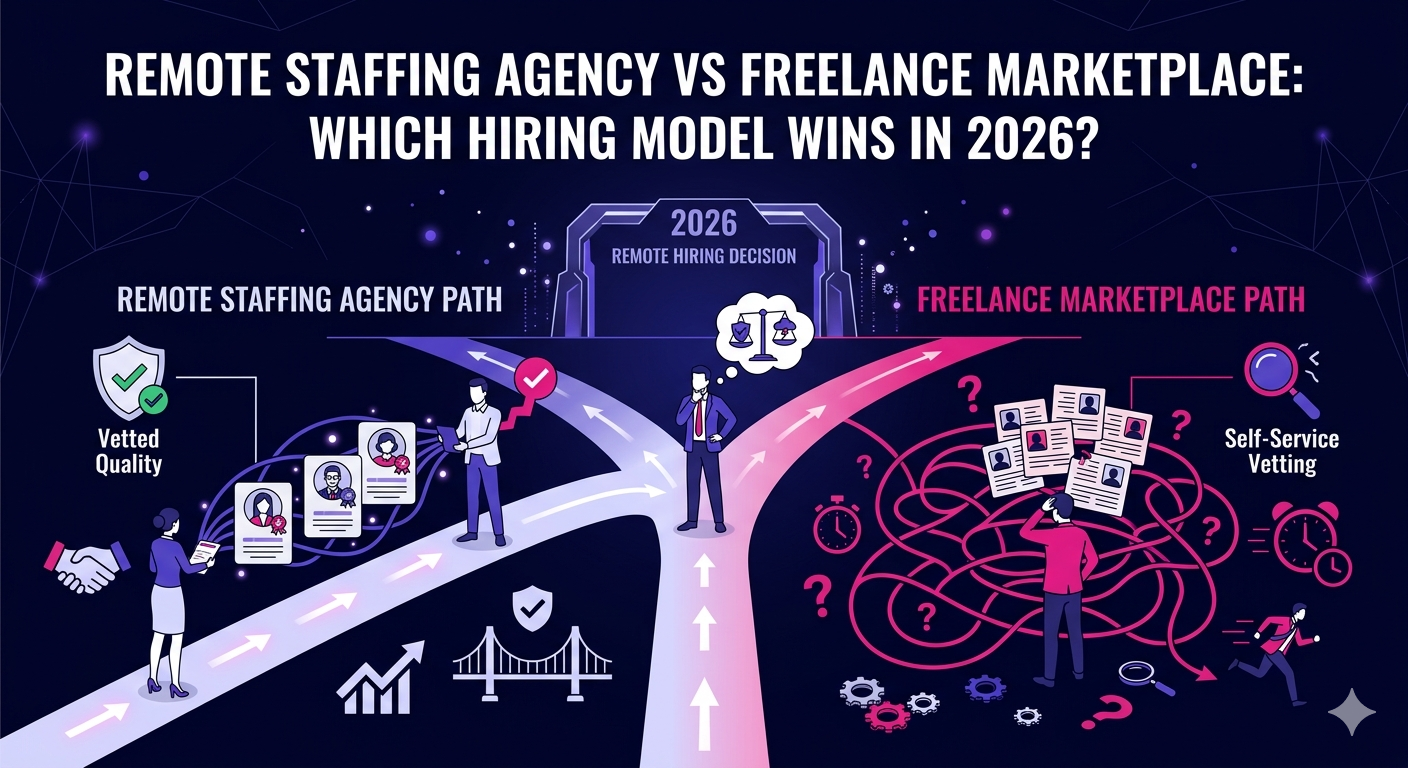
When businesses decide to hire remotely, they immediately face a foundational choice: should you work with a remote staffing agency vs freelance marketplace? Both options give you access to off-site talent, but the experience, reliability, and outcomes they deliver are fundamentally different.
In 2026, with remote hiring now mainstream across industries, understanding the practical difference between a remote staffing agency and a freelance marketplace is no longer optional. It is a strategic decision that will shape your team quality, operational efficiency, and long-term growth capacity. This guide breaks down each model clearly so you can choose the right one for your business.
What Is a Remote Staffing Agency?
A remote staffing agency sources, vets, and places dedicated remote professionals on behalf of client businesses. Rather than presenting you with a pool of self-registered freelancers to sift through, a staffing agency takes on the recruitment process itself, matching your specific requirements with pre-screened candidates who have already been evaluated for skills, communication ability, and professional reliability.
The agency manages the pipeline. You receive a shortlist of qualified candidates or, in many cases, a direct placement into your team. Ongoing performance support is typically built into the engagement model, making the agency a true partner rather than just a talent source.
What Is a Freelance Marketplace?
A freelance marketplace is a self-service platform where independent contractors create profiles and businesses browse, compare, and hire them directly. Popular examples include Upwork, Fiverr, and Toptal. The hiring business bears full responsibility for posting jobs, reviewing applications, running interviews, and managing ongoing performance.
Freelance marketplaces offer a large volume of available workers at a wide range of price points, which appeals to businesses looking for speed and variety. However, the trade-off is significant: quality is inconsistent, turnover is high, and the time investment required to find and manage reliable talent is substantial.
Remote Staffing Agency vs Freelance Marketplace: A Detailed Comparison
1. Talent Vetting and Quality Control
This is the most consequential difference in the remote staffing agency vs freelance marketplace debate.
On a freelance marketplace, anyone can create a profile. While some platforms have verification systems or top-tier tiers, the vast majority of the talent pool is self-reported and self-managed. Businesses frequently report hiring freelancers whose skills did not match their profiles, leading to lost time and budget on failed engagements.
A remote staffing agency applies a structured, multi-stage vetting process before any candidate reaches a client. Skills assessments, background checks, communication evaluations, and role-specific performance testing all occur before placement. You receive talent that has already been validated, which dramatically reduces hiring risk and ramp-up time.
2. Dedicated vs Project-Based Talent
Freelance marketplaces are optimized for project-based or task-based work. Freelancers typically manage multiple clients simultaneously, which means your business is rarely their primary focus. Availability can shift without notice, timelines can slip, and continuity is a constant challenge.
Remote staffing agencies place dedicated professionals who work exclusively for your business during their contracted hours. This mirrors the commitment and focus of a full-time employee, creating far stronger alignment with your goals, processes, and team culture.
3. Time Investment and Hiring Speed
On the surface, freelance marketplaces appear faster. You can post a job and receive applications within hours. However, filtering through dozens or hundreds of applications, running multiple rounds of interviews, and testing candidates before committing to a hire can take days or weeks and still result in a poor outcome.
A remote staffing agency compresses this process significantly. Because the agency maintains a pre-vetted pipeline of candidates organized by role type, matching a business with a qualified professional is far faster than managing a marketplace search independently. Many staffing agencies can place candidates within days of receiving a brief.
4. Accountability and Performance Support
When a freelancer underperforms on a marketplace, the recourse is limited. You leave a review and start the hiring process over again, absorbing all the costs and delays that come with it.
With a remote staffing agency, the relationship does not end at placement. Agencies typically provide ongoing performance support, replacement guarantees, and client success management. If a placed professional is not meeting expectations, the agency is motivated to resolve that quickly because its reputation depends on long-term outcomes, not one-time transactions.
5. Role Specialization and Scope
Freelance marketplaces carry broad catalogs of workers across hundreds of skill categories, but depth in specialized business roles varies considerably. Finding a highly skilled sales development representative, a trained paralegal, or a certified PPC expert on a general marketplace often means wading through a high volume of underqualified applicants.
Specialized remote staffing agencies organize their talent pipelines by role type and industry function. If your business needs a dedicated remote digital marketer through a staffing agency like The Remote Reps, you receive candidates who have been vetted specifically for digital marketing competency, not generalist contractors who listed marketing as one of many skills.
6. Cost Considerations
Freelance marketplaces often appear cheaper upfront. Hourly rates for lower-tier freelancers can be very low, which appeals to budget-conscious businesses. However, the total cost of a bad hire, including the time spent vetting, onboarding, managing, and replacing a freelancer who does not perform, often far exceeds what a staffing agency would have charged for a reliable placement from the start.
Remote staffing agencies, particularly those using an offshore model, also offer significant cost savings over domestic hiring while delivering consistent, managed talent. The combination of lower offshore labor rates and reduced hiring overhead makes agency-placed talent highly competitive on total cost, even when the initial placement fee is factored in.
When a Freelance Marketplace Makes Sense
To be balanced, there are scenarios where a freelance marketplace is genuinely the right tool:
- Short-term, clearly defined projects with a fixed scope and deliverable
- One-off creative tasks such as a logo design, a single video edit, or a landing page copy job
- Situations where you have internal HR capacity to manage a lengthy vetting process
- Testing a new role or function before committing to a full-time hire
Outside of these scenarios, the limitations of a freelance marketplace become liabilities for most businesses that are trying to build reliable, scalable remote teams.
When a Remote Staffing Agency Is the Stronger Choice
The remote staffing agency model outperforms the freelance marketplace in the following situations:
- You need a dedicated, full-time or near-full-time remote professional
- The role is specialized and requires validated skills, not self-reported competencies
- You want to scale a team across multiple functions without running parallel hiring processes
- Reliability, continuity, and accountability are non-negotiable for your business operations
- You lack the internal bandwidth to manage a complex freelancer vetting process
- Long-term performance and retention matter more than short-term cost minimization
According to McKinsey’s research on remote staffing agency vs freelance marketplace models and workforce performance, organizations that invest in structured, managed remote hiring processes report stronger productivity outcomes and lower turnover rates compared to those relying on self-managed freelancer platforms.
What to Look for in a Remote Staffing Agency
Not all staffing agencies are created equal. When evaluating a remote staffing agency vs freelance marketplace for your next hire, use these criteria to identify the right agency partner:
- A transparent, role-specific vetting process with verifiable standards
- Specialization in the business functions you need to fill
- A track record of placements backed by verifiable client results
- Replacement guarantees and ongoing performance support
- Clear contracts covering IP protection, confidentiality, and data security
- Experience working with businesses at your stage of growth
You can explore real outcomes from businesses that have used this model by reviewing the client success stories at The Remote Reps, where companies across industries share how agency-placed remote talent transformed their operations.
Conclusion: Remote Staffing Agency vs Freelance Marketplace and the Right Path Forward
The remote staffing agency vs freelance marketplace comparison ultimately comes down to what your business values more: the appearance of flexibility or the reality of performance. Freelance marketplaces offer volume and surface-level speed. Remote staffing agencies offer reliability, accountability, and professionals who are genuinely invested in your business’s success.
For businesses serious about building high-performing remote teams in 2026, the agency model delivers a compounding advantage over time. Lower risk, better talent, and a partner invested in your outcomes make it the superior choice for most growth-focused companies.
Ready to experience the difference a dedicated remote staffing agency makes? Visit The Remote Reps and connect with a staffing specialist who can match you with the right remote professional for your business today.
Frequently Asked Questions
What is the core difference between a remote staffing agency vs freelance marketplace?
The core difference between a remote staffing agency vs freelance marketplace lies in who manages the hiring process and the nature of the talent relationship. A remote staffing agency vets, places, and supports dedicated remote professionals on your behalf. A freelance marketplace is a self-service platform where you search, evaluate, and hire independent contractors yourself, with no agency involvement in quality control or performance management.
Is a remote staffing agency vs freelance marketplace more cost-effective?
When comparing a remote staffing agency vs freelance marketplace on total cost, staffing agencies often deliver better value despite higher upfront placement fees. Marketplace hiring carries hidden costs including time spent vetting applicants, managing failed placements, and rehiring after turnover. Staffing agencies, especially those using offshore models, reduce these costs significantly by delivering pre-vetted, reliable talent with performance guarantees built into the engagement.
Which option gives businesses more control, a remote staffing agency vs freelance marketplace?
In the remote staffing agency vs freelance marketplace comparison for control, both models give businesses day-to-day management over their remote workers. However, a staffing agency provides additional layers of accountability through performance support, replacement guarantees, and dedicated client success management. Freelance marketplaces place the entire burden of performance management on the hiring business with limited recourse when things go wrong.
How does talent quality differ between a remote staffing agency vs freelance marketplace?
Talent quality is one of the most significant distinctions in the remote staffing agency vs freelance marketplace debate. Staffing agencies apply multi-stage vetting processes including skills assessments, background checks, and role-specific evaluations before any placement. Freelance marketplace profiles are largely self-reported, and quality varies enormously. For roles requiring validated skills and reliable performance, a staffing agency consistently delivers stronger outcomes.
When should a business choose a remote staffing agency vs freelance marketplace?
Businesses should choose a remote staffing agency over a freelance marketplace when they need a dedicated, full-time professional in a specialized role, want to scale a remote team across multiple functions, or lack the internal capacity to manage a lengthy freelancer search. A freelance marketplace is better suited for short-term, project-based tasks with clearly defined deliverables and a fixed scope.
Can a remote staffing agency fill more specialized roles than a freelance marketplace?
Yes. While freelance marketplaces carry large volumes of generalist workers, specialized remote staffing agencies maintain role-specific talent pipelines that go far beyond what most marketplaces can reliably source. Agencies focused on business growth functions can place sales professionals, digital marketers, legal support staff, customer service teams, and technical specialists, all vetted specifically for those roles rather than relying on self-reported credentials.