
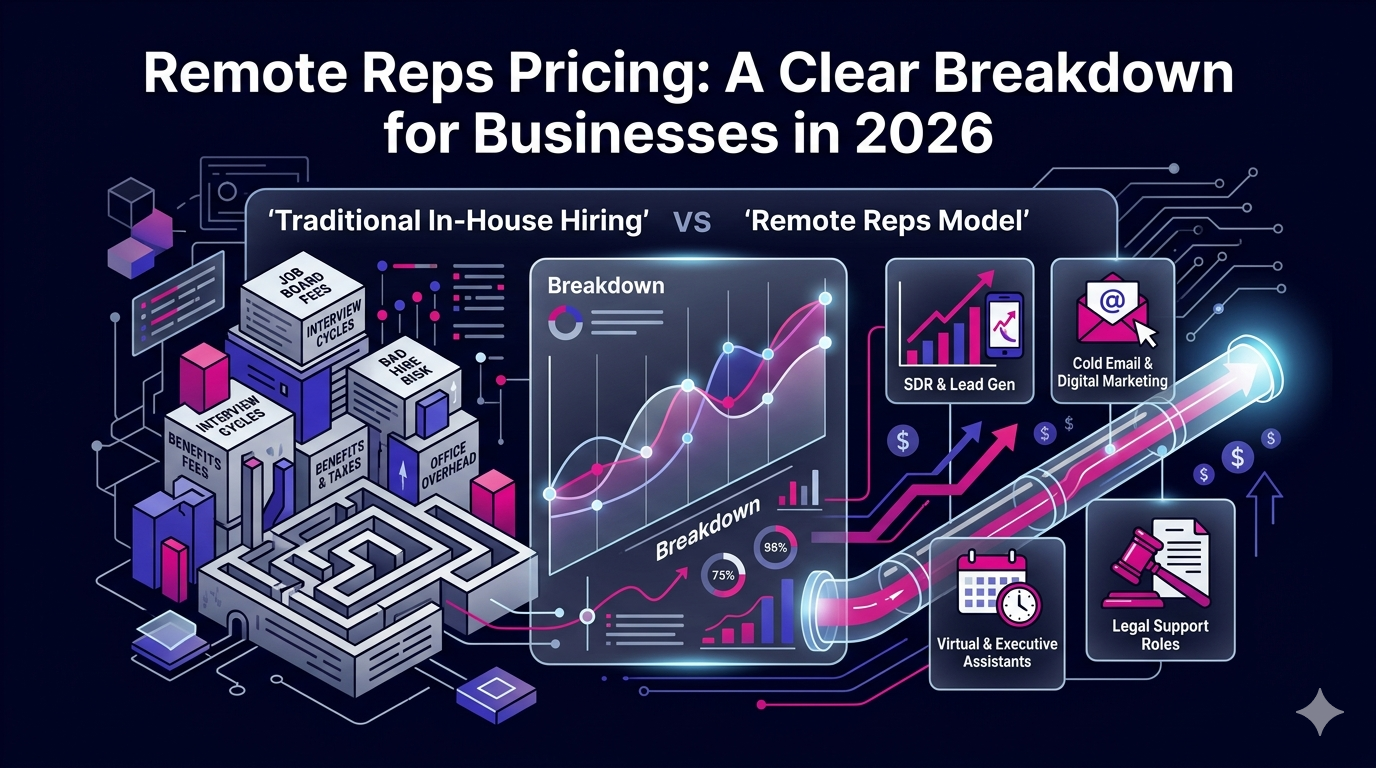
If you are evaluating remote staffing options and want to understand Remote Reps pricing before committing, you are asking exactly the right question. Pricing is one of the first things businesses want clarity on, and rightly so. What you invest in remote talent directly affects your margins, your growth trajectory, and your ability to compete. This guide walks you through how Remote Reps pricing works, what influences cost, and how it compares to traditional hiring in 2026.
Why Remote Reps Pricing Is Different From Typical Staffing Costs
Most businesses approach remote staffing with a freelance marketplace mindset: browse profiles, pick the cheapest option, and hope for the best. That model produces inconsistent results and often costs more in the long run through lost productivity, re-hiring, and constant onboarding cycles.
Remote Reps pricing is structured differently. The platform operates on a quality-first model, meaning businesses pay for access to pre-vetted, role-specific professionals rather than unfiltered candidate pools. This distinction matters a great deal when you factor in the true cost of a bad hire, which research consistently places at anywhere from one to three times the role’s annual salary.
In 2026, with remote hiring more competitive than ever, the value of a structured pricing model built around quality and accountability becomes even clearer.
What Factors Influence Remote Reps Pricing?
Remote Reps pricing is not a single flat rate. It varies based on several factors that reflect the complexity and specialization of the role being filled. Understanding these variables helps businesses set realistic expectations and budget more accurately.
Role Type and Specialization
The most significant driver of Remote Reps pricing is the type of role being filled. A virtual assistant placement will carry different pricing from a GTM engineer or a paralegal. Roles that require niche technical skills, industry knowledge, or compliance awareness are naturally priced to reflect the higher bar set during candidate vetting. Businesses should expect pricing to scale with specialization.
Engagement Duration and Scope
Remote Reps pricing also reflects the scope of the engagement. A part-time support role carries different economics than a full-time, long-term placement. Businesses that commit to longer engagements often access better overall value because the platform can invest more deeply in matching and onboarding quality candidates for sustained performance.
Number of Roles and Team Size
Companies hiring multiple roles simultaneously or building out entire remote departments can expect pricing structures that reflect volume. This is particularly relevant for businesses scaling rapidly in 2026, where the ability to hire several roles across sales, marketing, and operations from a single platform offers both cost and time efficiencies.
Industry-Specific Requirements
Certain industries, including legal, e-commerce, and SaaS, require remote talent with domain-specific experience. Remote Reps pricing for these placements accounts for the additional screening and matching required to source professionals who understand the relevant tools, workflows, and compliance requirements of a given sector.
Remote Reps Pricing vs. Traditional In-House Hiring
To understand Remote Reps pricing in context, it helps to compare it against the real cost of traditional hiring. Most businesses underestimate how expensive in-house recruitment actually is when all costs are accounted for.
The True Cost of In-House Hiring in 2026
A standard in-house hire in 2026 involves job board fees, recruiter time, interview rounds, background checks, onboarding resources, benefits, payroll taxes, office overhead, and training. When you stack all of these costs together, the total investment for a single mid-level hire can easily run well beyond the base salary. And if the hire does not work out within the first few months, that entire cost is essentially lost.
What Remote Reps Pricing Eliminates
Remote Reps pricing covers access to talent that has already been vetted, matched, and prepared to contribute. Businesses do not pay for job board listings, wasted interview cycles, or the uncertainty that comes with cold sourcing. The platform absorbs those friction costs, and what businesses pay reflects a streamlined, accountable process rather than a speculative one.
According to data on remote staffing cost benchmarks published by SHRM in 2026, the average cost per hire across industries continues to rise year over year. Platforms like The Remote Reps offer a structurally more efficient alternative for businesses looking to control these costs without sacrificing talent quality.
Which Roles Offer the Best Value Within Remote Reps Pricing?
Every business has different priorities, but certain role categories tend to deliver especially strong ROI relative to Remote Reps pricing. Here are the placements where businesses consistently report the best return:
Sales Development Representatives and Lead Generation
SDRs and lead generation experts are revenue-facing roles where performance is directly measurable. When Remote Reps pricing for these placements is weighed against the pipeline value a quality SDR generates, the math almost always works in the business’s favor. Companies report that a single well-placed SDR can deliver multiples of their placement cost in qualified opportunities within the first quarter.
Explore the full scope of what this looks like through The Remote Reps SDR service page, which details how the platform sources and vets sales development talent.
Cold Email Experts and Digital Marketers
Outbound and digital marketing roles are another area where Remote Reps pricing delivers measurable value quickly. A skilled cold email expert running targeted outbound sequences, or a digital marketer managing paid and organic channels, can generate returns that dwarf their placement cost within a relatively short timeframe. These roles are in high demand through the platform in 2026, and the talent pool reflects that maturity.
Executive and Virtual Assistants
For founders and senior leaders, time is the scarcest resource. Remote Reps pricing for executive and virtual assistant placements is often the highest-ROI investment a business leader can make, freeing up hours each week that can be redirected toward revenue-generating activity. The platform’s executive assistant service is consistently one of the top-requested placements across client segments.
Legal Support Roles
Law firms and in-house legal teams using Remote Reps pricing for paralegal and legal assistant placements often find it far more cost-effective than hiring through traditional legal staffing agencies. The platform’s legal support talent is vetted for both professional knowledge and remote work readiness, which is a combination that is difficult to source through generic channels.
How to Evaluate Whether Remote Reps Pricing Is Right for Your Business
Before engaging with any remote staffing platform, it is worth running a simple internal assessment. Ask yourself the following questions:
- How much time is your team currently spending on recruitment and onboarding?
- What has a recent bad hire actually cost your business in time, money, and morale?
- Which roles, if filled by high-performing remote talent today, would have the biggest immediate impact?
- Are you comparing Remote Reps pricing against the full cost of alternatives, or just the surface-level fee?
For most businesses that work through this exercise honestly, Remote Reps pricing looks increasingly competitive. The platform charges for outcomes, not just activity, and that distinction is what makes it worth a serious look in 2026.
Getting Started and Understanding Your Investment
If you are ready to explore Remote Reps pricing in detail for your specific needs, the best starting point is a direct conversation with the team. The platform does not operate on a rigid one-size-fits-all pricing sheet because business needs vary too much for that model to serve clients well. What you can expect is a transparent discussion about your requirements, followed by a pricing structure that reflects the roles, scope, and timeline that make sense for your situation.
You can also review verified client outcomes on the testimonials page to see how other businesses have evaluated and experienced Remote Reps pricing in practice. If you are a remote professional considering joining the network, the For the Reps section covers what working through the platform looks like from the talent side.
In 2026, the businesses that win on remote hiring are the ones that look beyond the sticker price and evaluate total value. Remote Reps pricing, when assessed against the full cost of alternatives, consistently holds up as a smart investment for businesses serious about building high-performing remote teams.
Frequently Asked Questions About Remote Reps Pricing
How is Remote Reps pricing structured for different role types?
Remote Reps pricing varies based on the role’s specialization, required experience level, and engagement scope. Entry-level support roles such as virtual assistants are priced differently from highly specialized placements like GTM engineers, paralegals, or cold email experts. The platform provides customized pricing based on your specific requirements rather than offering a single flat rate.
Is Remote Reps pricing competitive compared to traditional staffing agencies?
Yes, Remote Reps pricing is generally more cost-effective than traditional staffing agencies when you account for the full cost of hiring. Traditional agencies often charge placement fees of 15 to 25 percent of annual salary on top of the time cost of sourcing and interviewing. Remote Reps pricing bundles vetting, matching, and support into a more streamlined and transparent investment.
Does Remote Reps pricing change for long-term or high-volume engagements?
Remote Reps pricing reflects the scope and duration of each engagement. Businesses hiring multiple roles or committing to longer-term placements can expect pricing structures that offer better overall value. It is worth discussing your volume and timeline directly with the team to understand what options are available for your specific situation in 2026.
What is included in Remote Reps pricing beyond the placement itself?
Remote Reps pricing includes candidate vetting, role-specific matching, placement coordination, and ongoing post-placement support. Unlike transactional job boards where you pay to post and then manage everything yourself, the platform remains involved throughout the engagement to ensure performance and address any adjustments needed. This support layer is a key part of what businesses are paying for.
How does Remote Reps pricing compare to hiring a full-time in-house employee?
When you factor in salary, benefits, payroll taxes, office costs, equipment, and the time cost of recruitment, full-time in-house hiring is substantially more expensive than most businesses initially estimate. Remote Reps pricing removes many of these overhead layers, making it a leaner and faster path to building a capable team, particularly for businesses in growth mode during 2026.
Can I get a customized Remote Reps pricing quote before committing?
Yes, The Remote Reps provides customized pricing discussions based on your business needs, role requirements, and engagement scope. Rather than locking clients into rigid pricing tiers, the platform works with each business to build an investment structure that aligns with their goals and budget. Reaching out directly is the best way to get accurate Remote Reps pricing for your specific use case.