
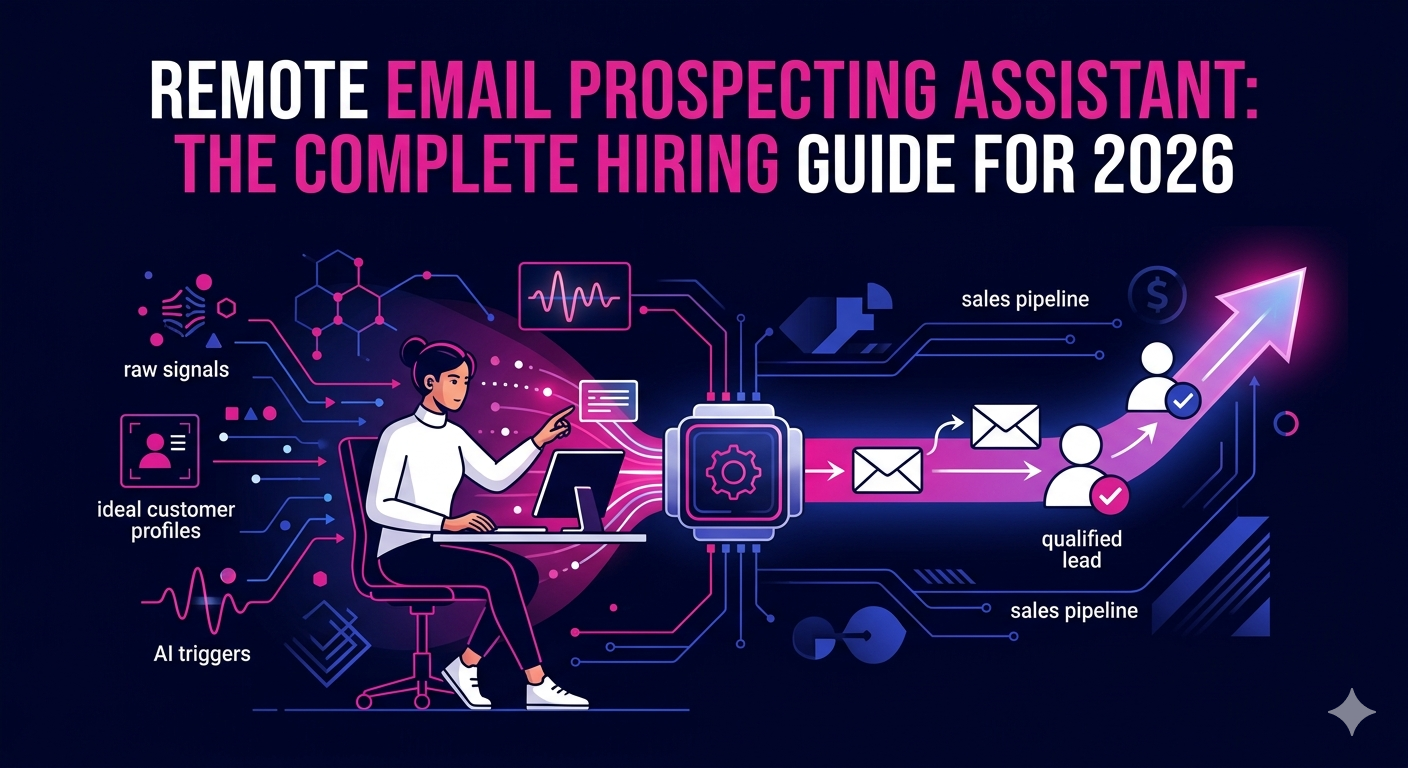
Your sales team is spending too much time researching prospects, building lists, and crafting outreach sequences instead of closing deals. That is exactly the problem a remote email prospecting assistant is built to solve. In 2026, the demand for dedicated outbound prospecting talent has never been higher, and the remote model has become the most cost-effective way to build that capability without the overhead of a full in-house hire. This guide covers what a remote email prospecting assistant actually does, what skills and tools to look for, what it costs, and how to hire one that delivers real pipeline results.
What Is a Remote Email Prospecting Assistant?
A remote email prospecting assistant is a specialist who handles the research, list-building, email sequence management, and outreach execution that feeds your B2B sales pipeline. They work entirely remotely, typically on your schedule, and operate as a dedicated extension of your sales or marketing team.
This role sits at the intersection of research and execution. Unlike a general virtual assistant, a prospecting specialist understands sales psychology, deliverability mechanics, intent-based targeting, and how to write outreach that earns replies rather than getting flagged as spam.
Core Tasks a Remote Email Prospecting Assistant Handles
- Researching and building highly targeted prospect lists based on your Ideal Customer Profile
- Identifying and verifying contact data using platforms like Apollo, ZoomInfo, or Lead411
- Writing and testing personalized email sequences and follow-up cadences
- Managing sending infrastructure including domain warm-up and deliverability monitoring
- Tracking intent signals such as funding rounds, hiring activity, and leadership changes
- Routing qualified replies to your sales team and logging activity in your CRM
- Reporting on open rates, reply rates, qualified meetings booked, and pipeline contribution
Why Businesses Need a Remote Email Prospecting Assistant More Than Ever in 2026
The B2B outbound environment has changed significantly. According to 2026 research from Autobound, approximately 81% of sales teams now use AI in some capacity, up from roughly 50% in 2024. Yet the teams seeing the best results are not simply adding tools. They are pairing intelligent platforms with dedicated human specialists who can interpret signals, personalize at a strategic level, and adapt in real time.
At the same time, outreach is getting harder. Decision-makers receive an average of 121 emails per day, and generic, automated sequences are seeing sharply declining response rates. What cuts through in 2026 is precision: the right message, to the right person, at the right moment, triggered by a genuine buying signal.
A remote email prospecting assistant bridges this gap. They combine the efficiency of modern outreach tools with the judgment that only a skilled human specialist can provide.
The Cost Case for Hiring Remotely
A fully loaded in-house SDR in 2026 typically costs between $8,000 and $15,000 per month when you factor in salary, benefits, office space, and management overhead. A dedicated remote email prospecting assistant delivers comparable prospecting output at significantly lower cost, often between $1,500 and $4,000 per month, depending on experience and scope.
Remote hiring also removes geographic constraints entirely. You can access top prospecting talent from markets where the cost of living is lower but the skill level is high, and you keep full control of your data, infrastructure, and processes throughout the engagement.
Skills to Look for in a Remote Email Prospecting Assistant
Not every outreach specialist is the same. The 2026 prospecting landscape rewards a specific combination of technical know-how and strategic thinking. Here is what separates strong candidates from average ones.
Signal-Based Prospecting Knowledge
Targeting based purely on firmographics, company size, industry, and location, is now considered structurally insufficient. The modern approach relies on intent data and business signals. Your prospecting assistant should know how to identify trigger events like funding rounds, executive hires, technology stack changes, and expansion announcements, and build outreach triggered by these real-time signals rather than static lists. Research shows organizations using signal-qualified leads report 47% better conversion rates compared to traditional lead scoring methods.
Email Deliverability Fundamentals
Google, Yahoo, and Microsoft now require SPF, DKIM, and DMARC authentication for bulk senders. Non-compliant emails are rejected outright, yet only 16% of sending domains are fully compliant. A skilled remote email prospecting assistant must understand domain setup, inbox warm-up, bounce rate management, and sender reputation, because none of this matters without deliverability first.
Copywriting and Personalization at Scale
Buyers in 2026 can identify generic, AI-templated outreach instantly. Your specialist needs to write messages that feel personal, reference specific context about the prospect’s situation, and connect your value proposition to a problem the prospect is actually experiencing right now. This is a learned craft, not a default output of automation tools.
Tool Proficiency
A strong remote email prospecting assistant should be comfortable working across the core outbound stack. Look for hands-on experience with contact data platforms such as Apollo.io, ZoomInfo, or Lead411, sequencing tools like Saleshandy, Instantly, or Lemlist, and CRM platforms including HubSpot or Salesforce. Familiarity with enrichment and signal tools like Clay or Bombora is increasingly valuable.
Performance Reporting and Pipeline Focus
Activity metrics like sends and open rates are not enough. Your hire should report on qualified reply rates, meetings booked, and pipeline value generated by their outreach. If a candidate cannot speak to these outcomes from previous roles, that is a signal worth taking seriously.
How to Structure the Role for Maximum Output
Getting the most from a remote email prospecting assistant requires a clear setup from day one. Treat this hire as you would any sales team member: give them context, set measurable goals, and create a feedback loop with your closers.
- Define your ICP in writing before onboarding starts, including ideal company profile, target roles, and disqualifying factors
- Share existing copy, case studies, and sales collateral so your assistant understands how your best salespeople communicate
- Set weekly targets for prospect volume, sequences launched, and positive replies handed off
- Schedule a brief weekly sync to review what is working, what is being adjusted, and what the pipeline looks like
- Give your assistant access to your CRM so all activity is logged and nothing falls through the gaps
The teams seeing the best outbound results in 2026 are not handing over a tool login and hoping for the best. They are treating their prospecting assistant as a strategic partner in pipeline generation.
Where to Hire a Qualified Remote Email Prospecting Assistant
Generic freelance platforms introduce unnecessary risk when you need someone who can execute complex outbound campaigns with minimal supervision. A better path is working with a specialist placement partner who pre-vets candidates and matches them to your specific needs.
At The Remote Reps, we connect growth-focused businesses with experienced remote cold email experts and prospecting specialists who bring proven outbound skills, deliverability knowledge, and a track record of filling pipelines across industries. Every placement is matched to your ICP, your tools, and your team’s workflow so you are not starting from scratch.
For additional context on what makes outbound prospecting work in 2026, the Autobound state of AI sales prospecting report for 2026 covers the latest benchmarks on signal-based outreach, AI adoption across sales teams, and the prospecting approaches that are generating the most qualified pipeline right now.
If you also need broader pipeline generation support beyond email outreach, explore our remote lead generation experts who can extend your outbound reach across multiple channels.
The Bottom Line: Invest in Dedicated Prospecting Talent
In 2026, the businesses filling their pipelines most efficiently are not the ones with the biggest outreach budgets. They are the ones with the most focused execution. A dedicated remote email prospecting assistant gives you a specialist who wakes up every day thinking about how to find your next qualified prospect and get a reply from them. That focus is nearly impossible to replicate with a generalist hire or a tool alone.
If your sales team is spending more time prospecting than selling, or if your current outreach is generating volume without qualified pipeline, it is time to bring in the right person. The Remote Reps makes that hire fast, affordable, and low-risk.
FAQ: Remote Email Prospecting Assistant
What exactly does a remote email prospecting assistant do?
A remote email prospecting assistant handles the research, list-building, email sequence writing, deliverability management, and outreach execution that generates qualified leads for your sales team. They identify high-intent prospects using buying signals, write personalized email campaigns, manage sending infrastructure to protect deliverability, and hand off qualified replies to your closers. Their goal is to keep your pipeline full so your sales team can focus on converting rather than sourcing.
How is a remote email prospecting assistant different from an SDR?
An SDR typically handles both outbound prospecting and early-stage qualification calls across multiple channels. A remote email prospecting assistant is more focused: they specialize in the research and email outreach side of the pipeline, delivering highly targeted, well-crafted outreach at scale. For businesses that do not need a full SDR function, or that want to separate prospecting from qualification, a dedicated email prospecting assistant is a more efficient and cost-effective structure.
What tools should a remote email prospecting assistant already know in 2026?
Strong candidates in 2026 should have hands-on experience with contact data platforms like Apollo.io, ZoomInfo, or Lead411, sequencing tools such as Instantly, Saleshandy, or Lemlist, and CRM platforms like HubSpot or Salesforce. Knowledge of signal-based prospecting tools like Clay or Bombora is increasingly valuable. They should also understand email authentication requirements including SPF, DKIM, and DMARC, and be able to manage domain warm-up and inbox placement actively.
How much does hiring a remote email prospecting assistant typically cost?
In 2026, a dedicated remote email prospecting assistant typically costs between $1,500 and $4,000 per month depending on their experience level, the complexity of your outbound program, and the number of sequences and accounts they manage. This is significantly lower than a fully loaded in-house SDR, which typically runs between $8,000 and $15,000 per month when salary, benefits, and overhead are included. For most B2B teams, the remote model delivers a better cost-per-qualified-meeting ratio.
How quickly can a remote email prospecting assistant start generating results?
A well-onboarded remote email prospecting assistant can typically launch initial campaigns within the first two weeks. Most outbound programs need four to six weeks of testing and optimization before you see consistent qualified pipeline, which is standard for any new outreach initiative regardless of who runs it. The fastest ramp-ups happen when businesses provide a clear ICP, existing sales collateral, and CRM access from day one. Specialists with direct experience in your industry or deal type will shorten this curve further.