The rules of business productivity changed the moment AI tools became mainstream. In 2026, the professionals who understand how to leverage artificial intelligence in their daily workflows are not just marginally more productive than those who do not. They are categorically more capable, faster, and more effective across virtually every business function. Hiring an AI enabled remote worker means bringing someone onto your team who combines genuine professional skills with the ability to use modern AI tools to amplify their output, reduce errors, accelerate turnaround times, and deliver results that a non-AI-enabled counterpart simply cannot match at the same cost or pace.
This guide explains what an AI enabled remote worker is, why the model delivers extraordinary value for businesses in 2026, which roles benefit most from AI enablement, how to identify genuinely AI-capable candidates, and how to build an AI enabled remote workforce that compounds its advantage over time.
What Is an AI Enabled Remote Worker?
An AI enabled remote worker is a skilled professional who works remotely and actively integrates AI tools into their daily workflow to enhance the quality, speed, and scope of the work they produce. The AI enablement is not incidental. It is a core part of how they do their job. Rather than treating AI as an occasional novelty, an AI enabled remote worker uses tools such as ChatGPT, Claude, Gemini, Perplexity, Midjourney, Jasper, Copy.ai, HubSpot AI, Salesforce Einstein, and dozens of role-specific AI platforms as standard instruments of their professional practice.
Critically, AI enablement does not replace the professional’s skill, judgment, or expertise. It amplifies them. A skilled remote copywriter with AI tools produces better content faster. A skilled remote SDR with AI-powered personalization tools books more meetings. A skilled remote paralegal with AI-assisted research tools reviews documents more thoroughly in less time. The AI does not do the work. The AI enabled remote worker uses it strategically to do significantly more work at a higher standard.
What Makes a Remote Worker Genuinely AI Enabled
- Practical fluency with the AI tools most relevant to their role and function, not just surface-level awareness
- The judgment to know when AI output requires verification, refinement, or human oversight and when it can be used directly
- Experience building repeatable AI-assisted workflows that increase consistent output quality and volume
- The ability to write effective prompts that elicit the specific type of output their role requires
- Awareness of the limitations of AI tools and where human expertise must take precedence
- A continuous learning mindset that keeps pace with rapidly evolving AI capabilities and new tool releases
Why AI Enabled Remote Workers Deliver Extraordinary Value in 2026
The productivity gap between AI-enabled and non-AI-enabled professionals has widened dramatically in 2026. Businesses that recognize this gap and prioritize hiring AI enabled remote workers are capturing a compounding structural advantage over those that do not. Here is why.
Multiplied Output at the Same Cost
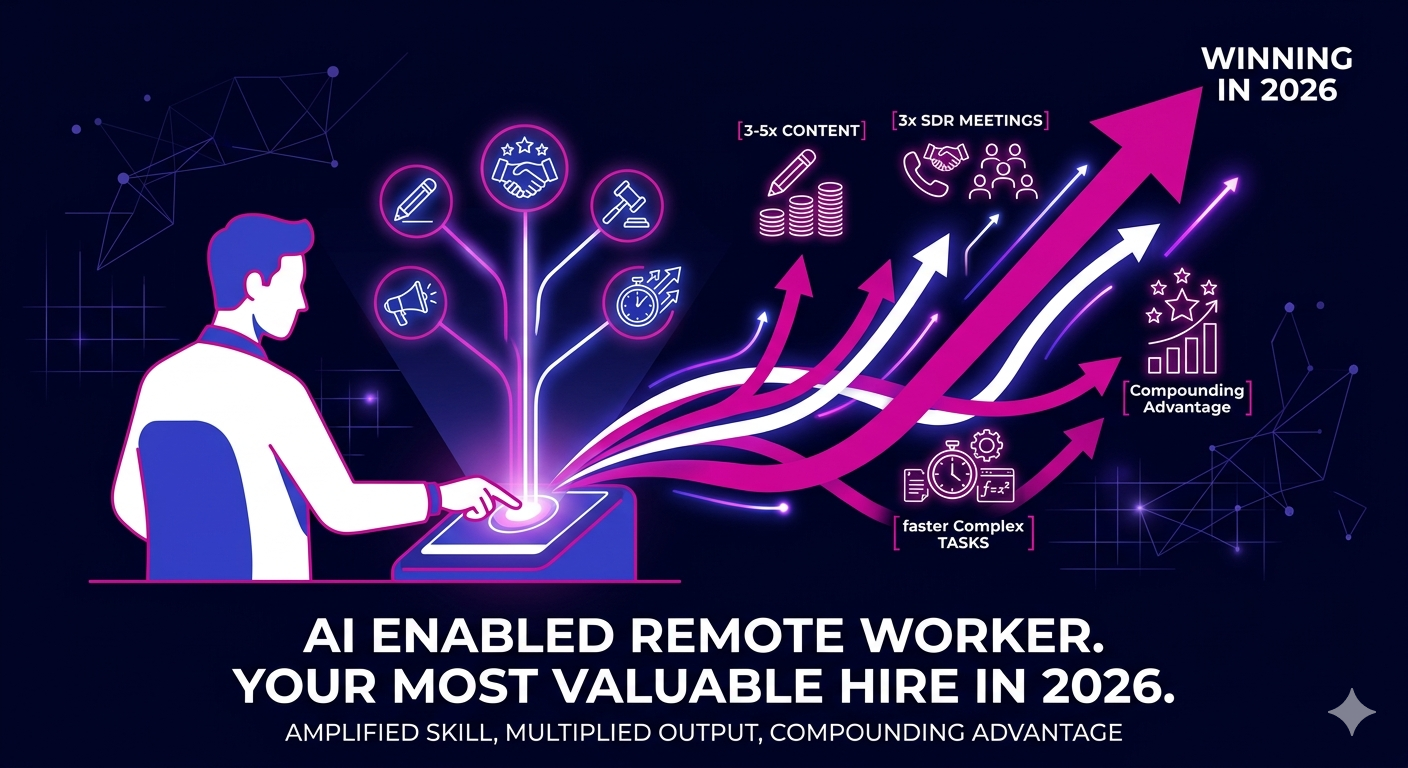
An AI enabled remote worker does not just work faster. They produce at a scale that fundamentally changes the economics of the role. A remote content marketer who uses AI to accelerate research, structuring, drafting, and editing can produce three to five times the volume of polished content compared to a non-AI-enabled counterpart working the same hours. A remote customer support specialist using AI-assisted response generation resolves tickets significantly faster with higher consistency. A remote SDR using AI for prospect research and personalized outreach sequences contacts more leads with higher quality messaging per day. The output multiplier is real and measurable across nearly every business function.
Higher Quality Through AI-Assisted Review and Refinement
AI tools are particularly powerful as a quality layer. An AI enabled remote worker uses AI to proofread, fact-check, identify gaps, test assumptions, generate alternative approaches, and verify completeness before submitting work. This reduces error rates, improves consistency, and produces output that arrives in better condition for final human review or direct deployment. The quality improvement compounds: every iteration of AI-assisted review adds a layer of polish that pure human production at the same pace typically cannot achieve.
Faster Turnaround on Complex Tasks
Many business functions involve complex tasks that require significant research, synthesis, and structured output: market analysis, competitive reports, legal document reviews, SEO content strategies, sales outreach sequences, and campaign planning, among others. An AI enabled remote worker can complete these tasks in a fraction of the time required without AI assistance, allowing your business to move faster on strategy, execution, and adaptation without proportionally increasing headcount.
Continuous Skill Expansion Through AI Access
AI tools give professionals access to capabilities that extend beyond their formal training. A remote virtual assistant who uses AI can generate professional-grade reports, conduct sophisticated market research, draft complex correspondence, and analyze data sets in ways that would have required specialist skills five years ago. An AI enabled remote worker’s effective capability set is broader and more flexible than their job title alone suggests, making them genuinely more versatile as your business needs evolve.
Competitive Advantage in Every Business Function
When your remote team members are AI enabled and your competitors’ teams are not, the compounding productivity and quality advantage shows up in your pipeline velocity, your marketing output, your customer experience, your operational efficiency, and ultimately your revenue growth. In 2026, AI enablement is increasingly the distinguishing factor between businesses that execute at a high level and those that struggle to keep pace.
Which Remote Roles Benefit Most from AI Enablement
While AI tools enhance productivity across virtually every professional role, some functions see particularly transformative gains when their practitioners are genuinely AI enabled.
Sales and Revenue Roles
AI enabled sales professionals use tools for prospect research, personalized outreach generation, objection handling preparation, CRM data enrichment, call summary generation, and follow-up email drafting. An AI enabled remote SDR contacts more prospects, personalizes messaging more effectively, and books more meetings per week than a non-AI-enabled counterpart. An AI enabled remote sales rep prepares more thoroughly for each deal, responds faster to prospect questions, and manages a larger pipeline with the same level of attention.
Marketing and Content Roles
AI enablement transforms marketing output. An AI enabled remote digital marketer generates campaign briefs, ad copy variants, landing page content, and performance analyses faster and at higher volume. An AI enabled remote SEO specialist uses AI for keyword clustering, content gap analysis, meta description generation, and technical audit interpretation at a scale and speed that manual work cannot approach. An AI enabled remote social media manager generates content ideas, caption variants, and engagement responses more consistently and at higher volume across platforms.
Lead Generation and Outbound Roles
AI enabled remote lead generation experts use AI for prospect list enrichment, intent signal analysis, ICP scoring, and personalized outreach message generation at scale. An AI enabled remote cold email expert creates, tests, and iterates on sequences faster, generates higher-performing subject line variants, and personalizes at a depth that dramatically improves reply rates.
Administrative and Operations Roles
AI enabled remote virtual assistants and remote executive assistants use AI for meeting summary generation, research compilation, document drafting, email triage classification, and workflow automation. The reduction in time spent on routine cognitive tasks frees them for more complex, judgment-based work that genuinely requires human skill and discretion.
Legal and Compliance Support Roles
AI enabled remote legal support professionals including remote legal assistants and remote paralegals use AI-assisted tools for document review, legal research summaries, contract clause identification, and intake form processing. Under appropriate attorney supervision, AI enablement in legal support roles significantly reduces the time required to prepare case materials and manage documentation workflows.
How to Identify a Genuinely AI Enabled Remote Worker During Hiring
In 2026, many candidates claim AI proficiency without being able to demonstrate it meaningfully. Here is how to separate genuinely AI enabled professionals from those who list it on a resume without practical depth.
Ask for Specific AI Tool Experience by Role
Ask candidates to name the specific AI tools they use in their daily workflow and describe how they use each one. A genuinely AI enabled remote worker will have a detailed, role-specific answer: “I use Claude for drafting and refining outreach sequences, Apollo’s AI features for prospect research enrichment, and Otter.ai for meeting summary generation.” Vague answers about “using AI tools generally” indicate surface-level familiarity rather than genuine integration.
Request a Live or Recorded AI-Assisted Task Demonstration
For roles where AI output is central to performance, ask candidates to complete a short role-relevant task using their AI workflow during or after the interview. A remote SEO specialist could be asked to build an AI-assisted keyword cluster for a given topic. A remote content marketer could draft and refine a short piece using their preferred AI tool. The quality of the output and the fluency of the process reveals genuine AI capability in a way that a resume cannot.
Assess Prompt Quality and AI Judgment
Ask candidates to describe a complex or nuanced task they recently completed using AI tools. How did they frame the prompt? How did they verify or refine the output? Where did they apply human judgment to override or improve the AI’s work? The answers to these questions reveal whether the candidate uses AI as a thoughtful professional tool or relies on it uncritically, which is equally important for assessing their overall reliability and output quality.
Building a Culture of AI Enablement Across Your Remote Team
The highest-performing remote organizations in 2026 do not treat AI enablement as an individual employee attribute. They treat it as an organizational practice, investing in shared tool access, cross-functional learning, and regular sharing of AI workflow discoveries that raise the entire team’s capability over time.
- Provide standardized access to AI platforms most relevant to your team’s core functions rather than expecting employees to source their own tools
- Create a shared knowledge repository where team members document effective AI prompts, workflows, and use cases they have discovered
- Include AI workflow efficiency as a regular topic in team meetings or async check-ins so best practices spread across roles and functions
- Incorporate AI enablement proficiency as an explicit criterion in hiring, performance reviews, and role development discussions
- Allocate time for team members to experiment with new AI tools and share findings rather than treating AI learning as purely self-directed
According to McKinsey’s research on AI enabled remote worker productivity and the economic potential of generative AI, organizations that systematically build AI proficiency into their workforce report productivity gains of 20 to 40 percent across knowledge work functions, with the largest gains in roles that involve significant writing, research, analysis, and repetitive structured communication tasks.
Conclusion: Hire AI Enabled Remote Workers and Build the Workforce Your Business Needs to Win in 2026
The most important competitive advantage available to businesses in 2026 is not a particular product, a larger budget, or a better market position. It is the quality and capability of the people on your team, specifically whether those people are equipped and skilled to work at the frontier of what modern AI tools make possible. An AI enabled remote worker who combines genuine professional expertise with deep AI tool fluency delivers output, speed, and quality that redefines what a single person can contribute to your business goals.
The Remote Reps places AI enabled remote professionals across sales, marketing, operations, legal support, and administrative roles for businesses building the remote teams of 2026 and beyond. Our candidates are vetted for both role-specific professional skills and genuine AI tool proficiency in the functions most relevant to your business needs.
Read what our clients say about the results they have achieved with remote professionals through The Remote Reps, or visit theremotereps.com to start building your AI enabled remote team today.
FAQ: AI Enabled Remote Worker
What is an AI enabled remote worker and how are they different from a standard remote hire?
An AI enabled remote worker is a skilled professional who actively integrates AI tools into their daily workflow to enhance the quality, speed, and volume of their output. The key difference from a standard remote hire is that an AI enabled remote worker uses modern AI platforms such as Claude, ChatGPT, Gemini, and role-specific AI tools as standard instruments of their professional practice rather than occasionally or superficially. This genuine integration produces measurably higher output at the same cost, faster turnaround on complex tasks, and more consistent quality across deliverables. In 2026, the productivity gap between genuinely AI enabled professionals and those without AI fluency has become one of the most significant hiring differentiators in knowledge work roles.
Which roles benefit most from hiring an AI enabled remote worker?
In 2026, virtually every knowledge work role benefits from AI enablement, but the roles that see the most dramatic productivity gains when filled by an AI enabled remote worker include content marketing, SEO, outbound sales and SDR work, lead generation, email marketing, digital advertising, virtual and executive assistance, customer support, legal document support, and data analysis. Any role that involves significant writing, research, communication, data processing, or structured repetitive tasks is a strong candidate for the AI enablement multiplier effect. The higher the cognitive complexity and volume of the work involved, the more significant the advantage an AI enabled remote worker brings relative to a non-AI-enabled counterpart.
How do I verify that a candidate is genuinely AI enabled during the hiring process?
Verifying genuine AI enablement requires going beyond resume claims. Ask candidates to name the specific AI tools they use in their daily workflow and describe exactly how they use each one for their core job functions. Request a live or recorded demonstration of an AI-assisted task relevant to the role. Ask them to describe a recent complex task they completed using AI tools, how they structured their prompts, how they evaluated the output quality, and where they applied their own judgment to refine or override the AI. Candidates who can answer these questions with specific, detailed, practical answers are genuinely AI enabled. Those who speak in generalities about “using AI to improve efficiency” without concrete examples are likely describing surface-level familiarity rather than genuine workflow integration.
Does hiring an AI enabled remote worker mean replacing human judgment with AI output?
No. Hiring an AI enabled remote worker means hiring a skilled professional who uses AI as a tool to amplify their human judgment, expertise, and output rather than replace it. The best AI enabled remote workers understand precisely where AI adds value and where human oversight, critical thinking, and professional expertise must take precedence. AI tools are most valuable for accelerating research, generating first drafts, checking consistency, processing structured data, and scaling repetitive high-volume tasks. Human judgment remains essential for strategic decisions, sensitive communications, creative direction, quality evaluation, and any output that carries professional, legal, or reputational significance. An AI enabled remote worker brings both the AI fluency and the professional judgment to apply each appropriately.
What AI tools should an AI enabled remote worker have experience with in 2026?
The most relevant AI tools vary by role, but in 2026 the foundational tools that an AI enabled remote worker across most business functions should have practical experience with include large language models such as Claude, ChatGPT, or Gemini for writing, research, and analysis; AI-powered research and summarization tools such as Perplexity or Otter.ai; role-specific AI features within platforms such as HubSpot AI, Salesforce Einstein, Apollo AI, or Surfer SEO; image and creative AI tools such as Midjourney or Adobe Firefly for marketing roles; and workflow automation platforms such as Zapier or Make with AI-connected integrations. An AI enabled remote worker in a specific function should also be fluent with the AI capabilities embedded in the specialist tools most common to that function, such as AI writing assistants in CMS platforms for content roles or AI-powered sequencing features in outreach tools for sales roles.
How do AI enabled remote workers stay current as AI tools evolve rapidly?
Genuinely AI enabled remote workers treat continuous learning about AI tools as a professional responsibility rather than an optional extra. They follow relevant AI newsletters, podcasts, and community forums in their field, experiment with new tools and features as they are released, share workflow discoveries with colleagues, and invest regular time in updating their skill set alongside their core professional knowledge. When evaluating candidates, look for evidence of this learning habit: have they adopted tools that were released in the past 6 to 12 months? Can they speak to how their AI workflow has evolved over the past year? A commitment to staying current with AI is as important as current proficiency, because the tools available in 2026 will be materially different again within 12 to 18 months.