
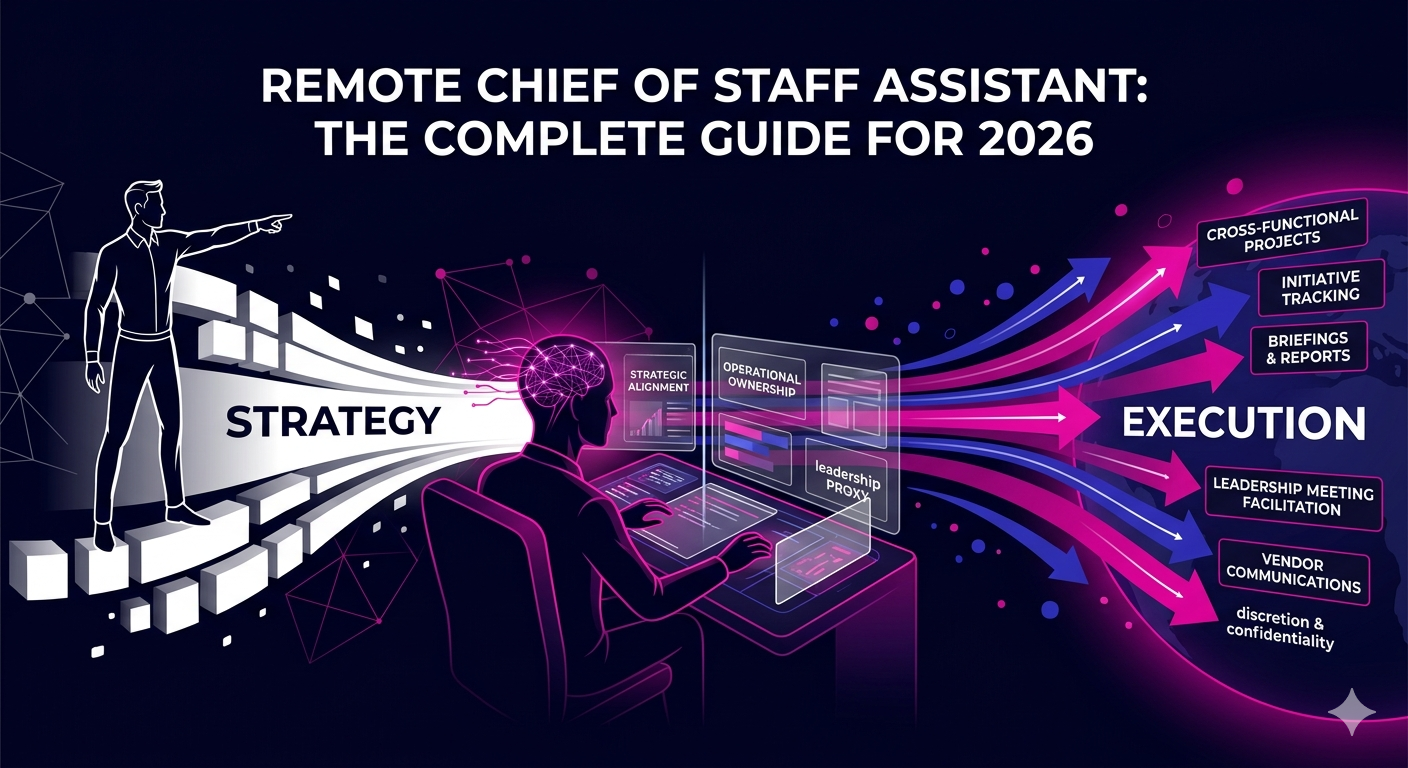
As businesses grow more complex and leadership teams stretch thinner, a new role has moved to the center of high-performing organizations: the remote chief of staff assistant. Part strategic operator, part executive support partner, this role bridges the gap between the C-suite and the rest of the organization. In 2026, companies that have embraced this model are moving faster, communicating more clearly, and scaling with far less friction than those relying on traditional support structures alone.
This guide covers everything you need to know about hiring, managing, and maximizing a remote chief of staff assistant, whether you are a founder, a CEO, or a senior executive ready to operate at a higher level.
What Is a Remote Chief of Staff Assistant?
A remote chief of staff assistant is a senior-level operational professional who supports an executive or leadership team from a remote location. They sit at the intersection of strategy and execution, ensuring that decisions made at the top actually get implemented across the organization.
This role is distinct from a traditional executive assistant. While an executive assistant focuses primarily on scheduling, communications, and administrative tasks, a remote chief of staff assistant also takes ownership of cross-functional projects, manages priorities on behalf of the executive, and often acts as a proxy in meetings or communications when the leader is unavailable.
Remote Chief of Staff vs. Executive Assistant: Key Differences
- Scope: A chief of staff assistant operates at a strategic and operational level, not just an administrative one.
- Ownership: They own outcomes, not just tasks. They follow through until projects are complete.
- Influence: They often interact directly with department heads, investors, or clients on behalf of the executive.
- Judgment: They are expected to make independent decisions aligned with the executive’s vision and values.
That said, many organizations hire someone who fills both functions, providing the hands-on administrative support of an executive assistant alongside the strategic leverage of a chief of staff. This hybrid profile is increasingly common in 2026, especially at startups and fast-scaling companies.
Core Responsibilities of a Remote Chief of Staff Assistant
The day-to-day responsibilities of a remote chief of staff assistant vary depending on the size and stage of the organization. However, most professionals in this role are expected to handle a consistent set of high-impact functions.
Strategic and Operational Duties
- Tracking and following up on executive priorities and company-wide initiatives
- Preparing briefings, reports, and decision-support materials for leadership
- Running or facilitating leadership meetings, including setting agendas and capturing action items
- Coordinating cross-functional projects across departments or remote teams
- Conducting research to support strategic planning, competitive analysis, or investment decisions
- Representing the executive in select internal or external communications
Administrative and Executive Support Duties
- Managing the executive’s calendar, inbox, and daily schedule
- Preparing for and debriefing after high-stakes meetings
- Handling travel logistics, vendor relationships, and recurring operational tasks
- Drafting and editing communications on behalf of the executive
- Managing confidential information with discretion and professionalism
The common thread across all of these responsibilities is that a remote chief of staff assistant operates with a high degree of trust and autonomy. They are not waiting for instructions. They are proactively identifying what needs to happen and making sure it does.
Why the Demand for Remote Chiefs of Staff Has Grown in 2026
Several converging forces have driven explosive growth in demand for this role over the past few years.
Executives Are Stretched Further Than Ever
The modern executive is expected to lead internal teams, manage investor relationships, drive sales, build culture, and stay on top of a rapidly changing competitive landscape. Without a trusted operational partner, critical priorities get dropped. A remote chief of staff assistant creates the bandwidth needed for executives to focus on the work only they can do.
Remote Work Has Made the Role More Accessible
In the past, chief of staff roles were almost always reserved for in-person, full-time hires. The normalization of remote work has changed this entirely. Today, a highly experienced remote chief of staff assistant can support your organization from anywhere in the world, operating asynchronously or in real time depending on your needs. This has dramatically expanded the talent pool and lowered the cost of accessing top-tier operational talent.
Companies Are Optimizing for Speed
In a competitive market, the speed of execution is a strategic advantage. A remote chief of staff assistant removes friction from the leadership layer, enabling faster decision-making, cleaner communication, and more consistent follow-through on strategic priorities. Organizations that have made this investment report measurable improvements in execution quality and leadership effectiveness.
What to Look for When Hiring a Remote Chief of Staff Assistant
This is not a role where you can afford to hire purely on resume credentials. The right remote chief of staff assistant needs a very specific combination of skills, character, and working style.
Essential Qualities
- High emotional intelligence: They will work closely with the most senior people in your organization and must navigate those relationships with care.
- Strong written communication: Much of their output will be written, from executive briefings to stakeholder emails. Quality matters.
- Systems thinking: They need to see how different parts of the organization connect and identify where things are breaking down.
- Discretion: They will be exposed to highly sensitive information. Trust is non-negotiable.
- Bias toward action: A great chief of staff assistant does not need constant direction. They take initiative and follow through independently.
- Comfort with ambiguity: The role frequently involves navigating situations where there is no clear playbook.
Technical Skills for 2026
In addition to soft skills, your remote chief of staff assistant should be proficient with the tools your organization relies on. This typically includes project management platforms like Asana or Notion, communication tools like Slack, document management through Google Workspace or Microsoft 365, and an understanding of AI-powered productivity tools that are now standard in high-functioning remote teams.
How Much Does a Remote Chief of Staff Assistant Cost?
Compensation for a remote chief of staff assistant is higher than a standard executive assistant role, reflecting the elevated scope and responsibility. In 2026, market rates typically look like this:
- Early-career or part-time remote chief of staff: $2,000 to $3,500 per month
- Experienced full-time remote chief of staff assistant: $3,500 to $6,000 per month
- Senior operator with executive-level experience: $6,000 to $9,000+ per month
When compared to the cost of a full-time, in-office hire with equivalent experience, a remote chief of staff assistant typically represents a savings of 30 to 50 percent when benefits, office overhead, and employer taxes are factored in. The return on investment becomes even clearer when you consider the executive time freed up and the organizational leverage created.
Where to Find a Qualified Remote Chief of Staff Assistant
Finding the right person for this role requires a thoughtful approach. The most reliable sourcing channels in 2026 include the following.
Specialized Remote Staffing Platforms
Dedicated remote staffing agencies are the most efficient path to finding a qualified remote chief of staff assistant. They pre-screen candidates for the skills and experience relevant to senior operational roles, match you based on your specific leadership needs, and typically offer some form of replacement guarantee. This removes the guesswork and dramatically shortens your time to hire.
To explore vetted remote executive and operational support professionals, visit The Remote Reps’ executive assistant services, where you can connect with experienced candidates ready to support leadership teams at scale.
Professional Networks and Referrals
Peer referrals carry significant weight for a role that depends so heavily on trust. If a respected colleague has worked with an excellent remote chief of staff assistant, that recommendation is worth more than any application. Build this kind of network intentionally and ask for introductions when the time comes.
LinkedIn Sourcing
LinkedIn remains a strong platform for finding senior operational talent. Search for candidates with backgrounds that combine executive support, operations management, and project leadership. Look for experience in environments that mirror your own in terms of pace and complexity.
For a broader overview of how remote staffing can support your entire leadership operation, explore The Remote Reps and see how they match businesses with remote professionals across every operational function.
How to Set Your Remote Chief of Staff Assistant Up for Success
Even the best hire will struggle without the right foundation. Invest in onboarding properly from day one.
- Share your top priorities clearly and revisit them regularly
- Give full context, not just tasks. Explain the why behind each priority.
- Define decision-making authority early so they know when to act independently and when to escalate
- Create a regular cadence of one-on-one meetings to align, debrief, and course-correct
- Build in space for them to surface problems they are seeing across the organization
The relationship between an executive and their remote chief of staff assistant is one of the most high-leverage partnerships in any organization. When it works well, the entire organization benefits.
For more information on what the best remote chief of staff professionals bring to a leadership team, industry research consistently highlights strategic alignment, cross-functional coordination, and execution accountability as the top three value drivers.
Frequently Asked Questions About Remote Chief of Staff Assistants
What is the difference between a remote chief of staff assistant and a remote executive assistant?
A remote chief of staff assistant operates at a higher strategic and operational level than a remote executive assistant. While an executive assistant focuses on calendar management, inbox organization, and administrative support, a remote chief of staff assistant takes ownership of cross-functional projects, tracks strategic priorities, and often acts as a leadership proxy. Many organizations now look for hybrid professionals who can provide both levels of support.
Is a remote chief of staff assistant suitable for a small business?
Yes. A remote chief of staff assistant can add tremendous value at small businesses and startups, particularly where a single founder or small leadership team is managing many functions simultaneously. At this stage, having someone who can own execution, manage initiatives, and keep leadership organized is often the difference between controlled growth and operational chaos. The remote model also makes this level of talent accessible at a lower cost than a traditional in-office hire.
How do I know if I am ready to hire a remote chief of staff assistant?
You are likely ready if you find yourself regularly dropping priorities, spending time on tasks others could handle, or lacking someone to hold the organization accountable to your strategic direction. If your business has reached a level of complexity where you need a trusted partner to manage operations on your behalf, a remote chief of staff assistant is the right next hire.
What tools does a remote chief of staff assistant typically use?
In 2026, a skilled remote chief of staff assistant typically works across a range of tools including project management platforms like Asana or Notion, communication tools like Slack or Microsoft Teams, document and spreadsheet tools within Google Workspace or Microsoft 365, and video conferencing solutions like Zoom or Google Meet. They may also use AI productivity tools for research, summarization, and drafting. Comfort with automation platforms like Zapier is increasingly common in senior remote operational roles.
How is performance measured for a remote chief of staff assistant?
Performance for a remote chief of staff assistant is typically measured by the quality of execution on strategic priorities, the reduction of operational friction experienced by the executive, stakeholder feedback, and consistency of follow-through on assigned initiatives. Qualitative metrics like communication quality and judgment in ambiguous situations are just as important as task completion rates. Regular one-on-one reviews help keep expectations aligned and performance on track.
How long does it take to onboard a remote chief of staff assistant?
A well-structured onboarding process for a remote chief of staff assistant typically spans four to eight weeks before they are operating with full independence. The first two weeks should focus on context and access, weeks three and four on observing and shadowing key workflows, and the second month on taking increasing ownership of defined priorities. The more documentation and process clarity you can provide upfront, the faster this timeline becomes.