The way businesses hire has changed permanently. Whether you are scaling a startup, streamlining operations, or building a distributed sales team, you have probably come across the term remote staffing. But what is a remote staffing agency, exactly, and how is it different from a traditional recruiter or freelance marketplace? This guide answers that question in full and shows you how the right remote staffing partner can transform the way you grow your team in 2026.
What Is a Remote Staffing Agency?
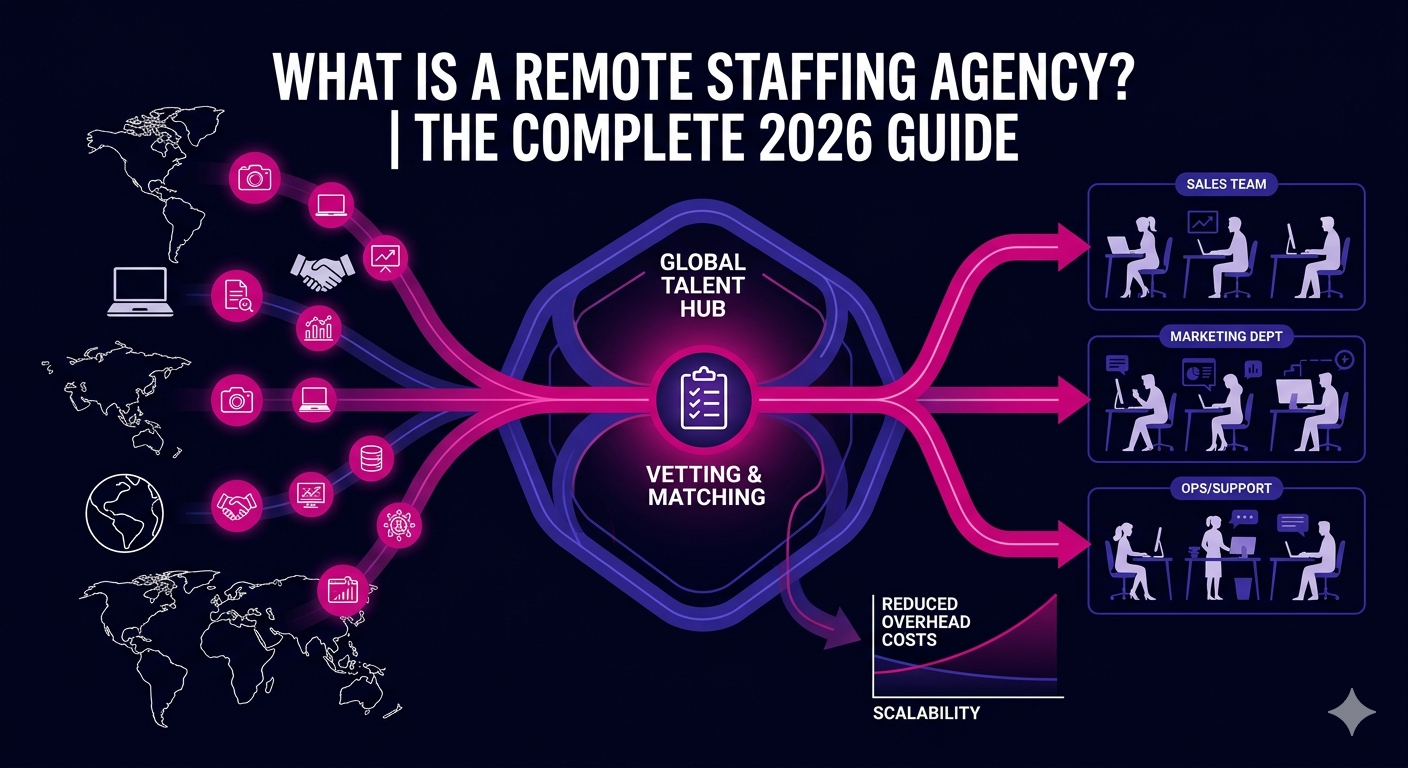
A remote staffing agency is a company that sources, vets, and places skilled professionals in remote roles on behalf of client businesses. Unlike a traditional staffing firm that focuses on local or on-site placements, a remote staffing agency operates across geographies, connecting you with top talent regardless of where they are located in the world.
The agency handles the heavy lifting: candidate sourcing, skills assessments, background checks, and initial interviews. You receive a shortlist of qualified professionals who are ready to start contributing quickly. Once placed, the professional typically works exclusively for your business, functioning as a dedicated team member rather than a freelancer juggling multiple clients.
How a Remote Staffing Agency Differs from a Freelance Platform
This is one of the most common points of confusion. Here is a clear breakdown:
- Freelance platforms (such as Upwork or Fiverr) connect you with independent contractors who work for multiple clients simultaneously. Quality and availability vary significantly.
- Remote staffing agencies place dedicated professionals who work full-time or part-time exclusively for you. They are integrated into your workflows, attend your meetings, and are accountable to your management.
- Traditional staffing agencies focus on local, in-office placements and often have limited reach for digital or knowledge-work roles.
The dedicated model is what makes a remote staffing agency particularly valuable for roles that require consistency, deep product knowledge, or ongoing relationship building, such as sales development, customer support, or executive assistance.
What Roles Can a Remote Staffing Agency Fill?
Modern remote staffing agencies cover a wide range of functions across sales, marketing, operations, and support. In 2026, the most in-demand remote placements include:
Sales and Revenue Roles
- Sales Development Representatives (SDRs) for outbound prospecting
- Full-cycle sales representatives for closing deals remotely
- Cold email specialists who build and optimize outreach campaigns
- GTM engineers who build and automate go-to-market infrastructure
Marketing and Digital Roles
- SEO specialists to drive organic traffic
- PPC and paid media experts for performance advertising
- Social media managers who grow and manage brand presence
- Digital marketers and media buyers for full-funnel campaigns
- E-commerce and Amazon marketing specialists
Operations and Support Roles
- Virtual assistants and executive assistants for administrative tasks
- Customer support professionals for handling client communications
- Legal assistants, legal secretaries, and paralegals for law firms and legal departments
For a full view of what dedicated remote professionals can do for your business, explore the remote lead generation experts available through The Remote Reps, one of the most comprehensive remote staffing platforms operating in 2026.
How Does a Remote Staffing Agency Work?
The process is simpler than most business owners expect. Here is a typical engagement from start to placement:
Step 1: Define Your Requirements
You share details about the role, required skills, hours, and the tools your team uses. The agency uses this information to search their talent pool and wider network for suitable candidates.
Step 2: Candidate Screening and Vetting
The agency screens applicants for skills, communication ability, reliability, and cultural fit. This often involves skills tests, portfolio reviews, and structured interviews. You only see candidates who meet the bar.
Step 3: Interview and Selection
You interview a shortlist of pre-vetted candidates and make the final hiring decision. Most remote staffing agencies provide two to five finalists, giving you meaningful choice without overwhelming you with options.
Step 4: Onboarding and Integration
Once selected, the remote professional is onboarded into your systems. The agency typically supports the transition period to ensure a smooth start. From that point on, the professional reports directly to you.
Step 5: Ongoing Management and Support
You manage the day-to-day work. The agency remains available for replacements, performance support, or scaling your team with additional hires.
Key Benefits of Using a Remote Staffing Agency in 2026
The case for working with a remote staffing agency has never been stronger. Here is what businesses are gaining:
- Significant cost savings: Remote professionals, particularly those based in talent-rich markets outside the US and Western Europe, typically cost 40 to 70 percent less than equivalent local hires when accounting for salary, benefits, and overhead.
- Faster time to hire: Agencies maintain active talent pools and can often place a qualified professional within one to three weeks, compared to the 6 to 12 week average for in-house recruiting.
- Access to pre-vetted talent: Every candidate has already been screened, tested, and verified. You skip the sourcing and early filtering stages entirely.
- Reduced hiring risk: Most agencies offer replacement guarantees. If a placement does not work out within a defined period, they find a replacement at no additional cost.
- Scalability: You can grow your remote team quickly in response to new opportunities without the delays and commitments of traditional hiring.
A 2025 SHRM workforce report found that companies using remote staffing agencies reduced their average cost-per-hire by 34% and cut time-to-productivity for new hires by nearly three weeks compared to direct hiring methods.
What to Look for When Choosing a Remote Staffing Agency
Not all remote staffing agencies are created equal. Here are the factors that separate the best from the rest:
Specialization in Your Role Type
A generalist staffing agency may not have deep expertise in placing sales professionals or technical marketers. Look for agencies that specialize in or have a strong track record for the specific function you are hiring.
Transparent Vetting Process
Ask how candidates are assessed. Strong agencies use multi-stage screening that includes skills evaluations, communication tests, and reference checks. Be cautious of any agency that cannot clearly explain its vetting methodology.
Pricing Clarity
Understand exactly what you are paying for. Some agencies charge a one-time placement fee. Others operate on a monthly retainer model where the fee covers ongoing support and replacement guarantees. Both can be good depending on your needs, but there should be no hidden costs.
Replacement and Support Guarantees
The best remote staffing agencies stand behind their placements with guarantees. Look for a minimum 30-day replacement guarantee and preferably 60 to 90 days.
Client Testimonials and Track Record
Real client results matter. Review case studies, testimonials, and independent reviews. A reputable remote staffing agency will have verifiable success stories across multiple industries and role types.
You can read verified client experiences and learn more about how a leading remote staffing agency delivers results for businesses across industries on The Remote Reps testimonials page.
Is a Remote Staffing Agency Right for Your Business?
Working with a remote staffing agency is the right move if you need to hire quickly without a long internal recruiting process, want to reduce labor costs without sacrificing quality, are open to managing a distributed team, or are looking to scale a specific function such as sales, marketing, or support without full-time hiring commitments.
It tends to be less suitable for roles that legally require in-person presence, highly sensitive positions with strict local compliance requirements, or businesses that are not yet set up to manage remote workers effectively.
For most growing businesses in 2026, however, a remote staffing agency is one of the most efficient and cost-effective hiring strategies available. To learn more about how remote staffing agencies operate globally, the Society for Human Resource Management’s talent acquisition resources offer authoritative guidance on remote hiring best practices.
Frequently Asked Questions: What Is a Remote Staffing Agency?
What is a remote staffing agency and how is it different from a recruiter?
A remote staffing agency sources, screens, and places dedicated remote professionals into your business on an ongoing basis. A traditional recruiter typically focuses on one-time placements for permanent, local roles. Remote staffing agencies specialize in distributed hiring and often provide post-placement support, replacement guarantees, and talent pools that span multiple countries.
What types of roles does a remote staffing agency typically fill?
A remote staffing agency can fill a wide variety of roles including sales development representatives, digital marketers, SEO specialists, virtual assistants, customer support agents, executive assistants, cold email experts, and legal support professionals. The best agencies have vetted talent across both technical and non-technical functions.
How much does it cost to use a remote staffing agency?
Pricing for a remote staffing agency varies by model and region. Placement fees typically range from one to three months of the candidate’s salary. Monthly retainer models range from $500 to $2,000 depending on the role and level of support included. Despite the fee, businesses almost always save money compared to in-house hiring when total employment costs are factored in.
How quickly can a remote staffing agency place a candidate?
Most established remote staffing agencies can present qualified candidates within 5 to 10 business days. Full placement, including interviews and onboarding, typically takes two to four weeks. This is significantly faster than the standard 6 to 12 week in-house hiring timeline for most knowledge-work roles.
Is a remote staffing agency a good option for small businesses?
Yes, a remote staffing agency is often an ideal solution for small businesses that need skilled talent but cannot justify the overhead of full-time local employees. The ability to access pre-vetted professionals at lower cost points, combined with the speed of placement, makes remote staffing agencies particularly valuable for small and growing teams that need to move fast without sacrificing quality.
What should I prepare before contacting a remote staffing agency?
Before reaching out to a remote staffing agency, prepare a clear role description including required skills, expected hours, tools your team uses, and a realistic budget. The more specific you are upfront, the faster and more accurately the agency can match you with the right candidate. Having a basic onboarding plan ready also helps reduce ramp-up time once a placement is made.