The way businesses operate has fundamentally shifted. In 2026, staying competitive is no longer just about working harder — it is about working smarter. A virtual assistant trained in AI tools is one of the most powerful investments a business owner or executive can make right now. These professionals combine traditional administrative skills with advanced AI capabilities, helping teams automate repetitive tasks, scale content production, and accelerate sales pipelines without adding heavy overhead.
If you have been relying on a traditional VA or handling too many tasks yourself, it is time to understand what a modern, AI-fluent virtual assistant can actually do for your business.
What Is a Virtual Assistant Trained in AI Tools?
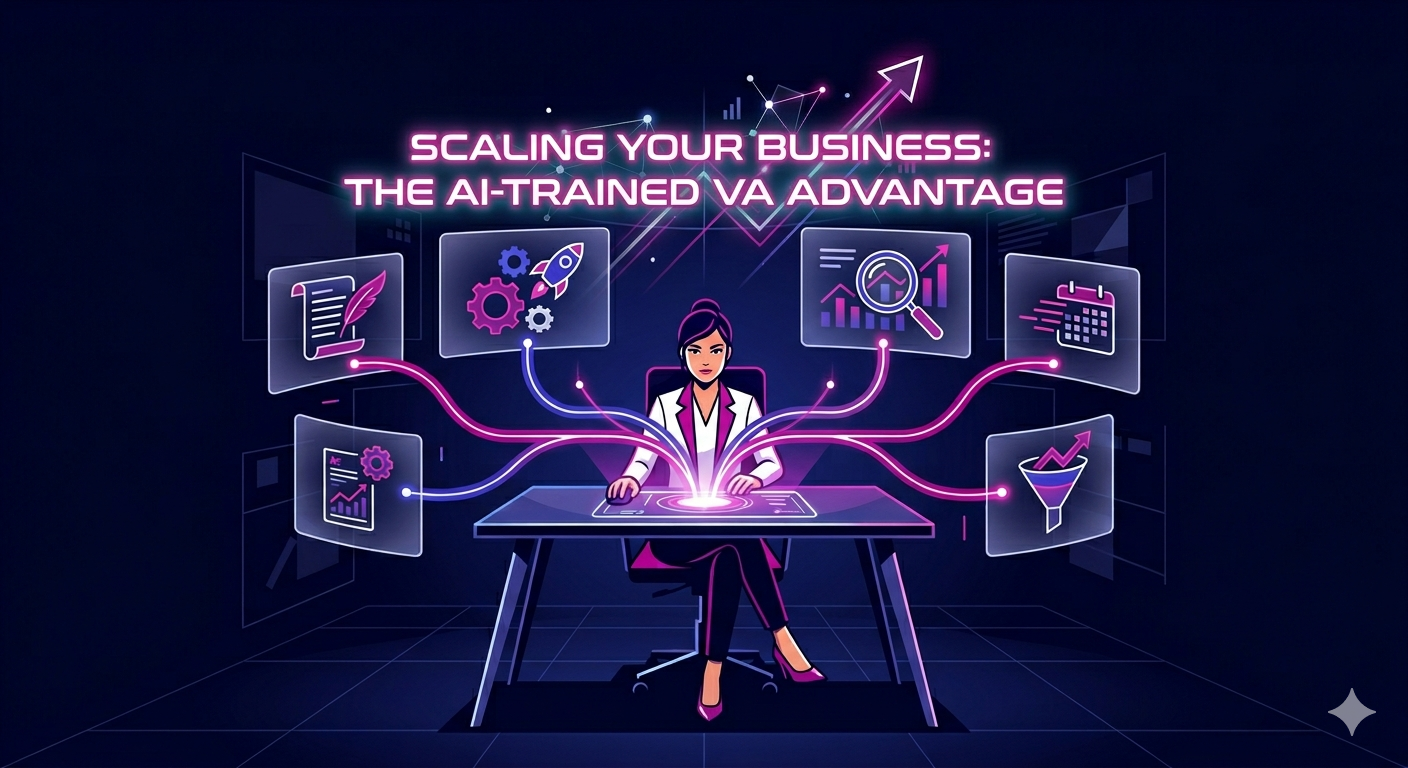
A virtual assistant trained in AI tools is a remote professional who has been upskilled or specifically hired for their ability to use artificial intelligence platforms as part of their daily workflow. This goes well beyond basic admin work. These VAs are proficient in tools like ChatGPT, Claude, Gemini, Jasper, Midjourney, Notion AI, and dozens of automation platforms like Make (formerly Integromat) and Zapier.
Their core skill set typically includes:
- Drafting and editing content using AI writing platforms
- Building automated workflows that reduce manual data entry
- Conducting AI-assisted research and competitive analysis
- Managing CRM updates, email sequences, and calendar coordination with AI tools
- Creating AI-generated graphics or presentations for internal use
- Summarizing meetings, reports, and long documents using AI
In short, a virtual assistant with AI training can accomplish in two hours what a traditional VA might take a full day to complete — and with higher consistency.
The Business Case for Hiring an AI-Trained Virtual Assistant in 2026
The demand for AI-fluent remote talent has surged dramatically. According to a 2025 McKinsey report, organizations that effectively integrate AI into their workflows report productivity gains of 20 to 40 percent across administrative functions. An AI-trained virtual assistant sits right at the intersection of this opportunity.
Here is why businesses are increasingly prioritizing this type of hire:
Reduced Time on Low-Value Tasks
Executives and business owners lose enormous chunks of their week to inbox management, scheduling, data formatting, and report generation. An AI-trained VA handles all of this faster and with fewer errors by using purpose-built tools designed for each task type.
Scalable Output Without Hiring Full-Time Staff
A single virtual assistant trained in AI tools can effectively multiply output across content, outreach, research, and admin. You get the leverage of a small team through one well-equipped remote professional.
Cost Efficiency Compared to In-House Hires
Remote AI-trained VAs eliminate overhead costs associated with office space, equipment, benefits, and payroll taxes. For many small and mid-sized businesses, this makes enterprise-level productivity accessible at a fraction of the traditional cost.
Faster Onboarding and Ramp-Up
Because AI tools standardize so many processes, onboarding an AI-trained VA is often faster than training a traditional employee. Standard operating procedures can be fed into AI tools directly, cutting the learning curve significantly.
Key AI Tools a Modern Virtual Assistant Should Know
When evaluating or hiring a virtual assistant with AI capabilities, it helps to understand which platforms matter most. Here are the categories and tools that top-tier AI-trained VAs should be fluent in:
Generative AI and Writing Platforms
- ChatGPT and Claude for drafting emails, content, SOPs, and research
- Jasper or Copy.ai for marketing copy and ad content
- Grammarly Business for proofreading and tone adjustment
Workflow Automation Tools
- Zapier for connecting apps and automating repetitive triggers
- Make (Integromat) for multi-step automation workflows
- Notion AI for project management and documentation
Data and Research Tools
- Perplexity AI for rapid research and citation gathering
- Apollo.io and Clay for AI-enhanced lead research and enrichment
- Google Gemini for integrated workspace tasks
Communication and Scheduling
- Otter.ai for meeting transcription and summarization
- Reclaim.ai or Motion for intelligent calendar management
- Front or Superhuman for AI-powered inbox management
If your current VA is not using at least a handful of these tools in their daily workflow, you are leaving significant productivity on the table. You can explore TheRemoteReps’ virtual assistant services to find pre-vetted, AI-trained virtual assistants who are ready to plug into your business immediately.
How an AI-Trained VA Supports Sales and Marketing Teams
One of the highest-ROI use cases for a virtual assistant trained in AI tools is sales and marketing support. Here is how they add direct, measurable value:
Lead Generation and Prospecting
AI-trained VAs can use tools like Clay and Apollo.io to build highly targeted prospect lists, enrich contact data, and prepare personalized outreach sequences at a scale that would take a human researcher days to produce manually.
Email and Content Production
From cold email sequences to LinkedIn posts, AI-assisted content creation allows VAs to produce large volumes of quality-reviewed material quickly. Combined with human editing judgment, the output is both fast and strategically sound.
CRM Management and Reporting
Keeping a CRM clean, updated, and actionable is tedious work. AI-trained VAs use automation tools to sync data across platforms, flag stale opportunities, and generate weekly pipeline reports without manual spreadsheet work.
For businesses that need specialized outbound support, pairing an AI-trained VA with a dedicated sales development representative creates a formidable prospecting engine that combines strategic human judgment with AI-driven efficiency.
What to Look for When Hiring a Virtual Assistant Trained in AI Tools
Not every candidate who lists “AI tools” on their resume has practical, workflow-integrated experience. Here is what separates genuinely skilled AI-trained VAs from those with surface-level exposure:
- Demonstrated workflow examples: Can they show you automations they have built or content pipelines they have managed using AI?
- Tool-specific proficiency: Do they know how to write effective prompts? Can they troubleshoot a Zapier workflow? Can they use AI for research without hallucinating sources?
- Judgment and quality control: AI tools still require human oversight. The best AI-trained VAs know when to trust AI output and when to verify or rewrite it.
- Communication and responsiveness: A VA working remotely must be proactive, clear, and reliable. Technical skills mean nothing without strong communication habits.
- Track record with similar businesses: Look for VAs who have supported businesses in your industry or at your growth stage. Check references and read client testimonials to understand the real-world impact they have delivered.
Industries That Benefit Most from AI-Trained Virtual Assistants
While any business can benefit from an AI-fluent VA, certain industries see outsized returns:
- E-commerce: Product listings, customer support automation, and ad copy generation at scale
- Legal services: Document summarization, research assistance, and calendar management
- Real estate: Lead follow-up, CRM updates, and listing content creation
- SaaS and technology companies: Content production, onboarding support, and data operations
- Marketing agencies: AI-assisted copy, report generation, and client communication management
Across all of these sectors, research from Gartner on AI in the workplace consistently shows that businesses integrating AI into their administrative workflows outperform those that do not, particularly in speed-to-execution and output volume per team member.
Remote vs. In-House: Why Remote AI-Trained VAs Win in 2026
The remote work infrastructure that matured between 2020 and 2025 has made geography irrelevant for most knowledge-work tasks. In 2026, the best AI-trained virtual assistants are distributed across time zones, which means businesses can have support coverage during hours that an in-house hire simply could not provide.
Remote AI-trained VAs also tend to self-select for discipline and digital fluency. The nature of remote work rewards those who are organized, proactive, and comfortable with technology — exactly the qualities you want in someone managing AI-powered workflows on your behalf.
Getting Started: How to Onboard an AI-Trained Virtual Assistant
Once you have hired the right person, a smooth onboarding process accelerates time-to-value significantly. Here are the key steps:
- Document your top 10 recurring tasks and identify which ones are candidates for AI automation
- Provide access to your core tools: CRM, email platform, project management software
- Share brand guidelines and communication tone documents so AI-generated content stays on-brand
- Set up a weekly async check-in using a shared Notion or Google Doc to track progress and blockers
- Start with a two-week trial project to align expectations and build trust before expanding responsibilities
Conclusion: Future-Proof Your Operations Today
The businesses winning in 2026 are those that have embraced leverage. A virtual assistant trained in AI tools is one of the clearest paths to doing more with less — faster content, smarter outreach, cleaner data, and more time for the work only you can do.
Whether you are a founder wearing too many hats or an operations leader looking to scale without bloat, the right AI-trained VA can transform your capacity within weeks. Do not wait for the perfect moment. Start exploring your options today and see what becomes possible when skilled human judgment meets the power of modern AI tools.
Ready to hire a virtual assistant trained in AI tools? TheRemoteReps specializes in placing pre-vetted, AI-fluent remote professionals who are ready to deliver results from day one.
Frequently Asked Questions
What does a virtual assistant trained in AI tools actually do on a daily basis?
A virtual assistant trained in AI tools handles a wide range of tasks using AI platforms to boost speed and quality. Daily activities typically include drafting communications with AI writing tools, building or maintaining automation workflows, conducting AI-assisted research, managing CRM data, summarizing documents or meetings, and producing content like social posts or reports. The specific mix depends on your business needs, but the common thread is that AI tools allow these VAs to complete tasks far faster than a traditional VA could.
How is a virtual assistant trained in AI tools different from a regular virtual assistant?
A regular virtual assistant relies primarily on manual effort and basic software tools to complete tasks. A virtual assistant trained in AI tools actively uses platforms like ChatGPT, Zapier, Notion AI, and others to automate, accelerate, and enhance their work. This translates to higher output volume, faster turnaround times, and the ability to take on more complex, multi-step tasks that a traditional VA would struggle to manage efficiently.
Is it expensive to hire a virtual assistant trained in AI tools?
Compared to hiring a full-time in-house employee with equivalent skills, a virtual assistant trained in AI tools is significantly more cost-effective. You eliminate overhead costs like office space, equipment, and benefits. Rates vary based on experience, specialization, and geography, but many businesses find that a skilled AI-trained VA delivers a return on investment within the first month through time savings and output gains alone.
What industries benefit most from a virtual assistant trained in AI tools?
Any business that relies on knowledge work, content production, or administrative coordination can benefit. Industries that see the highest ROI include e-commerce, legal services, SaaS companies, real estate, marketing agencies, and professional services firms. In all of these sectors, the ability to produce high-quality output quickly and keep operations organized gives AI-trained VAs a clear edge over traditional support roles.
How do I evaluate whether a candidate is truly a virtual assistant trained in AI tools?
Look beyond the resume. Ask candidates to walk you through a workflow they have built using AI tools, share examples of AI-assisted content they have produced, or demonstrate how they would approach a specific task using the tools you rely on. Strong candidates will have concrete examples and will be able to discuss the limitations of AI tools as confidently as their strengths. Checking references and reviewing case studies from past clients is also highly recommended.
Can a virtual assistant trained in AI tools support my sales team?
Absolutely. A virtual assistant trained in AI tools can provide significant support to sales teams by managing lead research and data enrichment, building prospecting lists, drafting personalized outreach sequences, updating CRM records, and generating pipeline reports. When paired with a dedicated sales development representative, an AI-trained VA helps create a high-output prospecting system that drives consistent pipeline growth.
How long does it take to onboard a virtual assistant trained in AI tools?
Onboarding an AI-trained virtual assistant is typically faster than onboarding a traditional employee because AI tools can standardize and accelerate the learning process. Most businesses see their AI-trained VA operating at full productivity within two to four weeks, depending on the complexity of the workflows involved. A clear onboarding checklist, tool access setup, and an initial trial project help accelerate this timeline considerably.