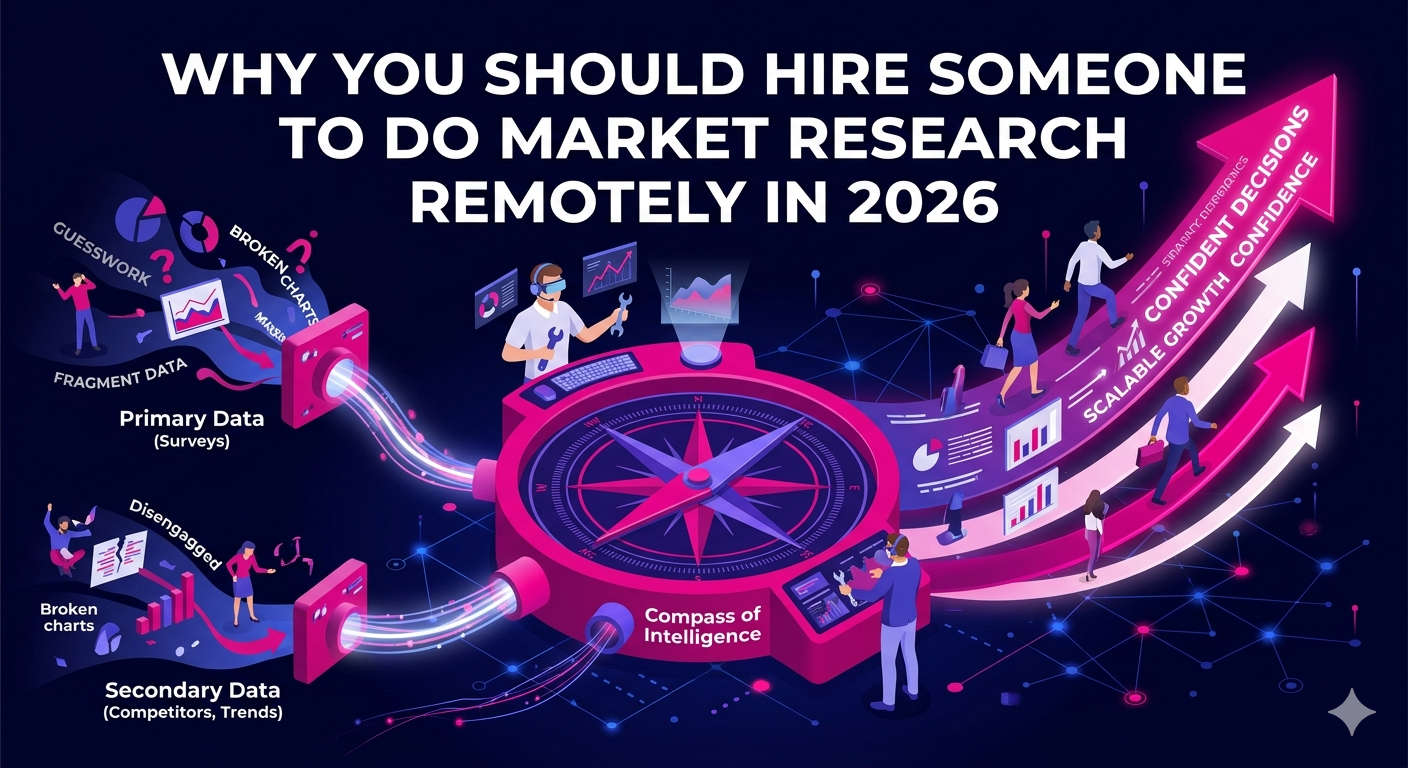
If you have been wondering whether to hire someone to do market research remotely, you are asking exactly the right question. In 2026, businesses that rely on guesswork instead of data are losing ground fast. Consumer behavior shifts quickly, new competitors enter markets overnight, and pricing dynamics can change within a single quarter. Having a dedicated remote market research specialist on your side means you always have the intelligence you need to make confident decisions, without the expense of a full-time in-house researcher.
This guide covers everything you need to know: what remote market researchers actually do, how to find the right one, what to expect in terms of results, and how to set your collaboration up for success from day one.
What Does It Mean to Hire Someone to Do Market Research Remotely?
Remote market research is the process of gathering, analyzing, and interpreting data about your target market, competitors, customers, and industry trends through a specialist who works outside your physical office. This person uses digital tools, databases, survey platforms, and analytical software to deliver structured insights directly to you, regardless of geography.
The scope of work can vary widely depending on your needs. Some businesses hire a remote researcher for a one-time project, such as validating a new product idea before launch. Others bring on a part-time or full-time remote specialist to continuously monitor market trends and competitive activity.
Core Tasks a Remote Market Researcher Handles
- Competitor analysis: tracking pricing, positioning, product launches, and marketing strategies of rival brands
- Customer and buyer persona research: identifying who your ideal customers are, what they value, and how they make purchasing decisions
- Industry trend analysis: monitoring developments in your sector that could create opportunities or threats
- Keyword and search demand research: understanding what your potential customers are searching for online
- Survey design and data collection: building and distributing surveys to gather direct feedback from target audiences
- Data synthesis and reporting: turning raw data into clear, actionable reports with strategic recommendations
The Business Case for Hiring a Remote Market Research Specialist
The traditional approach to market research involved either paying a large consultancy tens of thousands of dollars for a report or trying to do it yourself with limited time and tools. Neither option works well for growing businesses in 2026. Remote hiring gives you a third, far more practical path.
Cost Savings Without Sacrificing Quality
Hiring a full-time in-house market research analyst in a major city can cost upward of $70,000 to $90,000 per year when you factor in salary, benefits, and overhead. A skilled remote researcher working on a part-time or project basis can deliver the same caliber of insights at a fraction of that cost. Many businesses in 2026 are staffing their entire research function remotely and reinvesting the savings into acting on the insights they receive.
Access to Specialized Skills
When you hire someone to do market research remotely, geography no longer limits your talent pool. You can find specialists who have deep expertise in your specific industry, whether that is SaaS, e-commerce, health and wellness, financial services, or consumer packaged goods. This level of specialization is nearly impossible to find in a single local hire.
Faster Turnaround on Critical Decisions
A dedicated remote researcher can focus entirely on your project without the distractions of office life. This focus typically results in faster delivery of research reports, meaning you can make product, pricing, and marketing decisions sooner and with greater confidence.
How to Find the Right Person to Do Market Research Remotely
Not all remote researchers are equal. The quality of your market intelligence depends entirely on the person producing it. Here is how to approach the search strategically.
Define Your Research Objectives First
Before you post a job or contact a staffing service, be specific about what you need. Are you validating a new product concept? Trying to understand why customers are churning? Looking to enter a new geographic market? The clearer your objectives, the easier it is to find a researcher with the right background and methodology for your situation.
Look for Industry-Specific Experience
A researcher who has worked extensively in your category will already understand the key data sources, the relevant competitive benchmarks, and the typical buyer behavior patterns. This reduces the ramp-up time considerably and produces more nuanced findings than a generalist can deliver.
Assess Analytical and Communication Skills Together
Great market research is only valuable if it can be communicated clearly. When evaluating candidates, ask to see a sample report or presentation. Look for someone who can explain complex data in plain language and connect findings directly to business decisions. Strong Excel and data visualization skills are a plus, but clear thinking and concise writing matter just as much.
Use a Vetted Remote Staffing Platform
Trying to source, screen, and hire remote researchers on your own is time-consuming and risky. Working with a platform that has already done the vetting for you saves weeks of effort. The Remote Reps offers a curated roster of remote digital marketing and research specialists who are pre-screened for quality and reliability. Instead of wading through dozens of unqualified applicants, you can connect with professionals who are ready to contribute from the start.
For businesses with broader growth ambitions, pairing your market researcher with a remote lead generation expert ensures that the insights your researcher uncovers are immediately put to work attracting and converting the right prospects.
Setting Up a Successful Remote Market Research Engagement
Hiring the right person is just the beginning. How you structure and manage the engagement determines how much value you actually get from the investment.
Provide a Clear Research Brief
A research brief is a one to two page document that outlines your business background, the specific questions you need answered, the decisions that will be influenced by the findings, your target audience or market segment, and the timeline and deliverable format you expect. Providing this upfront saves significant back-and-forth and produces more focused, useful output.
Agree on Deliverable Formats
Different stakeholders have different preferences. Some want a detailed written report with charts and data tables. Others prefer a concise executive summary with bullet-point takeaways. Agree on the format before work begins, and specify whether you want raw data files alongside the summary.
Set Up Regular Check-Ins
Even for project-based engagements, a mid-point check-in helps catch any misalignments early. If the researcher is heading in a direction that will not answer your core questions, it is much better to course-correct at the halfway point than to receive a final report that misses the mark.
Build a Feedback Loop
After receiving each deliverable, provide structured feedback on what was useful, what needs more depth, and what can be dropped in future iterations. This feedback loop is especially important if you are working with a researcher on an ongoing basis, as it continuously raises the quality and relevance of the work over time.
What to Expect From a Remote Market Research Specialist in 2026
The tools and methodologies available to remote researchers in 2026 are more powerful than ever. A skilled specialist will typically draw on a combination of the following:
- Primary research tools: SurveyMonkey, Typeform, and Pollfish for direct customer data collection
- Competitive intelligence platforms: SEMrush, Similarweb, and SpyFu for digital presence and traffic analysis
- Social listening tools: Brandwatch and Sprout Social for monitoring brand sentiment and trending conversations
- Industry databases: Statista, IBISWorld, and Euromonitor for sector-level trend data and forecasts
- AI-assisted analysis: modern researchers use AI tools to process large datasets and identify patterns more quickly, then apply human judgment to interpret what those patterns mean for your specific business context
According to Statista’s market research industry overview, global spending on market research and data analytics continues to grow year over year, reflecting how central reliable market intelligence has become to competitive strategy across industries.
Industries That Benefit Most From Remote Market Research
While virtually any business can benefit from better market intelligence, certain industries see an especially high return when they hire someone to do market research remotely:
- E-commerce and retail: Understanding shifting consumer preferences, seasonal demand patterns, and competitor pricing in real time is critical for profitability.
- SaaS and technology: Feature prioritization, competitive positioning, and go-to-market strategy all depend on accurate market data.
- Health and wellness: Regulatory changes, consumer trends, and competitive product launches require constant monitoring.
- Financial services: Market entry decisions and product development both benefit enormously from rigorous external research.
- Consumer packaged goods: Understanding where your products sit in the competitive landscape and how consumer perceptions are shifting drives everything from packaging to messaging.
FAQ Section
What qualifications should I look for when I hire someone to do market research remotely?
When you hire someone to do market research remotely, prioritize candidates with a background in business, marketing, economics, or a related field, combined with hands-on experience using research tools like SEMrush, Statista, or survey platforms. Industry-specific experience is a major advantage. Strong analytical thinking and clear written communication are non-negotiable, since the value of research depends on how actionable the insights are.
How much does it cost to hire someone to do market research remotely?
Costs in 2026 range widely depending on the scope and duration of the work. For a focused project such as a competitive landscape report, expect to pay between $500 and $2,500. For ongoing part-time remote research support, monthly retainers typically range from $1,000 to $3,500. These figures are substantially lower than the cost of equivalent in-house hires, especially when you factor in benefits and overhead.
Can I hire someone to do market research remotely on a short-term project basis?
Yes, and this is actually one of the most popular models for remote market research in 2026. Many businesses bring on a remote researcher for a defined project, such as validating a new product, entering a new market, or auditing their competitive positioning. Once the project is complete, they either transition to an ongoing retainer or return for future projects as needed.
How do I ensure quality when I hire someone to do market research remotely?
Quality control starts with a thorough hiring process: review work samples, check references, and run a paid test project before committing to a larger engagement. During the project, provide a detailed brief, set clear milestones, and schedule a mid-project check-in. Working with a vetted staffing platform that pre-screens talent significantly reduces the risk of poor quality output.
What tools does a remote market research specialist typically use?
A skilled remote researcher working in 2026 uses a combination of competitive intelligence tools like SEMrush and Similarweb, survey platforms like SurveyMonkey or Typeform, industry databases like Statista and IBISWorld, social listening tools, and AI-assisted data analysis platforms. The specific toolkit varies depending on the type of research and the industry being studied.
How long does it take to get results when I hire someone to do market research remotely?
Timelines depend on the complexity and scope of the research. A focused competitive analysis can be completed in three to five business days. A comprehensive market sizing and customer segmentation study might take two to four weeks. Agreeing on a clear timeline and deliverable schedule upfront ensures that expectations on both sides are aligned from the start.
Start Making Smarter Business Decisions Today
The companies that win in competitive markets are the ones that act on better information faster than everyone else. When you hire someone to do market research remotely, you gain access to that information advantage without the cost and commitment of an in-house team. Whether you need a one-time deep dive into your competitive landscape or ongoing intelligence to guide your growth strategy, a remote market research specialist delivers exactly what you need, when you need it.
Explore the pre-vetted remote specialists at The Remote Reps and take the first step toward running a more informed, confident, and competitive business in 2026.