
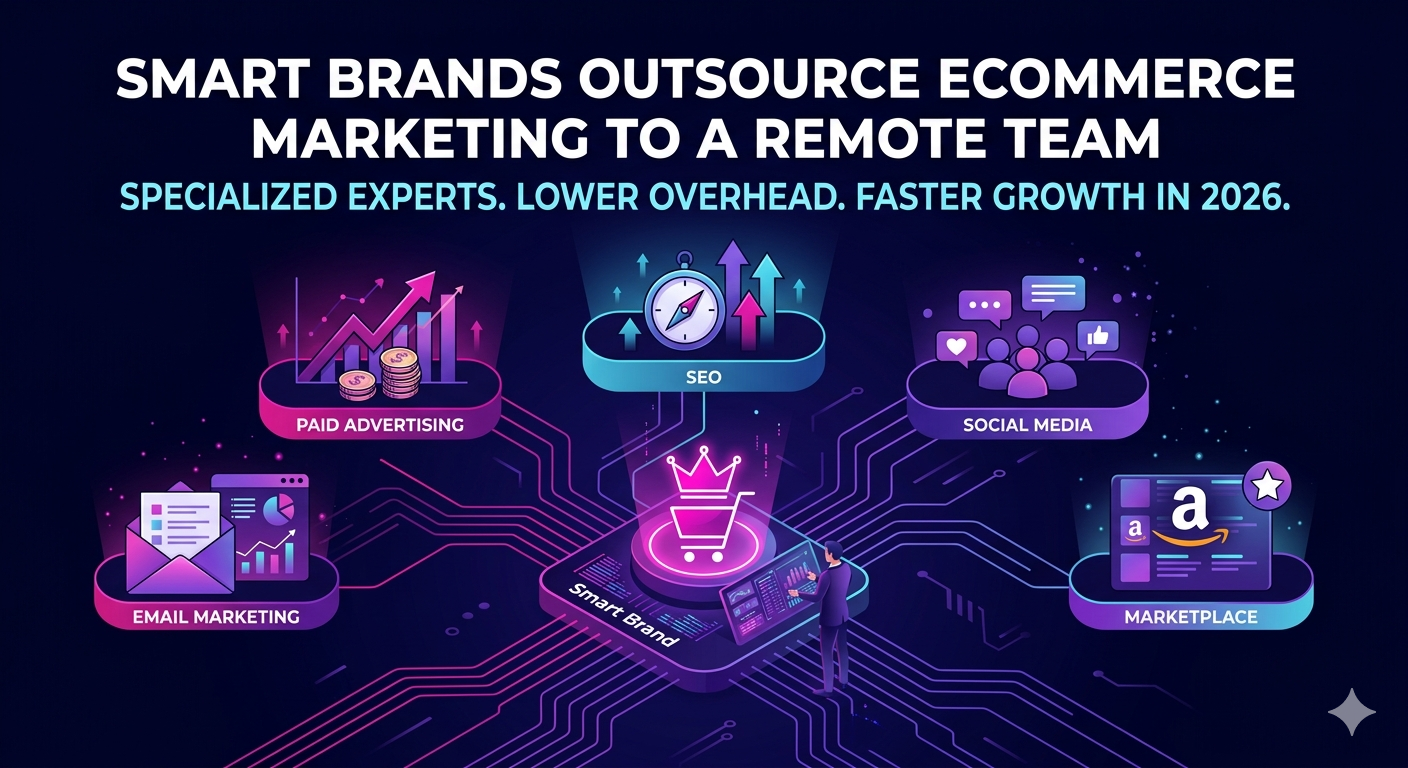
Running an ecommerce business in 2026 is more competitive than ever. Ad costs are rising, consumer expectations are higher, and the skill set required to compete across SEO, paid media, email, and social has grown well beyond what most in-house teams can cover alone. That is exactly why more ecommerce brands are choosing to outsource ecommerce marketing to a remote team rather than trying to hire, train, and retain specialists in every channel.
This guide covers the full case for remote ecommerce marketing, what roles to outsource first, how to structure your remote team, and what results you should realistically expect.
The Business Case for Outsourcing Ecommerce Marketing in 2026
The numbers behind remote outsourcing have only gotten stronger over the past few years. Brands that have moved away from bloated in-house marketing departments in favor of lean, specialized remote teams are consistently reporting lower costs per acquisition, faster execution, and better results across core channels.
Cost Efficiency That Compounds Over Time
Hiring a full-time in-house digital marketing manager in the US costs between $75,000 and $110,000 per year before benefits and overhead. Building a team of specialists covering paid media, SEO, email, and social would run well over $400,000 annually. When you outsource ecommerce marketing to a remote team, you access those same skill sets at a fraction of the cost, without the long hiring cycles or fixed overhead.
Access to Specialists, Not Generalists
A remote outsourcing model lets you pair each marketing channel with someone who does that one thing at a high level. Your Google Ads campaigns are managed by a PPC specialist. Your SEO is handled by someone who builds organic traffic for a living. Your product listings are optimized by an Amazon expert. Generalists trying to do everything rarely perform at the level that competitive ecommerce requires in 2026.
Speed and Flexibility
Remote teams scale with your business. During a product launch or peak season, you can expand capacity quickly. In slower periods, you are not carrying the cost of a full team on salary. That flexibility is a genuine competitive advantage for brands with seasonal sales cycles or rapid growth trajectories.
Which Ecommerce Marketing Functions Should You Outsource First?
Not every function needs to be outsourced at the same time. Most ecommerce brands get the fastest return by starting with the channels that are most technically complex or most time-intensive relative to internal bandwidth.
Paid Advertising and Media Buying
Paid media is one of the highest-leverage and most technical areas of ecommerce marketing. A skilled PPC or media buying specialist manages budgets, audience targeting, creative testing, and bid strategy daily. Mistakes are expensive. Getting this channel right with an experienced remote specialist typically delivers faster returns than almost any other outsourcing decision.
Search Engine Optimization
Organic search is a long-term compounding asset for any ecommerce brand. Remote SEO specialists handle technical audits, keyword strategy, on-page optimization, link building, and content planning. Because SEO is time-intensive and highly technical, it is a natural fit for a dedicated remote expert rather than a task shared across an already stretched internal team.
Social Media Management
Consistent, high-quality social media presence requires daily attention that most ecommerce founders and internal teams simply cannot sustain. Remote social media managers handle content calendars, community management, campaign scheduling, and performance reporting, freeing your team to focus on product and operations.
Email and Customer Retention Marketing
Email remains one of the highest ROI channels in ecommerce. A remote email marketing specialist handles list segmentation, automation flows, campaign strategy, and A/B testing. This is a channel where expertise makes a significant difference in revenue outcomes and one that is often under-resourced in growing ecommerce businesses.
Amazon and Marketplace Management
If you sell on Amazon or other marketplaces, the complexity of listing optimization, sponsored ads, review management, and algorithm compliance is enough to justify a dedicated specialist. Remote Amazon experts are one of the most in-demand outsourcing hires for ecommerce brands in 2026.
To explore the full range of roles available, visit the remote ecommerce marketing experts at TheRemoteReps and see how each specialist can be matched to your specific channel needs.
How to Build and Manage a Remote Ecommerce Marketing Team
Choosing to outsource ecommerce marketing to a remote team is the first decision. Building a team that actually performs requires structure, clear communication, and the right operational habits from day one.
Start With a Clear Scope of Work
Before you bring anyone on, document what success looks like for each channel. Define KPIs, reporting cadences, tools to be used, and how each role connects to broader business goals. The more clarity you provide up front, the faster your remote team can contribute meaningfully.
Use the Right Tools for Remote Collaboration
An effective remote ecommerce marketing team in 2026 runs on a short stack of tools: a project management platform like Asana or ClickUp, a communication hub like Slack, a shared reporting dashboard using Google Looker Studio or a similar tool, and cloud-based file storage. Keep the tool stack lean and ensure every team member is trained on it from day one.
Set a Weekly Operating Rhythm
Regular check-ins are what separate high-performing remote teams from disconnected freelancer collections. A weekly sync covering channel performance, priorities, and blockers keeps everyone aligned. Monthly performance reviews with clear data against KPIs create accountability and drive continuous improvement.
Work With a Specialist Placement Agency
Finding remote ecommerce marketing specialists independently through job boards is time-consuming and hit-or-miss. Working with an agency that specializes in placing vetted remote marketing professionals significantly reduces time-to-hire and improves placement quality. Agencies pre-screen for skills, communication ability, and relevant ecommerce experience before you ever speak to a candidate.
According to research published by McKinsey Digital on remote work and talent strategy, companies that access specialized talent through flexible remote models consistently outperform those that rely solely on local hiring pipelines, particularly in technical and digital marketing disciplines.
What Results Should You Expect When You Outsource Ecommerce Marketing?
Setting realistic expectations matters. The first 30 to 60 days are primarily an onboarding and calibration phase. Your remote team is learning your brand voice, product catalog, customer data, and existing channel performance. Deep optimization and revenue impact typically begin in month two and compound from there.
Short-Term Wins (Days 1 to 60)
- Immediate bandwidth relief for your internal team
- Audit of existing channel performance with clear improvement roadmaps
- Quick technical fixes in SEO, ad account structure, or email flows
- Consistent social media publishing and engagement
Medium-Term Growth (Months 2 to 6)
- Measurable improvement in paid media ROAS and cost per acquisition
- Growing organic search traffic from SEO work
- Higher email open rates, click rates, and revenue per subscriber
- Stronger brand presence across social platforms
Long-Term Compounding Returns (Month 6 and Beyond)
- Organic search as a sustainable, low-cost traffic source
- Refined paid media campaigns with deep performance data
- A loyal, well-segmented email list driving repeat revenue
- A remote marketing team that knows your brand as well as any in-house hire
Common Mistakes to Avoid When Outsourcing Ecommerce Marketing
Outsourcing Without a Strategy
Remote specialists execute better when they operate within a clear strategic framework. If you outsource individual tasks without defining the overarching marketing strategy, you get disconnected execution rather than a coherent growth plan. Define the strategy first, then bring in specialists to execute it.
Hiring Generalists for Specialist Roles
Resist the urge to hire one remote “digital marketer” to handle everything. Ecommerce marketing at a competitive level requires channel specialists. A single generalist managing PPC, SEO, email, and social simultaneously will produce mediocre results across all of them.
Neglecting Onboarding
Remote team members cannot perform at their best without proper onboarding. Share brand guidelines, historical performance data, customer personas, competitive context, and channel-specific goals before you expect results. Onboarding is an investment that pays for itself within the first few weeks.
FAQ: Outsource Ecommerce Marketing to a Remote Team
How much does it cost to outsource ecommerce marketing to a remote team?
The cost to outsource ecommerce marketing to a remote team depends on the number of channels and specialists involved. Individual remote specialists typically range from $20 to $60 per hour depending on expertise and placement channel. A full remote ecommerce marketing team covering paid media, SEO, email, and social can often be built for $60,000 to $120,000 per year, compared to $300,000 or more for an equivalent in-house team in a major US market.
What ecommerce marketing roles are best suited for a remote team?
When businesses outsource ecommerce marketing to a remote team, the highest-impact roles are typically PPC and paid media specialists, SEO experts, email marketing managers, social media managers, Amazon marketplace specialists, and content marketers. These roles are highly technical, channel-specific, and well-suited to independent remote execution with regular performance reporting.
How do I manage quality control when I outsource ecommerce marketing to a remote team?
Quality control starts with clear KPIs defined before work begins. Set monthly performance benchmarks for each channel, use shared dashboards for real-time visibility, hold weekly syncs to review progress, and conduct monthly reviews with structured performance data. Working with a reputable remote staffing agency also provides a layer of accountability and replacement guarantees if performance does not meet expectations.
How long before I see results after I outsource ecommerce marketing to a remote team?
Most ecommerce brands begin seeing meaningful improvements within 60 to 90 days of outsourcing ecommerce marketing to a remote team. Paid media and email optimizations can show results faster, often within 30 days. SEO and content-driven channels take longer, typically three to six months to show significant organic traffic growth. Setting realistic timelines and reviewing early indicators helps calibrate expectations during the onboarding phase.
Is it safe to outsource ecommerce marketing to a remote team in terms of brand consistency?
Yes, with proper onboarding and clear brand documentation. Before your remote team begins work, provide a brand style guide, tone of voice guidelines, approved messaging frameworks, and customer persona documentation. Remote specialists who are properly briefed maintain brand consistency at the same level as in-house hires. Using a shared content calendar and approval workflow adds an additional layer of oversight during the early months.
Can I outsource ecommerce marketing to a remote team if I am a small business?
Absolutely. In fact, small and mid-sized ecommerce businesses often benefit most from the remote model because it gives them access to specialist-level talent they could not afford to hire full-time. Starting with one or two high-priority channels and expanding from there is a practical and cost-effective approach for businesses at any stage of growth.
The Bottom Line: Build Your Remote Ecommerce Marketing Team Today
The brands winning in ecommerce in 2026 are not necessarily the ones with the biggest budgets. They are the ones executing most effectively across the channels that drive revenue. When you outsource ecommerce marketing to a remote team of specialists, you get focused execution, lower overhead, and the kind of channel-level expertise that generalist in-house teams cannot match.
The window to build this competitive advantage is open now. Start with one channel, prove the model, and scale from there. Explore the full suite of remote ecommerce marketing services at TheRemoteReps and take the first step toward a leaner, higher-performing marketing operation today.