
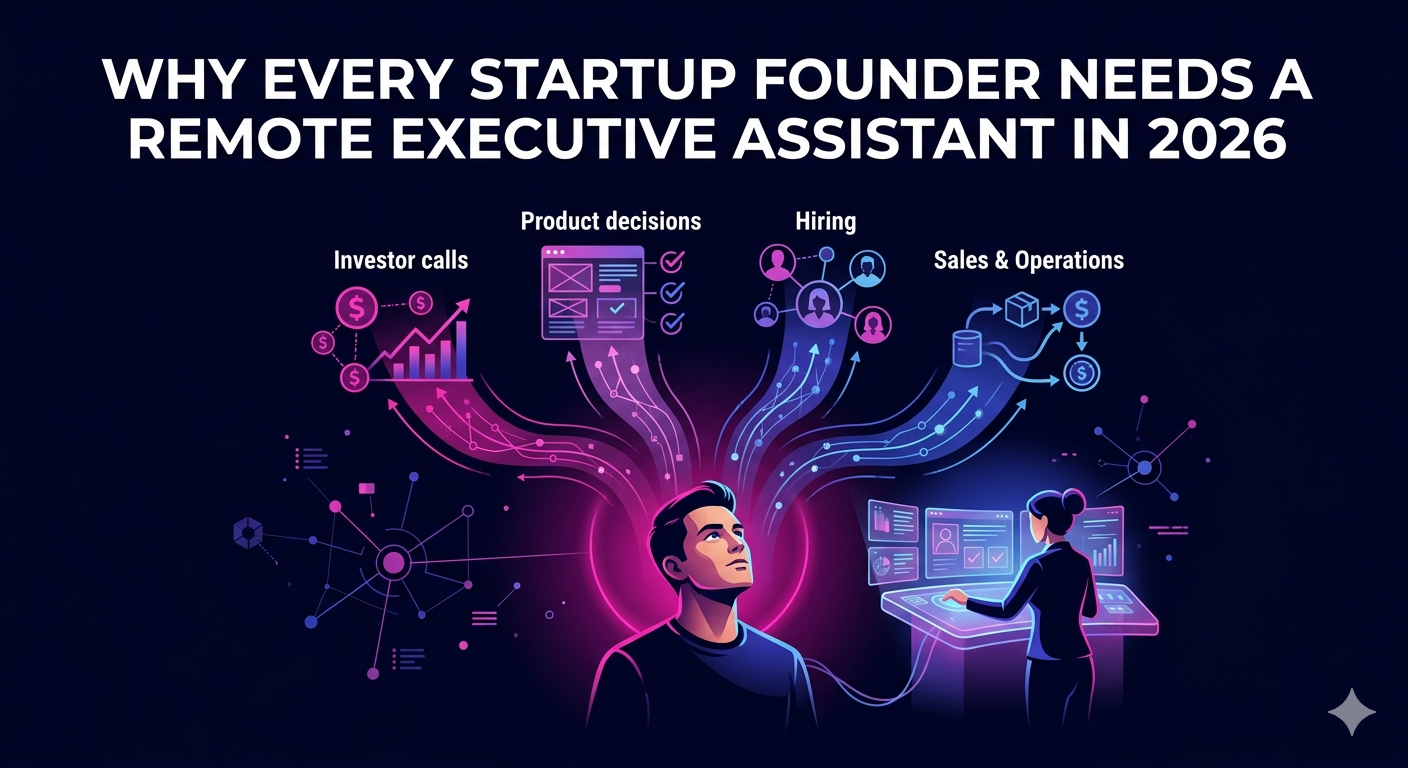
Running a startup in 2026 means wearing more hats than ever. Product decisions, investor calls, hiring, sales, operations, and strategy all land on the founder’s desk simultaneously. If you are a startup founder drowning in low-leverage tasks, a remote executive assistant could be the single most impactful hire you make this year.
A remote executive assistant for a startup founder is not just a calendar manager. When placed correctly, this person becomes a force multiplier who protects your time, accelerates your output, and keeps your operation moving even when you are heads-down on your most important work.
This guide covers exactly why founders need one, what to delegate, how to find the right fit, and how to structure the relationship for maximum results.
What Is a Remote Executive Assistant for a Startup Founder?
A remote executive assistant (EA) is a highly skilled professional who supports a founder or executive at the strategic level, operating entirely from a remote location. Unlike a standard virtual assistant who handles routine tasks, an executive assistant takes ownership of complex, judgment-driven responsibilities.
For a startup founder specifically, a remote EA understands the pace, ambiguity, and high stakes of a scaling company. They are comfortable making decisions with limited information, managing up, and adapting quickly as priorities shift.
How a Remote EA Differs from a General Virtual Assistant
- Scope: An EA manages high-priority workflows. A VA handles repeatable, process-driven tasks.
- Judgment: An EA makes calls on your behalf. A VA follows documented procedures.
- Relationship: An EA operates as a trusted right hand. A VA operates as a task executor.
- Communication: An EA represents you externally with investors, partners, and clients.
Both roles are valuable. But for a founder who is past the early scrappy stage and scaling toward product-market fit or beyond, an executive assistant is the right level of support.
Why Startup Founders Need Remote Executive Assistant Support in 2026
The founder time problem has only intensified. Research from 2025 showed that founders spend an average of 23 hours per week on administrative and coordination tasks that do not require their unique expertise. In 2026, with distributed teams, async-first cultures, and faster product cycles, that number has grown.
A remote executive assistant for a startup founder solves this problem at the root. Here is what the numbers look like in practice:
- Founders with dedicated EA support report reclaiming 15 to 20 hours of deep work time per week
- Investor communication response rates improve significantly when managed through a prepared EA
- Scheduling conflicts and missed follow-ups drop to near zero with a proactive EA managing the calendar
The Compounding Value of an Executive Assistant Over Time
In the first 30 days, your EA saves you time. In 90 days, they start anticipating your needs. At six months, they are operating as a strategic partner who knows your priorities, your communication style, your key relationships, and your blind spots. That compound value is what makes this hire so different from any other early operational investment.
Core Responsibilities of a Remote Executive Assistant for Founders
The scope of an EA role varies by company stage and founder preference, but the following responsibilities represent the highest-leverage areas for most startup founders in 2026.
Calendar and Time Management
- Owning the founder’s calendar end to end, including scheduling, blocking focus time, and rescheduling conflicts
- Coordinating across time zones for investor meetings, board calls, and team standups
- Creating weekly schedules aligned to the founder’s stated priorities
Communications and Inbox Management
- Filtering, prioritizing, and drafting responses across email and Slack
- Managing inbound inquiries from investors, partners, press, and job applicants
- Tracking follow-ups and ensuring nothing falls through the cracks
Research and Decision Support
- Preparing briefing documents before important meetings
- Researching vendors, tools, candidates, or market data on request
- Summarizing reports, articles, or investor memos into actionable takeaways
Project and Operations Coordination
- Tracking progress on founder-led initiatives across tools like Notion, Asana, or Linear
- Coordinating between departments so the founder stays informed without being a bottleneck
- Managing logistics for offsites, travel, events, and key milestones
For founders who need both executive-level support and specialized business functions, The Remote Reps executive assistant services provide vetted professionals who are ready to support high-growth startups from day one.
How to Find the Right Remote Executive Assistant for Your Startup
Not every EA is a fit for a startup environment. The skills that make someone an exceptional EA at a Fortune 500 company are different from what a fast-moving startup founder needs. Here is what to look for.
Key Qualities for a Startup-Ready Remote EA
- Comfort with ambiguity: Startup priorities shift weekly. Your EA needs to adapt without requiring constant redirection.
- Proactive communication: They should surface problems before they reach you, not wait for you to ask.
- Startup literacy: Familiarity with funding stages, investor communication norms, and startup tooling (Notion, Slack, Linear, etc.) saves weeks of onboarding.
- High discretion: An EA has access to sensitive information. Trust and confidentiality are non-negotiable.
- Async fluency: In a remote-first world, the ability to communicate clearly and manage work without real-time check-ins is essential.
Where to Source a Remote Executive Assistant for Your Startup
Founders have several options when hiring a remote EA in 2026. Freelance platforms offer flexibility but require significant vetting effort. Hiring agencies provide pre-screened candidates with faster time-to-placement. Specialized remote staffing platforms that focus on business-critical roles offer the best balance of quality, speed, and fit.
According to Harvard Business Review’s guidance on executive delegation for startup founders, the most effective leaders are those who build trusted support systems early, before they reach capacity. Waiting until you are overwhelmed to hire an EA means losing months of potential leverage.
How to Onboard a Remote Executive Assistant at a Startup
Onboarding a remote EA at a startup requires more intentionality than a standard hire. The absence of office osmosis means you need to be deliberate about transferring context.
Week One Priorities
- Walk through your calendar structure and how you like to work
- Introduce them to key team members, investors, and recurring contacts
- Share your communication style preferences and response time expectations
- Grant access to tools with clear permission levels
Build a Founder Context Document
A founder context document is one of the most useful tools for onboarding a remote EA. It should include your top three priorities for the quarter, your communication preferences, a list of key relationships and how to engage them, your decision-making framework for common situations, and a list of things that should never reach your inbox unfiltered.
This document alone can cut your onboarding time in half and give your EA the confidence to act with autonomy much sooner.
Common Mistakes Startup Founders Make with Remote EAs
Even with the right hire, the wrong setup can limit results. Avoid these patterns:
- Underdelegating: Assigning only low-stakes tasks out of hesitation keeps your EA underutilized and you overloaded.
- Skipping check-ins: A weekly 20-minute sync is the minimum needed to keep priorities aligned in a fast-moving startup.
- No written playbooks: If your EA has to ask you about every edge case, you have not yet documented enough. Build SOPs for recurring decisions.
- Treating the EA as a reactive resource: The best EA relationships are collaborative. Involve your EA in planning conversations, not just execution.
If you are also building out your go-to-market function alongside your EA hire, The Remote Reps SDR services can help you scale outbound without adding full-time headcount.
The ROI of a Remote Executive Assistant for a Startup Founder
The return on investment from a great remote EA is one of the highest in your entire hiring budget. Consider this: if your time as a founder is worth $500 per hour and your EA saves you 15 hours per week, that represents $7,500 in weekly value created, far exceeding the cost of a skilled remote EA.
Beyond raw time savings, the compounding benefits include faster investor response cycles, fewer dropped balls in critical deals, a better-organized operation that impresses partners and hires, and a founder who shows up to every meeting prepared and focused.
In 2026, the most competitive startups are not the ones with the most funding. They are the ones with the most leverage. A remote executive assistant for a startup founder is one of the clearest leverage points available.
Ready to build your support team? The Remote Reps connects startup founders with elite remote talent across executive support, sales, marketing, and operations.
Frequently Asked Questions: Remote Executive Assistant for Startup Founder
What does a remote executive assistant for a startup founder actually do?
A remote executive assistant for a startup founder manages high-priority responsibilities like calendar ownership, inbox management, investor communication coordination, research, and cross-functional project tracking. Unlike a general VA, a remote EA operates with judgment and autonomy, taking decisions off the founder’s plate rather than just completing assigned tasks.
When should a startup founder hire a remote executive assistant?
Most founders benefit from hiring a remote executive assistant once they are spending more than 15 hours per week on tasks that do not require their unique expertise. In 2026, that threshold is reached earlier than ever due to the complexity of running distributed teams and managing investor relationships remotely.
How much does a remote executive assistant for a startup founder cost?
The cost of a remote executive assistant for a startup founder varies based on experience, location, and scope. In 2026, skilled remote EAs with startup experience typically range from $1,500 to $4,000 per month for part-time to full-time engagements. Working with a vetted staffing platform can reduce the time and cost of finding the right fit significantly.
How is a remote executive assistant for a startup founder different from a virtual assistant?
A remote executive assistant for a startup founder operates at a higher level than a standard virtual assistant. An EA uses professional judgment, manages complex communications, represents the founder externally, and takes strategic ownership of priorities. A VA typically executes well-defined, repeatable tasks with documented procedures.
What tools does a remote executive assistant for a startup use?
A remote executive assistant for a startup founder should be fluent in tools common to startup environments. These include Notion or Confluence for documentation, Slack for team communication, Google Workspace for calendar and email, Asana or Linear for project tracking, and Zoom for video coordination. Startup-ready EAs in 2026 also understand CRM tools and investor management platforms.
How long does it take to see results from a remote executive assistant for a startup founder?
Most startup founders report meaningful time savings within the first two weeks and full operational impact within 60 to 90 days. The key to faster results is thorough onboarding, a clear founder context document, and a consistent weekly check-in rhythm. A remote executive assistant for a startup founder becomes more valuable over time as they build context and anticipate needs proactively.