
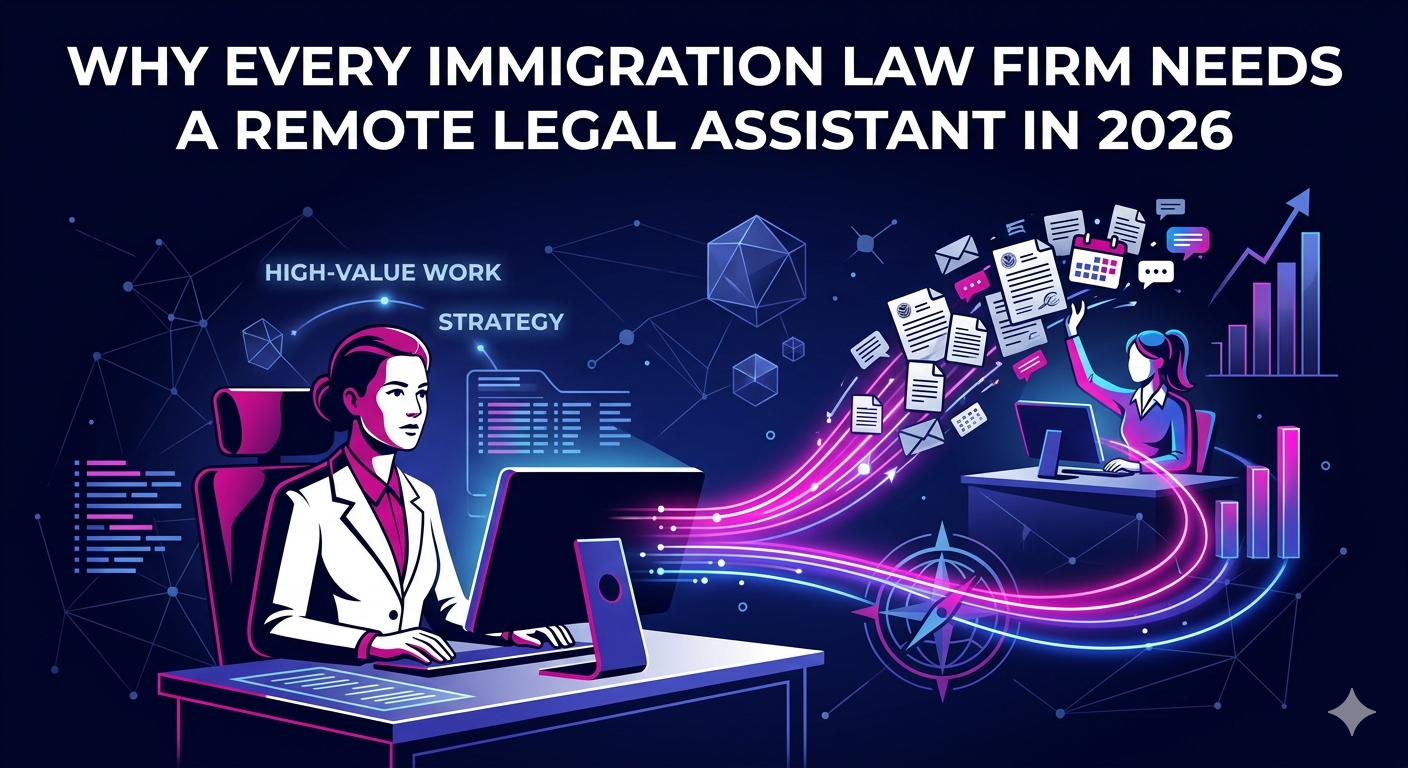
Immigration law is one of the most document-intensive, deadline-driven, and emotionally charged areas of legal practice. Clients are counting on your firm to get every form right, every deadline met, and every communication handled with care. The administrative pressure on attorneys and senior staff is relentless. That is exactly why the decision to bring on a remote legal assistant for immigration law firm work has become one of the smartest operational moves a firm can make in 2026.
Whether you run a solo immigration practice or a growing multi-attorney firm, a skilled remote legal assistant can take on a substantial portion of your administrative and case management workload so your attorneys can focus on the legal work that actually requires their expertise.
The Growing Case for Remote Legal Support in Immigration Practice
Immigration law firms face a unique set of operational challenges. Caseloads fluctuate with policy changes, filing deadlines are rigid and unforgiving, and the volume of paperwork tied to each client matter is enormous. At the same time, many firms operate with lean teams and tight margins.
Hiring a full-time in-office legal assistant in 2026 means taking on salary, benefits, payroll taxes, and office space costs. For a small or mid-sized immigration firm, that overhead can be difficult to justify, especially during slower filing periods.
A remote legal assistant for an immigration law firm provides a flexible, cost-effective alternative. You access the same level of skill and dedication without the fixed overhead, and you can scale the engagement up or down as your caseload demands.
What a Remote Legal Assistant for Immigration Law Firm Can Handle
Many immigration attorneys underestimate how much a well-trained remote legal assistant can take off their plate. The scope of support goes well beyond basic administrative tasks.
Case File Preparation and Organization
Immigration cases involve extensive documentation including visa applications, supporting evidence, client statements, government correspondence, and fee receipts. A remote legal assistant organizes these materials into properly structured case files and keeps everything updated as the case progresses.
Form Preparation and Petition Drafting Support
USCIS forms require precision. A trained remote legal assistant for immigration law firm support can prepare drafts of commonly used forms such as I-130, I-485, I-765, and DS-260 based on client intake information, which the supervising attorney then reviews and finalizes. This reduces the time attorneys spend on routine form completion without compromising accuracy.
Deadline Tracking and Calendar Management
Missing a filing deadline in immigration law can have serious consequences for clients. A remote legal assistant monitors case timelines, flags upcoming deadlines, schedules client appointments, and maintains the firm’s legal calendar with the attention to detail this work demands.
Client Communication and Follow-Up
Immigration clients often have questions between appointments and need regular updates on their case status. A remote legal assistant handles routine client correspondence, collects outstanding documents, and ensures clients feel informed and supported throughout the process.
Government Agency Correspondence
Drafting responses to requests for evidence, preparing cover letters for filings, and tracking correspondence with USCIS, NVC, and consulates are all tasks a qualified remote legal assistant can manage under attorney supervision.
Document Review and Data Entry
Reviewing client documents for completeness, entering information into case management software, and preparing filing checklists are time-consuming but critical tasks that remote legal assistants handle efficiently.
Skills to Look for in a Remote Legal Assistant for Immigration Law Firm Work
Not every legal assistant has the background needed to support immigration practice effectively. When evaluating candidates, prioritize these qualifications:
- Familiarity with USCIS forms, filing procedures, and case categories including family-based, employment-based, and humanitarian immigration
- Experience with immigration case management software such as INSZoom, Cerenade, or MyCase
- Strong written and verbal communication skills for client and agency correspondence
- Attention to detail and accuracy in document preparation
- Understanding of confidentiality obligations and attorney-client privilege
- Ability to manage multiple open cases simultaneously without dropping details
- Proficiency in document management platforms and cloud storage tools
Experience matters, but attitude and work ethic matter just as much. A remote legal assistant who is proactive, organized, and genuinely invested in client outcomes will add more value than a candidate with credentials alone.
How Pre-Vetting Changes the Hiring Equation
The traditional approach to hiring a remote legal assistant involves posting a job, reviewing dozens of applications, and conducting multiple rounds of screening before finding someone qualified. For a busy immigration firm, that process can take weeks and still result in a disappointing hire.
Working with a staffing company that specializes in pre-vetted remote legal talent changes that equation entirely. The screening, skills testing, and communication evaluations happen before you ever see a candidate profile. You receive a shortlist of professionals who have already demonstrated the abilities your practice requires.
Explore pre-vetted remote legal assistants who have been specifically evaluated for the skills and professionalism that immigration law firm environments demand. You can also review client testimonials from firms that have successfully built their support teams through a pre-vetted hiring process.
Compliance and Confidentiality Considerations
One concern immigration attorneys often raise about remote legal support is whether confidentiality and ethical obligations can be maintained outside an office environment. The answer is yes, provided the right protocols are in place.
When onboarding a remote legal assistant for immigration law firm work, attorneys should address the following:
- Require the assistant to sign a confidentiality and non-disclosure agreement before beginning work
- Use encrypted communication channels and secure cloud-based file storage
- Provide access to case management systems through role-based permissions that limit exposure to only relevant files
- Establish clear protocols for handling physical documents if any paper files need to be scanned and submitted
- Conduct periodic check-ins to review data security practices and reinforce confidentiality standards
Most experienced remote legal assistants are already familiar with these expectations. A candidate who pushes back on reasonable confidentiality requirements is a candidate to pass on.
What It Costs to Hire a Remote Legal Assistant for Immigration Law Firm Support
Cost is always a consideration for smaller immigration practices. In 2026, the pricing for a remote legal assistant depends on experience level and the scope of work involved:
- Entry-level remote legal assistant: Suitable for document organization, data entry, and calendar management. Typically ranges from $700 to $1,200 per month for part-time engagements.
- Mid-level legal assistant with immigration experience: Handles form preparation, client correspondence, and agency filings. Typically ranges from $1,200 to $2,200 per month.
- Senior remote legal assistant: Manages complex caseloads, drafts responses to RFEs, and supports multiple attorneys. Typically ranges from $2,200 to $3,500 per month.
Compared to the fully-loaded cost of an in-office hire, even a senior remote legal assistant represents significant savings for most immigration firms.
Setting Your Remote Legal Assistant Up for Success
The firms that get the most from remote legal support invest a little time upfront in structured onboarding. Here are the practices that make the biggest difference:
- Provide a written overview of your firm’s case workflows and standard operating procedures
- Grant access to your case management software and file storage on day one
- Assign a point of contact within the firm for daily questions and guidance during the first few weeks
- Start with a defined set of tasks before expanding responsibilities as trust is established
- Schedule weekly check-ins to review open cases, upcoming deadlines, and any issues that need attorney attention
For additional guidance on ethical obligations when supervising non-attorney staff remotely, the American Bar Association’s professional responsibility resources provide authoritative guidance relevant to remote legal assistant supervision in immigration and other practice areas.
Conclusion: Build a Leaner, More Capable Immigration Practice
The immigration law firms that thrive in 2026 are the ones that deploy their attorney talent strategically and support it with skilled remote professionals who handle the administrative and procedural load. Bringing on a remote legal assistant for immigration law firm operations is not a compromise. It is a deliberate upgrade to how your firm operates.
Stop letting form preparation, deadline tracking, and client follow-up consume your attorneys’ billable hours. Visit The Remote Reps to connect with pre-vetted remote legal assistants who are ready to support your immigration practice from day one.
Frequently Asked Questions
What is a remote legal assistant for immigration law firm and what do they do?
A remote legal assistant for immigration law firm is a trained legal support professional who works off-site to assist with case file preparation, form drafting, deadline tracking, client communication, and document management. They perform the same functions as an in-office legal assistant but operate remotely using shared digital tools and case management platforms under attorney supervision.
Can a remote legal assistant for immigration law firm handle USCIS form preparation?
Yes. A qualified remote legal assistant for immigration law firm support can prepare draft versions of standard USCIS forms including I-130, I-485, I-765, and others based on client intake information. The supervising attorney reviews and certifies all filings, but the assistant handles the time-consuming preparation work that would otherwise consume attorney hours.
How do I ensure confidentiality when using a remote legal assistant for immigration law firm work?
To protect confidentiality when using a remote legal assistant for immigration law firm matters, require a signed non-disclosure agreement, use encrypted communication channels, restrict case management system access to relevant files only, and establish written security protocols from the start of the engagement. Most experienced remote legal assistants are familiar with these requirements and will follow them without issue.
Is a remote legal assistant for immigration law firm less effective than an in-office hire?
Not when the right systems are in place. A remote legal assistant for immigration law firm work can be equally or more productive than an in-office counterpart because they tend to have fewer distractions and are often highly motivated to perform well in a results-oriented remote role. Regular check-ins, clear task assignments, and proper tool access are the key ingredients for remote legal assistant success.
How quickly can I onboard a remote legal assistant for immigration law firm support?
When you hire through a pre-vetted staffing company, you can typically onboard a remote legal assistant for immigration law firm support within one to two weeks. The candidate screening has already been completed, so you move straight from the interview to offer to onboarding. A structured first-week plan with defined tasks and tool access ensures the assistant can begin contributing almost immediately.
What is the difference between a remote legal assistant for immigration law firm and a remote paralegal?
A remote legal assistant for immigration law firm typically handles administrative and procedural support such as form preparation, scheduling, and client communication. A remote paralegal generally takes on more substantive legal work such as legal research, drafting legal memoranda, and preparing more complex case documents. Both roles are valuable, and the right choice depends on the specific support needs of your practice.