
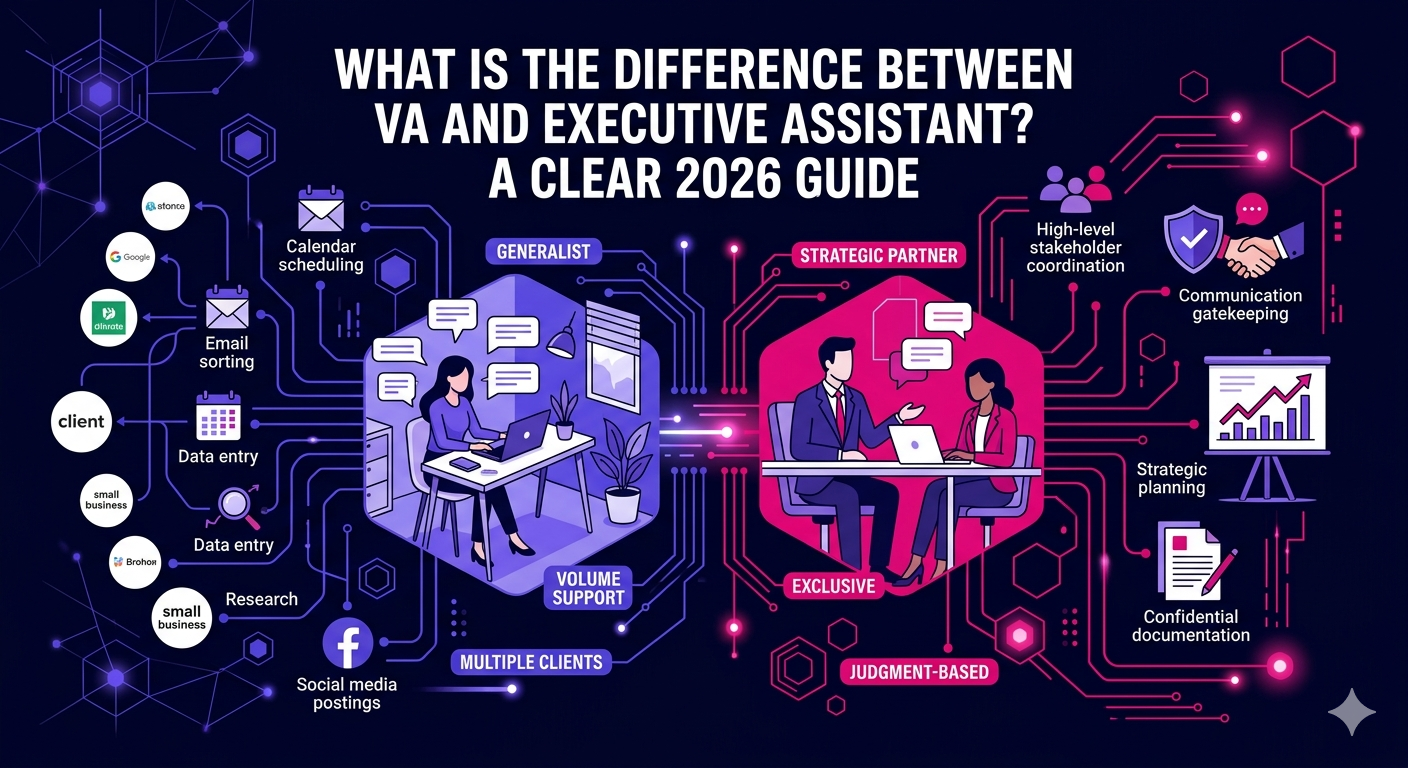
If you are scaling a business in 2026, you have probably asked yourself: what is the difference between a VA and executive assistant? The two roles sound similar, and they do overlap in some areas. But hiring the wrong one can cost you time, money, and momentum. Understanding exactly where the roles diverge will help you make a smarter hiring decision and build a support structure that actually fits the way you work.
This guide breaks down both roles clearly, compares their responsibilities, and helps you figure out which one your business needs right now.
Defining the Two Roles: VA vs Executive Assistant
What Is a Virtual Assistant?
A virtual assistant, commonly referred to as a VA, is a remote professional who handles a broad range of administrative and operational tasks. VAs typically work with multiple clients at once or on a part-time basis, providing flexible support across areas like:
- Email inbox management and filtering
- Calendar scheduling and appointment booking
- Data entry and spreadsheet management
- Customer service and basic client communication
- Research tasks and online errands
- Social media scheduling and basic content posting
- Travel booking and expense tracking
VAs are generalists by nature. They are skilled at handling volume and keeping day-to-day operations running smoothly. They are ideal for business owners who need reliable help with recurring tasks but do not yet require a senior-level strategic partner.
What Is an Executive Assistant?
An executive assistant, or EA, is a senior-level support professional who works directly with one executive or a small leadership team. The role goes well beyond administrative work. Executive assistants are trusted with high-stakes decisions, confidential information, and responsibilities that have a direct impact on how an executive uses their time and influence.
Typical executive assistant responsibilities include:
- Managing complex, multi-party scheduling across time zones
- Acting as a communication gatekeeper for C-suite executives
- Preparing board-level documents, briefings, and presentations
- Coordinating internal and external stakeholders on behalf of the executive
- Managing confidential HR matters, contracts, and financial documents
- Anticipating executive needs before they are voiced
- Leading special projects and cross-functional initiatives
An executive assistant is not just doing tasks. They are protecting the executive’s focus, shielding their time, and operating as an extension of their decision-making capacity.
Key Differences Between a VA and an Executive Assistant
Now that both roles are defined, here is a direct comparison across the dimensions that matter most when hiring.
Scope of Responsibility
A VA handles defined, repeatable tasks with clear instructions. An executive assistant manages open-ended responsibilities that require judgment, initiative, and context about the executive’s priorities. The EA often decides what needs to be done rather than waiting to be told.
Level of Autonomy
VAs generally operate within set workflows and check in regularly for direction. Executive assistants are expected to act independently, represent the executive in communications, and make real-time decisions on their behalf when the executive is unavailable.
Relationship Structure
Most VAs work across multiple clients. This means their attention and availability is divided, which is perfectly appropriate for the types of tasks they handle. Executive assistants work exclusively with one executive or one leadership team. The relationship is deeply collaborative and requires a high level of trust, confidentiality, and alignment with the executive’s goals and personality.
Seniority and Experience
VAs range from entry-level to mid-career professionals. Many excellent VAs are building their remote careers and bring strong organizational skills without requiring deep corporate or executive-level experience. Executive assistants typically come with years of experience supporting C-level leaders, managing complex operations, and navigating corporate environments. Their value is built on a combination of hard skills and soft skills like discretion, emotional intelligence, and business acumen.
Cost Comparison in 2026
Because of the difference in seniority and exclusivity, executive assistants typically cost more than virtual assistants. However, when hiring remote talent through a vetted staffing platform, both roles remain significantly more cost-effective than their in-office equivalents. A remote VA might be engaged for 10 to 20 hours per week at a competitive hourly rate, while a remote executive assistant is typically hired on a full-time basis with a higher monthly retainer that reflects their strategic value.
When Should You Hire a Virtual Assistant?
A VA is the right choice when your main challenge is volume. If you are spending hours each week on tasks that are repetitive, clearly defined, and do not require someone to know your full business context, a VA will free up your time efficiently and affordably.
Consider hiring a VA if you need help with:
- Inbox management and email responses using templates
- Scheduling routine calls and meetings
- Managing your social media content calendar
- Organizing files and maintaining databases
- Handling customer inquiries and basic support tickets
If you are a founder, small business owner, or solo operator who is drowning in administrative work, a virtual assistant is often the first and most impactful hire you can make. Explore remote virtual assistant services to find vetted VAs who are ready to work your business hours and plug into your existing workflow immediately.
When Should You Hire an Executive Assistant?
An executive assistant becomes necessary when your bottleneck is no longer volume but complexity. When your calendar involves multi-stakeholder coordination, when confidential matters require a trusted intermediary, or when you need someone who can represent you in your absence, a VA will not be sufficient.
Consider hiring an executive assistant if you:
- Lead a team of 10 or more people and manage external partnerships
- Spend more than 30 percent of your week on scheduling and communications
- Handle sensitive financial, legal, or strategic information regularly
- Travel frequently and need someone to manage your world while you are away
- Have outgrown your current VA and need a more proactive, senior partner
For executives who need a highly capable remote partner, hire a remote executive assistant through a platform that vets specifically for C-suite support experience, discretion, and US-hours availability.
Can the Same Person Do Both Jobs?
Occasionally, a highly experienced VA will have the skills to function as an executive assistant for a less complex role. But this is the exception, not the rule. Expecting a VA to manage the strategic demands of executive-level support typically leads to frustration on both sides. The cleaner approach is to define the scope of work you need, then hire specifically for that scope.
In some growing businesses, it makes sense to hire both: a VA to handle volume tasks and an executive assistant to manage the executive’s strategic time. This combination creates a highly efficient support layer without overloading either role.
A Side-by-Side Summary
Here is a quick reference comparison to make the decision easier:
- Task type: VA handles routine and repeatable tasks. EA handles complex and judgment-based work.
- Client relationship: VA often works with multiple clients. EA works exclusively with one executive.
- Level of trust required: VA requires moderate trust. EA requires high-level trust and confidentiality.
- Autonomy: VA follows instructions. EA exercises independent judgment.
- Best for: VA suits founders and small business owners. EA suits senior executives and scaling companies.
- Cost: VA is typically lower cost. EA reflects senior-level pricing.
According to Indeed’s career resource on virtual assistant vs executive assistant roles, the key distinction comes down to the depth of involvement and level of trust each role requires, with executive assistants functioning as strategic partners rather than task executors.
Making the Right Hire for Your Business in 2026
The question of what is the difference between a VA and executive assistant is ultimately a question about what your business needs most right now. Both roles deliver real value. Both can be hired remotely at a significant cost advantage compared to in-office equivalents. The key is matching the role to the actual scope of work you need covered.
If you are still unsure which role fits, start by listing every task you want to delegate. If the majority are routine and process-driven, start with a VA. If the list includes managing your communications, representing you in meetings, and handling sensitive business matters, invest in an executive assistant from the start.
Ready to hire? Browse vetted remote talent across both roles at The Remote Reps and find the right support professional for your stage of growth.
Frequently Asked Questions
What is the difference between a VA and executive assistant in terms of daily tasks?
The difference between a VA and executive assistant in daily tasks comes down to complexity and judgment. A VA handles clearly defined, repeatable tasks like inbox sorting, scheduling, and data entry. An executive assistant manages open-ended responsibilities like drafting executive communications, coordinating high-level meetings, and making real-time decisions on behalf of the executive.
What is the difference between a VA and executive assistant when it comes to cost?
The difference between a VA and executive assistant in cost reflects their seniority and exclusivity. VAs are often engaged part-time or across multiple clients, making them more affordable for smaller businesses. Executive assistants are typically full-time hires with higher compensation that reflects their strategic role, though hiring remotely through a vetted platform keeps costs well below domestic in-office rates for both roles.
What is the difference between a VA and executive assistant in terms of who they work for?
A VA often supports multiple clients simultaneously, which works well for task-based work that does not require deep business context. An executive assistant works exclusively with one executive or leadership team, building the close working relationship and insider knowledge that high-level support requires.
Can understanding what is the difference between a VA and executive assistant help me decide which to hire first?
Yes, absolutely. If your main need is to offload volume tasks and free up a few hours each week, hire a VA first. If you are an executive who needs a trusted strategic partner to protect your time and manage complex operations, start with an executive assistant. Many businesses eventually hire both to cover different layers of support.
What is the difference between a VA and executive assistant when hiring remotely?
When hiring remotely, the difference between a VA and executive assistant remains the same in terms of scope and seniority, but remote hiring makes both roles more accessible and cost-effective. A remote VA can be onboarded quickly for specific task workflows, while a remote executive assistant requires a more thorough vetting process to ensure they have the experience, discretion, and communication skills to represent an executive effectively across digital channels.
Is it possible for a virtual assistant to grow into an executive assistant role over time?
It is possible, but it requires a deliberate transition. A VA who takes on increasingly strategic responsibilities, earns a high level of trust, and develops business acumen over time can grow into an executive assistant role. However, for businesses that need executive-level support right away, it is more efficient to hire a candidate who already has that experience rather than waiting for a VA to develop it.