
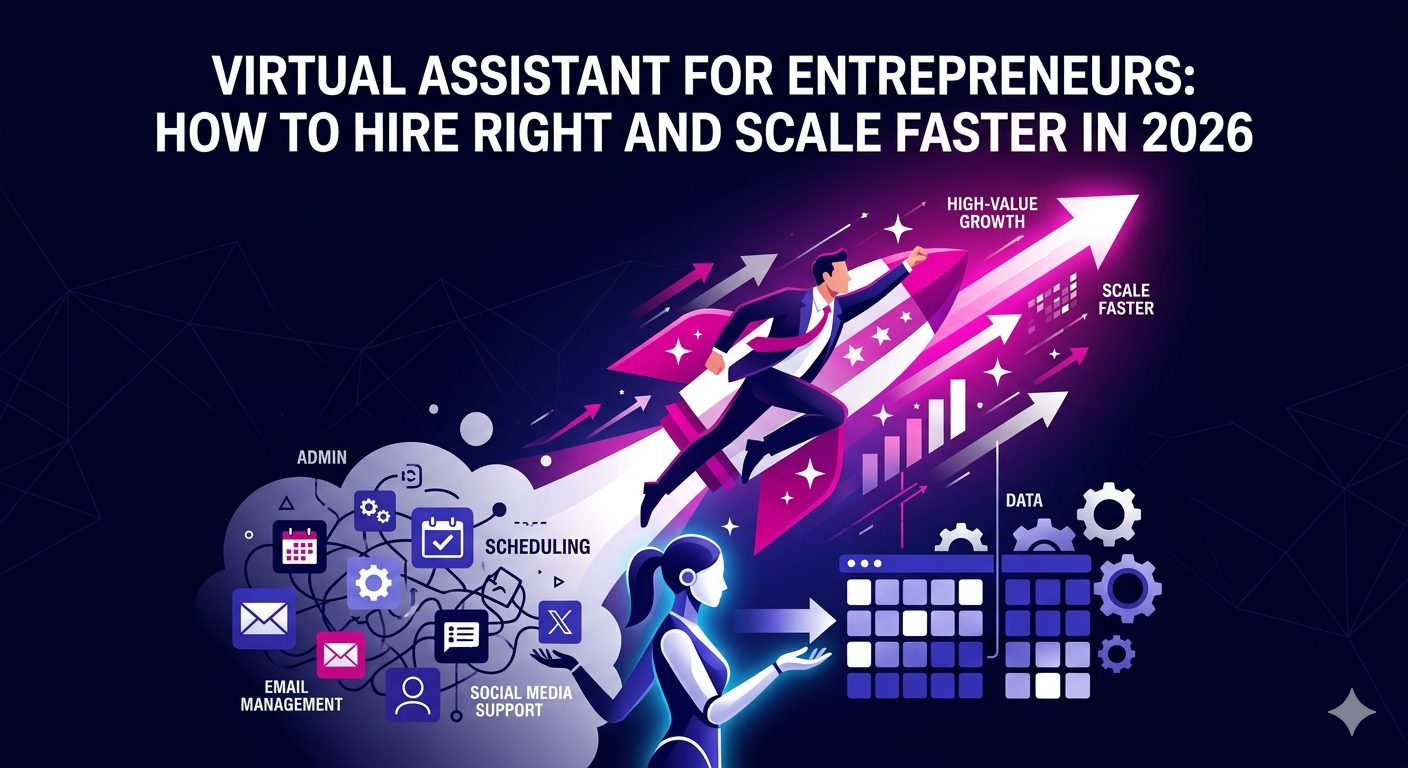
Every entrepreneur reaches a breaking point where the business cannot grow because they cannot clone themselves. That is exactly where a virtual assistant for entrepreneurs becomes one of the most powerful tools available in 2026. Whether you are building a startup, running an e-commerce brand, or leading a service-based business, delegating the right tasks to a skilled remote professional gives you back the hours you need to focus on strategy, sales, and growth.
This guide covers everything you need to know: which tasks to hand off first, what skills to prioritize, how to find the right VA, and how to set your new hire up for immediate success.
Why Entrepreneurs Need a Virtual Assistant in 2026
The pace of business has accelerated significantly. In 2026, solo founders and small business owners are expected to manage marketing, operations, customer relationships, admin, and finances simultaneously. Doing all of this alone is not sustainable, and it is not smart.
A virtual assistant for entrepreneurs is not a luxury. It is a practical solution to the most common bottleneck in business growth: the founder’s time. When you offload repetitive and administrative tasks to a capable VA, you free yourself to do the high-value work that actually moves the needle.
The Entrepreneur’s Time Problem
- The average entrepreneur spends 16 hours per week on administrative tasks that could be delegated
- Reactive work such as email management and scheduling consumes up to 28 percent of the average workday
- Founders who delegate effectively grow their businesses three times faster on average than those who try to manage everything alone
- Burnout from overwork is among the top reasons early-stage businesses stall or fail
Hiring a virtual assistant for entrepreneurs is one of the most direct interventions available to solve this problem without the cost or commitment of a full-time in-office hire.
What Tasks Should Entrepreneurs Delegate to a Virtual Assistant?
One of the most common mistakes first-time delegators make is keeping too much. The goal is to hand off anything that does not require your specific expertise, relationships, or decision-making authority. Here are the categories where a VA creates the most immediate impact for entrepreneurs.
Administrative and Scheduling Tasks
- Calendar management and appointment scheduling
- Email inbox organization, filtering, and drafting responses
- Travel coordination and itinerary preparation
- Data entry, file organization, and document formatting
- Meeting preparation, minutes, and follow-up action items
Research and Reporting
- Competitor and market research
- Lead list building and prospect research
- Industry news monitoring and summary reports
- Vendor and supplier comparisons
- Content research and topic ideation
Marketing and Social Media Support
- Scheduling and publishing social media posts
- Responding to comments and direct messages
- Basic graphic creation using tools like Canva
- Email newsletter preparation and list management
- Blog post formatting and uploading to CMS platforms
Customer Support and Relationship Management
- Handling routine customer inquiries and support tickets
- Onboarding new clients with templated communications
- Following up with leads and scheduling sales calls
- Managing CRM records and updating contact information
The right virtual assistant for your business from TheRemoteReps can handle one or several of these categories, depending on your current priorities and the size of your operation.
Key Skills to Look for in a Virtual Assistant for Entrepreneurs
Not every VA is a good fit for entrepreneurial environments. Startups and small businesses move fast, shift direction frequently, and need remote team members who can adapt without hand-holding. Here are the skills that matter most.
Communication and Professionalism
A virtual assistant for entrepreneurs must communicate clearly and proactively. Because most interactions happen asynchronously via email, Slack, or project management tools, written communication quality is non-negotiable. Look for candidates who write with clarity, flag potential problems early, and keep you informed without requiring you to chase updates.
Tech Savviness and Tool Proficiency
In 2026, a strong VA should be comfortable across a range of tools including Google Workspace, Microsoft 365, Zoom, Slack, Trello or Asana, and basic CRM platforms. Depending on your business, you may also need proficiency in e-commerce platforms, email marketing tools, or social media schedulers. Always confirm which tools a candidate has hands-on experience with before hiring.
Proactive Problem-Solving
The best virtual assistants do not just complete tasks. They anticipate what comes next and flag issues before they become problems. For an entrepreneur, this proactive mindset is invaluable because it means your VA extends your capacity rather than simply executing a to-do list.
Reliability and Self-Management
Without a physical office structure, a virtual assistant for entrepreneurs must be self-directed. They need to manage their own time, meet deadlines consistently, and communicate promptly about any obstacles. Assess this quality during the hiring process by asking candidates to walk you through how they manage competing priorities on a given workday.
How to Hire a Virtual Assistant as an Entrepreneur
The hiring process matters as much as the candidate you ultimately choose. A structured approach saves time and dramatically increases the chances of a successful long-term working relationship.
Step 1: Define Your Needs Before You Search
Write down every task you want to delegate and estimate how many hours per week each one takes. This gives you a realistic picture of how many hours of VA support you actually need, whether that is 10 hours per week or a full-time 40-hour engagement. It also helps you identify whether you need a generalist or a specialist.
Step 2: Choose the Right Hiring Channel
Generic freelance marketplaces flood you with unvetted applications and require extensive screening. A specialized remote staffing platform matches you with candidates who have already been assessed for communication skills, reliability, and relevant experience. For entrepreneurs who value their time, this is almost always the smarter route.
Step 3: Conduct a Skills-Based Evaluation
Rather than relying solely on interviews, give shortlisted candidates a small paid test task that reflects actual work they would do in the role. This reveals far more about their capabilities and work style than any answer to a hypothetical interview question.
Step 4: Set Clear Expectations from Day One
Document your processes, preferred communication channels, working hours, and performance expectations before your VA starts. A well-prepared onboarding process reduces the ramp-up period significantly and sets the tone for a productive working relationship.
Step 5: Review and Adjust Regularly
Schedule a brief weekly check-in for the first 60 days. Use this time to give feedback, answer questions, and identify any tasks that need clearer documentation or additional training. Regular early feedback prevents small issues from becoming costly problems later.
How Much Does a Virtual Assistant Cost for Entrepreneurs in 2026?
Cost is one of the most frequently asked questions among entrepreneurs considering their first VA hire. The range is wide because it depends on the type of work, the VA’s location and experience level, and whether you are hiring directly or through a staffing company.
- General administrative VAs: $8 to $20 per hour for remote professionals based in Southeast Asia, Latin America, or Eastern Europe
- Specialist VAs (e-commerce, legal, marketing): $20 to $35 per hour depending on the function and seniority
- Full-time dedicated VAs: $1,200 to $3,500 per month for a full-time remote professional through a staffing platform
- Part-time arrangements: 10 to 20 hours per week at hourly rates, ideal for entrepreneurs still building their delegation muscle
Compared to hiring a local in-office assistant, a virtual assistant for entrepreneurs can deliver the same or greater productivity at a fraction of the total cost when you factor in salary, benefits, equipment, and office overhead.
According to findings from Small Biz Genius research on entrepreneur productivity and delegation, entrepreneurs who delegate administrative work consistently report higher revenue growth and fewer hours worked per week, confirming that the ROI on a virtual assistant is measurable and meaningful.
Conclusion: Free Your Time and Grow Your Business
The single most valuable resource you have as an entrepreneur is your time and attention. A skilled virtual assistant for entrepreneurs gives you more of both by handling the tasks that keep your business running while you focus on the ones that make it grow.
In 2026, remote talent is more accessible, better trained, and more affordable than ever. There has never been a better moment to make the hire that changes how you work. Start by identifying the tasks that are slowing you down, then find a pre-vetted VA who is ready to take them off your plate from day one.
Frequently Asked Questions: Virtual Assistant for Entrepreneurs
What does a virtual assistant for entrepreneurs actually do?
A virtual assistant for entrepreneurs handles a wide range of tasks that free up the founder’s time and mental bandwidth. Common responsibilities include calendar management, email handling, research, social media scheduling, customer support, CRM updates, travel coordination, and document preparation. The specific scope depends on your business type and what you need to delegate most urgently.
How many hours per week does an entrepreneur typically need a virtual assistant?
Most entrepreneurs start with 10 to 20 hours per week and expand from there as they build trust and identify more tasks to delegate. If your business is growing quickly or you are managing multiple projects simultaneously, a full-time virtual assistant for entrepreneurs at 40 hours per week may be the right fit from the start. Begin by documenting the tasks you want to delegate and estimating the time each one takes weekly.
Is a virtual assistant for entrepreneurs different from a regular VA?
In practical terms, the skills overlap significantly, but a virtual assistant working with entrepreneurs needs a higher degree of adaptability, proactivity, and comfort with ambiguity. Entrepreneurial environments change fast, priorities shift, and processes are often still being built. The best VAs for entrepreneurs are self-starters who can operate with minimal direction and help build systems rather than just follow existing ones.
What is the best way for an entrepreneur to find a reliable virtual assistant?
The most efficient path for a virtual assistant for entrepreneurs is to use a specialized remote staffing platform that pre-screens candidates for communication quality, reliability, and relevant skills. Generic freelance platforms can work but require extensive vetting on your end. A dedicated staffing company handles that process for you and typically offers replacement guarantees if a placement does not work out, protecting your time and investment.
How long does it take to see results after hiring a virtual assistant as an entrepreneur?
Most entrepreneurs begin to feel a meaningful reduction in their workload within the first two to three weeks after hiring a virtual assistant. The first week typically involves onboarding and familiarizing the VA with your tools and processes. By weeks two and three, a capable VA is handling delegated tasks independently. By the end of the first month, many entrepreneurs report saving 10 or more hours per week that they reinvest into high-value activities.
Can a virtual assistant for entrepreneurs also support business growth tasks?
Yes. Beyond administrative support, a virtual assistant for entrepreneurs can contribute directly to business growth by handling lead research, outreach follow-ups, content scheduling, customer onboarding, and basic marketing tasks. As trust builds over time, many entrepreneurs expand their VA’s responsibilities to include higher-level work such as reporting, light project management, and vendor coordination, making the role increasingly strategic.