
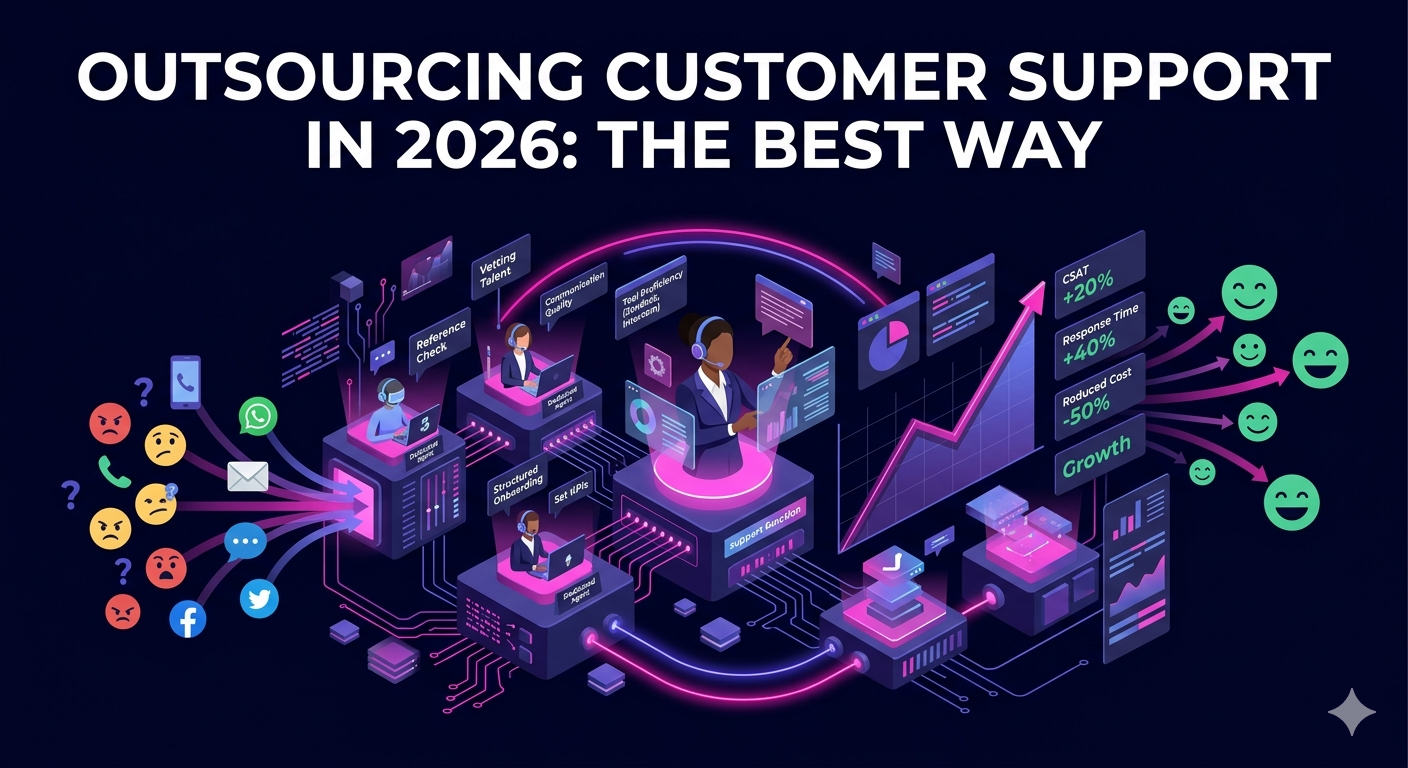
Customer experience is one of the most important competitive advantages a business can have in 2026, and finding the best way to outsource customer support has become a top priority for companies of every size. Whether you are a lean startup trying to scale without adding full-time headcount, or an established brand managing a growing volume of inquiries, outsourcing your customer support function can unlock faster response times, lower overhead costs, and consistently higher customer satisfaction scores.
But outsourcing customer support poorly can damage your brand reputation and frustrate the very customers you are trying to retain. This guide gives you a clear, practical roadmap to do it right.
Why Outsourcing Customer Support Is a Smart Business Move
The traditional model of building an in-house customer support team is expensive and time-consuming. Recruiting, training, managing, and retaining support staff demands significant resources. In contrast, outsourcing your customer support function to skilled remote professionals gives you access to experienced talent at a fraction of the cost while maintaining the quality your customers expect.
Here is what businesses consistently report after making the switch:
- Reduced cost per ticket by 40 to 60 percent compared to in-house teams
- Faster average response times across email, chat, and phone channels
- Greater flexibility to scale support capacity up or down as demand changes
- Improved customer satisfaction scores driven by dedicated, focused support professionals
- More time for internal teams to focus on core business functions and growth
The Best Way to Outsource Customer Support: A Step-by-Step Approach
There is no single template that works for every business, but the most successful outsourcing arrangements share a common set of practices. Follow these steps to build a customer support outsourcing strategy that delivers real results.
Step 1: Define Your Support Scope and Channels
Before you hire anyone, document exactly what your outsourced support team will handle. Consider the following questions:
- What channels do your customers use most: email, live chat, phone, or social media?
- What types of issues or inquiries make up the majority of your support volume?
- Are there sensitive topics, such as billing disputes or returns, that require special handling?
- What is your expected response time standard for each channel?
- Do you need 24/7 coverage, business-hours-only support, or something in between?
Answering these questions upfront allows you to write a precise job description, set realistic expectations with your outsourcing partner, and measure performance objectively once the engagement begins.
Step 2: Choose the Right Outsourcing Model
There are three main outsourcing models available to businesses in 2026, each with distinct trade-offs:
Dedicated Remote Support Professionals
This is widely considered the best way to outsource customer support for growing businesses. You hire one or more dedicated remote support professionals who work exclusively for your company on a part-time or full-time basis. They learn your brand, your products, and your customers deeply, delivering a level of consistency and quality that generalist call centers cannot match.
Working with a specialized remote staffing platform is the most efficient way to access this model. For businesses that want to outsource customer support to a vetted, experienced professional, the remote customer support experts at The Remote Reps are matched to your specific industry and support requirements, ensuring fast onboarding and reliable performance.
Shared Service or BPO Model
Business process outsourcing (BPO) firms provide shared support agents who handle multiple clients at once. This model can be cost-effective for very high-volume, transactional support needs, but it often results in lower brand alignment and less personalized customer interactions. It works best for businesses with standardized, script-driven support scenarios.
Hybrid Model
Many businesses in 2026 use a hybrid approach: a small dedicated in-house team handles complex, high-stakes interactions while outsourced remote professionals manage routine inquiries at scale. This model gives you the best of both worlds and is particularly effective for e-commerce, SaaS, and subscription businesses.
What to Look for When Outsourcing Customer Support
Selecting the right partner or professional is the single most important factor in a successful outsourcing arrangement. Here are the core qualities to prioritize:
Proven Communication Skills
Customer support is fundamentally a communication function. Your outsourced support professionals must write clearly, respond empathetically, and resolve issues efficiently. Evaluate written and verbal communication through real test scenarios during the hiring process, not just through an interview conversation.
Relevant Industry Experience
A support professional who has handled inquiries for software companies will ramp up far faster at a SaaS business than someone with only retail support experience. Industry familiarity reduces training time and leads to more accurate, confident responses for your customers.
Familiarity with Your Support Tools
In 2026, most support teams operate within platforms like Zendesk, Freshdesk, Intercom, HubSpot Service Hub, or Gorgias. Prioritize candidates who are already proficient in the tools your team uses. The learning curve for a new platform can delay productivity by weeks.
Strong Reference History
Always request references from previous clients or employers. Ask specifically about reliability, quality of responses, ability to handle difficult customers, and adherence to response time standards. A single reference call can prevent a hire that damages your customer relationships.
How to Set Your Outsourced Support Team Up for Success
Even the best outsourced customer support professionals will underperform without the right foundation. The businesses that get the most out of outsourced support do these things well:
- Create a detailed knowledge base: Document your products, policies, common questions, and escalation procedures in a format your remote team can reference instantly.
- Set clear KPIs from day one: Define targets for first response time, resolution time, customer satisfaction (CSAT) scores, and ticket closure rates.
- Establish a communication rhythm: Weekly check-ins and shared reporting dashboards keep outsourced teams aligned with your standards and business changes.
- Build an escalation path: Define exactly which issues the outsourced team should escalate, to whom, and within what time frame.
- Invest in onboarding: The first two to four weeks should include thorough product training, tone-of-voice guidance, and shadowing of existing support interactions.
Common Mistakes to Avoid When You Outsource Customer Support
Knowing what not to do is just as important as following best practices. These are the most frequent errors businesses make when outsourcing customer support for the first time:
- Choosing the cheapest option without evaluating communication quality or reliability
- Failing to provide adequate onboarding resources, which leads to inconsistent customer experiences
- Not setting measurable KPIs, making it impossible to evaluate performance objectively
- Outsourcing too many channels at once before the basic email or chat workflow is running smoothly
- Skipping reference checks due to time pressure during the hiring process
The Real Cost Advantage of Outsourced Customer Support in 2026
When businesses calculate the true cost of an in-house support hire, they typically include base salary, payroll taxes, benefits, equipment, office space, and management overhead. In 2026, this often totals between $55,000 and $80,000 annually for a single full-time support representative in North America or Western Europe.
A skilled dedicated remote support professional, sourced through a specialized staffing partner, typically costs between $18,000 and $35,000 per year depending on experience level and region. For businesses that need multiple agents or extended coverage hours, the savings compound quickly.
Beyond cost, the flexibility to scale your support team up during peak periods and reduce hours during slower seasons gives outsourcing a structural advantage that in-house hiring simply cannot match.
If your business also needs support across other functions, The Remote Reps offers a full range of remote professionals including virtual assistants for administrative support and lead generation experts to complement your customer-facing team.
For additional guidance on outsourcing best practices and building effective remote support teams, the Harvard Business Review’s outsourcing resource library offers in-depth research on how to outsource customer support and other business functions effectively.
Frequently Asked Questions About the Best Way to Outsource Customer Support
What is the best way to outsource customer support for a small business?
The best way to outsource customer support for a small business is to hire one or two dedicated remote support professionals through a specialized staffing agency. This gives you brand-aligned, consistent support without the overhead of a full in-house team. Start with email and chat support, establish a knowledge base, and set clear KPIs before expanding to additional channels.
How much does it cost to outsource customer support in 2026?
The cost to outsource customer support in 2026 varies by model and experience level. Dedicated remote support professionals typically cost between $18,000 and $35,000 per year, while BPO shared service models may charge on a per-ticket or per-hour basis. Working with a specialized staffing agency usually delivers the best cost-to-quality ratio for businesses that need reliable, brand-aligned support.
What channels should be included when I outsource customer support?
When deciding which channels to include when you outsource customer support, start with your highest-volume channel, typically email or live chat. Once that workflow is running smoothly with consistent quality, expand to phone, social media, or messaging apps. Trying to outsource all channels at once before establishing a solid foundation often leads to inconsistent customer experiences.
How do I maintain quality when I outsource customer support?
The best way to maintain quality when you outsource customer support is to build a thorough knowledge base, set measurable KPIs, conduct regular performance reviews, and invest in structured onboarding. Weekly check-ins, shared dashboards, and clear escalation protocols keep your outsourced team aligned with your brand standards and customer expectations over time.
Is it risky to outsource customer support to a remote professional?
The risk of outsourcing customer support to a remote professional is manageable when you use a reputable staffing agency that pre-screens candidates, verifies references, and matches talent to your specific needs. Risks such as inconsistent quality or poor communication can be mitigated through structured onboarding, clear performance expectations, and regular feedback cycles from day one.
What is the difference between a BPO and a dedicated remote support professional?
A BPO (business process outsourcing) firm provides shared agents who handle multiple clients simultaneously, which tends to result in lower brand alignment and more scripted interactions. A dedicated remote support professional works exclusively for your business, learns your products and culture deeply, and delivers a higher-quality, more personalized customer experience. For most growing businesses, a dedicated model is the best way to outsource customer support.
Start Outsourcing Your Customer Support the Right Way
The businesses winning on customer experience in 2026 are not necessarily the ones with the largest support teams. They are the ones that have found the best way to outsource customer support strategically, using dedicated remote professionals who are aligned with their brand, trained on their products, and held to clear performance standards.
If you are ready to reduce costs, improve response times, and give your customers a better experience, the path forward starts with finding the right outsourcing partner. Take the time to define your needs, use a trusted sourcing channel, and invest in proper onboarding. The returns will compound for years.