Pipeline is the lifeblood of every SaaS company. Without a consistent flow of qualified opportunities entering the top of the funnel, even the best product in its category will struggle to grow. The challenge most SaaS teams face is that building and maintaining that pipeline in-house is expensive, slow, and operationally complex. That is exactly why the model of hiring a remote SDR for a SaaS company has become one of the most adopted growth strategies in 2026.
A remote sales development representative handles outbound prospecting, lead qualification, and meeting booking so your account executives can focus on what they do best: closing deals. This guide covers everything you need to know to find, hire, and get results from a remote SDR built for the SaaS sales environment.
What Does a Remote SDR for a SaaS Company Actually Do?
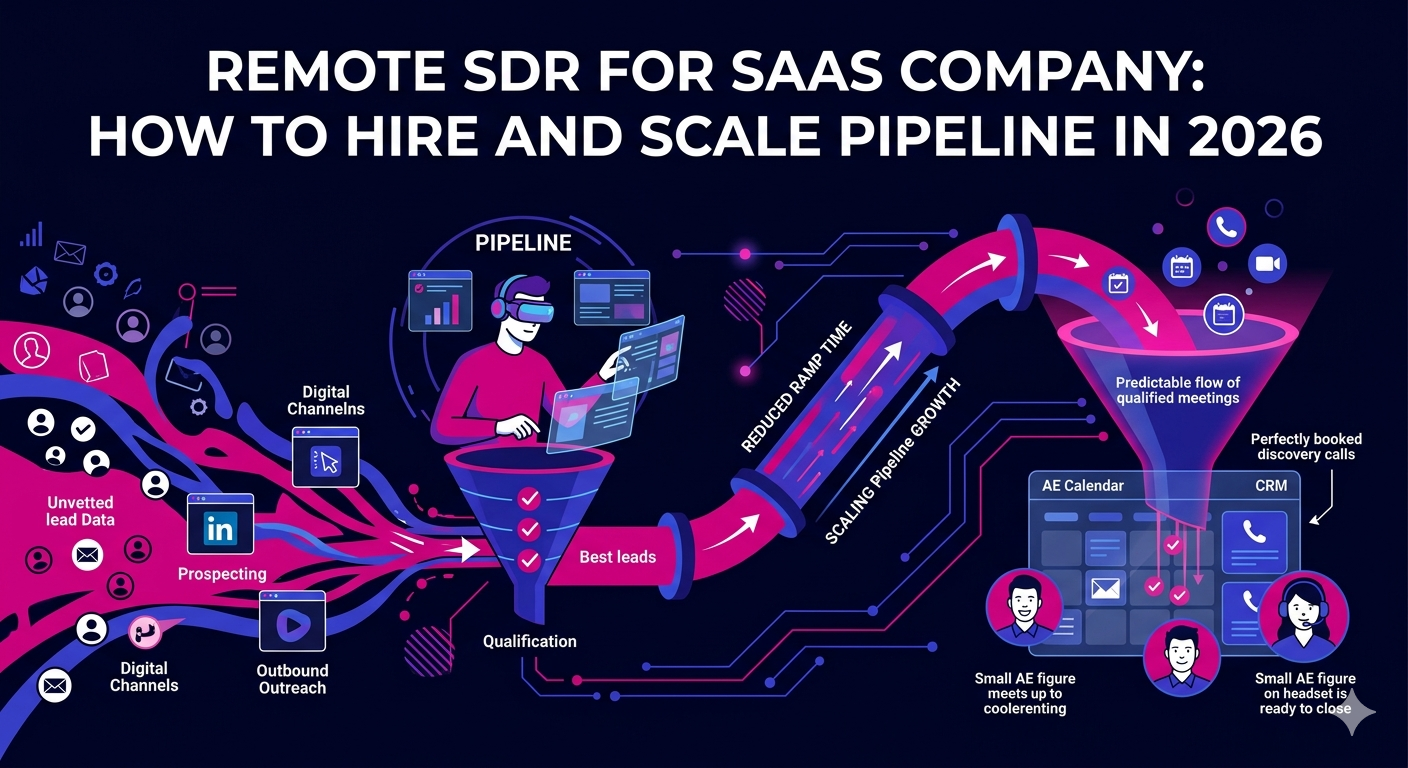
A sales development representative is responsible for the earliest stages of the sales process. Unlike an account executive who closes deals, an SDR generates and qualifies opportunities before handing them off to senior sales staff. In a remote context, this entire function is executed through digital channels and asynchronous communication tools.
Day-to-day responsibilities of a remote SDR for a SaaS company typically include:
- Researching and building targeted prospect lists based on your ideal customer profile
- Executing outbound outreach via cold email, LinkedIn, and phone
- Qualifying inbound leads who respond to marketing campaigns
- Booking discovery calls or product demos for account executives
- Logging all activity and prospect data in your CRM
- Following up with prospects across multiple touchpoints in a structured sequence
- Collaborating with marketing on messaging alignment and campaign feedback
The output is a predictable, measurable flow of qualified meetings that feeds directly into your revenue pipeline. When a remote SDR is performing well, the entire go-to-market engine runs more efficiently.
Why SaaS Companies Are Prioritizing Remote SDRs in 2026
The economics of SaaS sales have shifted considerably. Customer acquisition costs continue to rise, buying cycles have lengthened, and buyers are more resistant to generic outreach than ever before. In this environment, specialized, high-volume outbound prospecting is more important than ever, and the remote SDR model delivers that specialization without the overhead of a full in-house sales team.
Significant Cost Savings Over In-House Hiring
Hiring a full-time, office-based SDR in a major metro market can easily cost $70,000 to $90,000 per year in salary alone, before you factor in benefits, payroll taxes, equipment, office space, and management overhead. A remote SDR for a SaaS company accessed through a specialized staffing platform delivers equivalent output at a fraction of that total cost. For early-stage SaaS companies managing burn rate carefully, that difference is the difference between a sustainable growth model and an unsustainable one.
Faster Time to Pipeline
Recruiting, hiring, onboarding, and ramping an in-house SDR typically takes three to five months before they are producing at full capacity. Remote SDRs sourced through vetted staffing platforms arrive pre-screened for SaaS sales experience and can be operational in a matter of weeks. That acceleration in time to pipeline has a direct and measurable impact on revenue timelines.
Flexibility to Scale With Your Growth Stage
SaaS companies do not grow linearly. You may need two SDRs this quarter and five the next if a product launch or campaign drives a surge in demand. Remote staffing models let you scale SDR capacity up or down in line with your actual pipeline requirements, without the HR complexity of layoffs or the delay of lengthy hiring cycles.
Access to Specialists in SaaS Outbound
Not all SDRs are built the same. SaaS outbound requires specific skills: understanding software buying cycles, speaking fluently about ROI and integration, and navigating multi-stakeholder buying committees. Remote hiring opens your talent pool globally, making it far easier to find SDRs with genuine, proven experience in SaaS sales environments.
Core Skills to Look for in a Remote SDR for a SaaS Company
Identifying the right remote SDR candidate requires evaluating a specific set of skills beyond generic sales ability. Here is what separates a high-performing SaaS-focused remote SDR from an average one.
Cold Outreach Proficiency
Effective cold outreach in 2026 requires more than a template and a contact list. Look for candidates who understand personalization at scale, multi-channel sequencing, and how to craft messaging that speaks directly to a prospect’s specific pain points. Ask for sample email sequences or outreach frameworks they have used previously.
CRM Discipline and Data Hygiene
A remote SDR who does not log their activity accurately creates blind spots in your pipeline visibility. Proficiency with CRMs like Salesforce, HubSpot, or Pipedrive, combined with disciplined data entry habits, is non-negotiable for any remote SDR role at a SaaS company.
SaaS Product Literacy
Your remote SDR does not need to be a technical expert, but they must be able to understand and articulate your product’s value proposition clearly. Candidates who have sold SaaS products before, particularly in adjacent categories, ramp faster and produce better qualified meetings because they understand what buyers actually care about.
Self-Management and Accountability
In a remote environment, there is no manager walking the floor to check whether the SDR is hitting their daily call or email targets. The best remote SDRs are internally motivated, track their own metrics obsessively, and flag blockers proactively rather than waiting for their manager to notice underperformance.
Objection Handling and Active Listening
SaaS buyers are sophisticated. A remote SDR who can handle common objections confidently and listen well enough to adapt their pitch in real time will book significantly more meetings than one who relies on a rigid script.
How to Set Up a Remote SDR for Success at Your SaaS Company
The right hire placed in a poorly structured environment will still underperform. Here is how to set your remote SDR up to deliver from their first month.
Define Your Ideal Customer Profile Clearly
Before your remote SDR sends a single outreach message, they need to know exactly who they are targeting. Document your ideal customer profile in detail: company size, industry verticals, job titles, technology stack, common pain points, and disqualifying factors. The more specific this document is, the more accurate and efficient your SDR’s prospecting will be.
Build or Provide a Sequencing Framework
Do not ask your remote SDR to build outreach sequences from scratch unless they have proven experience doing so. Provide a tested framework of touchpoints across email, LinkedIn, and phone, then give them the latitude to personalize within that structure. This balances consistency with the personalization that modern SaaS buyers expect.
Establish Daily Activity Benchmarks
Set clear daily expectations for outreach volume: number of new prospects added to sequences, emails sent, LinkedIn connection requests, and calls attempted. These activity metrics are leading indicators of pipeline output and give you early warning if something is off before it shows up in the booked meetings count.
Schedule Regular Coaching Calls
Remote SDRs improve fastest when they receive structured, regular feedback on their outreach messaging and call recordings. Build a weekly or bi-weekly coaching call into your process from day one. This investment in their development directly accelerates the time it takes them to reach full productivity.
Where to Find a Vetted Remote SDR for Your SaaS Company
Generic job boards generate volume but rarely deliver quality SDR candidates who are genuinely ready to produce in a remote SaaS environment. Specialized remote staffing platforms that pre-vet candidates for sales development competency and SaaS industry familiarity deliver a far better return on your hiring investment.
Research from Sales Benchmark Index on remote SDR performance for SaaS teams consistently shows that structured hiring processes focused on role-specific competencies reduce SDR ramp time by up to 35 percent and significantly improve first-quarter pipeline output.
The Remote Reps places vetted remote SDRs with SaaS companies at every stage, from seed-stage startups building their first outbound motion to growth-stage companies scaling a team of ten or more. Every candidate is screened for outbound sales skills, CRM proficiency, and remote work discipline before you ever speak to them. Explore our remote SDR placement services for SaaS companies and start building your pipeline today.
Frequently Asked Questions About Hiring a Remote SDR for a SaaS Company
What is the typical ramp time for a remote SDR for a SaaS company?
A remote SDR for a SaaS company with prior outbound experience typically reaches full productivity within four to eight weeks when onboarded with a clear ICP, proven sequences, and regular coaching. SDRs without prior SaaS experience may take ten to twelve weeks to ramp fully. Choosing a candidate with relevant SaaS outbound experience is the single most reliable way to accelerate time to pipeline.
How many meetings per month should a remote SDR for a SaaS company book?
A fully ramped remote SDR for a SaaS company typically books between twelve and twenty-five qualified meetings per month, depending on the target market, average deal size, and quality of the outreach infrastructure they are working within. Enterprise-focused SDRs targeting senior buyers typically book fewer meetings at higher qualification levels, while SMB-focused SDRs can achieve higher volume with faster cycles.
What tools does a remote SDR for a SaaS company need to be effective?
A remote SDR for a SaaS company needs access to a CRM such as HubSpot or Salesforce, a sales engagement platform such as Outreach or Apollo for sequencing, a LinkedIn Sales Navigator subscription for prospecting, a reliable video conferencing tool, and a data enrichment source for contact information. Some SDRs also use AI-assisted writing tools to improve personalization at scale.
Should a remote SDR for a SaaS company focus on inbound or outbound leads?
Most remote SDRs for SaaS companies handle a blend of both, but the exact ratio depends on your go-to-market model. Companies with strong inbound demand generation often have SDRs spend 60 to 70 percent of their time qualifying and following up on inbound leads, with the remainder dedicated to outbound prospecting. Companies with limited inbound volume rely more heavily on outbound, requiring a candidate with stronger cold outreach skills.
How do I measure the ROI of a remote SDR for a SaaS company?
Measuring the ROI of a remote SDR for a SaaS company requires tracking a clear set of leading and lagging indicators. Leading indicators include daily activity volume, email open and reply rates, and LinkedIn connection acceptance rates. Lagging indicators include meetings booked per month, show rate on booked meetings, pipeline value generated, and closed-won revenue attributed to SDR-sourced opportunities. The most direct ROI calculation compares the cost of the SDR against the pipeline value and closed revenue they generate over a rolling 90-day period.
Can a remote SDR for a SaaS company work across multiple time zones?
Yes. One of the strategic advantages of hiring a remote SDR for a SaaS company is the ability to match their working hours to your primary target market. If your best prospects are on the US East Coast, a remote SDR based in a compatible time zone can hit inboxes and phones during peak response windows. Many SaaS companies with global ambitions hire multiple remote SDRs in different regions to maximize coverage and response rates across markets.