The way businesses build their sales teams has fundamentally changed. In 2026, hiring a remote sales development rep is not a compromise or a workaround. It is the preferred model for growth-focused companies that want to prospect smarter, move faster, and scale without the overhead of a traditional in-office sales floor. Whether you are building your first outbound function or expanding an existing one, understanding how to find, hire, and manage a high-performing remote sales development rep is one of the most valuable things you can do for your revenue engine right now.
This guide covers everything you need to know: what a remote SDR does, why the remote model outperforms traditional hiring in most situations, what to look for in a candidate, and how to set your remote sales development rep up for long-term success.
What Does a Remote Sales Development Rep Do?
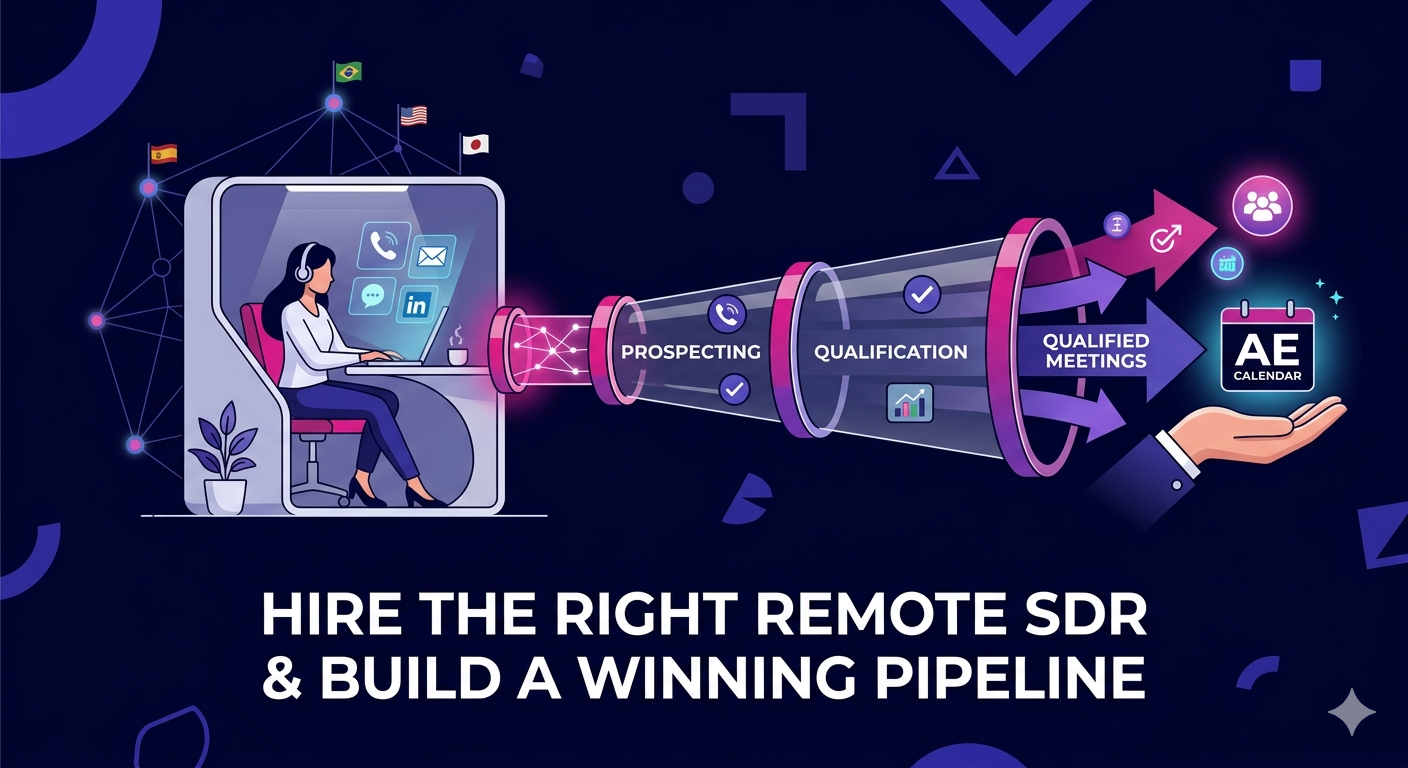
A sales development representative is responsible for the top of the sales funnel. Their core job is to identify potential customers, reach out through multiple channels, qualify their interest and fit, and book discovery calls or demos for your account executives or closing team. When that role is performed remotely, the rep operates from their own location using digital communication tools, CRM software, and outreach platforms.
The remote model does not change the substance of the role. It changes how it is delivered. A skilled remote sales development rep brings the same prospecting firepower as an in-office SDR, often more, because they are not distracted by office politics, commute fatigue, or non-essential meetings.
Core Responsibilities of a Remote Sales Development Rep
- Building and maintaining targeted prospect lists aligned with your ideal customer profile (ICP)
- Executing personalized outreach across cold email, phone, and LinkedIn
- Qualifying inbound leads against your defined criteria
- Handling initial objections with confidence and product knowledge
- Booking qualified discovery calls or product demos directly into AE calendars
- Logging all outreach activity and outcomes in your CRM in real time
- Collaborating with marketing to align outbound messaging with campaign themes
- Reporting weekly on key metrics: dials, emails, reply rates, and meetings booked
- Continuously testing and iterating on messaging based on response data
Why Hiring a Remote Sales Development Rep Makes Sense in 2026
The traditional model of building an in-house SDR team in a central office is losing ground for good reason. Here is why the shift toward remote sales development reps has accelerated in 2026 and shows no signs of reversing.
Access to a Global Talent Pool
When you limit SDR hiring to candidates within commuting distance of your office, you drastically shrink your talent pool. Hiring a remote sales development rep opens up access to skilled professionals across Latin America, Eastern Europe, Southeast Asia, and beyond. These candidates are often highly educated, fluent in English, experienced with Western business culture, and motivated by the opportunity to work with globally competitive companies.
Substantially Lower Cost Per Rep
The fully loaded cost of an in-house SDR in the United States in 2026 typically ranges from $75,000 to $110,000 per year when you factor in base salary, commission, benefits, payroll taxes, equipment, office space, and management overhead. A remote sales development rep hired through a specialized offshore staffing partner can deliver comparable or superior results at 40 to 65 percent of that cost. For companies running lean teams, that difference is transformative.
Faster Time to Productivity
A well-vetted remote sales development rep sourced through a quality staffing partner arrives pre-screened, sales-trained, and ready to onboard. Compare that to the 60 to 90 day ramp time typical of a new in-house SDR hire and the productivity advantage becomes clear almost immediately.
Built-In Flexibility and Scalability
Business needs change. A remote SDR model gives you the flexibility to scale your team up when pipeline demand increases and right-size it when business conditions shift, without the legal, HR, and financial complexity of restructuring a permanent in-house workforce.
Focused Execution Without Office Distractions
Remote sales development reps who are placed and supported well tend to maintain exceptionally high outreach volume because their entire work environment is structured around output. There are no impromptu meetings, no long commutes draining energy, and no office dynamics pulling attention away from prospecting.
What to Look for When Hiring a Remote Sales Development Rep
Hiring the right remote sales development rep requires evaluating both the hard skills that drive outbound performance and the soft skills that make remote collaboration work. Here is what to prioritize during your evaluation process.
Outbound Sales Skills and Experience
- Demonstrated experience with cold calling, cold email, and LinkedIn outreach
- Familiarity with CRM platforms such as Salesforce, HubSpot, or Pipedrive
- Experience using outreach sequencing tools such as Apollo, Outreach, or Salesloft
- Understanding of sales qualification frameworks such as BANT, MEDDIC, or SPIN
- Ability to research prospects and personalize outreach at scale
- Track record of meeting or exceeding booking targets in previous roles
Remote Work Competencies
- Strong written and verbal communication skills in English
- Proven ability to manage their own schedule and maintain output without micromanagement
- Reliable internet connection and a professional remote work setup
- Experience using collaboration tools such as Slack, Zoom, or Microsoft Teams
- High responsiveness and proactive communication about blockers or issues
Cultural and Brand Alignment
Your remote sales development rep will be the first voice many prospects hear from your company. They need to represent your brand accurately and professionally. During interviews, assess whether the candidate genuinely understands your product, asks intelligent questions, and communicates with the polish and confidence your prospects expect.
How to Structure Compensation for a Remote Sales Development Rep
Compensation structure matters significantly for SDR performance. A well-designed plan motivates high output while keeping costs predictable. In 2026, most remote sales development rep compensation packages include a combination of:
- Base salary or retainer: Provides income security and encourages consistent activity levels
- Activity-based bonuses: Rewards hitting weekly or monthly targets for calls, emails, or LinkedIn touches
- Meeting-booked commissions: Pays a per-meeting bonus for each qualified discovery call successfully booked
- Pipeline milestone bonuses: Rewards SDRs when deals they sourced reach defined stages in the pipeline
Avoid compensation plans that rely entirely on downstream revenue closed. Remote sales development reps control top-of-funnel activity, not closing outcomes. Rewarding what they can actually influence keeps motivation high and reduces unfair attrition.
Setting Your Remote Sales Development Rep Up for Success
Hiring the right person is only half the equation. How you onboard and manage your remote sales development rep determines whether they reach their potential quickly or take months to find their footing.
Provide a Thorough Onboarding Experience
Do not assume your remote SDR will figure things out independently. Build a structured onboarding plan that covers your product, your ICP, your messaging playbook, your objection-handling framework, and your CRM and tool setup. A well-onboarded remote sales development rep will outperform a poorly onboarded one by a significant margin within the first 30 days.
Define Clear KPIs From Day One
Establish measurable weekly and monthly targets for outreach volume, reply rates, and meetings booked. Share these targets before the rep starts so expectations are aligned from the beginning. Ambiguity around performance standards is one of the most common causes of underperformance in remote SDR roles.
Hold Regular Check-Ins and Coaching Sessions
Remote does not mean unsupported. Schedule weekly one-on-one meetings to review performance data, listen to call recordings, review email response rates, and coach on areas for improvement. The remote sales development reps who improve fastest are the ones whose managers invest in their development consistently.
Integrate Them Into Your Broader Revenue Team
Bring your remote sales development rep into relevant team meetings, Slack channels, and product updates. The more connected they feel to the broader business, the more motivated and effective they will be. Isolation is one of the biggest risks in remote work, and proactive inclusion is the antidote.
At The Remote Reps, we specialize in placing pre-vetted remote sales development reps who integrate seamlessly into your sales process and start generating pipeline from week one. You can also pair your remote SDR with a dedicated cold email expert or lead generation specialist to build a complete outbound function at a fraction of the cost of a traditional in-house team.
Complementary Roles That Amplify Your Remote SDR’s Performance
A remote sales development rep performs best when they are supported by the right surrounding infrastructure. Consider building out your remote revenue team with:
- Remote sales representatives to close the deals your SDR opens
- GTM engineers to build and optimize your outbound tech stack
- Digital marketers to run brand awareness and content campaigns that warm up cold prospects before outreach begins
- Virtual assistants to handle administrative tasks and free your SDR to focus entirely on prospecting
According to research from LinkedIn’s State of Sales Development report on remote sales development rep performance, remote SDRs who operate with clear playbooks, consistent coaching, and strong tool support consistently match or outperform their in-office counterparts on core pipeline metrics.
Conclusion: The Remote Sales Development Rep Is the Pipeline Engine Your Business Needs
In 2026, the businesses winning in their markets are not waiting for the perfect in-office SDR to walk through the door. They are hiring skilled remote sales development reps who can start building pipeline now, at lower cost, with greater flexibility, and with access to a far wider talent pool than local hiring ever allowed.
If you are ready to fill your pipeline with qualified meetings and scale your outbound function without scaling your overhead, hiring a remote sales development rep through a specialist partner is the fastest path forward.
See what our clients say about The Remote Reps, or visit theremotereps.com to start hiring your remote sales development rep today.
FAQ: Remote Sales Development Rep
What is a remote sales development rep and how do they differ from a traditional SDR?
A remote sales development rep performs the same core functions as a traditional in-office SDR: prospecting, outreach, qualification, and meeting booking. The key difference is that they work entirely from a remote location using digital tools, CRM platforms, and communication software. In 2026, the remote model is widely regarded as equally effective to in-office SDR work when the rep is properly vetted, onboarded, and supported with clear processes and regular coaching.
How much does it cost to hire a remote sales development rep in 2026?
The cost of hiring a remote sales development rep varies based on experience level and the talent market they are sourced from. Through an offshore staffing specialist, businesses typically pay between $2,000 and $5,500 per month for a dedicated remote SDR. This compares very favorably to the $75,000 to $110,000 fully loaded annual cost of an equivalent in-house SDR in the United States, making the remote model one of the highest-ROI hiring decisions available to growth-stage businesses.
How do I manage a remote sales development rep effectively?
Effective management of a remote sales development rep comes down to clarity, consistency, and communication. Set clear weekly KPIs for outreach activity and meetings booked, hold regular one-on-one video check-ins to review performance and provide coaching, use CRM reporting to track progress in real time, and create a collaborative environment through shared Slack channels and team meetings. Remote SDRs who receive consistent management support consistently outperform those left to operate without structured oversight.
What tools does a remote sales development rep need to be productive?
A well-equipped remote sales development rep needs access to a CRM platform such as Salesforce, HubSpot, or Pipedrive; an email sequencing and outreach tool such as Apollo, Outreach, or Salesloft; a business communication platform such as Slack or Microsoft Teams; LinkedIn Sales Navigator for social selling and prospect research; a video conferencing tool for internal meetings and prospect calls; and a reliable internet connection with a professional audio and video setup. Providing or subsidizing these tools from day one prevents productivity gaps during onboarding.
How quickly can a remote sales development rep start producing results?
A remote sales development rep sourced through a specialist staffing provider and given a thorough onboarding experience can typically begin booking qualified meetings within 3 to 6 weeks of starting. The first 2 to 3 weeks are usually spent learning the product, refining messaging, and setting up tooling. By week 4 onward, a well-onboarded remote SDR should be generating consistent outreach volume and delivering measurable pipeline contribution. Setting realistic expectations for this ramp period is important for both sides of the working relationship.
Can a remote sales development rep represent my brand professionally to prospects?
Yes, provided you hire through a provider with rigorous vetting standards. The best remote sales development reps are experienced in representing external brands, communicating professionally in English, handling objections confidently, and maintaining the standard of professionalism that high-quality prospects expect. During the hiring process, assess candidates through live role-play scenarios, written communication samples, and reference checks to validate that their professional presentation matches your brand standards before they ever contact a prospect on your behalf.