The way American companies find and retain talent has changed permanently. Remote hiring trends for US businesses are no longer shaped by crisis response but by deliberate strategy. In 2026, distributed teams are the norm, not the exception, and the businesses that master remote hiring are pulling ahead of the competition in speed, cost, and access to talent.
Whether you run a fast-growing startup or an established mid-market company, understanding where remote hiring is heading will help you build smarter teams and avoid costly mistakes. This guide breaks down the most important shifts happening right now and what you should do about them.
Why Remote Hiring Has Become a Long-Term Business Strategy
Remote work is no longer a perk or a pandemic-era compromise. According to research published by the Bureau of Labor Statistics in early 2026, over 38 percent of US private sector jobs now include some form of remote or hybrid work arrangement. More importantly, companies that have committed to remote hiring as a core strategy report measurable gains in talent quality, time-to-hire, and operating costs.
The conversation has shifted from “can remote work, work?” to “how do we build the best remote team possible?” That is a fundamental change in mindset, and it is driving the trends reshaping American hiring right now.
Top Remote Hiring Trends for US Businesses in 2026
1. Global Talent Pipelines Are Now Mainstream
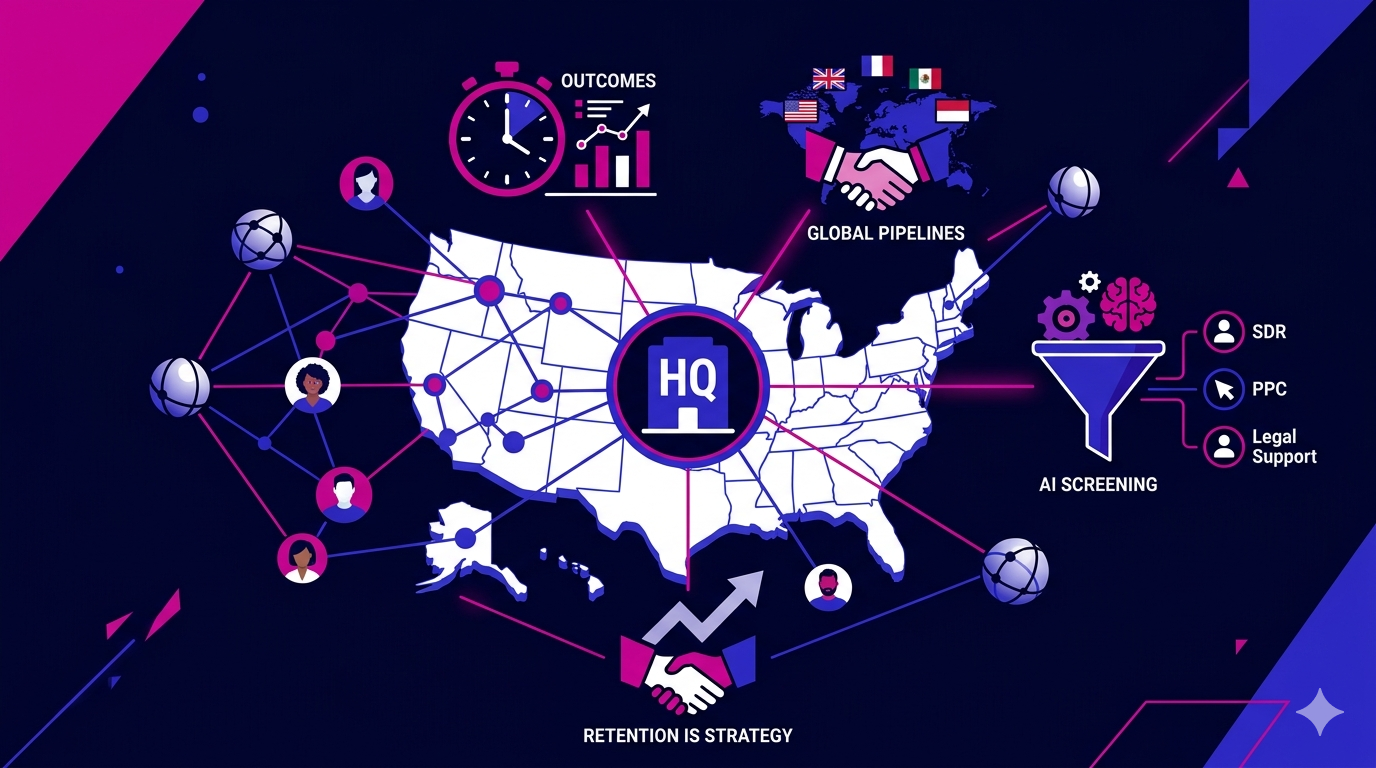
US businesses are no longer limiting their remote hiring to domestic candidates. In 2026, companies across sectors from tech to legal services to e-commerce are actively recruiting in Latin America, Eastern Europe, and Southeast Asia. This shift is driven by three forces: skills shortages in the US labor market, significant cost advantages in hiring internationally, and improved infrastructure for managing cross-border payroll and compliance.
Platforms that specialize in pre-vetted international remote talent have seen explosive growth. Businesses no longer want to spend months searching for candidates. They want ready-to-deploy professionals who understand US business culture and can contribute from day one.
2. Specialized Role Hiring Has Replaced Generic “Remote Employee” Searches
Early remote hiring was often unstructured, with companies posting generic roles and hoping for the best. That approach is gone. In 2026, businesses are hiring remotely for highly specific functions: SDRs, cold email experts, PPC specialists, social media managers, virtual assistants, and more. Each role now has its own hiring funnel, assessment criteria, and onboarding process.
This specialization is one reason why working with a focused remote staffing partner has become so valuable. Rather than posting on job boards and sifting through hundreds of unqualified applications, companies are turning to services that match them with candidates who have the exact skills and track record they need.
If your business is looking to hire in specific revenue-generating roles, exploring dedicated SDR hiring solutions can dramatically reduce time-to-hire and improve early sales pipeline performance.
3. AI-Assisted Screening Has Become Standard
Artificial intelligence now plays a significant role in the early stages of remote hiring. Resume screening, skills assessments, and even initial video interviews are increasingly handled by AI tools before a human recruiter gets involved. This has shortened hiring timelines considerably.
However, the best-performing companies are careful not to over-automate. AI is used to filter, but experienced hiring managers still make final decisions. The combination of speed through automation and judgment through human review is the winning formula in 2026.
4. Outcome-Based Hiring Is Replacing Hours-Based Thinking
One of the clearest remote hiring trends for US businesses right now is the shift away from measuring employees by hours worked toward measuring them by outcomes delivered. This is especially pronounced in remote environments where direct supervision is limited.
Companies are building detailed scorecards before they ever post a role. They define what success looks like at 30, 60, and 90 days. This outcome-first approach leads to better hiring decisions and faster performance curves for new remote hires.
5. Asynchronous Work Compatibility Has Become a Hiring Filter
Businesses hiring across time zones in 2026 are actively screening for candidates who can work independently and communicate clearly in writing. The ability to operate asynchronously, meaning work does not stop just because a manager is offline, has become a key competency.
Job postings now often include requirements like “comfortable with async-first communication tools” or “strong written communication in remote environments.” Candidates who cannot demonstrate this skill are increasingly passed over, regardless of their technical qualifications.
6. Retention Has Become as Important as Acquisition
Hiring remote talent is only half the battle. With global competition for skilled remote workers intensifying, US businesses are investing more in keeping the people they hire. Structured onboarding, clear career paths, regular virtual check-ins, and competitive compensation packages are all part of the new remote retention playbook.
Companies that treat remote hires as easily replaceable are seeing high turnover and rising costs. Those that invest in the employee experience are building loyal, high-performing distributed teams that outperform their office-only competitors.
Industries Leading the Remote Hiring Shift in 2026
While remote hiring has touched nearly every sector, some industries are ahead of the curve:
- Technology and SaaS: Remote-first by default for most roles, including sales, marketing, and support.
- Legal Services: Growing demand for remote paralegals, legal assistants, and legal secretaries handling administrative and research tasks.
- E-commerce and Retail: Remote teams now handle marketing, customer support, Amazon optimization, and fulfillment coordination.
- Digital Marketing Agencies: Almost entirely distributed, with remote specialists in SEO, PPC, social media, and media buying.
- Financial Services: Compliance, reporting, and back-office functions are increasingly handled by remote professionals.
Across all of these industries, the common thread is this: remote hiring is no longer about filling seats. It is about finding the right specialist, wherever they are, and integrating them effectively into your operation.
What US Businesses Are Getting Wrong About Remote Hiring
Even with all the progress, many companies are still making avoidable mistakes in their remote hiring processes. The most common include:
- Hiring without a clear onboarding structure, leading to confusion and early turnover.
- Underestimating the importance of time zone overlap when hiring internationally.
- Failing to define role expectations clearly before the search begins.
- Relying solely on self-reported skills without practical assessments.
- Treating remote roles as lower priority than in-office positions.
Avoiding these mistakes is what separates companies that struggle with remote hiring from those that build elite distributed teams consistently.
How to Stay Ahead of Remote Hiring Trends as a US Business
The most successful companies in 2026 are not reacting to remote hiring trends. They are anticipating them. Here is what that looks like in practice:
- Building a talent bench before you have an urgent need.
- Partnering with specialized remote staffing firms that have pre-vetted candidate pools.
- Investing in management training so your team knows how to lead remote professionals effectively.
- Regularly auditing your remote tech stack to ensure it supports collaboration and performance tracking.
- Staying current on employer of record services and international compliance to hire globally without legal risk.
For businesses ready to take a smarter approach to distributed team building, The Remote Reps provides access to pre-vetted remote professionals across sales, marketing, support, and more, helping US companies hire faster and build better teams.
The Outlook for Remote Hiring Through the Rest of 2026 and Beyond
The trajectory is clear. Remote hiring will continue to deepen and professionalize. Expect to see more sophisticated hiring funnels, more standardized global compensation frameworks, and greater investment in remote-first culture as a competitive differentiator.
Businesses that treat remote hiring as a temporary or secondary strategy will find themselves at a growing disadvantage in both talent acquisition and cost efficiency. Those that fully commit to building remote-capable organizations will have access to the best talent in the world at the right price points.
The winners in this next phase of remote hiring will not be the companies with the biggest budgets. They will be the companies with the clearest processes, the strongest employer brands in distributed talent markets, and the best partners to help them execute.
FAQ: Remote Hiring Trends for US Businesses
What are the biggest remote hiring trends for US businesses in 2026?
The top remote hiring trends for US businesses in 2026 include global talent sourcing, AI-assisted screening, outcome-based performance expectations, specialization in role-specific hiring, and a strong emphasis on retention strategies. Companies are moving beyond basic remote job postings and building structured, scalable distributed hiring systems.
How are remote hiring trends for US businesses affecting labor costs?
Remote hiring trends for US businesses are creating meaningful cost advantages. By hiring remotely, especially from international talent markets, companies can reduce base salary costs by 30 to 60 percent compared to equivalent US-based roles, while still accessing experienced, skilled professionals. Overhead costs related to office space and on-site benefits also decrease significantly.
Which roles are most commonly filled through remote hiring for US businesses?
Remote hiring trends for US businesses show the strongest growth in roles like sales development representatives, digital marketers, SEO specialists, virtual assistants, customer support professionals, cold email experts, and legal support staff. These roles are well-suited to remote work and have large talent pools available internationally.
How can US businesses find qualified remote candidates quickly?
One of the most effective ways US businesses can align with current remote hiring trends is to work with a specialized remote staffing partner that maintains pre-vetted talent pools. This reduces time-to-hire dramatically compared to traditional job board recruiting and ensures candidates meet the cultural and technical requirements of US employers.
Are remote hiring trends for US businesses different across industries?
Yes. Remote hiring trends for US businesses vary by industry. Tech and SaaS companies have been remote-first for years, while industries like legal services, e-commerce, and financial services are experiencing rapid growth in remote hiring more recently. Each industry has its own norms around compliance, communication tools, and role requirements that shape how remote hiring is structured.
What should US businesses look for when evaluating remote candidates?
Based on current remote hiring trends for US businesses, the most important qualities to assess include asynchronous communication skills, self-management and accountability, cultural alignment with US business norms, role-specific technical competence, and experience working in distributed team environments. Practical skills assessments and structured interviews are the most reliable screening methods.