
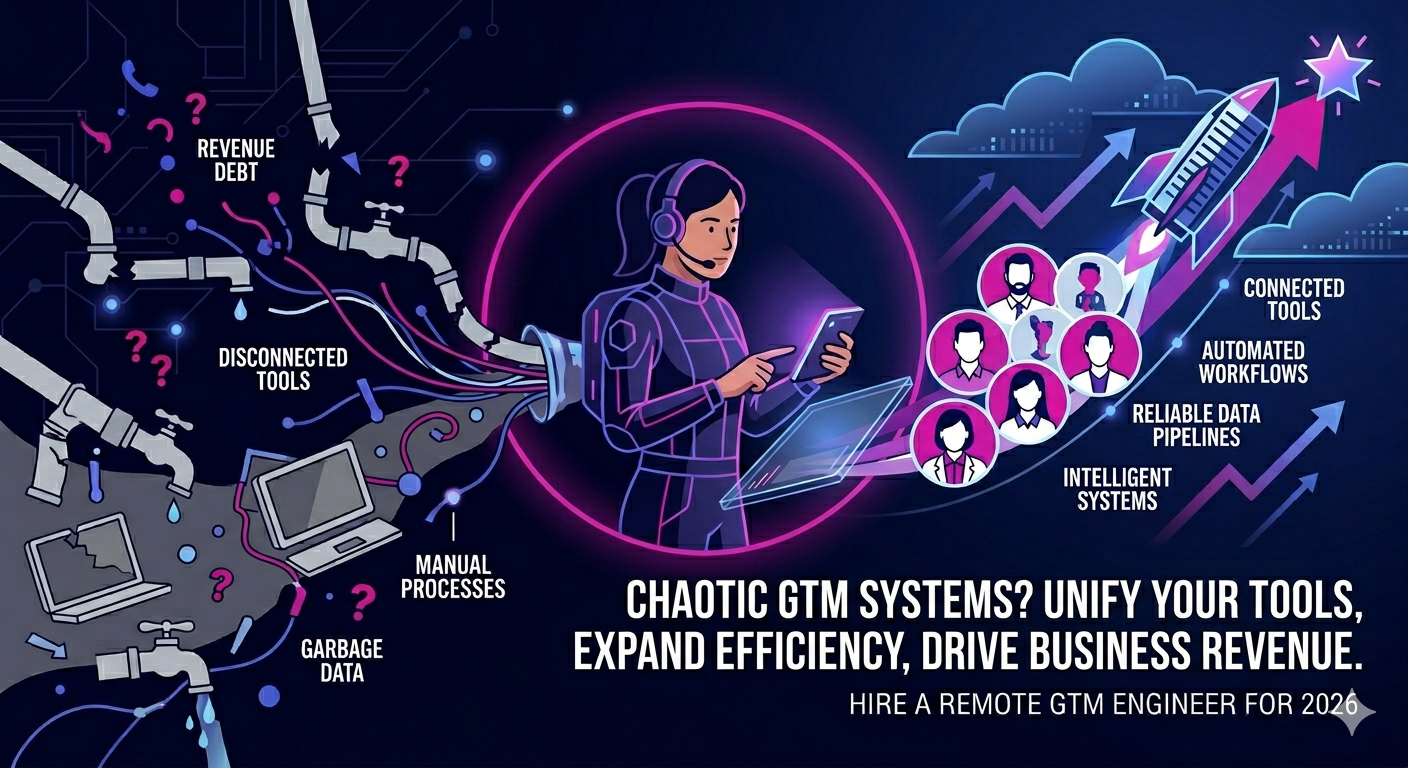
Modern revenue growth does not happen by accident. It is built, systematically, on a foundation of connected tools, automated workflows, reliable data pipelines, and intelligent systems that make every part of your sales and marketing motion faster, more consistent, and more measurable. In 2026, the person responsible for designing, building, and maintaining that infrastructure is called a go-to-market engineer, and the smartest growing companies are hiring a remote GTM engineer to do it at a fraction of the cost of a domestic in-house hire, with the technical depth and platform fluency needed to make their entire revenue stack operate at peak efficiency.
This guide covers everything you need to know about hiring a remote GTM engineer: what the role involves, what technical skills and experience to evaluate, how the position differs from adjacent roles, how much it costs in 2026, and how to onboard and integrate a remote GTM engineer so they deliver maximum impact from the moment they start.
What Is a Remote GTM Engineer?
A remote GTM engineer, sometimes called a revenue engineer or go-to-market engineer, is a technical specialist who builds and optimizes the systems, integrations, automations, and data flows that power a company’s go-to-market motion. They sit at the intersection of sales, marketing, and technology, translating revenue strategy into technical infrastructure. They are not a software developer, though they often write code. They are not a marketing operations manager, though they manage marketing systems. They are a specialist in making the entire revenue tech stack work together reliably, efficiently, and at scale.
The remote GTM engineer role emerged as sales and marketing technology became simultaneously more powerful and more complex. As businesses adopted CRMs, marketing automation platforms, sales engagement tools, data enrichment APIs, revenue intelligence platforms, and dozens of other point solutions, the technical overhead of making all these systems work together became a full-time job requiring dedicated engineering expertise focused specifically on go-to-market outcomes.
Remote GTM Engineer vs. Revenue Operations vs. Marketing Operations
- Remote GTM engineer: Primarily technical, focused on building and maintaining the integrations, automations, and data pipelines that power the revenue tech stack. Writes code, configures APIs, builds complex workflows, and ensures data flows reliably between systems.
- Revenue operations manager: Primarily strategic and analytical, focused on aligning sales, marketing, and customer success processes, managing forecasting, and driving cross-functional efficiency. May configure systems but is not typically building custom technical solutions.
- Marketing operations specialist: Focused on the marketing technology stack, campaign operations, lead management workflows, and database management within the marketing function. Overlaps with GTM engineering but is typically less technically deep and more operationally focused.
What Does a Remote GTM Engineer Do?
The scope of a remote GTM engineer’s work spans system architecture, integration development, automation building, and data management across the full go-to-market technology stack.
CRM Architecture and Administration
- Designing and maintaining a clean, scalable CRM data architecture in Salesforce, HubSpot, or equivalent platforms
- Building and managing custom objects, properties, pipelines, and reporting dashboards aligned to your specific revenue model
- Implementing lead routing, assignment, and scoring logic that ensures the right leads reach the right people at the right time
- Managing data quality including deduplication, enrichment, normalization, and regular database hygiene
- Building custom CRM workflows and automation sequences that reduce manual work across sales and marketing teams
Integration and API Development
- Building and maintaining API integrations between CRM, marketing automation, sales engagement, data enrichment, and analytics platforms
- Configuring and managing integration platforms such as Zapier, Make (Integromat), or Workato for no-code and low-code workflow automation
- Building custom integrations using APIs and scripting languages such as Python or JavaScript where off-the-shelf connectors do not meet requirements
- Managing webhook configurations and event-driven data triggers across interconnected systems
- Ensuring data consistency and accuracy across all connected platforms through robust synchronization logic
Sales Engagement and Outbound Infrastructure
- Configuring and optimizing sales engagement platforms such as Outreach, Salesloft, or Apollo for maximum sequence performance and deliverability
- Building email deliverability infrastructure including domain configuration, SPF, DKIM, and DMARC records, and warm-up processes
- Designing and implementing automated lead enrichment workflows that populate CRM records with firmographic, technographic, and intent data from sources such as Apollo, Clearbit, or ZoomInfo
- Managing cold outbound infrastructure including mailbox management, sending limits, and rotation strategies for scaled email campaigns
Analytics, Attribution, and Reporting
- Building revenue dashboards and reporting infrastructure that provides real-time visibility into pipeline, conversion rates, and campaign attribution
- Implementing multi-touch attribution models that accurately credit revenue generation across sales and marketing touchpoints
- Managing conversion tracking and event tagging across websites, landing pages, and digital advertising platforms
- Connecting data sources into business intelligence tools such as Looker, Tableau, or Google Looker Studio for cross-functional reporting
Why Hiring a Remote GTM Engineer Is a High-Return Investment in 2026
Revenue technology debt is one of the most expensive hidden costs in growing businesses. Disconnected systems, manual data transfers, broken automations, unreliable attribution, and CRM data quality issues collectively slow your entire go-to-market motion, create blind spots in your revenue reporting, and introduce errors that cost deals. Here is why a dedicated remote GTM engineer solves this problem so effectively.
Revenue Infrastructure Is Now a Competitive Advantage
In 2026, businesses with well-engineered go-to-market infrastructure run faster, see clearer, and waste less than those operating with a fragmented tech stack patched together with manual processes. An automated lead enrichment workflow that populates CRM records in real time, a reliable attribution model that shows exactly which channels and campaigns drive pipeline, and a sales engagement platform that maintains high deliverability and personalization at scale are not luxuries. They are the technical foundations of a scalable revenue engine.
GTM Engineering Skill Is Scarce and Expensive Locally
The combination of CRM architecture expertise, API integration experience, sales technology platform knowledge, and revenue analytics capability that defines a strong GTM engineer is genuinely rare in most local talent markets. In-house GTM engineers or revenue engineers in the United States command salaries of $100,000 to $160,000 per year in 2026. When you hire a remote GTM engineer through a specialist offshore staffing partner, you access comparable technical capability at 40 to 65 percent lower cost, making a level of technical sophistication accessible to businesses that could not otherwise afford dedicated GTM engineering expertise.
Technical Automation Multiplies Every Revenue Team Member’s Output
Every automation a remote GTM engineer builds represents time returned to your sales reps, SDRs, and marketers. An automated lead enrichment workflow eliminates hours of manual research per week. A well-configured lead routing system ensures no lead sits unworked in the wrong queue. A reliable email deliverability infrastructure means more of your outbound sequences land in inboxes rather than spam folders. These compounding efficiency gains are direct revenue multipliers that pay for a remote GTM engineer’s cost many times over.
Clean Data Drives Better Decisions Across the Entire Business
Garbage data produces garbage insights. A remote GTM engineer who maintains CRM data quality, builds reliable attribution models, and ensures all systems are accurately synchronized gives every revenue leader in your business the confidence to make strategic decisions based on what the data actually shows. That data confidence is genuinely valuable and genuinely rare in companies that have not invested in dedicated technical go-to-market infrastructure.
What to Look for When You Hire a Remote GTM Engineer
GTM engineering spans multiple technical disciplines. Knowing what to evaluate ensures you hire someone who can genuinely build and maintain the revenue infrastructure your business needs.
Essential Technical Skills
- Deep hands-on expertise in Salesforce or HubSpot CRM including custom object design, workflow automation, and advanced reporting
- Experience building and maintaining API integrations between SaaS platforms using both native connectors and custom code
- Proficiency with at least one scripting or programming language such as Python or JavaScript for custom integration and automation work
- Experience with integration platforms such as Zapier, Make, or Workato for workflow automation across multiple connected systems
- Hands-on experience with sales engagement platforms such as Outreach, Salesloft, or Apollo including configuration, sequence management, and deliverability management
- Familiarity with data enrichment tools including Apollo, Clearbit, ZoomInfo, and Lusha and experience building automated enrichment workflows
- Experience with email deliverability infrastructure including DNS record configuration, domain warm-up, and bounce and spam rate management
- Proficiency with web analytics, conversion tracking, and tag management using Google Tag Manager, GA4, and relevant ad platform pixels
Revenue Understanding and Strategic Alignment
The best remote GTM engineers combine deep technical skill with a genuine understanding of how sales and marketing motions work. They build systems with revenue outcomes in mind, not just technical elegance. Assess whether the candidate can explain how the integrations they build support specific revenue goals, not just what the technical configuration looks like. A remote GTM engineer who understands why the systems they build matter is significantly more valuable than one who can only explain how.
Documented Project and Infrastructure Examples
Ask every candidate to walk you through a specific GTM infrastructure project they built from scratch or significantly improved: what the business problem was, what technical solution they designed and implemented, and what measurable outcome the implementation produced. Strong candidates will have detailed, confident answers with specific examples of automation workflows, integration architectures, or data quality improvements they have delivered for real businesses.
How Much Does a Remote GTM Engineer Cost in 2026?
Monthly investment levels for a dedicated remote GTM engineer placed through a quality offshore staffing partner in 2026 typically include:
- Mid-level remote GTM engineer: $2,500 to $4,500 per month for candidates with 2 to 4 years of hands-on CRM configuration, API integration, and sales engagement platform experience
- Experienced remote GTM engineer: $4,500 to $6,500 per month for candidates with 4 to 7 years of multi-platform revenue infrastructure experience, custom integration development, and documented performance impact
- Senior remote GTM engineer: $6,500 to $9,000 per month for highly experienced specialists capable of architecting a full go-to-market technical stack from scratch, leading technical revenue operations, and mentoring junior team members
At every level, these rates represent substantial savings compared to the $100,000 to $160,000 annual salary of equivalent in-house GTM engineers in the United States, generating per-position annual savings of $50,000 to $90,000 or more.
When you are ready to hire a remote GTM engineer who can build the revenue infrastructure your business needs to scale efficiently, explore The Remote Reps’ dedicated remote GTM engineer placement service and connect with pre-vetted go-to-market engineering specialists ready to build your revenue tech stack from day one. You can complement your remote GTM engineer with a remote lead generation expert who benefits directly from the data infrastructure they build, or a remote cold email expert who operates on the outbound infrastructure your GTM engineer configures and maintains.
How to Onboard a Remote GTM Engineer for Maximum Impact
GTM engineering work has a long-lasting impact on your business infrastructure. A structured onboarding process ensures your remote GTM engineer builds on a solid foundation and avoids creating technical debt from the outset.
Week One: Infrastructure Audit and Architecture Review
Before your remote GTM engineer makes any changes to your existing systems, have them conduct a thorough audit of your current go-to-market tech stack: which tools are connected to which, how data flows between them, what integrations are functioning correctly, what is broken or missing, and what technical debt has accumulated. Document all existing workflows, automation rules, and integration configurations. This audit is the blueprint for a prioritized roadmap of improvements that your remote GTM engineer will execute systematically.
Week Two and Three: Quick Wins and Critical Infrastructure Fixes
Based on the audit, prioritize the highest-impact issues for immediate resolution. Broken lead routing that sends qualified leads to the wrong queues, missing CRM field mappings that cause data loss, and email deliverability issues that are suppressing outbound performance are examples of critical infrastructure problems that should be fixed before new capabilities are built on top of them. Early quick wins build trust and demonstrate the direct business value your remote GTM engineer brings to your revenue team.
Month Two and Beyond: Systematic Build-Out and Automation Expansion
With critical issues resolved, your remote GTM engineer should work from a documented project roadmap that systematically builds new capabilities in priority order: lead enrichment automation, attribution reporting, advanced CRM workflows, deeper integrations, and any custom development projects that support your specific revenue motion. Hold weekly technical reviews to track progress, review completed builds before they go live, and align on priorities for the coming sprint. The compounding value of a well-engineered go-to-market infrastructure becomes increasingly visible over time as automation saves more hours, data quality improves, and attribution reporting becomes more reliable.
According to Gartner’s research on remote GTM engineer roles and revenue operations technology, organizations that invest in dedicated go-to-market engineering expertise to maintain and optimize their revenue technology stack consistently achieve faster pipeline velocity, higher CRM data accuracy, and better cross-functional alignment between sales, marketing, and customer success teams than those relying on generalist resources to manage technical revenue infrastructure.
Complementary Roles That Benefit Most from Your Remote GTM Engineer’s Work
A remote GTM engineer builds the infrastructure that makes every other revenue role more effective. The roles that see the most direct benefit from strong GTM engineering include:
- Remote SDRs who rely on well-configured sales engagement platforms, reliable lead routing, and automated enrichment for faster, more personalized outreach
- Remote lead generation experts whose list building and CRM data management work is amplified by automated enrichment and data hygiene workflows
- Remote cold email experts whose sequence performance depends directly on the email deliverability infrastructure and sending domain configuration your GTM engineer maintains
- Remote digital marketers whose campaign attribution and performance reporting relies on the conversion tracking and analytics infrastructure your GTM engineer builds
- Remote sales representatives whose pipeline visibility, deal tracking, and forecasting accuracy depend on the CRM architecture and data quality your GTM engineer maintains
Conclusion: Hire a Remote GTM Engineer and Build the Revenue Infrastructure Your Business Deserves in 2026
Your revenue team is only as effective as the infrastructure supporting it. In 2026, the businesses that scale most efficiently are not the ones with the largest sales teams or the biggest marketing budgets. They are the ones with the smartest technical foundations: clean data, automated workflows, reliable integrations, and clear attribution that allows every revenue investment to be measured and optimized with confidence. A skilled remote GTM engineer builds that foundation at a cost that makes genuine financial sense and delivers compounding returns for as long as the engagement runs.
The Remote Reps places pre-vetted remote GTM engineers for businesses across every industry and growth stage. Our candidates are assessed for real CRM expertise, real integration development experience, and the revenue understanding that separates great GTM engineers from technically capable but commercially disconnected ones.
Read what our clients say about the revenue infrastructure results they have achieved through The Remote Reps, or visit theremotereps.com to start your remote GTM engineer search today.
FAQ: Remote GTM Engineer
What is a remote GTM engineer and what does the role involve?
A remote GTM engineer, or go-to-market engineer, is a technical specialist who builds and maintains the integrations, automations, data pipelines, and system architectures that power a company’s sales and marketing technology stack. They work remotely using cloud-based platforms and collaboration tools to design CRM data models, build API integrations between revenue tools, configure sales engagement platforms, implement lead routing and enrichment workflows, and build attribution and reporting infrastructure. The role sits at the intersection of technical engineering and revenue strategy, translating go-to-market goals into the technical systems that make those goals achievable at scale.
How is a remote GTM engineer different from a revenue operations manager?
A remote GTM engineer is primarily technical, spending the majority of their time building and maintaining the systems, integrations, and automations that power the revenue tech stack. They write code, configure APIs, build complex workflows, and architect data models. A revenue operations manager is primarily strategic and analytical, focused on aligning processes across sales, marketing, and customer success, managing forecasting, and driving cross-functional efficiency through reporting and process design. They may configure platforms but are not typically building custom technical solutions. Many scaling businesses benefit from both roles working in close collaboration, with the GTM engineer building what the revenue operations manager needs to execute strategy effectively.
What tech stack does a remote GTM engineer typically work with?
In 2026, a remote GTM engineer typically works across CRM platforms such as Salesforce or HubSpot; sales engagement platforms such as Outreach, Salesloft, or Apollo; data enrichment tools such as Clearbit, ZoomInfo, or Lusha; integration and automation platforms such as Zapier, Make, or Workato; email deliverability infrastructure tools; business intelligence and reporting platforms such as Looker, Tableau, or Google Looker Studio; web analytics and tag management through Google Analytics 4 and Google Tag Manager; and custom API integrations built in Python or JavaScript. The specific stack varies by business, and the best remote GTM engineers can adapt to new platforms quickly because their core skills of API integration, data modeling, and automation logic transfer across platforms.
How much does a remote GTM engineer cost compared to hiring one locally in the US?
In the United States in 2026, an experienced in-house GTM engineer or revenue engineer commands a base salary of $100,000 to $160,000 per year plus benefits and overhead, bringing the fully loaded annual cost to $130,000 to $200,000. A dedicated remote GTM engineer placed through a specialist offshore staffing partner costs $2,500 to $9,000 per month depending on experience level, representing an annual investment of $30,000 to $108,000. The resulting per-position annual savings range from $50,000 to $90,000 or more while delivering comparable or equivalent technical capability for the specific GTM engineering functions most relevant to your business needs.
How long does it take a remote GTM engineer to build meaningful infrastructure improvements?
Timeline varies significantly based on the current state of your tech stack and the complexity of the improvements required. Critical fixes such as broken integrations, missing field mappings, or deliverability infrastructure issues can typically be resolved within the first 2 to 3 weeks. More substantial builds such as a complete CRM data architecture redesign, a multi-platform enrichment automation workflow, or a custom attribution reporting system typically take 4 to 8 weeks depending on complexity and scope. Your remote GTM engineer should work from a documented project roadmap with prioritized deliverables and clear timelines so you have visibility into what is being built, when it will be completed, and what business outcome each build supports.
Can a remote GTM engineer support both HubSpot and Salesforce environments?
Many remote GTM engineers have hands-on experience with both HubSpot and Salesforce, and the underlying skills of data modeling, workflow automation, API integration, and reporting architecture transfer between both platforms. When evaluating candidates, confirm the depth of their experience in the specific CRM your business uses as their primary system of record, since each platform has meaningfully different architecture and configuration logic. Candidates with deep experience in your primary CRM and working knowledge of the other will be able to manage integrations between the two platforms if your business operates with both, which is common in larger organizations with separate marketing and sales CRM environments.