Every startup hits the same wall. You have a great product, a small team, and a burning need to generate pipeline. But hiring a full-time, in-house sales team is expensive, slow, and risky when your runway is limited. That is exactly why more founders and sales leaders are turning to a remote BDR for startup growth as their go-to solution in 2026.
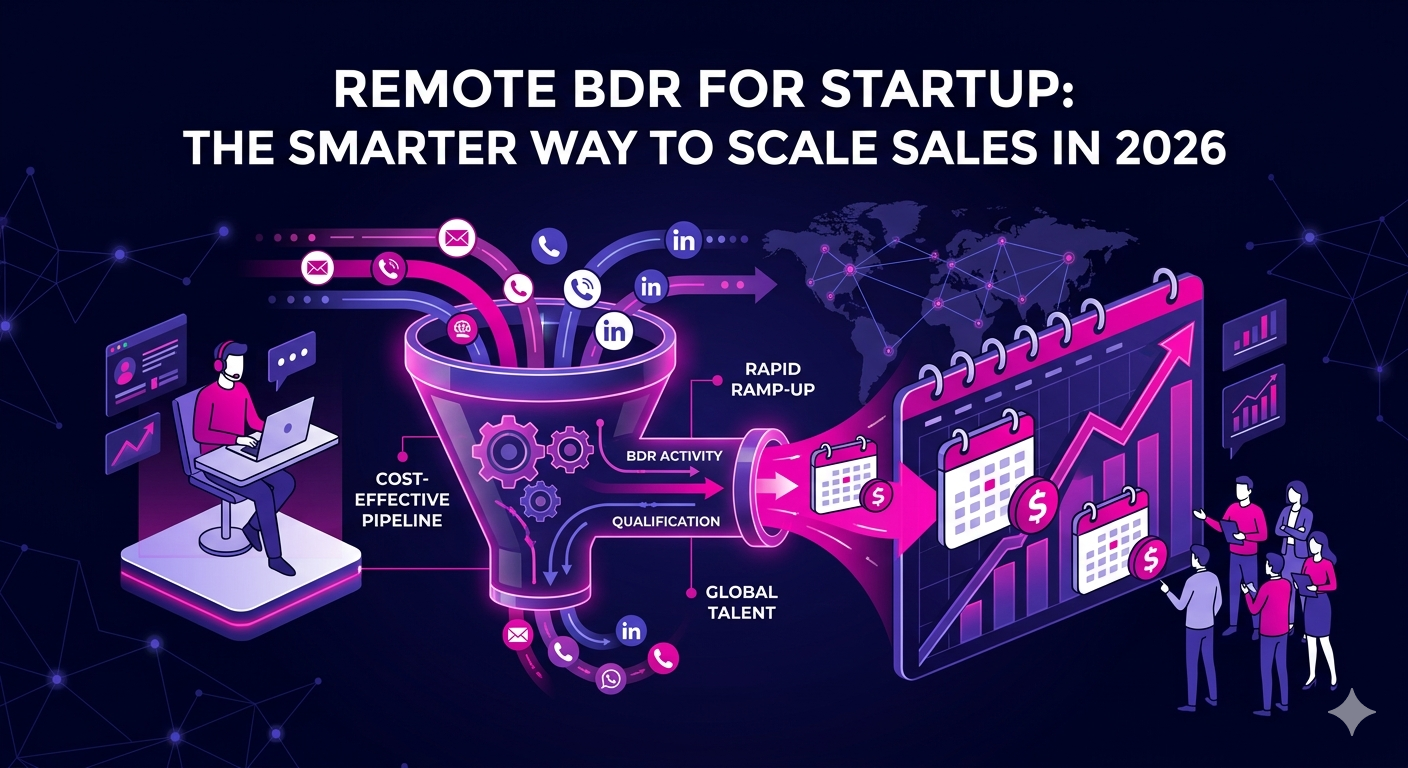
A remote Business Development Representative (BDR) handles top-of-funnel prospecting, outbound outreach, and lead qualification, all without the cost of a full-time hire. In this guide, you will learn what a remote BDR does, why startups are embracing this model, and how to find the right one for your stage of growth.
What Is a Remote BDR and Why Do Startups Need One?
A Business Development Representative is responsible for identifying potential customers, initiating contact, qualifying leads, and setting up meetings for account executives or founders. When this role is performed remotely, you gain all the pipeline-building power without the office space, benefits costs, or long recruiting cycles.
For startups, this matters enormously. Most early-stage companies cannot afford to hire two or three full-time sales reps and wait months for them to ramp. A remote BDR for startup teams solves this by giving you a trained, focused prospecting resource that is ready to hit the ground running.
Key Responsibilities of a Startup Remote BDR
- Researching and building targeted prospect lists
- Executing cold email and LinkedIn outreach sequences
- Following up with inbound leads and qualifying them against your ICP
- Booking discovery calls for founders or account executives
- Tracking activity and reporting pipeline metrics weekly
- Collaborating with marketing on messaging and campaign feedback
The Real Cost Advantage of Hiring a Remote BDR for Your Startup
Let us be direct about the numbers. A fully loaded in-house BDR in a major US city can cost anywhere from $70,000 to $90,000 per year when you factor in salary, benefits, payroll taxes, equipment, and onboarding time. Add in the three to four months it typically takes for a new rep to ramp, and you are looking at a significant investment before a single qualified meeting lands on your calendar.
A remote BDR for startup engagements, by contrast, typically operates at a fraction of that cost. You pay for productive output, not overhead. Many startups report cutting their cost-per-qualified-meeting by 40 to 60 percent by switching to a remote model, according to data published by Gartner’s sales development research.
Beyond Cost: Speed and Flexibility
Startups move fast. Your go-to-market strategy may pivot in a quarter. A remote BDR arrangement gives you the flexibility to scale effort up or down based on what the market is telling you. You are not locked into a 12-month employment contract when your focus shifts.
What to Look for When Hiring a Remote BDR for Startup Growth
Not all remote BDRs are built the same. When evaluating candidates or agencies, these are the qualities that separate pipeline builders from time-wasters.
Proven Outbound Experience
Look for someone who has run cold email campaigns, used sales engagement platforms like Outreach or Apollo, and has documented meeting-booked rates. Generic sales experience is not enough. You want a specialist in top-of-funnel, outbound prospecting.
Startup Mindset and Adaptability
A remote BDR joining a startup needs to be comfortable with ambiguity. There is no big playbook or dedicated sales ops team handing them a perfect Salesforce setup. They need to be resourceful, fast learners who can work with founders directly and adapt messaging quickly based on market feedback.
Strong Written Communication
Most early outreach in 2026 happens over email and LinkedIn. Your remote BDR needs to write compelling, personalized messages that get replies. Ask for writing samples or run a brief assignment during the hiring process.
Data Literacy
Good BDRs track their own numbers. Open rates, reply rates, conversion to booked meetings, show rates. If a candidate cannot speak confidently about their own metrics from past roles, that is a red flag.
How to Set Up Your Remote BDR for Success
Hiring the right person is only half the battle. Startups that get the most out of a remote BDR for startup programs invest time in onboarding and structure.
Define Your Ideal Customer Profile Clearly
Before your BDR sends a single email, you need a tight ICP. Company size, industry, tech stack, pain points, and decision-maker titles should all be documented. The clearer your ICP, the faster your BDR can build lists and personalize outreach.
Give Them the Right Tools
At minimum, your remote BDR needs access to a prospecting data source like Apollo or ZoomInfo, a sales engagement tool, a CRM, and a calendar booking tool. Do not expect them to work with spreadsheets and manual follow-ups.
Build a Feedback Loop
Hold a short weekly sync to review what replies are coming in, what objections are surfacing, and what is resonating. Your remote BDR is your frontline intelligence on how the market is responding to your messaging. That feedback is gold.
Outsourced Remote BDR vs. Freelance vs. Fully Embedded
Startups have three main options when adding a remote BDR function:
- Outsourced agency model: You engage a firm that provides trained BDRs alongside management and infrastructure. Fastest to launch, lower risk, ideal for early-stage validation.
- Freelance BDR: You hire an independent contractor. More control over messaging, but you are responsible for tools, management, and ramp time.
- Fully embedded remote hire: You bring on a full-time remote employee. Best for Series A and beyond when you need deep product knowledge and long-term pipeline building.
For most seed and pre-Series A startups, the outsourced model offers the best risk-to-reward ratio. You can validate your outbound motion before committing to a full-time hire.
If you are ready to explore what a dedicated remote SDR or BDR solution looks like for your startup, The Remote Reps connects high-growth companies with trained, pre-vetted remote sales professionals who are ready to build your pipeline from day one.
Common Mistakes Startups Make With Remote BDRs
Even with the right hire, startups can sabotage their own outbound programs. Here are the most frequent mistakes to avoid.
- Expecting results in week one without proper onboarding
- Giving the BDR a vague ICP and asking them to figure it out
- Skipping a CRM and losing track of prospects and follow-ups
- Measuring only activity volume rather than meeting-booked rates
- Neglecting to share product and competitive updates with the BDR team
FAQ Section: Remote BDR for Startup
What does a remote BDR for a startup actually do day to day?
A remote BDR for startup teams typically spends their day prospecting new accounts, sending personalized outreach via email and LinkedIn, following up on previous touches, qualifying inbound leads, and booking discovery calls for the founder or account executive. They also track and report their own outreach metrics weekly.
How much does it cost to hire a remote BDR for a startup?
Costs vary by model. A freelance remote BDR for startup might charge $3,000 to $6,000 per month. An outsourced BDR agency program may run $4,000 to $8,000 per month depending on volume and scope. Both options are significantly cheaper than a fully loaded in-house hire, which can exceed $80,000 per year in total cost.
When should a startup hire its first remote BDR?
A startup is ready to hire a remote BDR when it has a defined ICP, at least one validated use case, and a founder or sales lead who can manage the BDR and run discovery calls with qualified prospects. Hiring before those elements are in place often leads to wasted effort and budget.
Can a remote BDR for a startup work across different time zones?
Yes. One of the biggest advantages of hiring a remote BDR for startup use cases is global availability. Many remote BDRs are specifically experienced in working across time zones and can align their outreach hours with your target market, whether that is US Eastern, Pacific, or European business hours.
What tools does a remote BDR for a startup need?
A remote BDR for startup teams needs a prospecting data platform such as Apollo or ZoomInfo, a sales engagement tool like Outreach or Instantly, a CRM such as HubSpot or Salesforce, a calendar booking tool like Calendly, and a communication platform such as Slack for internal collaboration. Most of these tools have startup-friendly pricing tiers.
How do you measure the performance of a remote BDR for a startup?
Key performance indicators for a remote BDR for startup programs include number of prospects contacted per week, email open and reply rates, number of qualified meetings booked per month, show rate on booked meetings, and conversion rate from meeting to next stage in the pipeline. These metrics should be reviewed weekly in a short sync with the BDR.