Client relationships are the lifeblood of any digital agency. When those relationships are managed poorly, accounts churn, referrals dry up, and revenue stalls. The solution more agencies are turning to in 2026 is hiring a remote account manager for digital agency operations, a dedicated professional who owns client communication, project coordination, and retention without requiring a desk in your office.
This guide covers everything you need to know: what a remote account manager actually does, why the role is critical for agency growth, how to hire the right person, and how to set them up for long-term success.
What Does a Remote Account Manager for a Digital Agency Do?
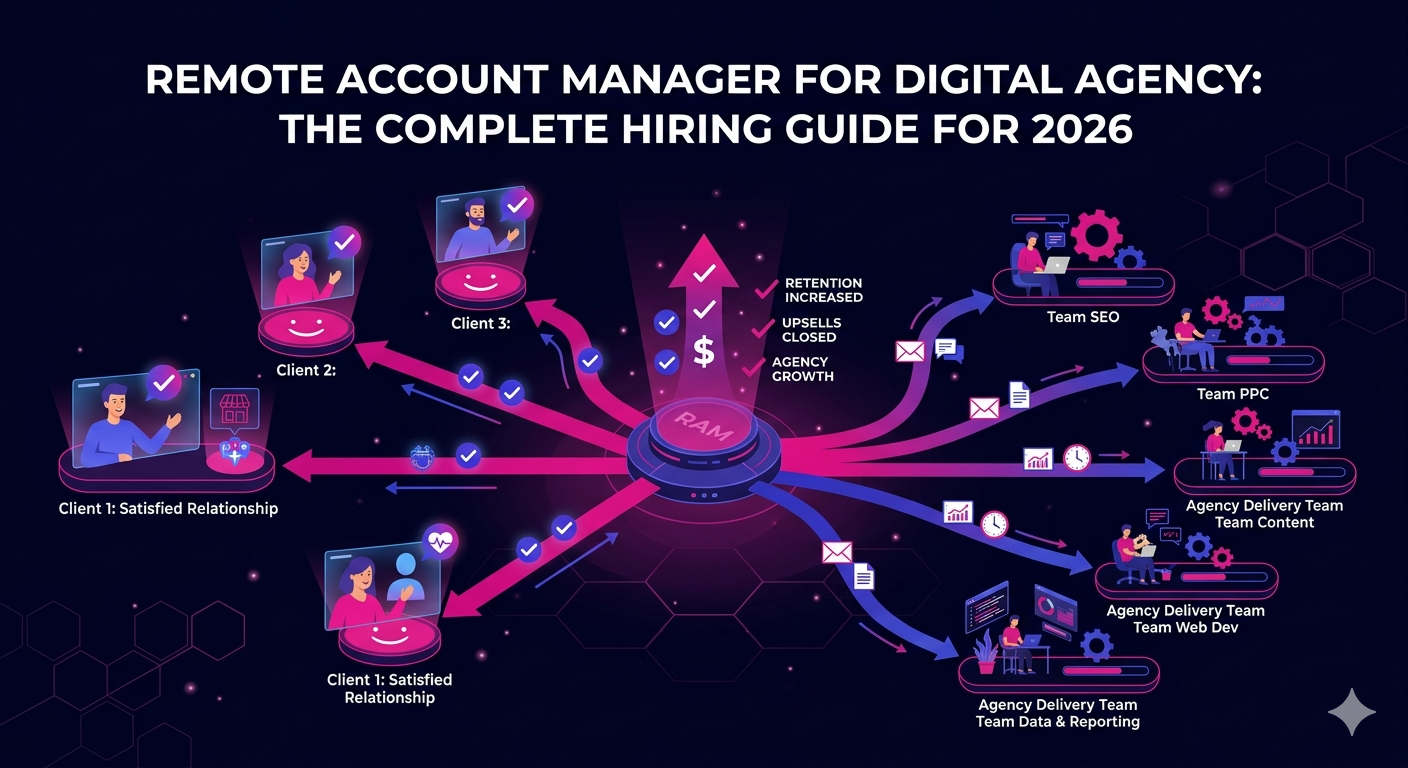
A remote account manager serves as the primary point of contact between your agency and its clients. They bridge the gap between your delivery teams and the clients paying the invoices, ensuring both sides stay aligned, informed, and satisfied throughout the engagement.
Core responsibilities typically include:
- Managing day-to-day client communication via email, Slack, and video calls
- Coordinating project timelines between clients and internal teams
- Preparing and presenting performance reports and campaign updates
- Identifying upsell and cross-sell opportunities within existing accounts
- Handling client concerns and resolving issues before they escalate
- Onboarding new clients and setting expectations from the start
- Tracking account health metrics and flagging at-risk relationships
When done well, account management is what turns a one-time project client into a long-term retainer partner. That compounding value is why investing in a dedicated remote account manager for your digital agency pays dividends far beyond the role’s direct cost.
Why Digital Agencies Are Hiring Remote Account Managers in 2026
The shift toward remote-first teams has matured significantly. In 2026, hiring a remote account manager for a digital agency is no longer a workaround. It is a deliberate, strategic choice that consistently outperforms the traditional in-house model on several key dimensions.
Broader Access to Experienced Talent
When you hire locally, you are limited to candidates within commuting distance. Opening your search to remote candidates means you can attract account managers with experience across a wide range of industries, niches, and agency types. That depth of experience directly benefits your clients.
Lower Overhead Without Lower Quality
A full-time, in-house account manager comes with salary, benefits, office space, equipment, and HR costs. A remote account manager delivers the same quality of client stewardship at a significantly lower total cost. For growing agencies operating on tight margins, that difference can fund two or three additional hires in other critical roles.
Timezone Flexibility for Multi-Region Clients
If your agency serves clients across multiple time zones, a remote account manager based in a complementary region can provide coverage outside of your core business hours. That responsiveness is a genuine competitive advantage in client retention.
Scalability Aligned With Agency Growth
As you win more clients, you need more account management capacity. Remote hiring lets you scale that capacity quickly without the friction of physical office constraints or lengthy local recruiting cycles.
Key Skills to Look for in a Remote Account Manager for a Digital Agency
Not every experienced account manager is the right fit for a remote digital agency environment. The role demands a specific combination of technical literacy, communication discipline, and self-management that not all candidates possess.
Strong Written and Verbal Communication
In a remote setting, communication is the job. Your remote account manager will spend the majority of their day writing emails, preparing updates, and leading video calls. Look for candidates who are clear, concise, and professional in all written communication during the hiring process itself. That is your best preview of how they will represent your agency to clients.
Digital Marketing Literacy
A remote account manager for a digital agency does not need to execute campaigns, but they need to understand them. Familiarity with concepts like SEO performance metrics, paid media KPIs, content strategy, and social media reporting allows them to speak credibly with clients and field questions without constantly routing them back to your technical team.
CRM and Project Management Proficiency
Comfort with tools like HubSpot, Salesforce, Asana, ClickUp, or Monday.com is non-negotiable. These platforms are the operational infrastructure of remote account management, and a candidate who needs extensive training on basic tools will slow your team down.
Proactive Problem Solving
The best account managers do not wait for clients to raise concerns. They identify potential friction points before they become complaints. In a remote setting, where you cannot simply walk over and check in, this proactive instinct is especially valuable.
Emotional Intelligence and Relationship Skills
Account management is fundamentally a people function. Your remote account manager needs to build genuine rapport with clients over video and email, navigate difficult conversations with composure, and maintain long-term trust even through project setbacks.
How to Structure the Role for Remote Success
Hiring the right person is only half the equation. Setting up the role correctly is what determines whether your remote account manager thrives or struggles.
Define Clear Ownership From Day One
Be explicit about which accounts they own, what decisions they can make independently, and when they need to escalate. Ambiguity in remote roles creates delays and erodes client confidence. A well-documented account ownership model prevents both.
Build a Structured Onboarding Process
Before your remote account manager speaks to a single client, they should have a thorough understanding of your agency’s services, positioning, client history, communication standards, and reporting cadence. Invest two to three weeks in onboarding before live client handoffs begin.
Set Cadence-Based Check-Ins
Weekly one-on-ones between your remote account manager and their direct supervisor keep communication flowing and give you early visibility into account health. Avoid the trap of only connecting when something goes wrong.
Give Them the Tools to Succeed
Ensure your remote account manager has access to your CRM, project management platform, reporting dashboards, and communication channels from their first day. A fragmented tech stack is one of the most common reasons remote account managers underperform in their first 90 days.
Where to Find a Qualified Remote Account Manager for Your Digital Agency
The quality of your remote account manager depends entirely on how well you source and screen candidates. Generic job boards surface a high volume of applicants with highly variable quality. Specialized remote staffing platforms that pre-vet candidates for digital agency environments deliver a far better signal-to-noise ratio.
According to research from SHRM on remote account manager hiring best practices, organizations that use structured screening processes and specialized sourcing channels reduce time-to-hire by up to 40 percent and see measurably better 90-day performance outcomes.
The Remote Reps specializes in matching digital agencies with vetted remote professionals across every client-facing and operational function. From account managers and remote digital marketers for agency teams to SDRs, customer support specialists, and executive assistants, every candidate is screened for the specific demands of remote agency work before you ever speak to them.
The Business Case: What a Great Remote Account Manager Delivers
The return on a skilled remote account manager for a digital agency is measurable and significant. Here is what agencies consistently report after making this hire:
- Higher client retention rates driven by consistent, proactive communication
- More upsells and expansions identified within existing accounts
- Faster issue resolution that prevents churn before it starts
- A lighter load on delivery teams who no longer handle client communication directly
- Stronger client relationships that generate referrals and case study opportunities
In an agency business, where the cost of losing a client almost always exceeds the cost of the account manager who could have retained them, this role delivers outsized ROI relative to its investment.
If your agency is ready to protect and grow its client base with a dedicated remote account manager, explore how The Remote Reps can connect you with pre-vetted remote talent built for digital agency environments. Visit The Remote Reps to find your remote account manager for digital agency growth and start building a client experience that drives retention and revenue.
Frequently Asked Questions About Hiring a Remote Account Manager for a Digital Agency
What is a remote account manager for a digital agency responsible for?
A remote account manager for a digital agency is responsible for managing client relationships, coordinating between clients and internal delivery teams, preparing performance reports, onboarding new accounts, and identifying growth opportunities within existing client relationships. They serve as the primary contact point between the agency and its clients, all performed remotely using digital communication and project management tools.
How much does a remote account manager for a digital agency typically cost?
The cost of a remote account manager for a digital agency varies based on experience level, geographic location, and the complexity of the accounts they manage. In 2026, remote account managers with one to three years of digital agency experience typically range from $2,500 to $5,000 per month, while senior professionals with five or more years of experience may command higher rates. In all cases, the total cost is substantially lower than an equivalent in-house hire when overhead is factored in.
Can a remote account manager for a digital agency handle multiple client accounts simultaneously?
Yes. A skilled remote account manager for a digital agency can typically manage between eight and fifteen accounts simultaneously, depending on the size, complexity, and communication frequency of each client. Agencies with larger enterprise accounts often assign fewer accounts per manager to ensure depth of service, while agencies with smaller retainer clients can run higher account loads per person.
What tools should a remote account manager for a digital agency know how to use?
A remote account manager for a digital agency should be proficient in CRM platforms like HubSpot or Salesforce, project management tools like Asana, ClickUp, or Trello, communication platforms like Slack and Zoom, and reporting tools relevant to your agency’s services such as Google Analytics, SEMrush, or Meta Ads Manager. Comfort with Google Workspace or Microsoft 365 for documentation and reporting is also essential.
How do I onboard a remote account manager for a digital agency effectively?
Onboarding a remote account manager for a digital agency effectively requires a structured two to three week process before any live client handoffs occur. This should include deep dives into your agency’s service offerings and positioning, reviews of each client account’s history and current status, access to all relevant tools and platforms, shadowing of existing client calls, and clear documentation of communication standards and escalation protocols. Structured onboarding is the single biggest predictor of long-term remote account manager success.
How do I measure the performance of a remote account manager for a digital agency?
Performance for a remote account manager for a digital agency should be tracked through a combination of quantitative and qualitative KPIs. Key metrics include client retention rate, net revenue retention across managed accounts, average response time to client inquiries, number of upsells or expansions closed within existing accounts, and client satisfaction scores collected through periodic surveys. Regular one-on-one reviews tied to these metrics create accountability and clarity for both manager and agency leadership.