
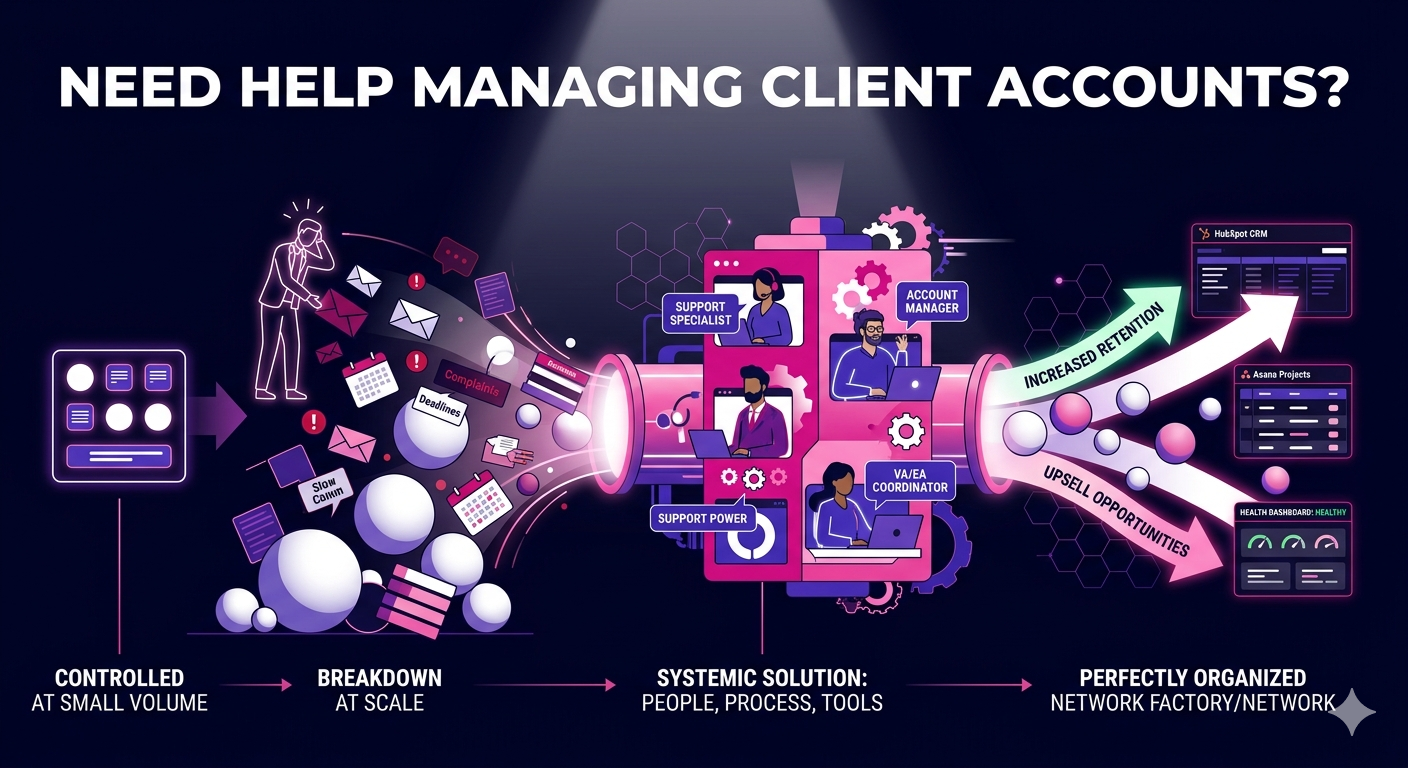
If you need help managing client accounts, you are dealing with one of the most common growth bottlenecks in service-based businesses. As your client roster expands, the systems and bandwidth that worked when you had five clients start breaking down when you have fifteen, twenty, or fifty.
The good news is that this is a solvable problem. In 2026, business owners have access to better tools, smarter processes, and more affordable remote talent than ever before. This guide walks you through exactly how to get your client account management under control so you can grow without sacrificing service quality.
Why Business Owners Need Help Managing Client Accounts as They Scale
Client account management is one of those functions that feels manageable at small volume and chaotic at large volume. The moment you start dropping balls, missing follow-ups, or delivering inconsistent service, client churn accelerates and your reputation takes a hit that is hard to recover from.
Here are the most common triggers that signal a business owner needs help managing client accounts:
- Clients are complaining that communication is slow or unclear.
- You are losing track of deliverables, deadlines, or open requests.
- Renewals and upsell conversations are falling through the cracks.
- You are the only person who knows the full picture for each client relationship.
- Your team is reactive instead of proactive with clients.
- Onboarding new clients feels disorganized and inconsistent.
If several of these describe your current situation, the issue is structural. You do not just need more effort. You need better systems and the right people in the right roles.
The Real Business Risk of Poor Client Account Management
When client accounts are managed poorly, the downstream effects go well beyond client dissatisfaction. Churn increases. Referrals dry up. Your team spends more time firefighting than delivering value. And the revenue required to replace churned clients consistently outweighs the cost of keeping them happy in the first place.
Research on client retention and account management best practices from Harvard Business Review consistently shows that acquiring a new customer costs significantly more than retaining an existing one. For businesses that need help managing client accounts, fixing retention is almost always the highest-ROI investment available.
What Strong Client Account Management Actually Looks Like
Before building a solution, it helps to understand what great looks like. High-performing client account management teams share a few consistent traits:
- Every client has a clearly assigned point of contact who owns the relationship.
- Proactive check-ins happen on a regular, scheduled cadence rather than only when problems arise.
- Deliverables and open items are tracked in a shared system, not in someone’s inbox or memory.
- Client health is monitored with clear signals for when a relationship is at risk.
- Renewal, upsell, and expansion conversations are planned well in advance, not last minute.
If your current setup does not reflect these traits, you need help managing client accounts at a process level before you add more volume.
How to Build a System That Actually Manages Client Accounts Well
There are three layers to solving a client account management problem: people, process, and tools. Fixing only one of the three will not produce lasting results. Here is how to approach all three.
Layer 1: Get the Right People Into Account Management Roles
The first and most impactful step when you need help managing client accounts is to stop relying on one person, usually yourself, to hold all the client relationships together. Dedicated account management requires dedicated people.
In 2026, remote account managers and customer support specialists are widely available and highly skilled. Hiring remotely gives you access to experienced professionals who can take full ownership of client communication, tracking, and relationship health without the overhead costs of traditional in-office hiring.
Roles that can directly address your need to manage client accounts better include:
- Customer Support Specialists: Handle day-to-day client queries, requests, and issue resolution so nothing falls through the cracks.
- Virtual Assistants: Manage scheduling, follow-ups, reporting, and administrative client touchpoints.
- Executive Assistants: Support senior relationship owners by managing calendars, preparing client materials, and coordinating internal teams around client deliverables.
If your business needs dedicated support to manage client relationships more effectively, you can explore remote customer support specialists who are placed specifically to improve client retention and satisfaction.
Layer 2: Build Repeatable Processes for Every Client Touchpoint
One reason businesses end up needing help managing client accounts is that everything lives in people’s heads rather than in documented systems. When a team member leaves or gets overwhelmed, institutional knowledge disappears and client relationships suffer.
Start by mapping every recurring client touchpoint and building a standard process for each one:
- Client onboarding: Define exactly what happens in the first 30 days. Who sends the welcome communication? What information is collected? When does the first check-in call happen?
- Regular check-ins: Establish a standing cadence for every client tier, whether that is weekly, biweekly, or monthly, and make attendance non-negotiable.
- Deliverable tracking: Create a shared project management workflow where every open item has an owner, a due date, and a status.
- Escalation protocols: Define what constitutes an urgent client issue and who handles it, so the response is fast and consistent every time.
- Renewal preparation: Build a process that triggers 60 to 90 days before a client contract renews so there is always time for a proper conversation.
Documented processes mean your client management quality does not depend entirely on any one person. It becomes a function of the system, not the individual.
Layer 3: Use the Right Tools to Stay on Top of Every Account
Technology does not replace great account management, but it makes great account management scalable. In 2026, the tools available to growing businesses are powerful, affordable, and increasingly easy to use.
Key tools for businesses that need help managing client accounts include:
- CRM platforms: Tools like HubSpot, Salesforce, or Pipedrive give your team a single source of truth for every client relationship, interaction history, and open opportunity.
- Project management software: Platforms like Asana, Monday.com, or ClickUp track deliverables and deadlines so nothing is forgotten.
- Client portals: Dedicated portals give clients visibility into their account status, reducing the volume of inbound check-in requests your team has to field.
- Automated check-in sequences: Simple email automations can trigger proactive touchpoints between live calls, keeping clients informed without requiring manual effort every time.
- Health scoring dashboards: Tools that aggregate client engagement, usage, and communication data into a simple health score help your team spot at-risk accounts before churn happens.
Prioritizing Which Client Accounts Need the Most Attention
Not all client accounts carry equal weight. When you are building or rebuilding your account management approach, start by segmenting your clients into tiers based on revenue, growth potential, and strategic importance.
A Simple Client Tiering Framework
- Tier 1 (High Value): Your largest, most strategic accounts. These receive the highest touch service, dedicated account managers, and the most proactive outreach.
- Tier 2 (Mid Value): Solid, consistent accounts with growth potential. Regular scheduled check-ins and structured deliverable tracking.
- Tier 3 (Standard): Smaller accounts managed primarily through automated touchpoints, self-service resources, and periodic human outreach.
Tiering your clients ensures that your highest-value relationships get the attention they deserve, and your team does not burn out trying to deliver the same level of service to every account equally.
When to Know It Is Time to Hire for Client Account Management
There is a clear point at which trying to manage everything in-house with existing bandwidth stops being a cost-saving decision and starts costing you clients. If you are regularly receiving complaints about communication, if renewals are being missed, or if you personally are spending more than a few hours a week just keeping clients from churning, it is time to hire.
The return on investment from proper account management staffing is direct and measurable. Better retention means more predictable revenue. More proactive account management means more expansion and upsell revenue. And freeing yourself from day-to-day client management means more time to grow the business.
Build a Client Management Operation That Runs Without You
If you need help managing client accounts, the solution is not working harder or longer hours. It is building a function that runs on the right people, clear processes, and the right tools.
Start with an honest audit of where your current client management is breaking down. Then hire the support you need, document the processes that matter most, and equip your team with the tools to stay proactive. The businesses that grow fastest in 2026 are the ones that treat client retention as a core operational function, not an afterthought.
FAQ: Need Help Managing Client Accounts
How do I know when I genuinely need help managing client accounts?
Clear signs include missed follow-ups, declining client satisfaction scores, increasing churn, or finding that your team is always reactive rather than proactive with clients. If you personally are the only person with full visibility into each relationship, that is a strong signal you need help managing client accounts before growth makes the problem worse.
What type of hire is best for a business that needs help managing client accounts?
It depends on the nature of your client relationships. For high-touch service businesses, a dedicated customer support specialist or remote account manager is usually the best starting point. For businesses that primarily need administrative support around client communication, a virtual assistant or executive assistant can handle the load effectively. The key is to match the role to the actual gap in your process.
Can remote professionals genuinely help with managing client accounts?
Yes, absolutely. In 2026, remote account management and customer support roles are fully mainstream and highly effective. Remote professionals manage client relationships across industries every day, handling communication, tracking deliverables, preparing reports, and ensuring client satisfaction without needing to be physically present. For businesses that need help managing client accounts, remote hiring opens up a much larger talent pool at more competitive costs.
What tools should I use if I need help managing client accounts at scale?
A CRM is the foundation. HubSpot and Salesforce are the most widely used options for service businesses. Layer in a project management tool like Asana or ClickUp for deliverable tracking, and consider a client portal for high-value accounts. Automation tools for check-in sequences and health score dashboards round out a complete tech stack for businesses that need help managing client accounts efficiently.
How does better client account management affect revenue?
Directly and significantly. Businesses that proactively manage client accounts see higher retention rates, more upsell and expansion revenue, and stronger referral pipelines. If you need help managing client accounts and act on it, the financial return typically comes in the form of reduced churn within 60 to 90 days and measurable expansion revenue within six months as account managers identify and develop growth opportunities inside existing relationships.
How quickly can I implement a better client account management system?
With focused effort, you can have a meaningful improvement in place within 30 days. Start by documenting your three most critical client touchpoints, assign a clear owner to each active account, and set up a simple CRM if you do not already have one. Hire remote support to fill the gaps and you will have the foundation of a proper client account management function running well before the end of the quarter.