
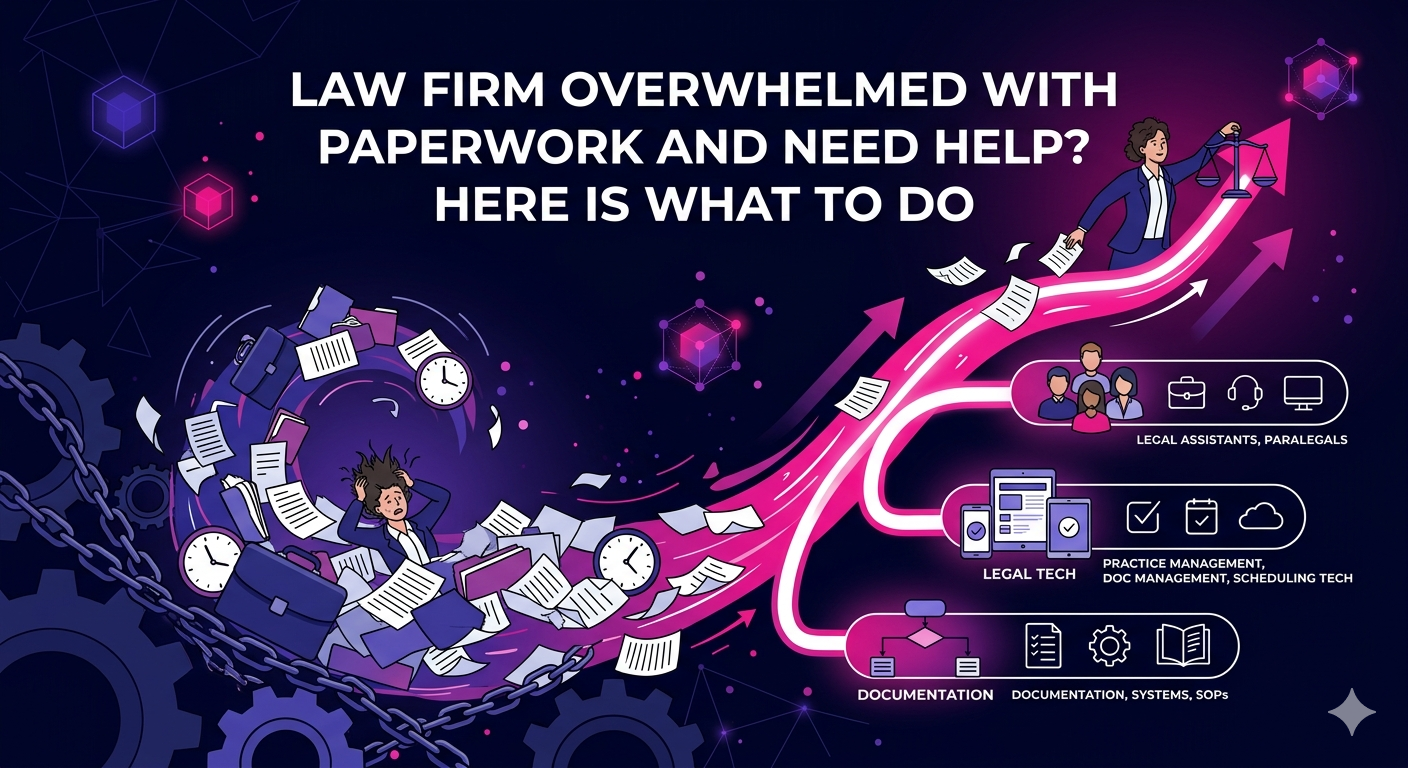
Legal professionals did not spend years in law school to spend their days buried in filing, data entry, document drafting, and client intake forms. Yet in 2026, countless attorneys and practice managers find themselves in exactly that position. If your law firm is overwhelmed with paperwork and needs help, you are not alone, and more importantly, there is a clear, practical path forward.
This guide walks you through why legal admin overload happens, what it costs your firm, and the specific steps you can take to delegate, systematize, and hire the right support so your attorneys can focus on what actually generates revenue and results.
Why So Many Law Firms Are Overwhelmed With Paperwork
The legal profession is uniquely document-heavy. Every case generates contracts, motions, correspondence, discovery materials, billing records, and compliance filings. As a firm grows, the administrative burden scales faster than most partners anticipate.
Common reasons law firms fall behind on paperwork:
- Understaffed admin teams: Many firms hire for legal talent but delay investing in support staff until the backlog becomes critical.
- Attorneys doing admin work: When partners and associates handle their own scheduling, filing, and document prep, billable hours disappear fast.
- Outdated workflows: Firms still relying on manual processes rather than modern legal tech tools accumulate bottlenecks quickly.
- High client volume without proportional staffing: Growth is good, but without the right support structure, it creates chaos.
- Staff turnover: Legal admin roles see high turnover, leaving gaps that fall back on attorneys and paralegals to fill.
The result is a firm where everyone is busy but nobody is operating at their highest and best use. If this sounds familiar, your firm is overdue for a structured solution.
The Real Cost of a Law Firm Overwhelmed With Too Much Paperwork
It is easy to frame the paperwork problem as an inconvenience. But the financial and operational costs are significant and measurable.
What happens when legal admin piles up:
- Lost billable hours: Every hour an attorney spends on filing or scheduling is revenue your firm never recovers.
- Client experience suffers: Slow response times, missed follow-ups, and document errors erode client trust and referrals.
- Compliance risk increases: Overworked teams miss deadlines, misfiled documents create liability exposure.
- Attorney burnout: Legal professionals report some of the highest burnout rates of any profession, and administrative overload is a major driver.
- Missed growth opportunities: When your team is underwater, taking on new clients or practice areas feels impossible.
A law firm overwhelmed with paperwork that needs help is not just an admin problem. It is a strategic and financial problem that compounds over time if left unaddressed.
Step 1: Audit Your Firm’s Administrative Workload
Before you can solve the problem, you need to understand its full scope. Spend one to two weeks tracking every administrative task your attorneys and paralegals are handling. Categorize them by type, time required, and whether legal expertise is actually needed to complete them.
Three categories to sort your tasks into:
- Attorney-only work: Legal strategy, court appearances, client counseling, complex drafting that requires a licensed professional.
- Paralegal-level work: Legal research, document review, case preparation, filings that require legal training but not full attorney oversight.
- Pure admin work: Scheduling, data entry, client intake, document formatting, billing, and correspondence that any trained support professional can handle.
Most firms discover that 40 to 60 percent of the tasks their attorneys are touching fall into the second or third category. That is your immediate delegation opportunity.
Step 2: Hire Remote Legal Support to Clear the Backlog
One of the most effective and cost-efficient ways for a law firm overwhelmed with paperwork to get real help in 2026 is through remote legal support professionals. Remote hiring gives you access to skilled legal assistants, paralegals, and legal secretaries without the overhead of a full in-office hire.
Remote legal roles that make an immediate difference:
Legal Assistants
Remote legal assistants for overwhelmed law firms handle client communication, document preparation, case file organization, deadline tracking, and general administrative support. They are trained to work within the structured demands of a legal environment and can be onboarded quickly with the right briefing and access to your systems.
Legal Secretaries
A remote legal secretary manages correspondence, schedules court dates and meetings, prepares legal documents for attorney review, and keeps your front-office operations running smoothly. For firms drowning in day-to-day admin, this role alone can reclaim hours of attorney time every week.
Paralegals
For more substantive legal work that does not require a licensed attorney, remote paralegals handle research, drafting, discovery support, and case management. They bridge the gap between admin support and attorney-level work and are especially valuable for high-volume practices.
Virtual Assistants
For general operational support, billing follow-ups, data entry, and client intake management, a dedicated virtual assistant can handle a wide range of tasks that are currently eating into your team’s productive hours.
Step 3: Document Your Processes Before Delegating
Delegation only works when the person taking over a task knows exactly what is expected. This is where many firms stumble. They hire support staff but fail to transfer knowledge properly, so quality suffers and the attorney ends up re-doing the work anyway.
A simple process documentation approach:
- Record a short Loom video walking through each task as you normally do it.
- Write a one-page SOP (Standard Operating Procedure) outlining the steps, tools used, and what a correct output looks like.
- Create templates for recurring documents, emails, and client communications.
- Define quality standards and review checkpoints, especially for client-facing materials.
Investing two to three hours in documentation upfront saves dozens of hours over the following months and dramatically improves the quality of work your remote team delivers.
Step 4: Use Legal Technology to Reduce the Volume of Manual Work
Hiring the right people is essential, but pairing that support with the right tools reduces the volume of manual work in the first place. In 2026, legal tech has matured significantly, and there are solid options for firms of every size.
Tools worth evaluating for an overwhelmed law firm:
- Clio or MyCase: Practice management platforms that centralize case files, billing, and client communication.
- DocuSign or Adobe Sign: Eliminate the back-and-forth of paper signatures for client agreements and contracts.
- Lawmatics: Automates client intake and follow-up sequences so no lead or onboarding step falls through the cracks.
- NetDocuments or iManage: Document management systems that organize, version-control, and retrieve files efficiently.
- Calendly or Acuity Scheduling: Remove manual scheduling by letting clients book directly based on attorney availability.
The right tech stack reduces the number of tasks that need human attention in the first place, which means your remote legal support team can focus on higher-value work.
Step 5: Restructure How Your Firm Handles Intake and Client Communication
Client intake and ongoing communication are two of the biggest admin time sinks in a busy law firm. Every new client requires forms, verification, conflict checks, retainer agreements, and onboarding steps. Every existing client generates status questions, document requests, and correspondence.
Assigning a dedicated remote support professional to manage intake and client communication creates a consistent, professional experience for clients while freeing attorneys from reactive interruptions throughout the day.
According to guidance published by the American Bar Association on law firm staffing and efficiency for overwhelmed legal practices, firms that delegate administrative and client communication tasks to trained support staff see measurable improvements in both billable hour recovery and client satisfaction scores.
Building a Sustainable Support Structure for Your Firm
The goal is not just to clear today’s backlog. It is to build a structure where paperwork never piles up to crisis level again. That means hiring proactively rather than reactively, building documentation habits into your team culture, and reviewing your support staffing as your caseload grows.
Law firms that invest in remote legal support early grow faster, retain better talent, and deliver a more consistent client experience than those that wait until the system breaks down.
Frequently Asked Questions
What should a law firm overwhelmed with paperwork do first to get help?
The first step is an honest audit of where your team’s time is actually going. Identify what percentage of attorney and paralegal time is spent on tasks that do not require their specific expertise. That gap is your starting point for delegation. A law firm overwhelmed with paperwork that needs help should prioritize hiring remote legal admin support for those lower-complexity, high-volume tasks first.
Is remote legal support reliable for a law firm overwhelmed with paperwork?
Yes, when hired through reputable platforms that pre-vet candidates for legal industry experience. Remote legal assistants, paralegals, and secretaries are accustomed to working within the structured demands of legal environments, including confidentiality standards, document protocols, and deadline-driven workflows. Many firms in 2026 rely on fully remote legal support teams with excellent results.
How quickly can remote legal staff help a law firm overwhelmed with paperwork get caught up?
Most remote legal support professionals can be onboarded within a few days once your processes are documented and access is granted. For firms with a significant backlog, a dedicated legal assistant or paralegal can begin making a measurable dent within the first week. Full productivity is typically reached within 30 days of onboarding.
What types of paperwork can remote staff handle for an overwhelmed law firm?
Remote legal support professionals can handle a wide range of tasks including client intake forms, document drafting and formatting, case file organization, court deadline tracking, correspondence management, billing support, scheduling, and research tasks. For a law firm overwhelmed with paperwork and in need of help, these are the highest-value areas to delegate first.
How much does it cost to hire remote legal support for an overwhelmed law firm?
Costs vary depending on the role and level of expertise required. Remote legal assistants and virtual assistants are generally available at significantly lower rates than in-office hires when accounting for salary, benefits, and overhead. For most small to mid-sized firms, even one well-matched remote hire produces a strong return on investment within the first billing cycle.
Can a small law firm overwhelmed with paperwork benefit from remote help, or is it only for large firms?
Small firms often benefit the most. Solo practitioners and small teams are disproportionately affected by admin overload because there is no buffer staff to absorb the volume. A single remote legal assistant or virtual assistant can transform the daily workflow of a small law firm overwhelmed with paperwork and give the lead attorney back the time needed to focus on billable client work and business development.