
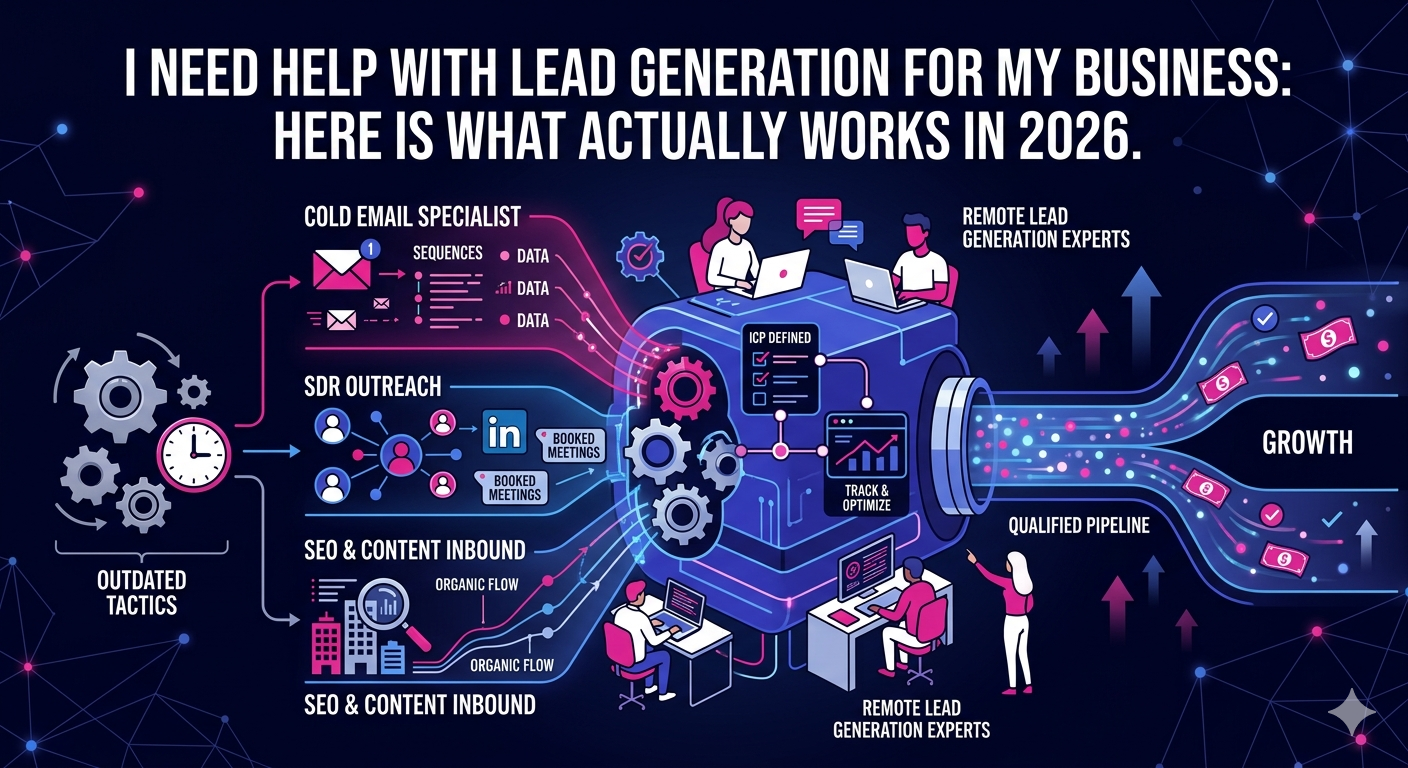
If you have ever typed “I need help with lead generation for my business” into a search bar at midnight, you are not alone. Thousands of business owners and sales managers do the same thing every week. The frustration is real: your product is solid, your team is motivated, but the pipeline stays dry. The good news is that lead generation is a solvable problem, and in 2026 there are more effective tools, strategies, and talent options than ever before.
This guide breaks down why lead generation fails for most businesses, what actually moves the needle today, and how to get the right help without wasting your budget.
Why Most Businesses Struggle to Generate Leads Consistently
Before fixing the problem, it helps to understand why it exists. Most businesses that need help with lead generation are dealing with one or more of these root causes:
- No defined ideal customer profile (ICP). When you try to sell to everyone, you convert no one. Without a tight ICP, outreach is scattered and conversion rates stay low.
- Outdated or inconsistent outreach. Cold calling scripts from 2018 do not work the same way in 2026. Buyers are more informed, more skeptical, and quicker to ignore generic pitches.
- Inconsistent follow-up. Studies consistently show that most deals close after five or more touchpoints, yet most sales reps give up after one or two attempts.
- No dedicated lead generation resource. Asking your account executives to prospect while closing is a recipe for neither happening well.
- Poor use of available channels. Most businesses rely on one or two channels when a multi-channel approach compounds results significantly.
Recognizing which of these applies to your business is the first step toward fixing it.
The Lead Generation Strategies That Work Best in 2026
The landscape has shifted. Here are the approaches that are generating the best results for B2B and B2C businesses right now.
Cold Email Done Right
Cold email is not dead. Poorly written, untargeted cold email is dead. When executed with precise targeting, strong personalization, and a clear value proposition, cold email remains one of the highest-ROI lead generation channels available. The key in 2026 is using data enrichment tools, verified contact lists, and sequences that feel human rather than automated.
Businesses that invest in dedicated cold email experts consistently outperform those that hand the job to generalist staff. A specialist knows how to write subject lines that get opened, bodies that get read, and calls-to-action that generate replies.
Sales Development Representatives (SDRs)
SDRs are the engine of a modern outbound sales machine. Their sole focus is prospecting, qualifying, and booking meetings for your closers. If you need help with lead generation for your business and you do not have dedicated SDRs, you are likely leaving significant revenue on the table.
The challenge for many growing businesses is cost. A full-time in-house SDR in a major market costs $55,000 to $80,000 per year before benefits and overhead. Remote SDRs offer the same skill set at a fraction of the cost, with faster ramp times because they come pre-trained in modern prospecting methodology.
Multi-Channel Outreach
Top-performing lead generation programs in 2026 combine email, LinkedIn, phone, and sometimes paid channels into a coordinated sequence. Each touchpoint reinforces the previous one. A prospect who sees your LinkedIn message and then receives a relevant email is far more likely to respond than someone who only receives one channel of contact.
SEO and Inbound Content
Outbound generates leads now. Inbound generates leads while you sleep. A well-optimized website that ranks for the keywords your ideal customers are searching builds a compounding asset that pays dividends for years. Pairing outbound with a strong inbound strategy is how businesses build pipelines that do not dry up between campaigns.
PPC and Paid Advertising
When you need results quickly, paid advertising can accelerate lead flow almost immediately. Google Ads, LinkedIn Ads, and Meta campaigns all have their place depending on your audience. The key is having someone who understands bid strategy, audience segmentation, and conversion optimization managing your spend, otherwise budget disappears with little to show for it.
How to Get Expert Help With Lead Generation for Your Business
Knowing the right strategies is one thing. Executing them consistently is another. Most businesses that say “I need help with lead generation” are not lacking knowledge. They are lacking bandwidth, specialized talent, or both.
Here are your main options in 2026:
Hire In-House
Hiring a dedicated in-house lead generation specialist or SDR gives you full control and deep company knowledge over time. The tradeoff is cost, time-to-hire, and risk. Finding, training, and retaining talent in a competitive market is a real challenge, and a bad hire costs far more than a good one saves.
Work With a Lead Generation Agency
Agencies can execute at scale and bring established processes. However, they often serve many clients simultaneously, which can dilute their attention to your account. Monthly retainers for quality agencies typically range from $3,000 to $10,000 or more, which is prohibitive for smaller businesses.
Hire Remote Lead Generation Experts
The most cost-effective model for most small and mid-sized businesses in 2026 is hiring vetted remote professionals who specialize in lead generation. You get dedicated attention, specialist skills, and significant cost savings compared to in-house or agency models. Platforms like The Remote Reps connect businesses with pre-vetted lead generation experts who are ready to start contributing from day one.
This model works particularly well because you can hire exactly the role you need, whether that is an SDR, a cold email specialist, a PPC expert, or a digital marketer, without committing to the overhead of a full-time employee.
Building a Lead Generation System That Scales
The goal is not just to generate leads this month. The goal is to build a system that reliably fills your pipeline every month without starting from scratch each time. Here is what that looks like:
- Step 1: Define your ICP. Document exactly who your best customers are, what problems they have, what their buying process looks like, and what objections they raise. Everything downstream depends on this.
- Step 2: Build your outreach infrastructure. This includes your CRM, your email sending infrastructure, your LinkedIn presence, and your content assets.
- Step 3: Launch multi-channel sequences. Use a combination of email, LinkedIn, and phone touchpoints across a 2 to 4 week window for each prospect.
- Step 4: Track and optimize. Monitor open rates, reply rates, meeting booked rates, and deal conversion. Adjust messaging, targeting, and channels based on data.
- Step 5: Add inbound over time. Use SEO and content to build a compounding inbound channel that reduces reliance on pure outbound over time.
If executing all of this sounds overwhelming, that is a signal that you need dedicated help. The most successful businesses in 2026 are those that recognize when to delegate and bring in specialized talent rather than trying to do everything internally.
What to Look for When Hiring Lead Generation Help
Not all lead generation help is equal. When evaluating candidates or partners, look for:
- Demonstrated experience in your industry or a comparable vertical
- Familiarity with modern tools such as Apollo, Clay, Instantly, LinkedIn Sales Navigator, and HubSpot
- A track record of measurable results, not just activity metrics
- Clear communication and a structured approach to reporting
- References or testimonials from businesses similar to yours
When you work with a platform like The Remote Reps, vetting has already been done for you. You get access to professionals who have been screened for skills, communication, and reliability, which cuts the time to a productive hire from months to days.
For more insight into what clients have experienced, read testimonials from businesses that have already solved their lead generation challenges through remote talent.
If you want to explore the full range of options available to you, HubSpot’s 2026 State of Marketing Report provides detailed benchmarks on lead generation performance across industries and channels, which can help you set realistic expectations and goals.
Final Thoughts: Stop Struggling and Start Building
If you need help with lead generation for your business, the worst thing you can do is nothing. Every month without a reliable pipeline is a month of missed revenue and market share lost to competitors who are investing in their outreach systems.
The strategies that work in 2026 are well-documented. The talent to execute them is accessible and, with the right platform, affordable. The only variable is whether you take action.
Start by identifying your biggest bottleneck: Is it the strategy, the execution, or the talent? Then get the specific help you need to solve that one problem. You do not have to fix everything at once. You just have to start.
Ready to get serious about lead generation? Explore dedicated SDR services and discover how a remote sales development representative can transform your pipeline within the first 30 days.
Frequently Asked Questions
I need help with lead generation for my business but I have a small budget. Where do I start?
Start with the channel that offers the highest ROI for your budget. For most small businesses, cold email paired with LinkedIn outreach delivers strong results at a low cost. Hiring a remote lead generation specialist on a part-time basis is often more cost-effective than a full-service agency and delivers more focus than a generalist hire.
How long does it take to see results when I get help with lead generation for my business?
Outbound campaigns typically begin generating responses within 2 to 4 weeks of launching. Meaningful pipeline impact, meaning qualified meetings and early-stage deals, usually becomes visible within 60 to 90 days. Inbound strategies like SEO take longer but build compounding value over 6 to 12 months.
What is the difference between an SDR and a lead generation expert?
An SDR (Sales Development Representative) focuses specifically on outbound prospecting, qualifying inbound leads, and booking meetings for account executives. A lead generation expert may have a broader scope that includes digital channels, content strategies, paid advertising, and data sourcing. Both roles are valuable depending on your pipeline needs.
I need help with lead generation for my business but I do not know my ideal customer. Is that a problem?
Yes, and it should be your first priority. Without a defined ideal customer profile, even the best lead generation tactics will produce poor results because you are targeting the wrong people. A good lead generation professional can help you identify and document your ICP based on your best existing customers and your market positioning.
Can remote lead generation experts work effectively without being in my office?
Absolutely. Lead generation is one of the roles most naturally suited to remote work. Modern tools like CRMs, video conferencing, shared dashboards, and communication platforms make it easy for remote professionals to integrate fully with your team and report transparently on their activity and results. Many businesses in 2026 run their entire sales development function remotely with excellent outcomes.
How do I measure success when I hire someone to help with lead generation for my business?
Key metrics to track include the number of qualified leads generated per month, meeting booked rate, email open and reply rates, cost per qualified lead, and ultimately the pipeline value attributed to lead generation activity. Establish these benchmarks in the first 30 days and review them weekly to ensure progress.