
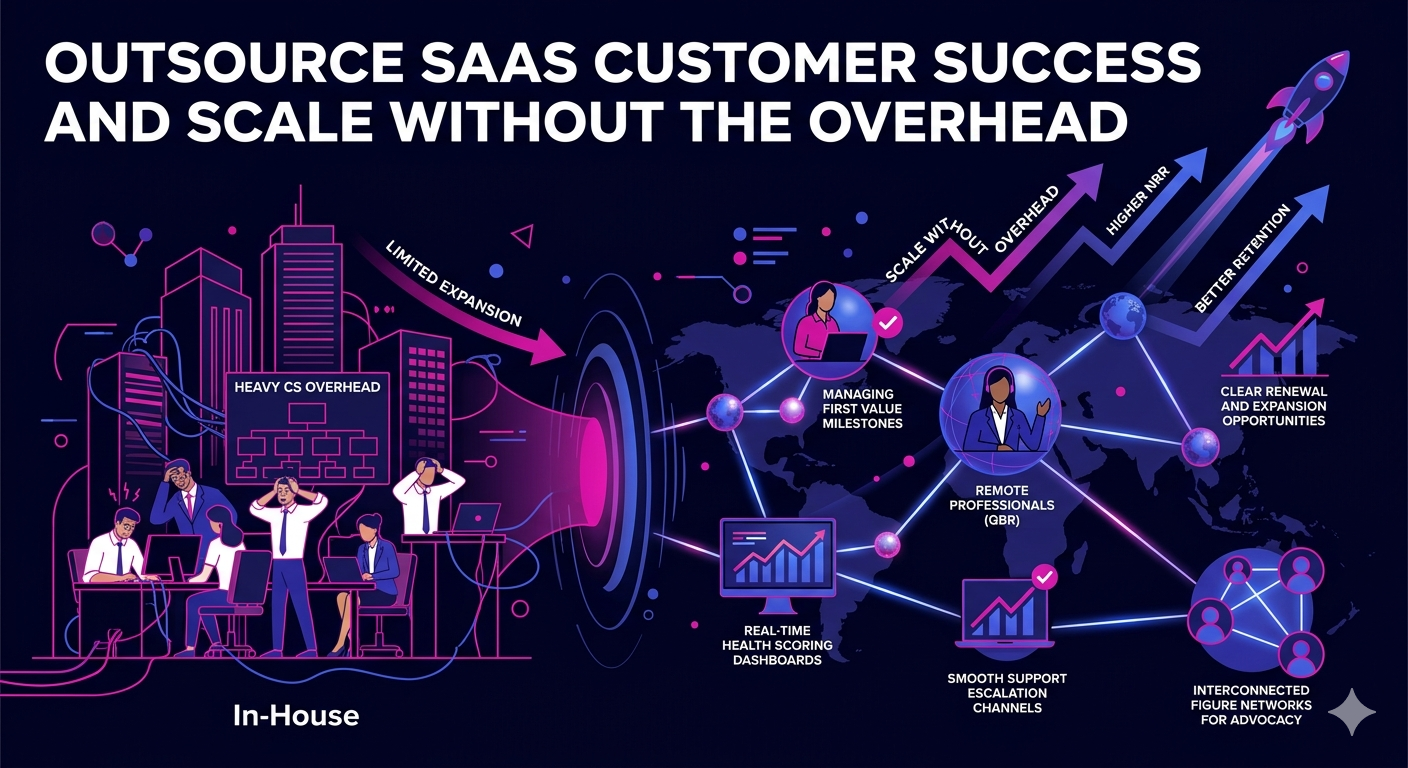
Every SaaS founder hits the same wall. Churn creeps up, onboarding slows down, and your internal team is stretched too thin to give customers the attention they need. The answer is not always to hire full-time. More SaaS companies in 2026 are choosing to outsource SaaS customer success as a faster, leaner path to better retention and healthier net revenue retention (NRR).
This guide breaks down exactly how it works, when it makes sense, and how to do it without losing the personal touch your customers expect.
Why SaaS Companies Are Outsourcing Customer Success in 2026
The SaaS market has matured. Investors no longer reward pure growth at all costs. They want efficient growth, and that means keeping the customers you already have. Customer success is no longer a nice-to-have. It is a revenue function.
But building an in-house CS team is expensive and slow. A single senior Customer Success Manager (CSM) in the US can cost $90,000 to $130,000 per year in base salary alone, before benefits, tools, and management overhead. For early-stage or growth-stage SaaS companies, that math is painful.
Outsourcing solves the problem. You get dedicated, experienced CS professionals without the hiring timelines, benefits burden, or management layers. You pay for performance and scale up or down as your customer base shifts.
Key Business Pressures Driving the Shift
- Rising customer acquisition costs making retention more valuable than ever
- Investors scrutinizing churn and NRR more closely than top-line ARR
- Lean teams unable to provide proactive, high-touch success coverage
- Geographic expansion requiring coverage across multiple time zones
- Product complexity increasing onboarding and adoption challenges
What Does Outsourced SaaS Customer Success Actually Include?
When you outsource SaaS customer success, you are not handing over a vague function to a call center. Done right, it means embedding trained remote professionals directly into your existing workflows, tools, and customer journey.
Core Responsibilities Covered
- Onboarding: Guiding new customers through setup, configuration, and first value milestones
- Health scoring: Monitoring product usage data and flagging at-risk accounts before they churn
- QBRs and check-ins: Running regular business reviews with key accounts
- Renewal and expansion: Identifying upsell and cross-sell opportunities within the existing customer base
- Support escalation: Acting as the bridge between customers and your technical or product teams
- Customer advocacy: Building relationships that lead to case studies, referrals, and reviews
Need dedicated customer support experts to complement your CS function? Remote Reps provides both, so your customers never fall through the cracks.
The Real Cost Difference: In-House vs. Outsourced CS
Let us look at a straightforward comparison for a SaaS company managing 150 accounts.
In-House Team Costs (Annual Estimate)
- 2 CSMs at $100,000 each: $200,000
- Benefits and payroll taxes (25%): $50,000
- CS tooling (Gainsight, ChurnZero, etc.): $20,000
- Recruiting, onboarding, training: $15,000
- Total: approximately $285,000 per year
Outsourced CS Team Costs (Annual Estimate)
- 2 dedicated remote CSMs: $80,000 to $110,000
- No benefits, no recruiting overhead
- Tools and processes often included or shared
- Total: approximately $80,000 to $110,000 per year
The savings are significant. More importantly, you can redirect that capital toward product development, marketing, or sales, which drives the growth that makes CS even more important.
How to Choose the Right Outsourced Customer Success Partner
Not all outsourcing arrangements are equal. Here is what separates a high-performing outsourced CS team from a mediocre vendor relationship.
1. SaaS-Specific Experience
Generic customer service experience does not translate to SaaS customer success. Look for professionals who understand product adoption curves, health scoring, renewal cycles, and expansion revenue. They should be comfortable inside tools like Salesforce, HubSpot, Intercom, Gainsight, or your preferred CRM.
2. Dedicated vs. Shared Resources
Some vendors pool CSMs across multiple clients. This dilutes attention and quality. Insist on dedicated professionals who work exclusively on your accounts and can learn your product deeply.
3. Communication and Accountability
Your outsourced team should operate as an extension of your company, not a separate entity. Expect daily standups, shared dashboards, and clear KPIs such as churn rate, time to first value, NPS, and expansion revenue.
4. Flexibility to Scale
Your CS needs will change as you grow. Your partner should be able to add headcount within weeks, not months, and adjust coverage models as your product and customer segments evolve.
According to Gainsight’s research on outsourced SaaS customer success strategies, companies that proactively invest in structured success programs see 20 to 30 percent improvements in net revenue retention compared to reactive support models.
Common Mistakes to Avoid When You Outsource SaaS Customer Success
Many SaaS teams get the strategy right but stumble on execution. Here are the pitfalls to avoid.
Treating It Like Outsourced Support
Customer success is proactive. Support is reactive. If you set up your outsourced CS team to just answer tickets and close issues, you will not get the retention and expansion outcomes you are paying for. Define the proactive motions clearly from day one.
Skipping the Onboarding Period
Even skilled professionals need time to learn your product, your customers, and your brand voice. Plan for a 30 to 60 day ramp period before expecting full productivity.
No Defined Success Metrics
Without shared KPIs, neither side can measure success. Agree upfront on churn targets, health score benchmarks, renewal rates, and CSAT or NPS goals.
Keeping Them Siloed
Your outsourced CS team should be in the same Slack channels, attend the same product updates, and have the same access to customer data as your internal team. Isolation kills performance.
Is Outsourcing SaaS Customer Success Right for Your Stage?
This model works best in specific scenarios. Here is a quick framework to decide.
Strong Fit
- Series A or B SaaS companies building out their first CS motion
- Companies with 50 to 500 accounts that cannot yet justify a large in-house team
- Teams expanding into new geographies or time zones
- Companies that have experienced churn spikes and need rapid intervention
Weaker Fit
- Enterprise SaaS with highly complex, deeply strategic accounts requiring executive sponsorship
- Companies where CS is deeply intertwined with product roadmap decisions at the board level
For most growth-stage SaaS companies, the math and the logic both point the same direction. Outsourcing is not a compromise. It is a smarter allocation of resources.
Getting Started: A Practical Roadmap
If you are ready to move forward, here is a simple four-step process to outsource SaaS customer success without disruption.
- Step 1 – Audit your current state: Map your customer journey, identify gaps in coverage, and document your top churn reasons.
- Step 2 – Define the scope: Decide which CS motions you want to outsource first (onboarding, renewals, health monitoring) and which stay in-house.
- Step 3 – Choose a partner: Vet for SaaS experience, dedicated staffing, and cultural alignment.
- Step 4 – Set KPIs and review cadence: Agree on metrics, reporting frequency, and escalation paths before work begins.
FAQ Section
What does it mean to outsource SaaS customer success?
To outsource SaaS customer success means hiring external remote professionals or a specialized agency to manage your customer relationships, onboarding, retention, and expansion activities on behalf of your company. These individuals work as an extension of your team using your tools, playbooks, and brand voice rather than operating as a detached vendor.
Is it safe to outsource SaaS customer success for enterprise accounts?
For most mid-market enterprise accounts, yes. When you hire dedicated professionals with strong SaaS experience and provide proper onboarding, they can manage complex relationships effectively. However, for the highest-value strategic accounts that require C-suite involvement, a hybrid model with internal executive sponsorship and outsourced operational support tends to work best.
How quickly can an outsourced SaaS customer success team get up to speed?
Most experienced remote CSMs reach full productivity within 30 to 60 days, depending on the complexity of your product. A structured onboarding program that includes product training, customer data access, and shadowing existing accounts significantly shortens this ramp time. Choosing a partner who hires specialists with relevant industry experience also reduces the learning curve considerably.
What metrics should I track when I outsource SaaS customer success?
The most important metrics include monthly and annual churn rate, net revenue retention (NRR), time to first value for new customers, customer health scores, QBR completion rates, renewal rates, and Net Promoter Score (NPS). You should review these with your outsourced team at least monthly, with a shared dashboard accessible to both sides at all times.
How is outsourced SaaS customer success different from outsourced customer support?
Customer support is reactive, meaning it responds to tickets, bugs, and user questions. Customer success is proactive, meaning it monitors health scores, drives adoption, prevents churn, and identifies expansion revenue. When you outsource SaaS customer success, you are investing in a revenue-generating function, not just a cost center. The skills, tools, and mindset required are fundamentally different from those of a support agent.
How much does it cost to outsource SaaS customer success?
Costs vary based on the number of accounts, the level of seniority required, and the scope of work. In general, companies can expect to pay between $40,000 and $110,000 per dedicated remote CSM annually, which is significantly less than the fully loaded cost of an equivalent in-house hire in North America or Western Europe. Many providers also offer flexible engagement models based on account tiers or ARR bands.