
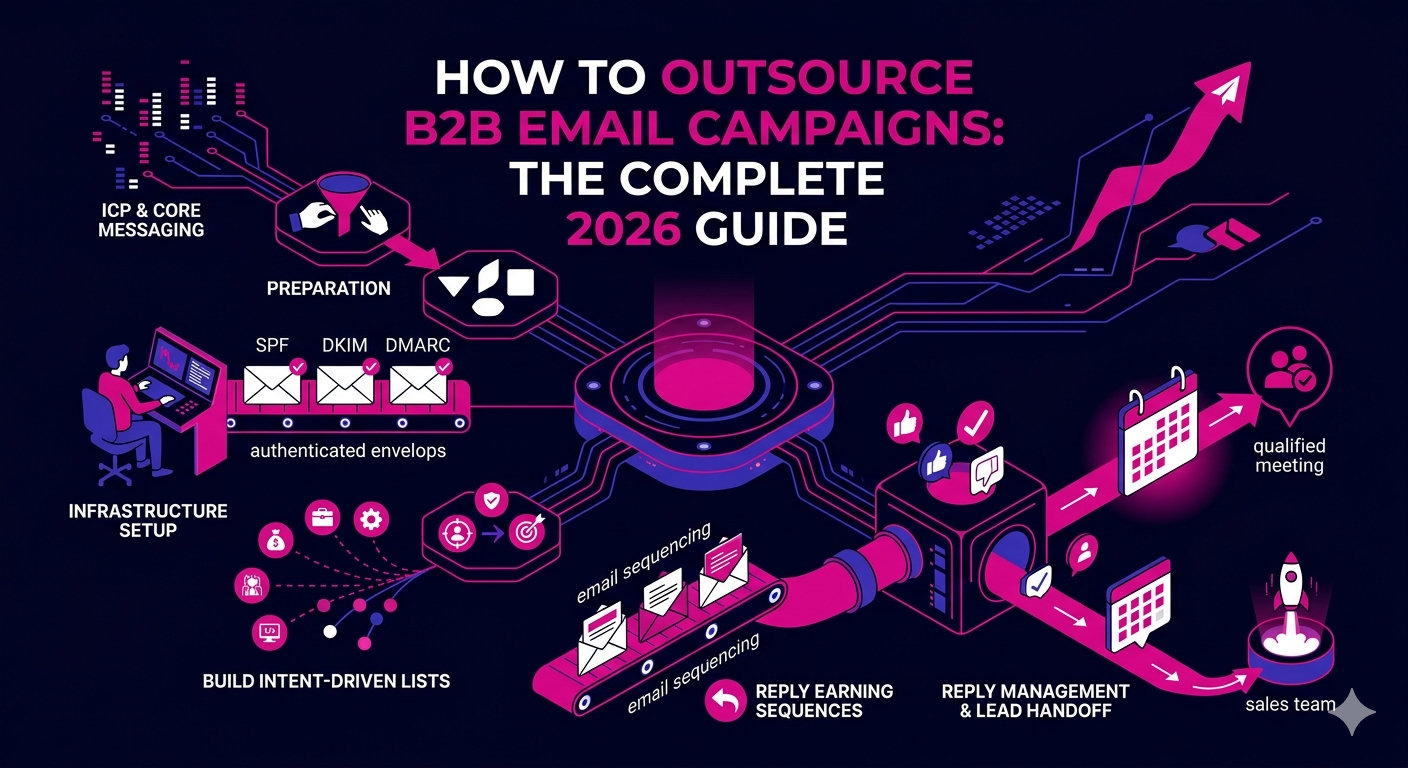
If your B2B pipeline is inconsistent and internal teams are stretched too thin to run email outreach properly, the answer is not to work harder. It is to bring in the right outside help. Knowing how to outsource B2B email campaigns effectively is one of the most impactful decisions a growing business can make in 2026. Done well, outsourced email campaigns fill your calendar with qualified meetings without pulling your team away from selling, product, or delivery. Done poorly, they burn your domain reputation and produce zero measurable return. This guide gives you a clear, step-by-step framework for outsourcing B2B email campaigns the right way.
Why Outsourcing B2B Email Campaigns Makes Sense in 2026
B2B email is not a simple task. According to benchmarks analyzed across billions of cold email interactions, the platform-wide average reply rate in 2026 sits at just 3.43%, with top-performing programs exceeding 10%. Reaching the top tier requires specialized expertise in deliverability, segmentation, copy, and data quality that most generalist marketers and sales teams do not have time to develop alongside their other responsibilities.
At the same time, the channel rewards investment. Companies that excel at email outreach generate up to 50% more sales-ready leads while cutting costs by roughly one-third compared to less disciplined programs. Segmented, well-targeted email campaigns drive 30% more conversions and up to 50% higher click-through rates than generic sends.
The case for outsourcing is straightforward: the expertise gap is real, the results ceiling is high, and the cost of doing it in-house poorly is significant. Up to 25% of B2B email contacts decay every year, your domain reputation can be permanently damaged by poor sending practices, and Gmail now enforces a spam complaint threshold of 0.1%, above which your emails face filtering or rejection. These are not risks worth taking with an undertrained internal team.
What to Prepare Before You Outsource B2B Email Campaigns
Outsourcing without preparation produces average results at best. The businesses that see the fastest pipeline growth from outsourced email campaigns are the ones that invest a week or two in getting organized before handing anything over.
Define Your ICP in Writing
Your Ideal Customer Profile is the foundation of every campaign. Before any outreach begins, document the types of companies you target, the roles you reach out to, the deal sizes that make sense, and the signals that suggest a prospect is ready to buy. Funding rounds, executive hires, technology stack changes, and hiring activity are all intent signals your outsourced team can use to prioritize who gets contacted first and when.
Gather Your Core Messaging Assets
Pull together case studies, customer testimonials, your value proposition statements, and any language your best salespeople use when they describe your offer. The person or team running your outsourced B2B email campaigns needs to understand how you talk about your product before they write a single sequence. Generic copy is one of the biggest reasons outsourced campaigns underperform, and it is almost always caused by inadequate briefing from the client side.
Align on Goals and KPIs
Decide upfront what success looks like. Open rates are unreliable in 2026 due to Apple Mail Privacy Protection inflating tracking data. The metrics that matter are qualified reply rates, positive reply rates, meetings booked per month, and pipeline value generated. Set specific targets, such as eight to twelve qualified meetings per month, and hold your outsourced partner accountable to these from the first monthly review.
How to Outsource B2B Email Campaigns: The Step-by-Step Process
Once your foundations are in place, here is the process for outsourcing B2B email campaigns in a way that generates real, measurable pipeline.
Step 1: Choose the Right Outsourcing Model
There are three main models for outsourcing B2B email campaigns. A dedicated remote cold email specialist works exclusively on your outreach program as a committed hire, typically for between $1,500 and $4,000 per month. A managed cold email agency handles everything under one retainer, typically for $3,000 to $15,000 per month. An outsourced SDR team adds phone and LinkedIn outreach alongside email for $5,000 or more per month.
For most growth-stage B2B companies, the dedicated remote specialist model offers the best balance of quality, control, and cost. You get someone who learns your product deeply, works inside your tools, and is accountable solely to your pipeline, not spread across twenty other clients.
The Remote Reps makes it simple to find and onboard experienced specialists. Explore our remote cold email experts who are pre-vetted, immediately deployable, and experienced in running B2B email campaigns across industries.
Step 2: Set Up the Infrastructure Correctly
Deliverability is the foundation of any outsourced B2B email campaign. Your specialist or agency must configure dedicated sending domains separate from your primary business domain, complete SPF, DKIM, and DMARC authentication, and run a minimum of two weeks of inbox warm-up before launching any sequences. Bounce rates must stay below 2% and spam complaint rates below 0.1%. Skipping any of these steps does not save time. It produces failed campaigns and potentially permanent domain damage.
Step 3: Build Intent-Driven Prospect Lists
Targeting based on company size and industry alone is no longer sufficient in 2026. The most effective outsourced B2B email campaigns use intent data and buying signals to identify prospects who are actively in-market. Your outsourced team should use tools like Apollo, Clay, ZoomInfo, or Lead411 to build lists that combine firmographic data with real-time signals. Emailing multiple contacts at the same target company also increases response rates by 93% compared to single-contact outreach, a strategy your specialist should implement systematically.
Step 4: Write Sequences That Earn Replies
Short emails perform best. Research from 2025 to 2026 data shows that emails between 50 and 125 words achieve approximately 50% higher reply rates than longer formats. Every sequence should include a clear trigger or reason for reaching out, a concise and specific value proposition, and a low-friction call to action. Follow-up emails matter enormously: two to five follow-ups are the minimum for optimal results, and persistence done professionally can increase reply rates by 50% or more. Your outsourced team should be testing subject lines, copy variations, and call-to-action language continuously.
Step 5: Manage Replies and Handoff Qualified Leads
Reply management is where many outsourced B2B email programs break down. Positive replies need to be routed to your sales team within hours, not days. Your specialist or agency should filter inbound replies, handle initial objections professionally, and book qualified meetings directly into your sales team’s calendars. All activity, including sends, replies, and booked meetings, should be logged into your CRM so nothing falls through and attribution is clear.
Step 6: Review, Report, and Optimize Weekly
Schedule a weekly 30-minute sync with your outsourced team to review what is working and what is being adjusted. Review reply rates by sequence, by audience segment, and by messaging angle. Look at what positive replies have in common. Ask what the next test will be. The outsourced campaigns that plateau are almost always the ones where the client treated reporting as a monthly event rather than a weekly discipline.
Common Mistakes When You Outsource B2B Email Campaigns
Understanding what goes wrong helps you avoid it. Here are the four mistakes businesses most consistently make when they outsource B2B email campaigns.
- Providing a vague or outdated ICP instead of a specific, documented profile with disqualifying criteria
- Measuring success by open rates instead of qualified meetings and pipeline value
- Allowing campaigns to launch before deliverability infrastructure is fully set up and warmed
- Failing to brief the outsourced team on brand voice, which leads to generic copy that does not match how your salespeople actually speak
For a deeper reference on what the best outsourced B2B email programs look like in practice, the Martal Group 2026 B2B cold email statistics and benchmarks guide covers reply rate benchmarks, follow-up cadence data, and what top-performing programs across 50 B2B verticals have in common.
Start Outsourcing Your B2B Email Campaigns Today
The pipeline gap between businesses that outsource B2B email campaigns with the right specialist and those still trying to run outreach as a side task is widening every quarter in 2026. If your sales team is strong at closing but stretched on prospecting, or if your email campaigns have been inconsistent and hard to measure, outsourcing to a dedicated specialist is the fastest path to a reliable, scalable outbound motion.
The Remote Reps connects you with pre-vetted remote specialists who are ready to own your B2B email campaigns from infrastructure setup to pipeline reporting. To expand beyond email, explore our remote lead generation experts for broader outbound support across multiple channels.
FAQ: How to Outsource B2B Email Campaigns
How do I know if I am ready to outsource B2B email campaigns?
You are ready to outsource B2B email campaigns when you have a clear ICP, a proven offer with at least some existing customer proof, and a sales team that can close meetings once they are booked. If your pipeline is inconsistent, if cold email has been sitting on the to-do list for months without traction, or if your internal team is spending prospecting time instead of selling time, outsourcing is the right move. You do not need to have perfected your email strategy internally first. That is what the outsourced specialist is there to build.
What should I expect to pay when I outsource B2B email campaigns?
The cost depends on the model. A dedicated remote specialist focused on your B2B email campaigns typically costs between $1,500 and $4,000 per month. A fully managed cold email agency typically charges between $3,000 and $15,000 per month. An outsourced SDR team with multichannel capability starts at $5,000 or more per month. For most growth-stage B2B businesses, the remote specialist model delivers the best return on investment, particularly in the first six to twelve months of building an outsourced outbound program.
How long does it take to see results when I outsource B2B email campaigns?
Most well-executed outsourced B2B email campaigns launch initial sequences within the first two to three weeks after infrastructure setup and warm-up. First qualified meetings typically appear within 30 to 60 days. Consistent, predictable pipeline from outsourced B2B email campaigns usually takes 60 to 90 days as targeting and copy are refined based on real reply data. Businesses that provide a thorough brief, clear KPIs, and active weekly feedback tend to see results at the faster end of this range.
Can I outsource B2B email campaigns without losing control of my brand voice?
Yes, and this is one of the most important things to get right when you outsource B2B email campaigns. The key is the quality and depth of the brief you provide. Share examples of your best sales conversations, your strongest case studies, and any language or phrases that feel off-brand. Review the first batch of sequences before they go live and give specific, actionable feedback. A strong outsourced specialist will adjust tone and messaging based on your input. If they are resistant to feedback on brand voice, that is a significant red flag.
What metrics should I track when I outsource B2B email campaigns?
When you outsource B2B email campaigns, focus on reply rates, positive reply rates, qualified meetings booked per month, and pipeline value generated by those meetings. Open rates are unreliable in 2026 due to Apple Mail Privacy Protection inflating data and should not be your primary success metric. Bounce rates should stay below 2% and spam complaint rates below 0.1% to protect your sending infrastructure. Monthly pipeline contribution from your outsourced email campaigns is the number that ultimately justifies the investment and guides ongoing budget decisions.