
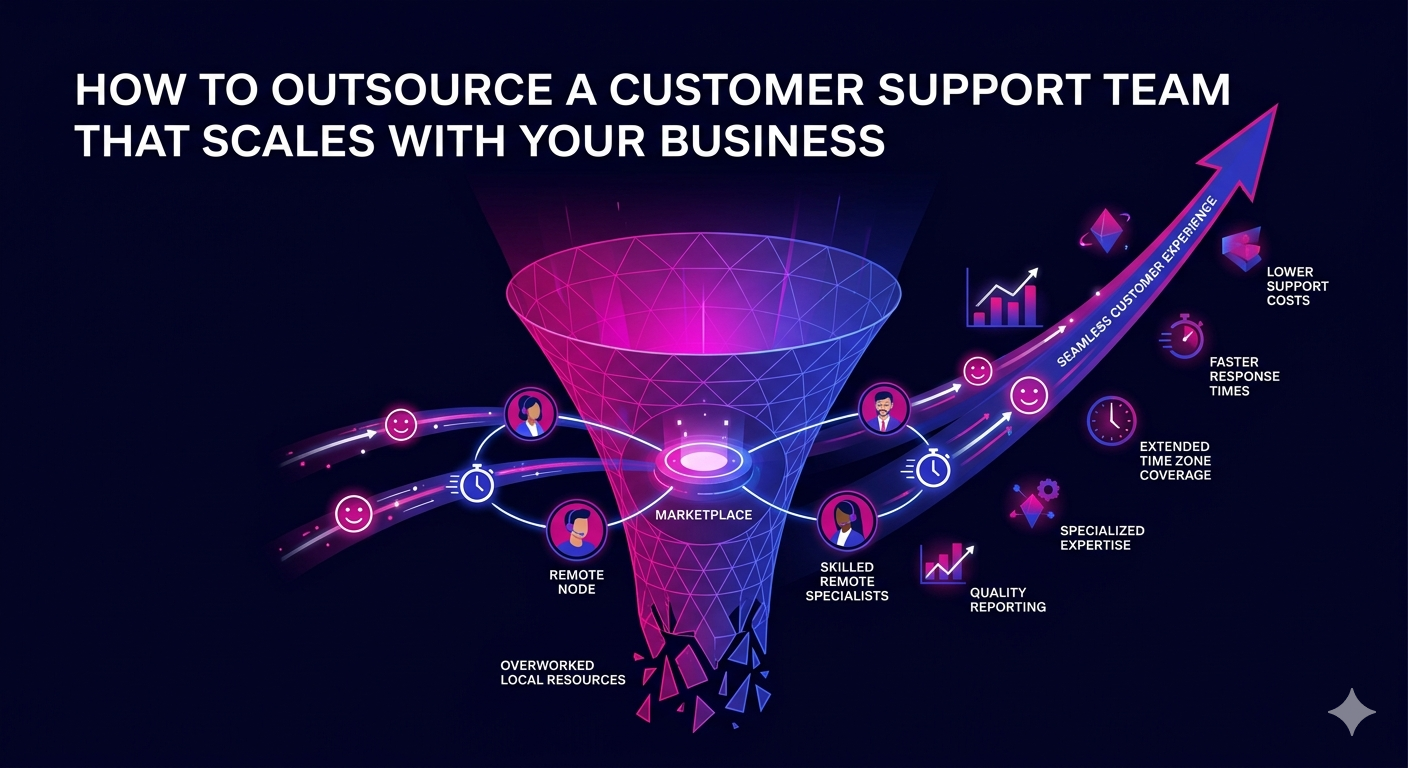
Every growing business reaches a point where internal support can no longer keep up. Response times stretch, ticket queues grow, and customer satisfaction starts to slip. The solution most high-performing companies turn to in 2026 is straightforward: outsource your customer support team to dedicated remote professionals who bring experience, flexibility, and focus that in-house generalists simply cannot match.
This guide covers the full picture of what it means to outsource a customer support team, including why businesses do it, what to look for, what it costs, and how to make the transition without disrupting your customers.
Why Businesses Choose to Outsource Their Customer Support Team
The decision to outsource a customer support team is rarely impulsive. It comes after businesses realize that in-house support is either too expensive to scale, too slow to adapt, or too inconsistent to trust with customer relationships at volume.
The most common reasons businesses make this move include:
- Rapid growth that outpaces the capacity of existing support staff
- The need for extended coverage across time zones without adding costly overnight shifts
- High turnover in traditional support roles driving constant recruiting and retraining costs
- The desire to access specialized expertise such as technical support, multilingual service, or platform-specific knowledge
- Pressure to reduce operational costs without reducing the quality of the customer experience
- A strategic shift toward focusing internal resources on product, sales, or operations rather than support
When executed correctly, outsourcing a customer support team delivers measurable improvements across every key support metric while freeing leadership to focus on growth rather than headcount management.
What an Outsourced Customer Support Team Actually Handles
One of the most important things to understand before you outsource a customer support team is the full range of functions a remote team can cover. This is far broader than many business owners initially expect.
Inbound Support Across Multiple Channels
A well-built outsourced support team handles customer inquiries across email, live chat, social media direct messages, helpdesk tickets, and phone calls. Multi-channel capability is standard among experienced remote support professionals and allows you to meet customers wherever they prefer to communicate.
Order Management and Account Queries
For e-commerce businesses, a significant portion of support volume relates to order status, returns, refunds, and account changes. An outsourced customer support team with CRM and order management platform experience can handle this volume efficiently, often with faster resolution times than internal teams managing competing priorities.
Technical and Product Support
SaaS companies and technology businesses frequently outsource first and second-tier technical support to remote specialists. These professionals handle onboarding questions, feature guidance, bug reporting, and troubleshooting before escalating complex cases to your internal engineering or product team.
Proactive Customer Success Activities
The best outsourced support teams go beyond reactive issue resolution. They conduct follow-up outreach, flag at-risk accounts, gather customer feedback, and identify opportunities to improve retention. This proactive layer turns your support function from a cost center into a genuine revenue retention asset.
Quality Assurance and Reporting
A structured outsourced customer support team also tracks its own performance. Regular reporting on first response time, first contact resolution rate, customer satisfaction score, and ticket volume gives you full visibility into support operations without needing to manage the data yourself.
The Real Cost of Outsourcing a Customer Support Team
Cost efficiency is one of the primary drivers behind the decision to outsource a customer support team. Here is a realistic breakdown of what to expect:
Individual Remote Representatives
A single experienced remote customer support professional typically costs between $1,500 and $3,500 per month for a full-time engagement depending on skill level, language requirements, and the complexity of your product or service. This compares to $45,000 to $70,000 per year for a comparable in-house hire in most Western markets once salary, benefits, equipment, and overhead are factored in.
Small Remote Support Teams
Businesses outsourcing a complete customer support team of three to five representatives typically invest between $5,000 and $15,000 per month. This range reflects the experience levels required, the number of channels covered, and whether a team lead or quality assurance function is included in the arrangement.
Scaled Operations
For businesses processing high ticket volumes or requiring 24/7 coverage across multiple time zones, outsourced team costs scale accordingly. Even at this level, the savings relative to equivalent in-house staffing remain substantial, typically in the range of 40 to 60 percent.
How to Evaluate Providers When You Outsource a Customer Support Team
Not every outsourcing path delivers the same results. The difference between a successful outsourced support operation and a disappointing one almost always comes down to how the team was sourced and how well the engagement was structured from the start.
Look for Industry-Specific Experience
Customer support is not a generic skill. The right team for a direct-to-consumer e-commerce brand looks very different from the right team for a B2B SaaS company. Prioritize candidates and providers with documented experience in your specific industry vertical and support environment.
Assess Communication Quality Directly
Do not rely on resumes alone. Request writing samples, conduct scenario-based assessments, and run a live test interaction before committing to any outsourced support arrangement. The quality of written and verbal communication is the single most important factor in customer-facing support roles.
Verify Platform and Tool Proficiency
Your outsourced team will work within your existing tech stack. Confirm that candidates are proficient in your helpdesk platform, CRM, and communication tools before onboarding begins. Common platforms include Zendesk, Freshdesk, Intercom, Salesforce, HubSpot, and Gorgias for e-commerce operations.
Require Transparent Reporting
Any reputable outsourced customer support team should provide regular performance reporting without being asked. Define reporting expectations upfront, including which metrics matter most to your business and how frequently you want performance reviewed.
Building the Right Structure for Your Outsourced Support Team
The structure of your outsourced customer support team should match the shape of your support needs. There is no single model that works for every business.
Dedicated vs. Shared Team Models
A dedicated outsourced team works exclusively for your business and develops deep product knowledge over time. A shared model, where representatives handle multiple clients, costs less but often produces shallower expertise and slower resolution times. For most growing businesses, a dedicated model delivers a stronger return on investment.
Time Zone Coverage Strategy
One of the most powerful advantages of remote outsourcing is the ability to build coverage across time zones without scheduling overnight shifts. Map your customer inquiry patterns to identify peak hours and geographic concentrations, then structure your outsourced team to cover those windows first.
Escalation Paths and Internal Integration
Your outsourced team needs a clear path to escalate issues that require internal knowledge, technical authority, or senior decision-making. Document these escalation paths in your knowledge base and make sure your outsourced team has direct channels to the right internal contacts for each category of issue.
Getting Started: How to Outsource Your Customer Support Team the Right Way
The transition to an outsourced support model goes smoothest when it is planned rather than reactive. Follow these steps to set your team up for success:
- Audit your current support volume, ticket categories, and peak demand windows before recruiting
- Document your product, services, common issues, and resolution workflows in a structured knowledge base
- Define your KPIs clearly, including target response times, resolution rates, and CSAT benchmarks
- Set up all platform access and communication tools before day one so your new team can start productively
- Schedule daily check-ins during the first two weeks and move to weekly reviews once the team reaches steady-state performance
- Build a feedback loop so your outsourced team can flag recurring issues that point to product or process improvements
The Remote Reps specializes in placing vetted remote customer support experts who are ready to integrate into your operations and deliver consistent, high-quality service from the start. Our placement process matches you with professionals based on your industry, tools, and communication standards.
If your support needs overlap with administrative or back-office functions, our remote virtual assistants can complement your support team with broader operational coverage.
For a comprehensive look at how leading companies structure their outsourced support operations, Help Scout’s guide to outsourcing customer service offers practical frameworks and benchmarks worth reviewing before you finalize your approach.
FAQ: Outsource Customer Support Team
What are the main benefits of choosing to outsource a customer support team?
The primary benefits of the decision to outsource a customer support team include significant cost savings compared to in-house hiring, access to experienced support professionals without a lengthy recruitment process, flexible scaling as your business grows, extended coverage across time zones, and the ability to redirect internal resources toward core business functions. Businesses that outsource their customer support team consistently report improvements in response time and customer satisfaction scores.
How do I maintain quality control when I outsource my customer support team?
Maintaining quality when you outsource a customer support team requires clear documentation, defined KPIs, and regular performance reviews. Establish a shared reporting dashboard, conduct periodic ticket audits, and collect direct customer feedback through CSAT surveys. Choose a remote staffing partner that offers dedicated placements so your team builds genuine product knowledge rather than rotating between clients.
Is it possible to outsource a customer support team for a technical product?
Yes. Many businesses successfully outsource customer support teams for complex technical products including SaaS platforms, hardware devices, and developer tools. The key is finding candidates with relevant technical backgrounds and providing thorough product training during onboarding. Remote specialists with experience in technical support roles can handle a high percentage of tier-one and tier-two queries independently.
How quickly can an outsourced customer support team be operational?
When working with a specialist remote staffing platform, an outsourced customer support team can typically be sourced, placed, and operational within two to four weeks. The onboarding period after placement usually takes an additional two to three weeks before representatives reach full competency. Having a well-organized knowledge base and clear onboarding documentation in place before day one accelerates this timeline considerably.
What size business should consider the decision to outsource a customer support team?
Businesses of almost any size benefit from choosing to outsource a customer support team, but it is particularly impactful for companies with 10 or more employees that are experiencing growing support volume, struggling with response time consistency, or facing high turnover in support roles. Early-stage startups also benefit from outsourcing support to avoid building a fixed cost structure before their customer base reaches scale.
Can I outsource a customer support team on a part-time or flexible basis?
Yes. Outsourcing a customer support team does not require a full-time, permanent commitment. Many remote staffing arrangements offer part-time engagements, project-based support during peak periods, and flexible scaling based on ticket volume. This makes the outsourced model especially attractive for seasonal businesses or companies in a growth phase where demand is unpredictable.