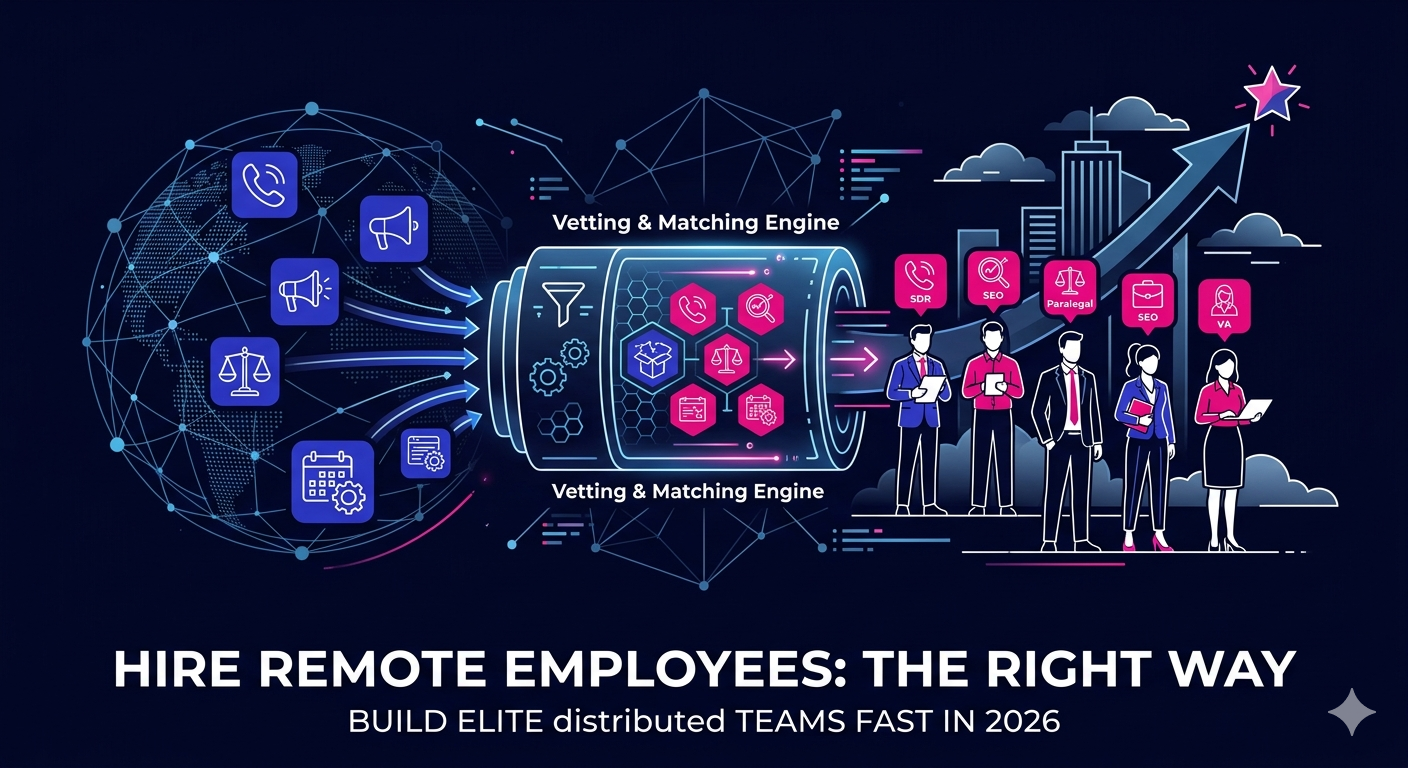
The decision to hire remote employees is no longer a workaround or a contingency plan. In 2026, it is simply how smart businesses grow. Whether you are scaling a SaaS company, running a lean startup, or expanding an established operation, building a remote team gives you access to global talent, lower overhead, and faster execution. The challenge is not whether to hire remote employees. The challenge is doing it right the first time.
This guide walks you through everything you need to know: the benefits, the risks to avoid, the roles worth hiring remotely, and the process that consistently delivers results.
Why More Businesses Choose to Hire Remote Employees in 2026
Remote work has matured significantly. The tools, workflows, and talent pools that support distributed teams are more developed than ever. Businesses that hire remote employees today are not experimenting. They are executing a proven model. Here is why the approach continues to gain momentum:
Lower Hiring and Operational Costs
Hiring locally in major metros means paying premium salaries, sourcing fees, and office costs. When you hire remote employees through a dedicated staffing partner, you can access highly skilled professionals at a fraction of the local market rate. Most businesses report savings of 40 to 70 percent compared to equivalent in-office hires, without compromising on quality or output.
A Wider, Deeper Talent Pool
Geography used to define who you could hire. That constraint no longer exists. When you hire remote employees, your candidate pool includes specialists from across the globe. Need a cold email expert with proven SaaS experience? A paralegal with expertise in IP law? A media buyer who has managed seven-figure ad budgets? These professionals exist. Remote hiring means you can find and place them.
Faster Time to Productivity
In 2026, experienced remote workers know how to hit the ground running. They are familiar with async communication, remote collaboration tools, and performance-driven environments. When you hire remote employees through a vetted staffing process, the ramp-up time is significantly shorter than with traditional hires who need time to adjust to new systems and workflows.
Built-In Scalability
Remote teams are inherently more flexible. You can expand quickly when demand increases and adjust your team structure when priorities shift. This flexibility is one of the most underrated benefits of choosing to hire remote employees, particularly for businesses operating in dynamic or seasonal markets.
The Most In-Demand Remote Roles in 2026
Not every role translates equally to a remote setting, but a wide range of functions are highly effective when staffed remotely. Here are the categories seeing the highest demand this year:
Sales and Revenue Teams
- Sales Development Representatives (SDRs) who qualify leads, run cold outreach, and book meetings at scale
- Sales Representatives who manage full sales cycles and close deals
- Cold Email Experts who write, test, and optimize outbound sequences for deliverability and conversion
- Lead Generation Experts who build and maintain outbound pipelines to fuel consistent revenue growth
Marketing and Digital Growth
- Digital Marketers who execute multi-channel campaigns across paid, organic, and social
- SEO Specialists who drive compounding organic traffic through technical and content strategies
- Social Media Managers who build communities, grow audiences, and manage brand voice
- PPC Experts and Media Buyers who manage paid advertising budgets across Google, Meta, and beyond
- E-commerce Marketing Experts who optimize product listings, funnels, and retention strategies
- Amazon Experts who manage marketplace performance, sponsored ads, and A-plus content
Operations and Administrative Support
- Virtual Assistants who handle scheduling, research, data management, inbox management, and more
- Executive Assistants who provide high-level support to founders, CEOs, and senior leadership
- Customer Support Experts who resolve issues, reduce churn, and protect your brand reputation
- GTM Engineers who build and optimize your go-to-market tech stack for scalable outbound
Legal and Professional Support
- Legal Assistants who support attorneys with documentation, scheduling, and case management
- Legal Secretaries who handle administrative functions within law firms and in-house legal departments
- Paralegals who assist with legal research, drafting, and case preparation
If you are ready to hire remote virtual assistants or any of the roles listed above, working with a dedicated staffing partner streamlines the entire process from sourcing to placement.
Common Mistakes When Businesses Try to Hire Remote Employees
Many companies struggle not because remote hiring is inherently difficult, but because they approach it the same way they approach traditional local hiring. Here are the most common mistakes and how to avoid them:
Skipping Role-Specific Vetting
A general interview process does not reveal whether a candidate can actually perform a specific remote role. A cold email expert needs to demonstrate campaign results, not just talk about strategy. An SDR should be assessed on their objection handling and pipeline metrics. When you hire remote employees, the vetting process must be role-specific and results-focused.
Hiring for Cost Instead of Value
It is tempting to prioritize the cheapest option when hiring remotely, especially given the cost advantages of distributed teams. But the cheapest hire is rarely the best hire. Focus on value and output rather than hourly rate. A highly skilled remote professional who delivers results will always outperform a lower-cost hire who underperforms.
Neglecting Onboarding and Communication Standards
Remote employees cannot pick things up through osmosis the way in-office staff can. When you hire remote employees, invest in a clear onboarding process. Define communication tools, response time expectations, performance metrics, and reporting cadences before day one. Clarity from the start prevents misalignment later.
Using Generic Job Boards Instead of Specialized Partners
Posting on a generic job board and waiting for applications is a slow and unpredictable process. A specialized remote staffing partner has pre-vetted talent pipelines ready to fill specific roles quickly. This dramatically reduces time-to-hire and increases the quality of candidates you see.
The Step-by-Step Process to Hire Remote Employees Successfully
Here is a proven process that consistently delivers high-quality remote hires:
- Define the role with precision. Go beyond a job title. Define the specific outcomes you need, the tools the candidate must know, the KPIs they will be held to, and the working hours and time zone requirements.
- Choose the right sourcing channel. For speed and quality, work with a staffing partner that specializes in the role type you need rather than relying on generic job platforms.
- Review pre-screened candidates. A good staffing partner will present a shortlist of candidates who have already been assessed for skills, communication, and role fit. You should be evaluating a small group of strong candidates, not sorting through hundreds of applications.
- Conduct a focused interview. Use your interview time to assess cultural alignment, communication style, and role-specific competency. Ask for examples, not hypotheticals.
- Make a fast decision. Top remote talent has options. When you find the right candidate, move quickly. A slow decision process often means losing the best person to a competitor.
- Onboard with structure. Provide clear documentation, set up all tools and access on day one, schedule regular check-ins during the first 30 days, and define success metrics so both sides know what winning looks like.
How a Remote Staffing Partner Makes It Easier to Hire Remote Employees
Doing all of this in-house takes significant time, resources, and expertise. That is why a growing number of businesses partner with specialized remote staffing agencies to handle the sourcing, vetting, and placement process on their behalf.
A quality remote staffing partner brings several advantages:
- Pre-vetted talent pipelines across multiple roles and skill sets
- Role-specific assessments that go beyond resume screening
- Faster time to hire compared to independent recruitment
- Placement guarantees that protect your investment if a hire does not work out
- Ongoing support to ensure the working relationship delivers long-term results
According to a 2025 report published by McKinsey’s People and Organizational Performance practice, companies that build structured remote hiring processes see significantly higher retention rates and faster productivity ramp-ups compared to those using unstructured approaches. Working with a remote staffing partner builds that structure into the process from day one.
What to Look for in a Remote Staffing Partner
If you decide to work with a remote staffing agency to hire remote employees, here is what to evaluate:
Specialization in Your Required Roles
Choose a partner that has proven experience in the specific roles you need. Generalist agencies with limited remote experience are a poor substitute for a specialized partner with an established track record in sales, marketing, legal support, or operations.
Transparent Vetting Standards
Ask how candidates are assessed. The best partners use multi-step screening that includes skills tests, communication assessments, background checks, and structured interviews. Understand the process before you commit.
Clear Pricing and Guarantees
Look for transparent pricing structures with no hidden fees, and ask about replacement policies. A confident staffing partner will stand behind their placements with a performance or replacement guarantee.
Client Results and References
Ask for case studies and client testimonials from businesses similar to yours. Real results from real clients are the best indicator of what you can expect when you hire remote employees through that partner.
Start Building Your Remote Team Today
In 2026, the businesses that win are the ones that build teams without borders. When you hire remote employees the right way, you gain access to elite talent at competitive rates, with the flexibility to scale as fast as your business demands.
The Remote Reps is a specialized remote staffing agency that helps businesses hire remote employees across sales, marketing, operations, and legal support. With a rigorous vetting process, dedicated account support, and a track record of successful placements, The Remote Reps makes it simple to build the team you need without the delays and uncertainty of traditional hiring.
Ready to get started? Visit The Remote Reps to learn more about how we help businesses hire remote employees who deliver real results from day one.
Frequently Asked Questions About How to Hire Remote Employees
What is the best way to hire remote employees in 2026?
The most effective way to hire remote employees in 2026 is to work with a specialized remote staffing agency that maintains vetted talent pipelines across key roles. This approach delivers faster placements, higher quality candidates, and a more structured onboarding process compared to posting independently on job boards. Define your role requirements clearly, review pre-screened candidates, and prioritize communication standards from the start.
How long does it take to hire remote employees through a staffing agency?
A well-established remote staffing agency can typically present qualified candidates within 3 to 7 business days of receiving your requirements. For standard roles such as virtual assistants, SDRs, or digital marketers, placements can be finalized within two weeks. More specialized roles may take slightly longer, but the process is still significantly faster than traditional in-house recruiting, which can take 4 to 8 weeks on average.
What roles can you hire remote employees for?
You can hire remote employees for a wide range of roles across nearly every business function. Common remote roles include sales development representatives, cold email experts, lead generation specialists, digital marketers, SEO specialists, social media managers, PPC and media buying professionals, virtual assistants, executive assistants, customer support agents, GTM engineers, and legal support staff including paralegals and legal assistants. Most operational and knowledge-based roles translate well to a remote environment.
How do you manage remote employees effectively after hiring?
Managing remote employees effectively requires clear systems from day one. Set defined KPIs and performance metrics, establish regular one-on-one check-ins, use a documented communication framework that specifies tools and response time expectations, and build a culture of async transparency. When you hire remote employees with strong communication skills and a track record of working in distributed teams, the management overhead is much lower than many businesses expect.
Is it safe to hire remote employees from overseas?
Yes. When you hire remote employees through a reputable staffing agency, the vetting process includes skills assessments, background checks, and communication evaluations regardless of where the candidate is based. Many businesses that hire remote employees internationally report excellent results, particularly when roles are well-defined and performance expectations are clearly communicated. A quality staffing partner also handles compliance and contracting frameworks to reduce legal and operational risk.
How much does it cost to hire remote employees?
The cost to hire remote employees varies depending on the role, skill level, and geography of the candidate. In general, businesses save between 40 and 70 percent on total compensation costs compared to equivalent local in-office hires when working with a remote staffing agency. The agency charges either a placement fee or a monthly retainer depending on the engagement model. When you factor in the reduced time-to-hire, lower turnover risk, and placement guarantees, working with a remote staffing partner offers strong return on investment compared to independent hiring.