Customer conversations happen in real time, and your ability to respond quickly and meaningfully determines whether a visitor converts or walks away. That is why more businesses in 2026 are investing in a dedicated remote Intercom support specialist to manage live chat, automate workflows, and deliver consistent, high-quality customer interactions at scale.
This guide covers everything you need to know: what the role involves, which skills matter most, how to onboard effectively, and where to find pre-vetted specialists who can start delivering results without a long ramp-up period.
What Does a Remote Intercom Support Specialist Do?
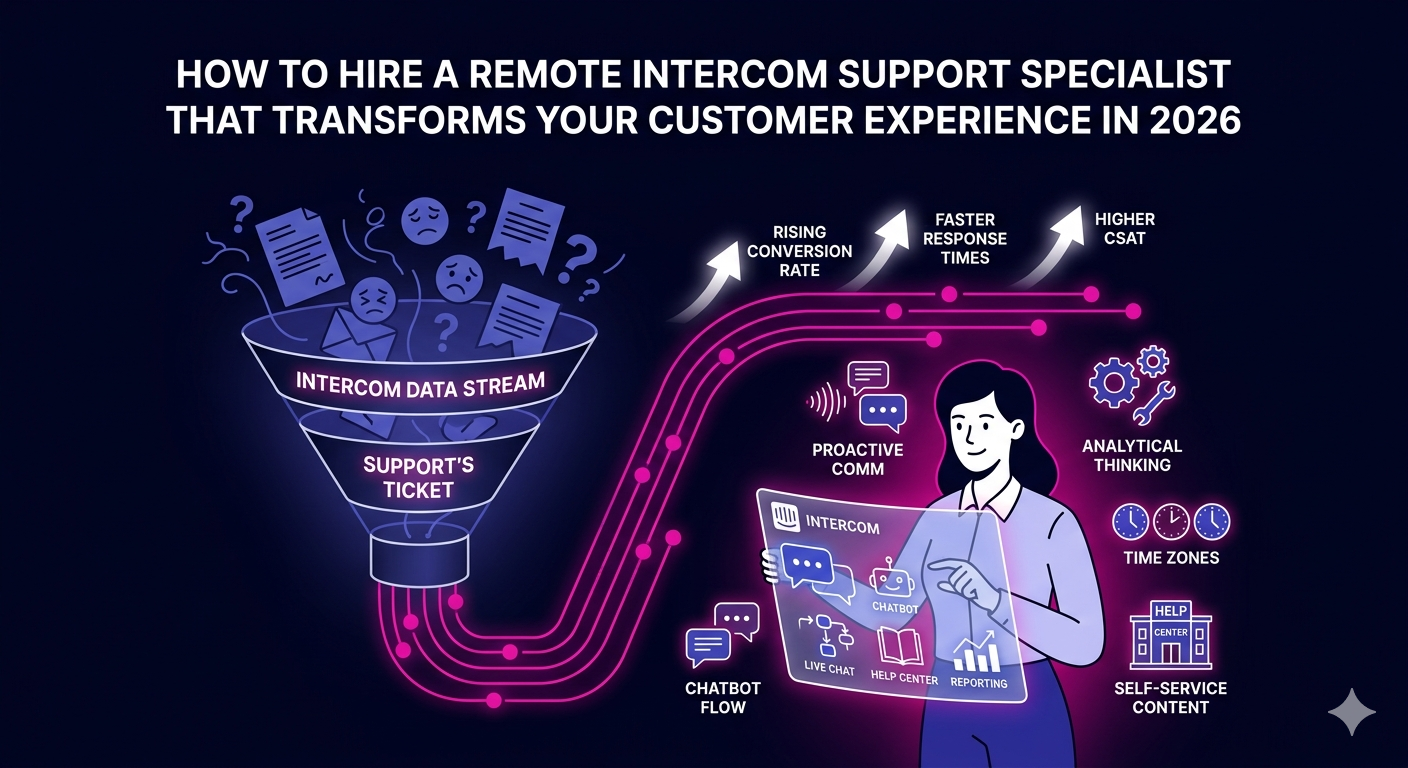
A remote Intercom support specialist is a customer-facing professional who operates entirely within the Intercom platform to manage and improve the support experience. Their responsibilities typically include:
- Handling inbound customer conversations via live chat, email, and in-app messaging
- Building and managing Intercom chatbot workflows and automated responses
- Tagging, routing, and prioritizing conversations using Intercom’s inbox tools
- Creating and maintaining Help Center articles to reduce ticket volume
- Analyzing Intercom reports to track response times, resolution rates, and CSAT scores
- Collaborating with product and sales teams using Intercom’s shared inbox and note features
Unlike a general support rep who might use multiple disconnected tools, a remote Intercom support specialist brings deep platform fluency that allows them to get more done in less time and with fewer errors.
Why Demand for Remote Intercom Support Specialists Is Growing in 2026
Several converging trends are pushing businesses toward dedicated remote Intercom professionals this year.
Intercom Has Become a Core Business Platform
Intercom is no longer just a chat widget. In 2026, it functions as a full customer communications hub that connects support, sales, and product teams. Businesses that use Intercom well see measurable improvements in conversion rates, support costs, and customer retention. Unlocking that full potential requires a specialist, not a generalist.
Remote Work Has Matured
The systems, tools, and management practices for remote teams have matured significantly. Hiring a remote Intercom support specialist today means accessing a global talent pool, often at a fraction of the cost of an equivalent in-house hire, without sacrificing quality or accountability.
Customer Expectations Have Raised the Bar
Customers in 2026 expect fast, personalized responses regardless of time zone. A remote specialist working across different hours means your Intercom inbox stays active and responsive well beyond your core business hours.
Key Skills to Look for in a Remote Intercom Support Specialist
When evaluating candidates, prioritize these competencies above general support experience.
Deep Intercom Platform Knowledge
Your specialist should be comfortable with Intercom’s full feature set: inbox management, Series automation builder, Custom Bots, Articles (Help Center), Outbound messaging, and the Reporting suite. Practical experience with Intercom’s REST API or Zapier integrations is a strong bonus for more technical roles.
Proactive Communication Style
Remote Intercom support specialists work independently and must communicate clearly without the benefit of in-person cues. Look for candidates who write with empathy, adjust their tone to match the customer’s situation, and know how to de-escalate difficult conversations.
Analytical Thinking
A strong specialist does not just respond to conversations. They analyze trends in ticket data, spot recurring issues, and suggest process improvements. Look for candidates who can read Intercom’s reporting dashboards and translate the data into actionable recommendations.
Content Creation for Self-Service
One of the highest-value activities a remote Intercom support specialist can perform is building out a robust Help Center. Candidates who can write clear, structured support articles reduce inbound ticket volume over time, delivering compounding returns on your investment.
Reliability and Remote Work Discipline
Self-management is non-negotiable in a remote role. The right candidate should have a proven track record of hitting response time targets, managing workload without close supervision, and communicating proactively when issues arise.
How to Structure the Onboarding of a Remote Intercom Support Specialist
Even experienced specialists need a structured onboarding to integrate smoothly with your team and workflows. Here is a practical framework:
Week One: Access and Orientation
Set up your specialist’s Intercom seat with the correct role permissions. Walk them through your existing inbox setup, tagging conventions, conversation routing rules, and escalation paths. Share any existing Help Center content and internal SOPs so they have a solid reference base from the start.
Week Two: Shadowing and Supervised Handling
Have your specialist shadow existing conversations before handling tickets independently. This allows them to absorb your brand voice, understand your product, and identify gaps in your current support documentation without risking customer experience in the process.
Week Three and Beyond: Independent Operation and Optimization
Once they are handling conversations independently, shift the focus to improvement. Assign them ownership of specific Help Center sections, ask them to audit existing chatbot flows, and begin weekly performance reviews using Intercom’s reporting tools.
Tools That Complement a Remote Intercom Support Specialist
To maximize your specialist’s effectiveness, make sure they have access to the right stack alongside Intercom:
- Slack or Microsoft Teams for internal communication and quick escalations
- Notion or Confluence for internal knowledge bases and SOP documentation
- Loom for async video walkthroughs during onboarding and training
- 1Password or LastPass for secure credential sharing across tools
- Zapier or Make to connect Intercom with your CRM, billing tools, or project management software
What Sets a Great Remote Intercom Support Specialist Apart
Beyond technical skills, the best remote Intercom support specialists share a few common traits that distinguish them from average candidates.
They treat every conversation as an opportunity to strengthen the customer relationship, not just close a ticket. They look for patterns in data that others overlook. They build self-service resources that reduce future support burden. And they communicate proactively with internal stakeholders, flagging issues before they escalate into larger problems.
These qualities are difficult to assess from a resume alone. That is why working with a vetted staffing partner significantly improves your chances of hiring someone who genuinely fits the profile.
Where to Find a Vetted Remote Intercom Support Specialist
Generic job boards rarely surface the Intercom-specific expertise you need. The most reliable path to finding a qualified remote Intercom support specialist is through a staffing partner that pre-screens candidates for both technical platform skills and remote work readiness.
Find a vetted remote Intercom support specialist through The Remote Reps and connect with customer support experts who are ready to integrate with your team and your tools from day one.
The Remote Reps focuses exclusively on placing skilled remote professionals in support, sales, marketing, and operations roles. Their rigorous screening process saves you weeks of sourcing, interviewing, and vetting so you can focus on running your business.
For a deeper understanding of how Intercom can be used to power a high-performing remote support operation, the Intercom blog on customer support is one of the most authoritative resources available, with practical guidance from real support teams.
Frequently Asked Questions About Hiring a Remote Intercom Support Specialist
What is the primary role of a remote Intercom support specialist?
A remote Intercom support specialist is responsible for managing customer conversations through the Intercom platform. This includes handling live chat and email inquiries, building automated chat workflows, maintaining Help Center content, and analyzing support performance data. Their core goal is to deliver fast, high-quality customer experiences while continuously improving the efficiency of the support operation.
How much does a remote Intercom support specialist typically cost?
Rates for a remote Intercom support specialist vary based on experience, location, and scope of work. Offshore specialists generally charge between $8 and $22 per hour, while those based in North America or Western Europe typically range from $20 to $50 per hour. Partnering with a specialist staffing service can help you identify the right fit at a rate that matches your budget and quality requirements.
Do I need to train a remote Intercom support specialist on my product?
Yes, product and workflow-specific training is always necessary, even for experienced specialists. A skilled remote Intercom support specialist will already know the platform inside out, but they will need to be briefed on your product, your customer base, your brand tone, and your internal escalation process. Plan for a structured onboarding period of two to four weeks for best results.
What metrics should I use to evaluate a remote Intercom support specialist?
The most relevant metrics to track through Intercom’s reporting include first response time, median resolution time, customer satisfaction (CSAT) score, number of conversations handled per day, and Help Center article views and deflection rates. Reviewing these metrics weekly gives you a clear, data-driven picture of your remote Intercom support specialist’s performance and impact.
Can a single remote Intercom support specialist manage a high-volume inbox?
It depends on your average daily conversation volume and the complexity of your support requests. A highly skilled remote Intercom support specialist using automation, macros, and well-structured chatbot flows can handle significantly more conversations than a less experienced agent relying on manual responses. For high-growth businesses, consider starting with one specialist and scaling as volume increases.
How do I ensure quality and accountability with a remote Intercom support specialist?
Clear KPIs, weekly performance check-ins, and Intercom’s built-in reporting tools are your primary accountability levers. Set measurable targets for response times and CSAT scores from the start, review conversations regularly through Intercom’s inbox, and create a feedback loop where your specialist can flag issues and suggest improvements. Accountability works best when expectations are clearly defined upfront.