
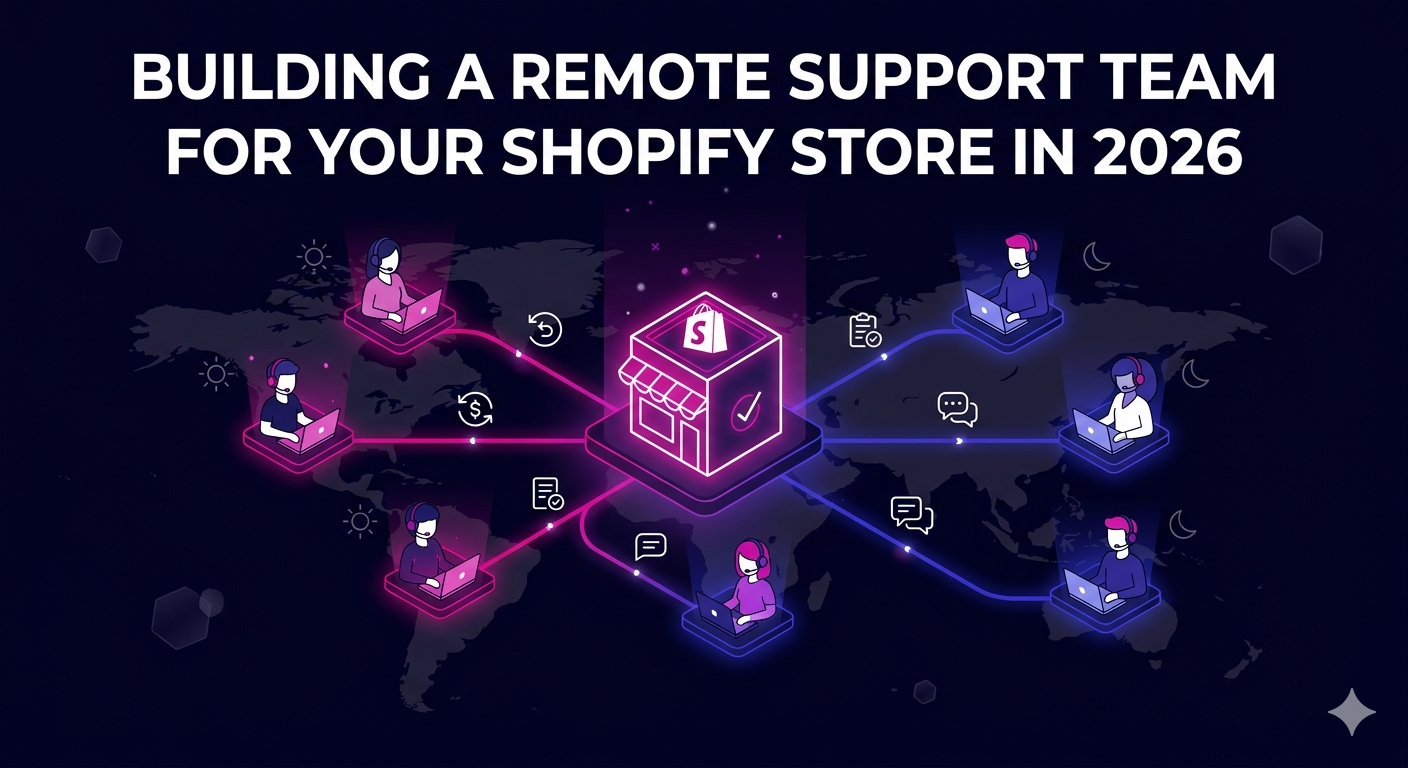
Running a Shopify store in 2026 means managing more moving parts than ever before. Between order inquiries, refund requests, product questions, and post-purchase follow-ups, customer support can quickly become the bottleneck that holds your growth back. The solution that more Shopify store owners are turning to is building a dedicated remote support team for their Shopify store, and the results speak for themselves.
A well-structured remote team handles your customer communication around the clock, keeps your response times low, and protects your store’s reputation without requiring you to hire locally or manage a physical office. This guide walks you through everything you need to know to build, hire, and manage a remote support operation that scales with your business.
Why a Remote Support Team Is Essential for Shopify Stores in 2026
Customer expectations have shifted significantly. Shoppers expect responses within hours, not days. They want support available across multiple channels including email, live chat, and social media. They expect agents who understand the product, the brand, and the buying experience.
Meeting those expectations with an in-house team is expensive and logistically complex. A remote support team for your Shopify store gives you access to trained professionals who can represent your brand at a fraction of the cost of local hires, often across multiple time zones so coverage is continuous.
Here is what a strong remote support operation delivers:
- Faster average response times across all customer channels
- Consistent brand voice in every customer interaction
- Higher customer satisfaction scores and repeat purchase rates
- Reduced churn caused by unresolved issues or slow communication
- Freed-up time for the store owner to focus on growth, not inbox management
What Roles Make Up a Remote Support Team for a Shopify Store
Not all support teams look the same. The right structure depends on your order volume, the complexity of your product, and the channels your customers use most. That said, most Shopify stores at a growth stage benefit from the following roles.
Customer Support Specialists
These are your frontline agents. They handle inbound inquiries via email, live chat, and sometimes phone. A good customer support specialist for a Shopify store understands how to navigate the Shopify admin, check order statuses, process refunds or exchanges, and escalate issues when needed. They are also trained to communicate in your brand voice so every interaction feels consistent.
Virtual Assistants
For stores that need flexible support beyond customer-facing tasks, a virtual assistant can cover order management, review moderation, supplier communication, and inbox triage. VA roles work especially well when your team is lean and you need someone who can move across multiple responsibilities without being limited to one function.
Social Media Support Specialists
Customers increasingly reach out through Instagram comments, Facebook messages, and TikTok replies. A social media specialist on your remote support team monitors these channels and responds in real time, making sure no complaint goes unanswered publicly and no positive interaction goes unacknowledged.
E-Commerce Operations Support
Larger stores often need someone who can manage returns processing, coordinate with fulfillment centers, and handle data entry tasks related to inventory and orders. This role bridges the gap between support and operations and becomes important as order volume grows.
How to Hire the Right Remote Support Team for Your Shopify Store
Hiring for a remote team requires a different approach than posting a local job listing and conducting in-person interviews. Here is how to approach it strategically.
Define Your Coverage Needs First
Before you post a job or reach out to an agency, map out exactly when your customers need support. Look at your ticket data and identify peak hours by day of week and time zone. This tells you how many people you need and what shift coverage is required. A Shopify store selling primarily to US customers with high weekend volume needs different staffing than one serving a global audience with steady daily volume.
Screen for Shopify-Specific Experience
General customer service experience is a starting point, but Shopify knowledge is a real advantage. Candidates who have already worked with Shopify admin, Gorgias, Zendesk, or similar helpdesk platforms can get up to speed in days rather than weeks. Ask candidates to walk you through how they would process a refund or look up an order in Shopify during the screening process.
Test for Communication Quality
Remote support is almost entirely written communication. Assess writing quality early in the hiring process. Send a sample support scenario and ask candidates to draft a response. Look for clarity, tone, empathy, and the ability to solve the problem efficiently without being robotic or overly formal.
Evaluate Time Zone Compatibility and Availability
One of the main advantages of building a remote support team for your Shopify store is the ability to cover time zones your local team cannot. Be upfront about shift requirements and confirm that candidates can commit to the hours you need. Reliability and consistency matter more than impressive credentials if your coverage windows are not met.
Building the Systems Your Remote Support Team Needs to Succeed
A remote support team is only as effective as the systems you put in place to support them. Before your first hire starts, build out the infrastructure that makes good work possible.
Set Up a Centralized Helpdesk
Tools like Gorgias or Zendesk connect directly to Shopify and give your remote team everything they need in one place: order history, previous ticket threads, refund and cancellation capabilities, and canned response libraries. Gorgias is particularly popular among Shopify merchants because of how deeply it integrates with the platform.
Create a Brand Knowledge Base
Your remote team cannot represent your brand effectively without knowing it well. Build a knowledge base that covers your product catalog, return and exchange policies, shipping timelines, FAQs, and escalation procedures. A well-documented knowledge base reduces onboarding time dramatically and ensures consistency across every agent.
Establish Clear Escalation Protocols
Not every issue should be resolved at the frontline level. Define exactly which situations require escalation, who handles escalations, and what the expected resolution time is. This protects your customers from falling through the cracks and gives your remote agents the clarity they need to act with confidence.
Track Performance with Real Metrics
The advantage of a remote setup is that everything is measurable. Track first response time, resolution time, customer satisfaction (CSAT) scores, and ticket volume by agent. Review these weekly and use them to coach your team and identify where processes can be improved.
Where to Find Vetted Remote Support Professionals for Your Shopify Store
Sourcing quality remote talent takes time if you go it alone. Posting on freelance platforms can yield inconsistent results and often requires sorting through a high volume of unqualified applicants.
Working with a specialist agency significantly shortens that process. The Remote Reps connects Shopify store owners with vetted customer support experts who are ready to represent your brand from day one. Whether you need one agent or a full remote support team, the matching process is designed around your specific store’s needs and volume.
For stores that also need broader operational support, pairing a customer support specialist with a remote virtual assistant gives you flexible coverage across both customer-facing and behind-the-scenes tasks.
According to Shopify’s research on e-commerce customer service best practices, stores that invest in structured support operations consistently outperform competitors on retention and lifetime customer value. Building a remote support team for your Shopify store is one of the highest-leverage investments you can make in 2026.
Conclusion: Start Building Your Remote Support Team Today
The cost of poor customer service is not just one lost sale. It is a negative review, a chargeback, a social media complaint, and a customer who never comes back. In 2026, when competition among Shopify stores is higher than ever, the brands that win are the ones that treat support as a core function, not an afterthought.
Building a remote support team for your Shopify store is more accessible than ever. The tools exist, the talent is available globally, and the agencies that specialize in e-commerce support can match you with the right people quickly. Start by mapping your coverage gaps, defining the roles you need, and reaching out to a specialist partner who can accelerate the hiring process.
Frequently Asked Questions: Remote Support Team for Shopify Store
What is a remote support team for a Shopify store and what do they do?
A remote support team for a Shopify store is a group of trained professionals who handle customer communication, order management, and post-purchase issues on behalf of a store owner. They work remotely and typically cover channels like email, live chat, and social media, using tools that integrate directly with Shopify to resolve inquiries efficiently.
How much does it cost to build a remote support team for a Shopify store?
The cost of building a remote support team for a Shopify store varies based on team size, coverage hours, and the experience level of the agents. Many store owners start with one part-time or full-time specialist and scale from there. Remote hiring typically costs 40 to 70 percent less than local hiring once you factor in salary, benefits, and office overhead.
What tools does a remote support team use to manage a Shopify store’s customer service?
A remote support team for a Shopify store typically uses a helpdesk platform like Gorgias or Zendesk, which integrates directly with Shopify to give agents access to order data, refund tools, and customer history. Communication is managed through shared inboxes, and performance is tracked via built-in analytics dashboards.
How do I ensure quality and consistency from a remote support team for my Shopify store?
Consistency from a remote support team for your Shopify store comes from strong onboarding documentation, a thorough brand knowledge base, canned responses for common scenarios, and regular performance reviews. Setting clear KPIs such as response time and CSAT scores from the start gives you visibility into quality and makes coaching straightforward.
Can a remote support team for a Shopify store handle multiple channels at once?
Yes. A well-structured remote support team for a Shopify store can manage email, live chat, social media comments and direct messages, and even SMS simultaneously. Using a centralized helpdesk that pulls all channels into one platform allows agents to switch between channels efficiently without losing context on any conversation.
How quickly can I get a remote support team up and running for my Shopify store?
With the right hiring partner, you can have a remote support team for your Shopify store operational within one to two weeks. Working with a specialist agency that pre-vets candidates dramatically shortens the time from posting to onboarding. The key is having your helpdesk, knowledge base, and escalation protocols ready before the first agent starts.