If you have ever found yourself asking “how do I manage remote employees in different time zones,” you are in good company. In 2026, distributed teams spanning multiple continents are no longer the exception. They are the standard operating model for thousands of growing businesses. And while the talent advantages are significant, the management challenges are equally real.
Time zone gaps create friction around meetings, approvals, communication delays, and team cohesion. But with the right systems and leadership approach, those same gaps can become a competitive advantage. This guide breaks down exactly how to manage remote employees in different time zones so your team stays aligned, productive, and motivated no matter where they are based.
Why Managing Remote Employees Across Time Zones Is Harder Than It Looks
On paper, remote work seems simple. Everyone has a laptop, a task list, and a video call app. In practice, managing remote employees in different time zones involves a layer of complexity that most managers underestimate until they are already in the middle of it.
Common pain points include:
- Delayed responses that slow down decisions and block progress
- Meetings that work for one region but fall at unreasonable hours for another
- Team members feeling disconnected from company culture and leadership
- Difficulty tracking performance and output without real-time oversight
- Miscommunication that goes unresolved for hours because no one is online simultaneously
Each of these problems is solvable, but they require intentional systems rather than improvised fixes. The managers who succeed with distributed teams treat time zone management as a core operational discipline, not an afterthought.
Step-by-Step: How to Manage Remote Employees in Different Time Zones
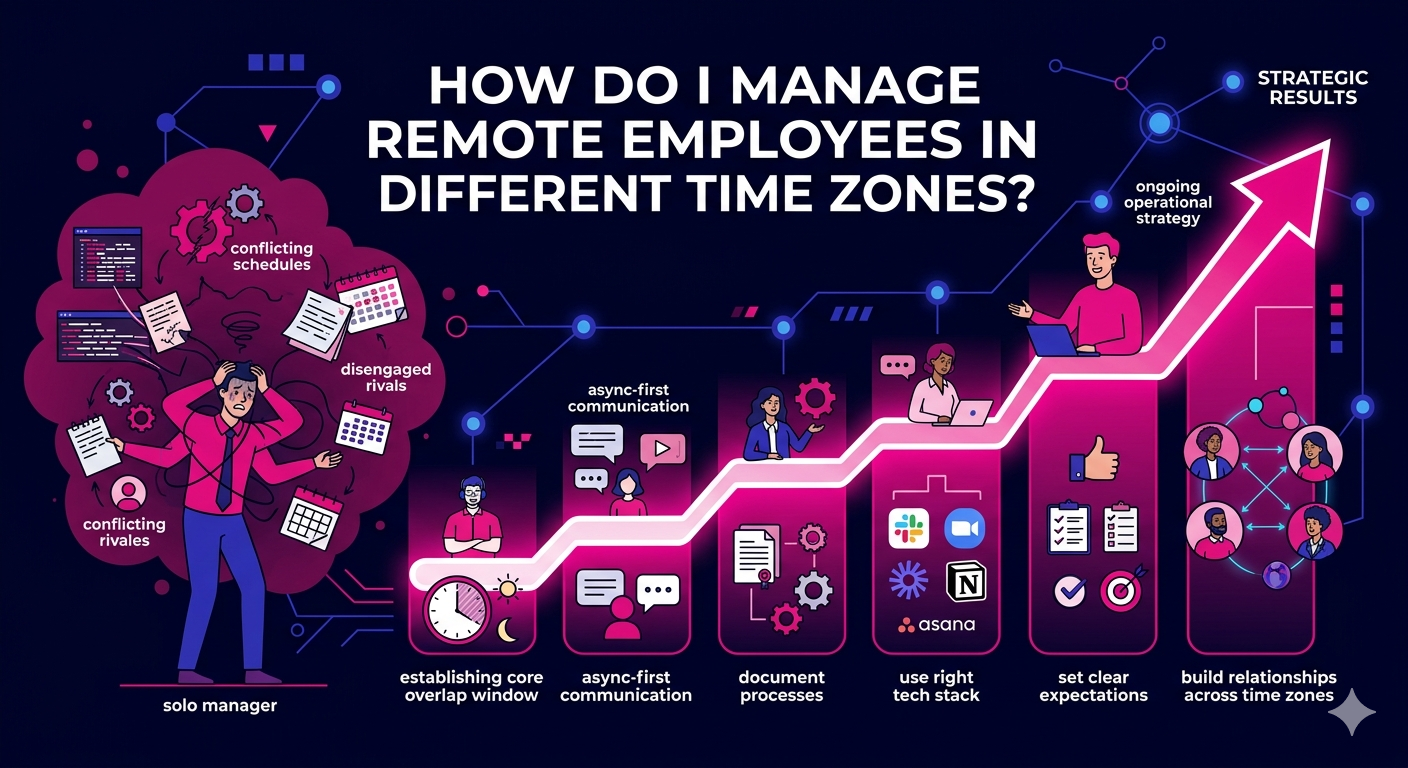
1. Establish a Core Overlap Window
One of the most effective ways to manage remote employees in different time zones is to define a daily core overlap window. This is a block of time, typically two to four hours, when all team members are expected to be online simultaneously regardless of their local time.
This window becomes the anchor for live collaboration, urgent decisions, and team check-ins. Outside of it, team members work asynchronously. Having a defined overlap prevents the frustration of perpetually missed communication while still giving each person flexibility in managing their own schedule.
When hiring, be transparent about the required overlap hours. This single step eliminates a significant amount of time zone misalignment before it even starts.
2. Default to Asynchronous Communication
Teams that try to manage remote employees in different time zones using a synchronous-first approach consistently struggle. When every question requires a real-time answer and every update needs a live meeting, teams in opposing time zones spend their days waiting rather than working.
Shifting to an asynchronous-first culture means:
- Using written updates and recorded video messages instead of scheduling calls for every topic
- Documenting decisions and their context in shared tools so anyone can catch up independently
- Setting clear response time expectations so team members know when they need to reply versus when a next-day response is acceptable
- Using project management platforms like Asana, Notion, or ClickUp to make task status visible without requiring a meeting to check in
Asynchronous communication respects each team member’s working hours while keeping information flowing consistently across the organization.
3. Document Everything
Documentation is the connective tissue of any team that needs to manage remote employees in different time zones. When decisions, processes, and context live in written form, any team member can access the information they need without waiting for someone in another hemisphere to wake up.
Prioritize documentation for:
- Role responsibilities and performance expectations
- Standard operating procedures for recurring tasks
- Meeting summaries and action items
- Project briefs, goals, and timelines
- Onboarding materials for new hires
Teams with strong documentation habits consistently outperform those that rely on verbal communication and informal knowledge sharing, particularly when working across time zones.
4. Use the Right Technology Stack
Technology will not solve time zone management problems on its own, but the wrong technology stack makes them significantly worse. Businesses looking to manage remote employees in different time zones effectively need tools purpose-built for distributed work.
A practical 2026 remote team tech stack includes:
- Communication: Slack or Microsoft Teams for threaded, organized messaging
- Video: Zoom or Loom for synchronous meetings and asynchronous video updates
- Project Management: ClickUp, Asana, or Monday.com for task visibility and accountability
- Documentation: Notion or Confluence for SOPs, wikis, and shared knowledge bases
- Time Zone Management: World Time Buddy or built-in calendar tools to schedule across regions without conflicts
The goal is to make information accessible and progress visible without requiring everyone to be online at the same time.
5. Set Clear Expectations Around Availability and Response Times
Ambiguity is the enemy of distributed teams. When managing remote employees in different time zones, one of the most impactful things a manager can do is define exactly what is expected in terms of availability, response times, and communication norms.
This means specifying:
- Which hours each team member is expected to be available for the core overlap window
- How quickly team members should respond to messages in various channels (urgent vs. non-urgent)
- How much advance notice is needed to schedule a meeting
- What constitutes an emergency that warrants off-hours contact
When these expectations are written down and communicated during onboarding, the daily friction of time zone management drops dramatically.
6. Prioritize Relationship Building Across Time Zones
Managing remote employees in different time zones is not purely a logistics challenge. It is also a people challenge. Team members who feel isolated or disconnected from their colleagues and leadership are more likely to disengage, underperform, and eventually leave.
Practical strategies for building team cohesion across time zones include:
- Rotating meeting times so the inconvenience of early or late calls is shared equitably rather than falling on the same people every week
- Hosting regular virtual team events that accommodate different regions
- Recognizing individual contributions publicly and consistently, regardless of where a team member is based
- Scheduling one-on-one check-ins that go beyond task status to include genuine relationship building
Managers who invest in relationships across time zones build teams that are more resilient, more communicative, and more loyal.
7. Hire With Time Zone Fit in Mind
One of the most proactive ways to manage remote employees in different time zones is to make time zone compatibility a deliberate part of the hiring process. Rather than hiring the most qualified candidate available globally and then trying to retrofit them into your team’s schedule, identify the time zones that work best for your operations and hire within them intentionally.
Working with a remote staffing platform that specializes in placing skilled professionals across different roles and geographies makes this process significantly easier. You can filter for candidates in specific regions, with specific availability windows, and with the communication skills needed to thrive in a distributed environment.
If your team needs reliable, skilled remote support across time zones, explore professional remote executive assistants who are experienced in managing cross-time-zone coordination and keeping distributed teams running smoothly.
For additional perspective on how businesses have successfully managed remote employees in different time zones, Harvard Business Review’s research on managing remote employees across time zones offers evidence-based insights from organizations that have built high-performing distributed teams.
The Biggest Mistake Managers Make With Distributed Teams
The most common mistake when trying to manage remote employees in different time zones is applying an in-office management mindset to a remote context. Monitoring hours, requiring constant availability, or scheduling unnecessary meetings to maintain visibility are all signals of a management approach that has not adapted to distributed work.
In 2026, the best remote managers lead with outcomes rather than activity. They define what success looks like, give their teams the tools and context to achieve it, and trust their people to deliver. This mindset shift is what separates thriving distributed teams from struggling ones.
Conclusion: Managing Remote Employees Across Time Zones Is a Learnable Skill
The question of how do I manage remote employees in different time zones does not have a single answer, but it does have a clear framework. Define your overlap window. Embrace asynchronous communication. Document your processes. Use the right tools. Set explicit expectations. Build real relationships. And hire with time zone fit in mind from the very beginning.
None of these strategies require a large budget or years of experience to implement. They require clarity, consistency, and a willingness to adapt your management approach to the reality of distributed work.
If you are ready to build a high-performing remote team that operates effectively across time zones, The Remote Reps connects businesses with pre-vetted remote professionals who are skilled, reliable, and ready to integrate into your operations from day one.
Frequently Asked Questions
How do I manage remote employees in different time zones without constant meetings?
The key to managing remote employees in different time zones without relying on constant meetings is building a strong asynchronous communication culture. Use written updates, recorded video messages, and project management tools to keep information visible and accessible. Reserve meetings for decisions and collaboration that genuinely require real-time discussion, and document the outcomes so team members in other time zones can stay informed without attending every call.
What tools help me manage remote employees in different time zones?
When figuring out how to manage remote employees in different time zones, the right tools make a significant difference. In 2026, effective distributed teams typically rely on Slack or Microsoft Teams for communication, Asana or ClickUp for project management, Notion for documentation, and Loom for asynchronous video updates. World Time Buddy and Google Calendar’s time zone features are also useful for scheduling across regions without conflicts.
How do I handle performance management when remote employees are in different time zones?
Managing remote employees in different time zones effectively means shifting performance management from activity-based to outcome-based. Define clear KPIs for each role, conduct regular one-on-one check-ins during your core overlap window, and use project management tools to track progress on deliverables. This approach ensures accountability without requiring real-time monitoring and works regardless of where a team member is located.
How many overlap hours do I need to manage remote employees in different time zones?
Most managers find that two to four hours of daily overlap is sufficient to manage remote employees in different time zones effectively. This window provides enough time for live collaboration, urgent decisions, and team alignment without requiring everyone to work the same full schedule. When hiring, be transparent about required overlap hours so candidates can confirm their availability before joining the team.
How do I keep remote employees in different time zones engaged and connected?
Team engagement is one of the softer but most important aspects of how to manage remote employees in different time zones. Rotate meeting times to distribute inconvenience fairly, recognize contributions publicly and regularly, schedule genuine relationship-building conversations beyond task updates, and create virtual team rituals that include everyone regardless of region. Employees who feel seen and connected are significantly more likely to stay engaged and perform at a high level.
Should I hire remote employees only in specific time zones to make management easier?
Hiring within specific time zones is one of the most proactive strategies for managing remote employees in different time zones. When the entire team or key roles fall within compatible time zones, the logistical complexity of distributed management decreases substantially. Working with a remote staffing platform that allows you to filter candidates by region and availability helps ensure you hire people who can genuinely integrate into your team’s schedule rather than working around it.