
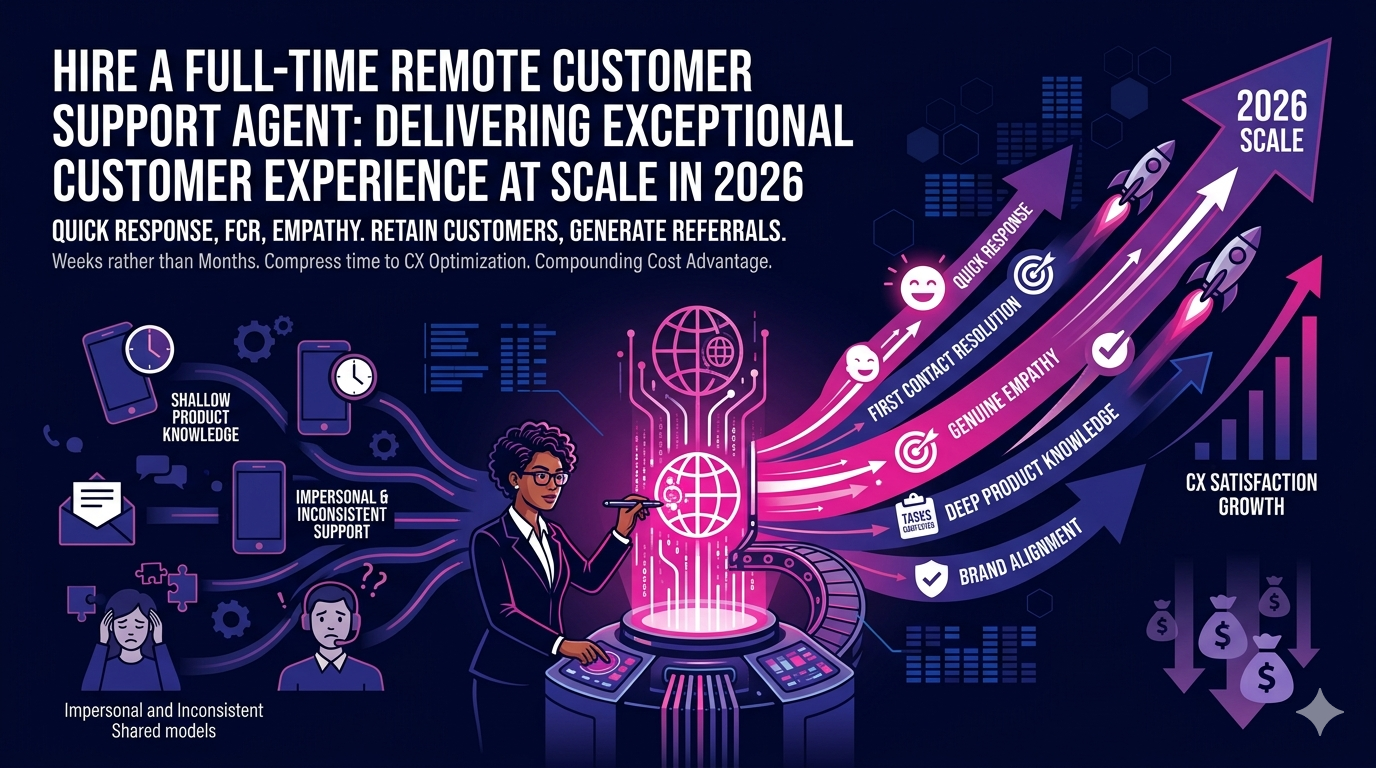
Customer experience is one of the most powerful differentiators available to businesses in 2026. Companies that respond to customer inquiries quickly, resolve issues on the first contact, and communicate with genuine empathy retain customers longer, generate more referrals, and build brand equity that takes competitors years to replicate. The most practical and cost-efficient way to build that kind of customer experience capability is to hire a full time remote customer support agent who dedicates their entire working day to representing your brand, resolving customer issues, and delivering the consistent, professional communication that turns one-time buyers into loyal advocates.
This guide covers everything you need to know about hiring a full time remote customer support agent in 2026: what the role involves, what quality to expect, what skills and attributes to evaluate, how much it costs, and how to onboard and manage your remote support agent for the customer satisfaction results your business needs.
What Does a Full Time Remote Customer Support Agent Do?
A full time remote customer support agent manages all customer-facing communications for your business from a remote location, working 40 hours per week exclusively for your brand. They are the front line of your customer experience: the person your customers interact with when they have a question, a problem, or a need that requires professional attention. Unlike a shared call centre agent who handles multiple brands simultaneously with shallow product knowledge, a full time dedicated remote support agent develops deep familiarity with your product, your policies, your brand voice, and your customer base, allowing them to deliver a quality of support that genuinely reflects your brand standards.
Core Responsibilities of a Full Time Remote Customer Support Agent
- Responding to customer inquiries via email, live chat, phone, and social media messaging within your defined response time targets
- Diagnosing and resolving product or service issues accurately, professionally, and efficiently on the first contact where possible
- Processing returns, refunds, exchanges, and account credits in compliance with your policies
- De-escalating frustrated or upset customers with patience, empathy, and effective problem-solving
- Escalating complex technical, billing, or policy-exception situations to appropriate internal team members with full context
- Logging all customer interactions, issues, and resolutions in your CRM or helpdesk system accurately
- Following up with customers to confirm issue resolution and satisfaction after complex interactions
- Identifying recurring complaint patterns or product issues and surfacing them to product or operations teams proactively
- Managing customer communications on marketplace platforms such as Amazon Seller Messaging or Etsy Conversations for e-commerce businesses
- Contributing to knowledge base maintenance by identifying gaps in documentation that cause recurring customer confusion
Why Hiring a Full Time Remote Customer Support Agent Delivers Superior Results Compared to Other Support Models
Businesses in 2026 have multiple options for staffing customer support. Understanding why a dedicated full time remote agent consistently outperforms the alternatives helps frame why this model is worth investing in.
Full Time vs. Shared Call Centre
Shared call centre arrangements route customer inquiries to agents who handle multiple brands simultaneously. These agents have shallow product knowledge, rely heavily on generic scripts, and have no brand loyalty to your business. The result is support that feels impersonal and inconsistent, that requires customers to repeat themselves across interactions, and that often fails to resolve issues on the first contact. A full time remote customer support agent who works exclusively for your business develops the brand knowledge, product familiarity, and customer relationship awareness that produces genuinely better support outcomes and higher customer satisfaction scores.
Full Time vs. Part-Time or Freelance Support
Part-time or freelance support arrangements introduce availability gaps, response time inconsistencies, and shallow brand investment that undermine the customer experience during the hours when the part-time agent is not working. A full time remote customer support agent provides consistent, 40-hour-per-week coverage and develops the depth of brand knowledge that only comes from dedicated, ongoing daily engagement with your product and customers.
Full Time Remote vs. In-Office at Domestic Rates
A full time in-office customer support agent in the United States in 2026 costs $40,000 to $58,000 per year in base salary plus $15,000 to $22,000 in benefits, payroll taxes, equipment, and office overhead, totaling $55,000 to $80,000 fully loaded per agent per year. A full time remote customer support agent placed through a quality offshore staffing partner delivers equivalent or superior customer experience at $10,000 to $33,600 per year, generating per-agent annual savings of $30,000 to $55,000 that can be reinvested in product development, marketing, or additional customer support capacity.
What to Look for When You Hire a Full Time Remote Customer Support Agent
The qualities that separate an excellent full time remote customer support agent from an average one are specific and worth evaluating rigorously during the hiring process. Here is a comprehensive evaluation framework.
Communication Quality: Written and Verbal
Customer support is fundamentally a communication discipline. Every interaction your remote support agent has with a customer reflects directly on your brand. Assess both written and verbal communication quality during the hiring process through multiple touchpoints:
- Written English quality in email responses and sample ticket replies: look for clarity, professionalism, appropriate tone, and freedom from grammar errors that would undermine customer confidence
- Verbal communication for phone support roles: clear enunciation, confident but warm tone, the ability to explain technical issues in plain language, and composure under pressure
- Empathy and tone calibration: the ability to match communication style to the emotional state of the customer, being firm when needed and warm when a situation calls for it
- Conciseness and accuracy: the ability to answer customer questions completely without unnecessary length or vagueness that prolongs resolution time
Helpdesk and CRM Platform Proficiency
- Hands-on experience with the helpdesk platform your business uses: Zendesk, Freshdesk, HubSpot Service Hub, Gorgias, Intercom, or others
- Familiarity with live chat tools and the ability to manage multiple concurrent chat conversations during peak inquiry periods
- CRM proficiency for maintaining accurate customer records, interaction histories, and issue tracking
- Ability to use knowledge base and response template tools to deliver consistent, accurate answers at speed
- Basic proficiency with screen sharing, remote access, or video call tools for technical support roles that require screen-based issue diagnosis
Problem-Solving Ability and Judgment
- Demonstrated ability to diagnose the root cause of a customer complaint accurately rather than addressing only the surface symptom
- Judgment about when to resolve an issue independently within their authority level and when to escalate to a more senior team member
- Creativity and flexibility in finding solutions for situations that fall outside standard policy boundaries while maintaining policy integrity
- The ability to de-escalate a genuinely upset customer through empathy and problem ownership rather than defensiveness or script-following
Work Ethic, Reliability, and Remote Professionalism
- Consistent schedule adherence and availability during your defined support hours, assessed through references from previous remote roles
- A reliable, high-speed internet connection and a quiet, professional home office environment suitable for customer-facing interactions
- Proactive communication about schedule changes, capacity constraints, or issues that could affect customer response times
- A track record of high customer satisfaction scores or positive customer feedback from previous support roles
How Much Does It Cost to Hire a Full Time Remote Customer Support Agent in 2026?
Monthly investment levels for a dedicated full time remote customer support agent placed through a quality offshore staffing partner in 2026 typically include:
- Entry-level full time remote support agent: $800 to $1,500 per month for candidates with foundational customer service experience handling standard inquiry types via email and live chat, with basic helpdesk platform familiarity
- Experienced full time remote support specialist: $1,500 to $2,800 per month for agents with 3 to 5 years of customer support experience, strong helpdesk proficiency, excellent CSAT track records, and experience managing more complex issue types including returns, billing disputes, and technical troubleshooting
- Senior remote support specialist or team lead: $2,800 to $4,500 per month for highly experienced professionals capable of managing complex escalations, coaching junior support agents, quality monitoring, and overseeing multi-channel support operations for higher-volume customer bases
These rates generate annual per-agent savings of $30,000 to $55,000 compared to the fully loaded cost of equivalent full time in-office support staff in the United States, making dedicated remote customer experience capability financially accessible at every business size and growth stage.
When you are ready to hire a full time remote customer support agent who delivers genuine, brand-aligned customer experience at a cost that fits your business model, explore The Remote Reps’ dedicated full time remote customer support agent placement service and connect with pre-vetted support professionals ready to represent your brand from day one. You can complement your support function by also hiring a remote virtual assistant to handle operational overflow tasks, or an remote e-commerce marketing expert to reduce inbound support volume through better product documentation and proactive customer communication.
How to Onboard a Full Time Remote Customer Support Agent for Rapid Results
The onboarding experience you provide to your full time remote customer support agent determines how quickly they can begin handling real customer interactions at your brand’s quality standard. Here is a proven three-week onboarding framework.
Week One: Product, Policy, and Platform Immersion
Walk your new full time remote customer support agent through your product or service in genuine depth: how it works, what problems it solves, the most common ways customers use it, and the most frequent issues or questions that arise. Review your support policies including return and refund procedures, shipping issue protocols, escalation thresholds, and any exceptions or special handling cases. Grant full access to your helpdesk, CRM, knowledge base, and any other platforms they will use. Provide a library of approved response templates for your most frequent inquiry types and walk through each one explaining the reasoning behind the tone and content choices.
Week Two: Supervised Ticket Handling and Quality Calibration
Have your full time remote customer support agent begin handling real tickets under supervision during week two. For email and chat interactions, review responses before they are sent where practical and provide specific written feedback on tone, accuracy, policy adherence, and brand voice alignment. For phone interactions, review call recordings and provide specific coaching on areas for improvement. This supervised period is critical for calibrating your agent’s understanding of your quality standard before they begin handling customer interactions fully independently.
Week Three and Beyond: Independent Operation and KPI Tracking
From week three, your full time remote customer support agent should be managing their full ticket queue independently. Begin tracking formal performance metrics including first response time, average resolution time, first contact resolution rate, and CSAT scores collected through post-interaction surveys. Hold a weekly performance review to celebrate strong results, address any recurring issues, and update knowledge base materials as your product and policies evolve. This weekly rhythm of measurement and feedback is what turns a capable support agent into a continuously improving customer experience asset for your business.
According to Zendesk’s Customer Experience Trends Report on full time remote customer support agent performance and customer expectations in 2026, customers rate response speed, first contact resolution, and agent empathy as the three most important drivers of satisfaction with support interactions. Full time dedicated remote support agents who are properly onboarded and receive consistent performance feedback consistently outperform shared and part-time support arrangements on all three of these critical satisfaction drivers.
Complementary Roles That Strengthen Your Full Time Remote Customer Support Function
A full time remote customer support agent handles the direct customer interaction layer of your support function. Several complementary remote hires can strengthen the overall customer experience ecosystem around your support agent:
- Remote virtual assistants who handle operational overflow tasks including order management research, vendor communication, and administrative follow-up that frees your support agent to focus entirely on customer interactions
- Remote e-commerce marketing experts who improve product documentation, FAQ content, and post-purchase communication sequences that reduce inbound support volume by addressing common questions proactively
- Remote GTM engineers who configure and optimize your helpdesk automation, ticket routing logic, and CRM integration so your support agent can work more efficiently and focus on complex interactions rather than routine ticket management
Conclusion: Hire a Full Time Remote Customer Support Agent and Build the Customer Experience Your Brand Deserves in 2026
Your customers form their most lasting impression of your brand not from your product alone but from every interaction they have when something goes wrong or they need help. In 2026, a full time remote customer support agent gives your business the dedicated, knowledgeable, brand-aligned customer experience capability it needs to deliver the kind of support that turns customers into advocates, at a cost that makes excellent customer service financially sustainable rather than a luxury reserved for businesses with large support budgets.
The Remote Reps places pre-vetted full time remote customer support agents for businesses across e-commerce, SaaS, professional services, and every other industry where customer experience matters. Our candidates are assessed for real communication quality, real helpdesk proficiency, and the empathy and professionalism that customer-facing roles demand.
Read what our clients say about the customer experience results they have achieved through The Remote Reps, or visit theremotereps.com to hire your full time remote customer support agent today.
FAQ: Hire Full Time Remote Customer Support Agent
What is the difference between hiring a full time remote customer support agent and using a shared call centre?
When you hire a full time remote customer support agent, you engage a dedicated professional who works exclusively for your business 40 hours per week, develops deep product knowledge, represents your specific brand voice, and builds the customer relationship awareness that produces genuinely better support outcomes over time. A shared call centre routes inquiries to agents handling multiple brands simultaneously, with shallow product knowledge, generic scripted responses, and no brand loyalty. For businesses where customer experience is a competitive differentiator, a full time dedicated remote customer support agent consistently produces higher CSAT scores, higher first contact resolution rates, and stronger customer retention than shared call centre arrangements.
How much does it cost to hire a full time remote customer support agent in 2026?
A full time remote customer support agent placed through a specialist offshore staffing partner in 2026 typically costs between $800 and $4,500 per month depending on experience level and specialization. Entry-level agents handling standard email and chat inquiries cost $800 to $1,500 per month. Experienced specialists with strong CSAT track records and complex issue handling capability fall in the $1,500 to $2,800 range. Senior specialists or team leads are priced at $2,800 to $4,500 per month. These rates generate per-agent annual savings of $30,000 to $55,000 compared to the fully loaded cost of equivalent full time in-office support staff in the United States.
What channels can a full time remote customer support agent handle?
A full time remote customer support agent in 2026 can manage customer inquiries across email, live chat, phone, social media direct messaging including Instagram, Facebook, and X, marketplace messaging platforms such as Amazon Seller Messaging and Etsy Conversations, WhatsApp and SMS support channels, and community forum or review platform responses. The specific channels your remote support agent manages depend on where your customers primarily reach out and the channel expertise of the candidate placed with your business. Specify your priority channels clearly when briefing a staffing partner to ensure you receive candidates with relevant experience across your active support channels.
How long does it take to onboard a full time remote customer support agent to a productive standard?
A full time remote customer support agent placed through a quality staffing partner and onboarded with a structured product, policy, and platform immersion program typically reaches independent, productive operation within 2 to 3 weeks of starting. During week one, the focus is on product knowledge, policy understanding, and platform access. Week two involves supervised ticket handling with close quality review and specific feedback. By week three, most full time remote support agents are managing their queue independently at a quality level that meets your brand standard. Agents who receive detailed onboarding, a well-maintained knowledge base, and clear escalation guidelines consistently reach productive independence faster than those with minimal onboarding support.
How do I measure the performance of a full time remote customer support agent?
The most important performance metrics for a full time remote customer support agent are first response time, which measures how quickly the agent replies to new inquiries; first contact resolution rate, which measures the percentage of issues resolved without requiring a follow-up; average resolution time, which measures how long it takes to fully close an issue; customer satisfaction score collected through post-interaction surveys; and ticket volume handled per shift. Modern helpdesk platforms including Zendesk, Freshdesk, and Gorgias generate these metrics automatically, giving you real-time visibility into your remote agent’s performance without requiring manual reporting. Review these metrics in a weekly check-in and use them to provide specific, constructive performance coaching on an ongoing basis.
Can a full time remote customer support agent work during US business hours?
Yes. When you hire a full time remote customer support agent through a staffing partner that specializes in US-hours-compatible placements, you can source candidates from markets such as Latin America, which shares natural time zone overlap with US Eastern and Central Time, and the Philippines, where working US-aligned hours for North American clients is a well-established professional practice. Specify your required support hours when briefing a staffing partner so they can match you with candidates who have a documented history of working within your operating window. For businesses that need coverage beyond standard US business hours, a remote support agent based in a different time zone can extend your support window cost-effectively without requiring expensive domestic overnight staffing.