
If you are building out your sales and marketing team in 2026, you have probably asked yourself the GTM engineer vs SDR question at least once. Both roles contribute to pipeline, both sit near the top of the funnel, and both can directly impact revenue. But they are fundamentally different in how they operate, what they build, and what kind of return you can expect from each.
Getting this decision wrong is expensive. Hiring an SDR when you need systems built means your reps burn hours on manual tasks. Hiring a GTM engineer when you need human-led outreach means your automation runs perfectly but nobody is actually having conversations with prospects.
This guide breaks down the GTM engineer vs SDR debate with clarity so you can make the right hire for where your business is today.
Understanding the Core Difference: GTM Engineer vs SDR
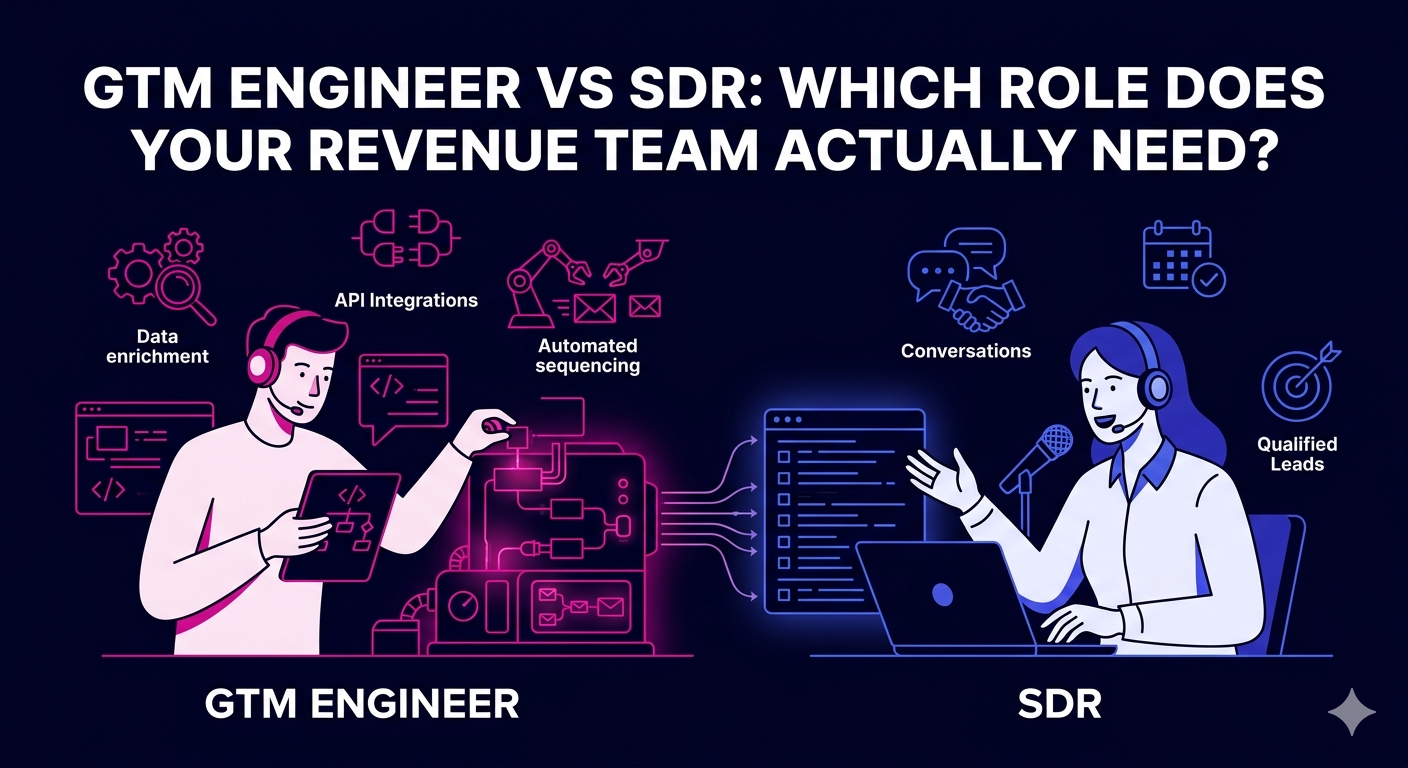
The simplest way to frame the GTM engineer vs SDR comparison is this: a GTM engineer builds the machine, and an SDR operates inside it.
A Sales Development Representative (SDR) is a human-led outbound role. SDRs research prospects, send personalized outreach, make cold calls, and book meetings for account executives. Their output is conversations and qualified pipeline. They are the voice of your outreach, and their performance depends heavily on their communication skills, resilience, and the quality of the systems they are given.
A Go to Market (GTM) Engineer is a technical revenue role. GTM engineers build the automation, data enrichment, and tooling infrastructure that powers outbound and inbound at scale. They set up workflows in tools like Clay, Instantly, and HubSpot. They write the logic that triggers the right message to the right prospect at the right time. Their output is systems that run continuously, often with little ongoing manual input.
A Side-by-Side Look at Both Roles
- Primary output: SDR produces meetings and qualified leads. GTM engineer produces automated workflows and infrastructure.
- Core skill set: SDR relies on communication and persuasion. GTM engineer relies on technical tooling and systems thinking.
- Daily activities: SDR sends emails, makes calls, follows up, and logs activity. GTM engineer builds sequences, configures integrations, enriches data, and monitors deliverability.
- Scalability: SDR output scales with headcount. GTM engineer output scales with system sophistication.
- Ramp time: SDRs typically ramp in 30 to 60 days. GTM engineers often need 60 to 90 days to fully map and improve a stack.
When You Need an SDR Over a GTM Engineer
Despite the buzz around automation and AI in 2026, there are situations where an SDR is clearly the right hire. Human outreach still converts at higher rates in many scenarios, particularly in enterprise, complex deal cycles, or highly relationship-driven markets.
Signs Your Business Needs an SDR Right Now
- You have a working outbound process but need more volume and coverage
- Your deals require a discovery conversation before a prospect will move forward
- You are targeting senior buyers who respond better to direct, personalized outreach
- Your AEs are spending time prospecting instead of closing
- You already have decent tooling in place and just need more pipeline throughput
In these scenarios, adding SDR capacity directly addresses the bottleneck. The systems are already there. What you need is a skilled human to activate them.
If you are ready to hire, you can explore vetted remote SDRs at The Remote Reps who are pre-screened and ready to contribute from day one without the overhead of a local hire.
When You Need a GTM Engineer Over an SDR
In many early-stage and growth-stage companies in 2026, the constraint is not headcount, it is infrastructure. Your SDRs are doing everything manually because the systems do not exist yet. Your CRM is messy. Your sequences are inconsistent. Your lead data is stale. In these cases, adding more SDRs just means more people doing inefficient work.
Signs Your Business Needs a GTM Engineer Right Now
- Your SDRs are spending more than two hours a day on manual research and data entry
- You are not sure if your outreach is landing in inboxes or hitting spam folders
- Your CRM data is incomplete, inconsistent, or poorly segmented
- You have bought multiple tools but they are not integrated or working together
- You want to scale outbound but do not want to scale headcount proportionally
- Your campaigns are not being tracked properly so you cannot tell what is working
A GTM engineer solves all of these problems. Once they build the foundation, your SDRs become dramatically more productive, and your cost per meeting drops significantly.
You can hire a remote GTM engineer through The Remote Reps and get the technical infrastructure your revenue team needs without building an in-house engineering function.
The GTM Engineer vs SDR Decision for Different Growth Stages
Your company stage is one of the most reliable signals for which role to prioritize in the GTM engineer vs SDR decision.
Pre-Product-Market Fit (0 to 10 Employees)
At this stage, manual outreach by founders or early hires is usually more valuable than automation. You need feedback from real conversations, not optimized sequences. An SDR or founder-led sales motion typically makes more sense here. A GTM engineer may be premature unless you are already doing high-volume outbound.
Early Growth Stage (10 to 50 Employees)
This is where the GTM engineer vs SDR question gets genuinely interesting. You likely have a few SDRs or a scrappy sales team, but the tooling is inconsistent and the process is manual. Bringing in a GTM engineer at this stage can multiply the output of every SDR on the team. Many companies find that one GTM engineer plus two SDRs outperforms six SDRs without any systems support.
Scale Stage (50 and Above)
At this stage, you need both. The GTM engineer handles infrastructure, automation, and data quality. The SDR team handles volume, conversation quality, and relationship-building. Neither role is optional at scale. The question becomes how many of each and what the right ratio looks like for your specific motion.
Can a GTM Engineer Replace an SDR Entirely?
This is a question that comes up constantly in the GTM engineer vs SDR conversation, especially as AI tools become more powerful. The short answer is: not entirely, but the role of the SDR is changing.
GTM engineers can automate prospecting, list building, initial outreach, and follow-up sequences. In some high-volume, low-touch sales motions, automation can carry a prospect all the way to a booked call without a human ever sending a manual email. But in most B2B environments, there is a moment where a human conversation is what converts a curious prospect into a qualified opportunity.
According to McKinsey’s B2B sales research, human interactions remain a decisive factor in high-value B2B purchases even as digital and automated touchpoints increase. This suggests that the GTM engineer vs SDR debate is not really about replacement. It is about optimization. Automation handles the volume and consistency. Humans handle the nuance and trust-building.
Building a Revenue Team That Uses Both Roles Together
The most effective revenue teams in 2026 are not choosing between a GTM engineer and an SDR. They are deploying both in a complementary structure where the engineer builds the systems and the SDRs operate within them at peak efficiency.
A practical model looks like this:
- The GTM engineer builds enriched lead lists, sets up sequencing, and monitors deliverability
- SDRs receive warm, pre-enriched leads and focus exclusively on personalization and outreach execution
- The GTM engineer tracks performance data and iterates on messaging and targeting
- SDRs provide qualitative feedback on objections and buyer language to inform future iterations
- Both roles report into a revenue operations or head of growth function that ties the motion together
This structure allows small teams to punch well above their weight. A two-person outbound team (one GTM engineer, one SDR) running a well-built system can outperform a five-person SDR team operating without systems support.
Conclusion: Making the Right Call on GTM Engineer vs SDR
The GTM engineer vs SDR decision comes down to a single diagnostic question: is your pipeline problem a systems problem or a volume problem?
If your systems are broken or nonexistent, fix them first with a GTM engineer. If your systems are solid and you just need more throughput, bring in SDRs. And if you are ready to build a high-performance revenue team that scales, invest in both.
The Remote Reps makes it easy to hire both roles remotely, quickly, and without the cost of traditional recruiting. Whether you need a technical GTM engineer to build your stack or experienced SDRs to fill your pipeline, the talent is ready and waiting.
Post your role today and find the remote revenue talent your team needs to grow in 2026.
FAQ: GTM Engineer vs SDR
What is the main difference between a GTM engineer and an SDR?
The core GTM engineer vs SDR difference is that a GTM engineer builds and manages the technical systems that power outbound, while an SDR uses those systems to conduct human-led outreach and book meetings. One builds the infrastructure; the other activates it.
Can a GTM engineer do the work of an SDR?
In the GTM engineer vs SDR comparison, there is limited overlap. A GTM engineer can automate many tasks that SDRs handle manually, including list building, initial email sequencing, and follow-ups. However, they are not typically responsible for live conversations, discovery calls, or relationship-driven outreach that human SDRs excel at.
Which role should an early-stage startup hire first: a GTM engineer or an SDR?
For most early-stage startups, the GTM engineer vs SDR priority depends on what is currently broken. If you have no outbound infrastructure, a GTM engineer builds the foundation that makes future SDR hires more effective. If you have basic tooling and need pipeline fast, an SDR can start contributing within weeks.
Is a GTM engineer more expensive than an SDR?
In the GTM engineer vs SDR cost comparison, GTM engineers tend to command higher compensation because of their technical skill set. However, the ROI can be higher because a single GTM engineer can multiply the output of an entire SDR team by automating manual work and improving system efficiency. The cost difference is often justified quickly.
Do I need both a GTM engineer and an SDR on my revenue team?
For most growth-stage and scale-stage companies, the answer to the GTM engineer vs SDR question is yes, you need both. The GTM engineer builds and maintains the system. The SDRs operate within it to create qualified pipeline. Together, they form the most efficient outbound revenue structure available in 2026.
Where can I hire a remote GTM engineer or SDR?
The fastest way to resolve the GTM engineer vs SDR hiring challenge is to work with a remote talent specialist. The Remote Reps provides pre-vetted remote GTM engineers and SDRs who are ready to contribute from day one, without the cost or delay of traditional recruiting processes.