
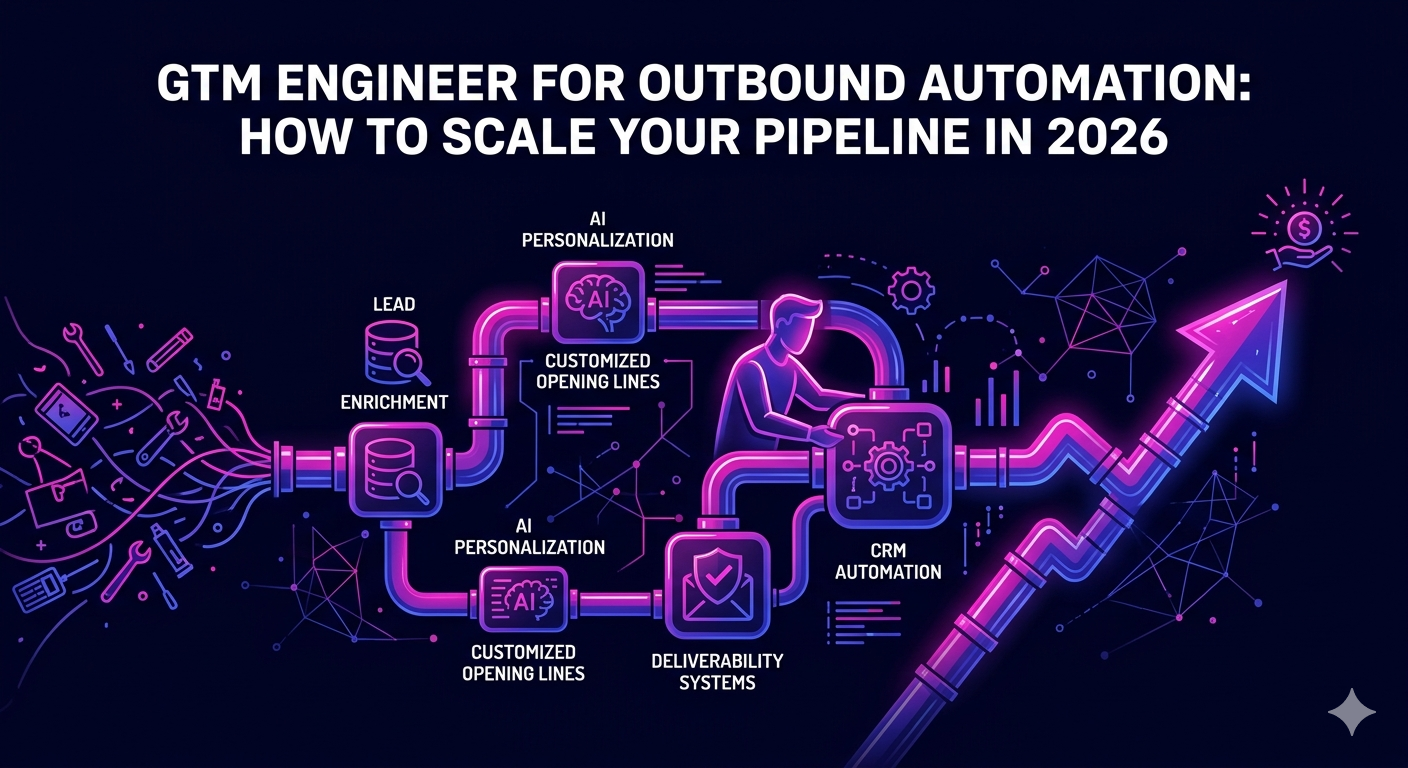
If your outbound motion still relies on manual prospecting, copy-pasted email templates, and disconnected tools, you are leaving serious revenue on the table. In 2026, the companies winning the outbound game are not the ones with the biggest sales teams. They are the ones with the best systems. That is exactly where a GTM engineer for outbound automation becomes one of the most valuable hires you can make.
This guide breaks down what a GTM engineer does within outbound, which systems they build, which tools they use, and how to determine whether your company is ready to bring one on board.
Why Outbound Automation Needs a GTM Engineer
Outbound sales has changed fundamentally over the past three years. Buyers are more skeptical, inboxes are more crowded, and generic mass outreach no longer converts. At the same time, the tooling available to sales teams has become incredibly powerful. The problem is that most sales and marketing teams do not have the technical skills to fully leverage these tools.
That gap is exactly what a GTM engineer fills. A GTM engineer for outbound automation is not a salesperson and not a pure developer. They sit at the intersection of both worlds, using technical skills to build the infrastructure that makes outbound more precise, more personalized, and more scalable.
The Core Problem with Traditional Outbound
Traditional outbound suffers from three major issues that automation can solve:
- Low personalization at scale: Sales reps either send generic blasts or spend hours personalizing individual emails. Neither approach scales efficiently.
- Poor data quality: Outreach built on stale or incomplete CRM data produces low reply rates and wastes rep time on bad-fit prospects.
- Disconnected tooling: Most teams use five or more tools that do not talk to each other, creating manual handoffs and data gaps that slow everything down.
A GTM engineer for outbound automation solves all three by building systems that enrich data automatically, personalize messaging at scale, and connect your entire tech stack into a seamless workflow.
What a GTM Engineer Builds for Outbound Automation
The day-to-day output of a GTM engineer focused on outbound will vary by company, but the core systems they build typically fall into these categories:
Automated Lead Enrichment Pipelines
Before a single email is sent, a GTM engineer will build a pipeline that automatically pulls data on your target accounts and contacts from sources like Clay, Apollo, Clearbit, and LinkedIn. This pipeline appends job titles, tech stack data, funding information, hiring signals, and intent data directly to your CRM records.
The result is a continuously updated list of high-fit prospects with the context needed to write relevant, personalized outreach without any manual research by your sales reps.
AI-Powered Personalization at Scale
One of the most impactful things a GTM engineer for outbound automation can build in 2026 is an AI personalization layer. By connecting enriched prospect data to a large language model via API, they can generate unique, relevant opening lines or full email variants for thousands of prospects automatically.
This is not the same as inserting a first name into a template. A well-built AI personalization system can reference a prospect’s recent LinkedIn post, their company’s latest funding round, or a job opening that signals a pain point your product solves. The output reads as genuinely human and specific, even at scale.
Cold Email Infrastructure and Deliverability Systems
Getting emails into the inbox is a technical problem that most sales teams underestimate. A GTM engineer for outbound automation will handle:
- Domain acquisition and warming strategy across multiple sending domains
- DNS configuration including SPF, DKIM, and DMARC records
- Mailbox rotation and volume management to protect sender reputation
- Spam trigger testing and subject line optimization
- Ongoing deliverability monitoring with automated alerts
Without this infrastructure in place, even the most well-crafted outbound sequences will fail to reach their intended recipients.
Multi-Channel Outbound Sequences
Email is one channel among several. A skilled GTM engineer for outbound automation will build sequences that coordinate outreach across email, LinkedIn, and even SMS or direct mail where appropriate. These sequences are triggered by prospect behavior, enrichment signals, or CRM stage changes, ensuring that the right message reaches each prospect at the right moment in their buying journey.
CRM Automation and Pipeline Hygiene
All of this outbound activity generates data that is only valuable if it flows correctly into your CRM. A GTM engineer will build workflows that automatically update contact records, log email activity, trigger internal notifications, and move deals through pipeline stages based on predefined criteria. This keeps your pipeline accurate and ensures that nothing falls through the cracks.
The Tools a GTM Engineer Uses for Outbound Automation
In 2026, the GTM engineering tech stack for outbound typically includes some combination of the following:
- Data and enrichment: Clay, Apollo, Clearbit, ZoomInfo, Prospeo
- Cold email sending: Instantly, Smartlead, Lemlist, Mailreach
- Workflow automation: n8n, Make, Zapier
- CRM: HubSpot, Salesforce
- AI and LLMs: OpenAI API, Anthropic Claude API, Groq
- LinkedIn automation: Heyreach, La Growth Machine, Expandi
- Analytics and reporting: Metabase, Looker Studio, native CRM dashboards
The real skill of a GTM engineer is not just knowing these tools individually. It is knowing how to connect them into a cohesive, automated system that requires minimal manual intervention from your sales team.
The Business Impact of Outbound Automation Done Right
When a GTM engineer for outbound automation builds and manages your outbound infrastructure properly, the results are measurable and significant:
More Pipeline with Fewer Resources
Automated enrichment and sequencing means your SDRs spend time on conversations, not research and data entry. A well-built outbound system can increase the number of qualified conversations per rep by two to four times without adding headcount.
Higher Reply and Meeting Rates
Personalized, well-timed outreach consistently outperforms generic blasts. Companies that invest in AI-powered personalization through a GTM engineer for outbound automation typically see reply rates two to three times higher than industry benchmarks for cold email.
Lower Cost Per Opportunity
By automating the repetitive, time-intensive parts of outbound, your cost per qualified opportunity drops significantly. You are doing more with the same team, which improves unit economics across your entire go-to-market motion.
According to McKinsey’s research on B2B sales and automation, companies that deploy advanced sales automation tools and processes consistently outperform their peers on revenue growth and sales productivity metrics.
If you are ready to build this kind of system, explore The Remote Reps’ GTM engineer staffing service to get matched with a specialist who has hands-on experience building outbound automation systems for B2B companies.
Is Your Company Ready to Hire a GTM Engineer for Outbound?
Not every company is at the right stage to bring on a GTM engineer for outbound automation. Here is a simple framework to evaluate your readiness:
You Are Ready If:
- You have a defined ICP and are actively running outbound to it
- Your team is spending significant time on manual prospecting or data entry
- You have basic tooling in place but it is not connected or fully utilized
- You want to scale outbound without proportionally increasing headcount
- You have seen early traction from outbound and want to accelerate it
You Might Not Be Ready Yet If:
- You are still searching for product-market fit
- You have not yet identified a repeatable outbound motion that converts
- Your sales team has fewer than two or three active reps working outbound
If you fall into the first category, the ROI on hiring a GTM engineer for outbound automation is often realized within the first 60 to 90 days.
FAQ: GTM Engineer for Outbound Automation
What exactly does a GTM engineer for outbound automation do?
A GTM engineer for outbound automation builds and manages the technical systems that power your outbound sales motion. This includes automated lead enrichment pipelines, cold email infrastructure, AI-driven personalization workflows, multi-channel sequences, and CRM automation. Their goal is to make your outbound more efficient, more personalized, and more scalable without increasing manual workload for your sales team.
How is a GTM engineer for outbound automation different from an SDR?
An SDR (sales development representative) is focused on having conversations and booking meetings. A GTM engineer for outbound automation is focused on building the systems that enable SDRs to have more of those conversations with better-qualified prospects. They are builders, not callers. The two roles are highly complementary and work best when paired together.
What results can I expect from a GTM engineer for outbound automation?
Results vary depending on your starting point, but companies that invest in a GTM engineer for outbound automation typically see improvements in reply rates, more qualified pipeline from the same or smaller outbound team, reduced cost per opportunity, and faster ramp time for new SDRs who benefit from better tooling and cleaner data.
How long does it take a GTM engineer to build an outbound automation system?
A skilled GTM engineer for outbound automation can typically have a foundational outbound system up and running within two to four weeks. This includes domain setup, enrichment pipelines, sequence configuration, and CRM integrations. More advanced systems with AI personalization and multi-channel coordination may take six to eight weeks to build and optimize fully.
Does outbound automation require ongoing maintenance?
Yes. Outbound automation systems require continuous monitoring and optimization. Deliverability conditions change, data sources update their APIs, and what works today in terms of messaging and timing may need to be adjusted next quarter. A GTM engineer for outbound automation should be viewed as an ongoing resource, not a one-time project hire.
Can a GTM engineer for outbound automation work remotely?
Absolutely. GTM engineering is one of the most remote-friendly technical roles in the go-to-market space. The work is system-based and asynchronous by nature, making it well-suited to remote collaboration. Many of the best GTM engineers for outbound automation work with clients across multiple time zones and deliver excellent results fully remotely.
Final Thoughts
In 2026, outbound automation is not a nice-to-have. It is a competitive necessity. The companies that invest in a GTM engineer for outbound automation today are building a compounding advantage that gets harder to close the longer you wait.
If you are serious about scaling your pipeline without scaling your headcount, the smartest next step is bringing a skilled GTM engineer on board. Start building smarter outbound today.