
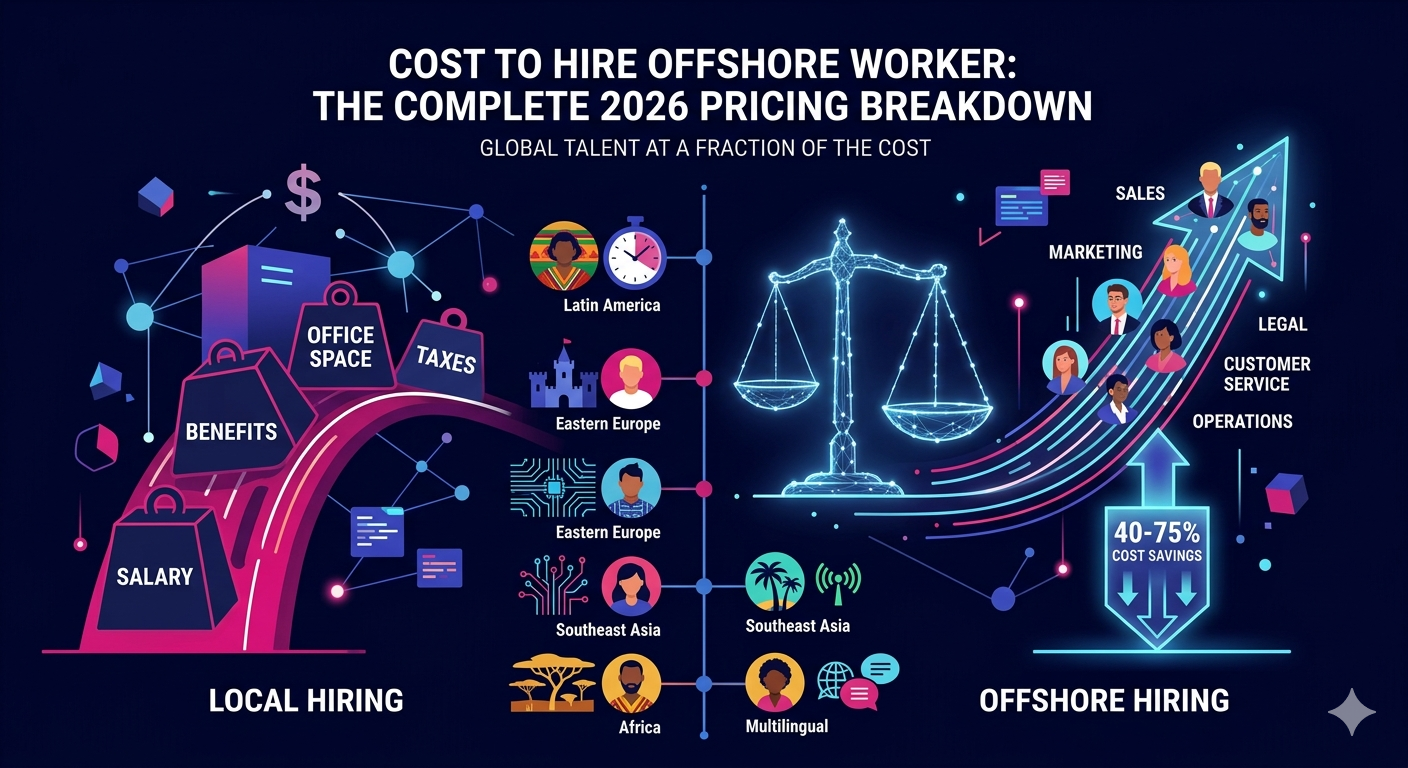
Understanding the true cost to hire an offshore worker is one of the smartest investments of time any business owner or hiring manager can make in 2026. Offshore hiring has moved well beyond low-cost call centers. Today, companies are building full departments offshore, spanning sales, marketing, legal support, customer service, and operations, at a fraction of what local hiring would cost.
But the pricing landscape is not always straightforward. Rates vary significantly by region, role, hiring model, and the platform you use. This guide gives you a complete, honest picture so you can budget accurately and hire with confidence.
Why More Businesses Are Asking About the Cost to Hire Offshore Workers in 2026
The pressure to control headcount costs has intensified across industries. Salaries, benefits, and commercial real estate in the US, UK, Canada, and Western Europe have climbed sharply over the past three years. Businesses that once dismissed offshore hiring as a tactic only for large enterprises are now actively exploring it as a core part of their workforce strategy.
The quality of offshore talent has also improved dramatically. Global connectivity, improved education systems, and the widespread adoption of remote work tools have created deep pools of skilled professionals in Latin America, Eastern Europe, Southeast Asia, and beyond. The question for most businesses is no longer whether to hire offshore, but how much it will cost and where to start.
Offshore Worker Cost by Region in 2026
Geography is the single biggest driver of offshore hiring costs. Here is a current breakdown of average annual costs for a skilled offshore professional across the most popular hiring regions:
Latin America
- Countries: Colombia, Mexico, Argentina, Brazil, Peru
- Average annual cost (contractor): $15,000 to $40,000
- Best for: Sales, marketing, customer support, virtual assistance, digital roles
- Key advantage: Strong English proficiency, US time zone overlap, growing talent pool
Eastern Europe
- Countries: Poland, Ukraine, Romania, Bulgaria, Serbia
- Average annual cost (contractor): $18,000 to $45,000
- Best for: Technical roles, legal support, finance, marketing
- Key advantage: Strong educational background, European business culture, high-quality output
South and Southeast Asia
- Countries: Philippines, India, Pakistan, Bangladesh, Vietnam
- Average annual cost (contractor): $8,000 to $28,000
- Best for: Customer support, back-office tasks, digital marketing, admin, legal assistance
- Key advantage: Lowest cost per hire, large workforce, strong English in Philippines and India
Africa and the Middle East
- Countries: South Africa, Egypt, Kenya, UAE
- Average annual cost (contractor): $8,000 to $22,000
- Best for: Customer service, content creation, sales support
- Key advantage: Competitive rates, growing talent base, multilingual capabilities
Offshore Hiring Cost by Role and Function
Beyond region, the role you are filling has a major impact on the cost to hire an offshore worker. Here is what businesses are typically paying in 2026 for the most in-demand offshore positions:
Sales and Business Development
- Sales Development Representative (SDR): $18,000 to $38,000 per year
- Lead Generation Specialist: $14,000 to $30,000 per year
- Cold Email Specialist: $12,000 to $26,000 per year
Marketing and Digital
- SEO Specialist: $14,000 to $32,000 per year
- Social Media Manager: $12,000 to $28,000 per year
- PPC or Media Buyer: $16,000 to $38,000 per year
- Digital Marketer (generalist): $14,000 to $35,000 per year
Customer Support and Admin
- Customer Support Agent: $10,000 to $24,000 per year
- Virtual Assistant: $8,000 to $20,000 per year
- Executive Assistant: $14,000 to $30,000 per year
Legal and Compliance
- Legal Assistant: $12,000 to $28,000 per year
- Paralegal: $16,000 to $35,000 per year
- Legal Secretary: $10,000 to $24,000 per year
Compare these figures to US market equivalents, which often run two to four times higher when benefits and overhead are included, and the savings potential becomes immediately clear.
To see pre-vetted offshore professionals across all of these categories, explore the offshore lead generation and sales experts available through The Remote Reps, where top-tier talent is matched to your specific business needs.
Offshore Hiring Models and Their Cost Structures
The hiring model you choose shapes your total cost just as much as the region or role. Here are the three most common approaches and what each one costs:
Freelancer or Independent Contractor
You engage an individual directly through a platform or via referral. You pay the agreed hourly or monthly rate with no benefits, taxes, or overhead. This is the most flexible and often lowest-cost option, but it requires more management on your end. Typical monthly costs range from $800 to $3,500 depending on role and region.
Remote Staffing Platform
You work with a platform that pre-vets candidates, handles initial screening, and may provide ongoing support. The platform charges a fee or markup above the worker’s rate, typically 15 to 30 percent. In exchange, you get vetted talent faster, reduced hiring risk, and often access to replacement guarantees. This is the most popular model for businesses hiring offshore workers for the first time. All-in monthly costs typically range from $1,200 to $4,500.
Employer of Record (EOR)
If you want to hire offshore workers as formal employees rather than contractors, an EOR handles payroll, compliance, and legal obligations in the worker’s home country. EOR fees typically add $300 to $700 per employee per month on top of the worker’s salary. This model is best for businesses building long-term offshore teams where employment classification matters.
Hidden Costs to Include When Calculating Your Offshore Hiring Budget
A complete picture of the cost to hire an offshore worker goes beyond the monthly rate. Here are the additional costs businesses often underestimate:
- Recruiting and sourcing time: If you are hiring without a platform, budget 20 to 40 hours of your team’s time to screen, interview, and evaluate candidates.
- Onboarding and training: Even skilled offshore workers need time to learn your tools, processes, and brand voice. Budget two to four weeks of reduced productivity and any training materials or sessions required.
- Software and communication tools: Slack, Zoom, project management platforms, and any role-specific software add $300 to $1,500 per worker per year.
- Equipment stipend: Some businesses provide a one-time home office stipend of $500 to $1,500, though many offshore workers are already equipped.
- Currency and payment transfer fees: International payments via wire transfer or platforms like Wise or Deel can incur fees of 0.5 to 2.5 percent per transaction. Factor this into monthly costs.
How to Get the Best Value When You Hire an Offshore Worker
Keeping the cost to hire an offshore worker competitive without sacrificing quality comes down to a few key principles:
- Be specific in your job description. Vague requirements attract poor-fit candidates and extend your hiring timeline.
- Hire through a vetted platform rather than sourcing cold. The quality control and time savings more than offset the platform fee.
- Prioritize communication skills alongside technical ability. A highly skilled worker with poor English or communication habits will cost you more in errors and rework than a mid-level hire with excellent communication.
- Run a paid trial project before committing to a long-term engagement. This is standard practice in offshore hiring and protects both parties.
- Set clear KPIs from day one. Offshore workers perform best when expectations are documented and reviewed regularly.
Industry benchmarking from Deloitte’s Global Outsourcing Survey on offshore workforce cost trends consistently shows that businesses with structured onboarding and clear KPI frameworks achieve 40 percent better retention with offshore hires compared to those who skip these steps.
Is the Cost to Hire an Offshore Worker Worth It for Small Businesses?
Absolutely. In fact, small and mid-sized businesses often see the most dramatic impact from offshore hiring because every dollar of overhead savings goes directly to the bottom line or can be reinvested in growth.
A startup that hires a remote SDR from Colombia at $2,200 per month rather than a local hire at $5,500 per month frees up $39,600 per year. That budget can fund another hire, a marketing campaign, or product development. Multiply that across even two or three offshore roles and the financial impact becomes transformative.
The key is approaching offshore hiring strategically, not as a shortcut, but as a deliberate, well-managed part of your talent strategy.
Frequently Asked Questions About the Cost to Hire an Offshore Worker
What is the average cost to hire an offshore worker in 2026?
The average cost to hire an offshore worker in 2026 depends heavily on region and role. For most knowledge-work positions, businesses pay between $10,000 and $40,000 per year for offshore contractors. Southeast Asian markets tend to be the most affordable, while Latin America and Eastern Europe command slightly higher rates in exchange for stronger time zone alignment and language skills.
What is included in the cost to hire an offshore worker?
The base cost to hire an offshore worker typically includes their monthly rate or salary and any platform or agency fees. A complete budget should also account for onboarding time, software tools, payment transfer fees, and an optional equipment stipend. Businesses using an Employer of Record service should add $300 to $700 per month per worker for compliance and payroll management.
How does the cost to hire an offshore worker compare to a local hire?
In most cases, the cost to hire an offshore worker is 40 to 75 percent lower than a comparable local hire when all costs are factored in. A US-based mid-level professional with full benefits and office overhead can cost $80,000 to $130,000 per year. An equivalent offshore professional typically costs $15,000 to $45,000 per year, depending on the region and the role.
Does a lower cost to hire an offshore worker mean lower quality?
Not when you hire through a reputable platform with a rigorous vetting process. The cost difference in offshore hiring reflects differences in cost of living and local market rates, not differences in ability. Many offshore professionals hold advanced degrees, have years of relevant experience, and have worked with international clients. Focusing on quality indicators like skills assessments, portfolio reviews, and trial projects ensures strong results regardless of cost.
Which offshore regions offer the best balance of cost and quality?
For businesses prioritizing time zone overlap and English fluency alongside a competitive cost to hire an offshore worker, Latin America (particularly Colombia, Mexico, and Argentina) and the Philippines offer the best overall balance in 2026. Eastern Europe (Poland, Romania, Serbia) is an excellent choice for technical, legal, or finance roles where specialized expertise is a priority.
How can I reduce the cost to hire an offshore worker without sacrificing results?
The most effective way to reduce the cost to hire an offshore worker while protecting quality is to work with a staffing platform that pre-vets candidates. This cuts sourcing time dramatically and reduces the risk of bad hires. Defining role requirements clearly, running paid trial projects, and investing in structured onboarding also reduce rework and turnover costs that erode the savings from offshore hiring.