
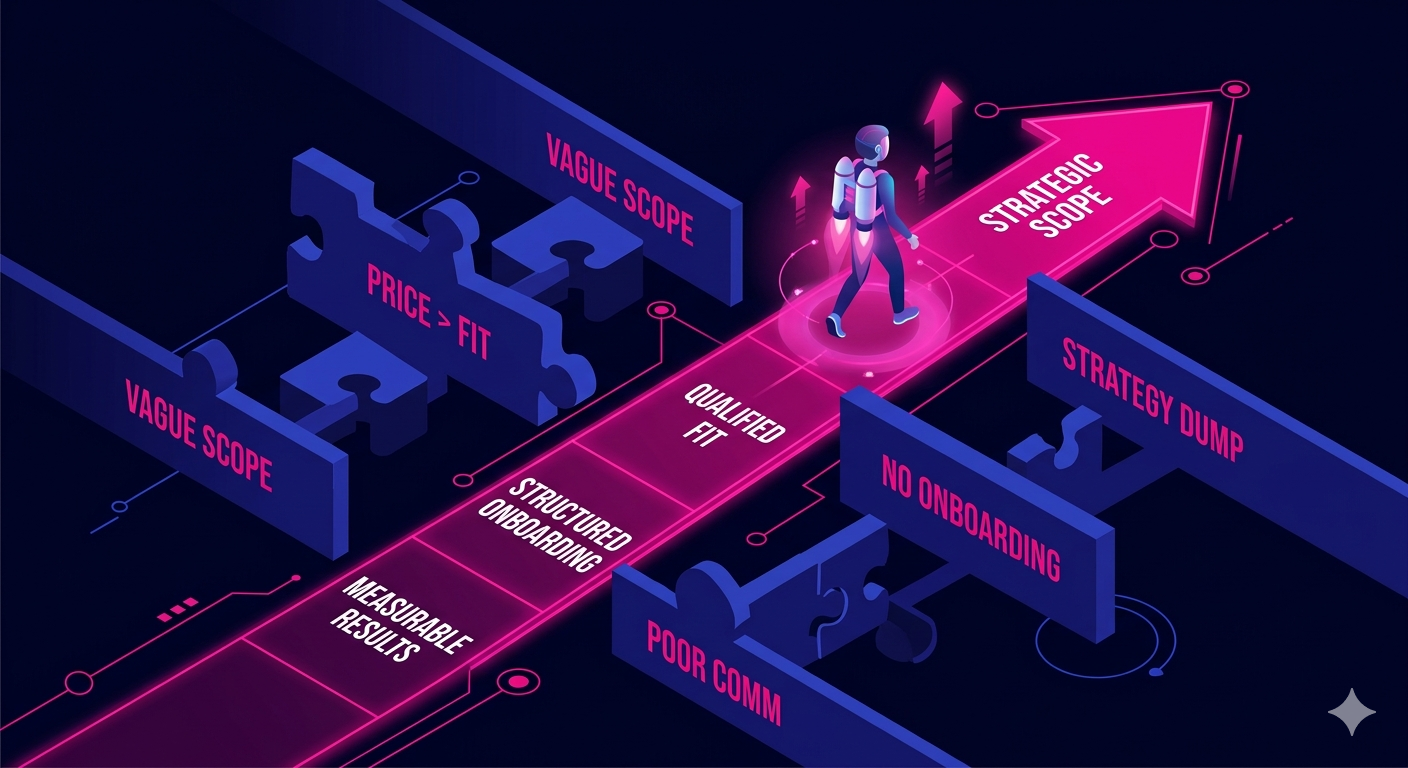
Outsourcing has helped thousands of businesses scale faster, reduce costs, and access world-class talent without the overhead of full in-house teams. But there are specific outsourcing mistakes to avoid if you want those benefits to actually materialize. Too many companies rush into outsourcing with the right intentions and end up with poor results, wasted budgets, and team friction that sets them back months. This guide covers the most damaging errors businesses make when outsourcing in 2026 and exactly how to avoid them.
Why Outsourcing Failures Are Still So Common in 2026
Despite how mature the outsourcing market has become, failures still happen at a surprising rate. A 2025 Deloitte Global Outsourcing Survey found that nearly one in three businesses reported dissatisfaction with at least one outsourced function in the previous 12 months. The root causes are almost always the same: poor planning, vague expectations, and choosing the wrong partner.
The good news is that these are entirely preventable problems. Understanding the outsourcing mistakes to avoid puts you in a position to make decisions that actually pay off. Here is where most businesses go wrong.
The Most Costly Outsourcing Mistakes to Avoid in 2026
Mistake 1: Outsourcing Without a Clear Scope of Work
The single most common outsourcing mistake is starting the process without a well-defined scope of work. Businesses often approach an outsourcing partner with a vague idea of what they need and assume the provider will figure out the details. That assumption leads to misaligned expectations, scope creep, and disappointment on both sides.
Before you engage any outsourced professional or agency, document the following:
- The specific tasks and responsibilities the role will own
- The tools and platforms the outsourced person will work within
- The performance metrics that define success
- The communication and reporting cadence you expect
- The timeline and any key milestones
A clearly written scope of work protects both parties and dramatically increases the likelihood of a successful outsourcing engagement.
Mistake 2: Choosing Price Over Fit
One of the most damaging outsourcing mistakes to avoid is selecting a provider based primarily on cost. Outsourcing can deliver significant savings, but choosing the cheapest option without evaluating fit, experience, and communication quality almost always results in rework, frustration, and eventual replacement costs that eliminate any initial savings.
In 2026, the best outsourcing decision balances cost efficiency with demonstrated capability. Ask for work samples, conduct skills assessments, and check references before committing. A slightly higher investment in a qualified professional will consistently outperform a low-cost hire who requires constant oversight and correction.
Mistake 3: Skipping the Onboarding Process
Many businesses make the mistake of assuming that outsourced professionals should hit the ground running with minimal guidance. While experienced outsourced workers are highly self-sufficient, they still need to understand your specific processes, brand voice, systems, and priorities before they can perform at their best.
Skipping onboarding is one of the most preventable outsourcing errors. Even a streamlined one-week onboarding process that covers your key tools, workflows, and expectations will dramatically accelerate performance and reduce early-stage errors. Treat your outsourced team members the same way you would treat a new in-house hire.
Mistake 4: Outsourcing Core Strategic Functions Too Early
Outsourcing works best for clearly defined, repeatable, or specialized functions. One outsourcing mistake to avoid is handing over core strategic decision-making or functions that are still evolving and poorly documented. If you cannot clearly explain a process or define what good output looks like, you are not ready to outsource it.
In 2026, the most successful outsourcing strategies follow this principle: keep strategy and culture internal, outsource execution and specialization. Functions like customer support, sales development, digital marketing execution, and administrative support are ideal candidates. Strategic planning, product roadmap decisions, and company culture development are not.
Mistake 5: Failing to Establish Communication Standards
Poor communication is one of the top reasons outsourcing relationships break down. When expectations around availability, response times, meeting cadence, and progress reporting are not set upfront, misunderstandings build and trust erodes quickly.
To avoid this outsourcing mistake, establish clear communication standards before work begins:
- Which platforms will be used for daily communication (Slack, Teams, email)
- How quickly responses are expected during working hours
- How frequently check-ins or status updates will occur
- How urgent issues should be escalated
- What documentation standards are required for completed work
Setting these norms early creates a professional working relationship and prevents the kind of communication breakdowns that derail outsourcing engagements.
Mistake 6: Working With the Wrong Outsourcing Partner
Not all outsourcing providers are created equal. One of the most important outsourcing mistakes to avoid is working with a generalist platform or low-quality agency when your role requires genuine expertise and vetting.
Specialized remote staffing partners who understand your industry and pre-vet candidates for both skills and remote work readiness deliver dramatically better outcomes than generic job boards or offshore marketplaces. The vetting process matters enormously because a technically capable candidate who cannot communicate well, manage their own time, or work independently in a remote environment will underperform regardless of their qualifications.
If you want to avoid the most common outsourcing pitfalls and connect with proven remote professionals, The Remote Reps provides pre-vetted remote talent across every key business function, helping you build outsourced teams that actually perform.
Mistake 7: Not Monitoring Performance After Onboarding
Another serious outsourcing mistake to avoid is a set-it-and-forget-it approach to management. Outsourced professionals need regular feedback, performance reviews, and clear accountability structures just like in-house employees. Assuming that handing off a task means it no longer requires your attention is a recipe for quality decline and missed expectations.
Set monthly performance reviews for all outsourced roles. Review the KPIs defined in your scope of work. Provide constructive feedback when standards are not being met and acknowledge strong performance when they are. Consistent oversight does not mean micromanagement. It means maintaining the standards and relationships that keep outsourcing partnerships productive long-term.
Mistake 8: Ignoring Time Zone and Availability Planning
Businesses outsourcing to talent in different time zones often underestimate how scheduling mismatches affect collaboration. This outsourcing challenge is manageable, but only if addressed proactively. Failing to plan for time zone differences leads to delayed responses, missed handoffs, and communication gaps that slow down work.
In 2026, the most effective approach is to either hire within time zones that overlap with your core business hours or structure work to be primarily asynchronous so that time zone gaps do not create bottlenecks. Define this clearly during the hiring process so candidates understand the scheduling expectations before they start.
How to Set Your Outsourcing Strategy Up for Success
Avoiding these outsourcing mistakes comes down to preparation, specificity, and choosing the right partners. Here is a practical checklist businesses use in 2026 to protect their outsourcing investments:
- Document roles and expectations before starting any search
- Evaluate candidates on skills, communication, and remote work experience, not just cost
- Build a structured onboarding plan, even a lightweight one, for every outsourced hire
- Set clear KPIs and review them monthly
- Choose specialized staffing partners with proven vetting processes
- Define communication norms and tools upfront
- Plan for time zone differences before they become problems
Businesses that follow these practices consistently report higher satisfaction, longer-term partnerships, and better ROI from their outsourced teams. The effort invested in preparation pays dividends for every month the relationship continues.
For a deeper look at how leading organizations structure their outsourcing strategies, Harvard Business Review’s analysis of outsourcing mistakes and how to avoid them provides research-backed perspective on what separates successful engagements from costly failures.
You can also explore our remote virtual assistant services as a low-risk starting point for businesses new to outsourcing who want proven talent without the complexity of a full recruitment process.
Conclusion: Avoid These Errors and Outsourcing Becomes a Competitive Advantage
The outsourcing mistakes to avoid are not complicated once you know what they are. Vague scopes, cost-first decisions, poor onboarding, and weak communication standards are the root causes of almost every outsourcing failure. Businesses that address these factors upfront transform outsourcing from a gamble into a reliable growth engine.
In 2026, access to world-class remote talent is unprecedented. The companies extracting the most value from that talent pool are the ones that approach outsourcing with the same rigor and intentionality they apply to every other business decision. Start with clarity, choose your partners carefully, and stay engaged throughout the relationship. The results will speak for themselves.
Frequently Asked Questions About Outsourcing Mistakes to Avoid
What are the most common outsourcing mistakes to avoid for small businesses?
The most common outsourcing mistakes to avoid for small businesses include outsourcing without a defined scope of work, choosing vendors based solely on price, and skipping the onboarding process. Small businesses often have tighter margins for error, so selecting a specialized staffing partner with a proven vetting process and investing time in clear expectations upfront is especially important.
How do I avoid outsourcing mistakes when hiring remotely for the first time?
When outsourcing for the first time, the key mistakes to avoid are being too vague about role requirements, underestimating the need for onboarding, and not setting performance metrics from the start. Begin with a clearly written job description, build a brief onboarding plan, and schedule a 30-day review to assess early performance. Starting with one outsourced role before scaling helps you refine your process before expanding.
Is outsourcing core business functions one of the outsourcing mistakes to avoid?
Yes, outsourcing core strategic functions too early is one of the most significant outsourcing mistakes to avoid. Functions that are still being developed internally, that require institutional knowledge, or that directly define your competitive position are not suitable for outsourcing until they are fully documented and stable. Execution-focused roles such as support, marketing, and administration are far better candidates for early outsourcing.
How does poor communication lead to outsourcing mistakes?
Poor communication is one of the primary drivers of outsourcing failures. When availability, response time expectations, reporting frequency, and escalation procedures are not defined upfront, misunderstandings accumulate and trust breaks down. To avoid this outsourcing mistake, establish your communication standards in writing before work begins and review them during the first week of the engagement.
Can choosing the wrong outsourcing platform lead to costly mistakes?
Absolutely. One of the most avoidable outsourcing mistakes is using a generic platform that does not vet candidates for remote work readiness or role-specific expertise. Generalist job boards and unverified freelance marketplaces expose businesses to candidates who may have technical skills but lack the communication, self-management, and accountability required to succeed in a remote outsourcing arrangement. Specialized staffing partners significantly reduce this risk.
How often should I review performance to avoid ongoing outsourcing mistakes?
Monthly performance reviews are the recommended standard for outsourced roles. Reviewing the KPIs defined in your scope of work each month allows you to identify issues early, provide timely feedback, and make adjustments before problems compound. Skipping regular reviews is itself one of the outsourcing mistakes to avoid, as it allows underperformance to continue unchecked and makes course correction much harder over time.