
The first few weeks at a new job shape everything that follows. For remote employees, that window is even more critical because there is no office environment to naturally orient them, no hallway conversations to fill in the gaps, and no manager dropping by a desk to check in. When onboarding goes wrong, productivity suffers, confidence drops, and turnover climbs. That is exactly why understanding onboarding best practices for remote employees is one of the most important investments any business owner can make in 2026.
This guide breaks down a proven, structured approach to remote onboarding so your new hires hit the ground running from day one.
Why Onboarding Best Practices for Remote Employees Matter More Than Ever
Remote work is now the default for a significant portion of the global workforce. But many businesses are still treating remote onboarding as a watered-down version of in-person onboarding rather than as its own distinct process that requires intentional design.
Poor onboarding leads to measurable business consequences. New hires who feel unsupported in their first 30 days are significantly more likely to start looking for other opportunities within their first six months. For remote employees, the risk is even higher because isolation and unclear expectations can set in quickly without proactive intervention.
Getting remote onboarding right, on the other hand, accelerates time-to-productivity, improves retention, and builds the kind of trust that makes distributed teams genuinely effective.
Before Day One: The Pre-Onboarding Checklist
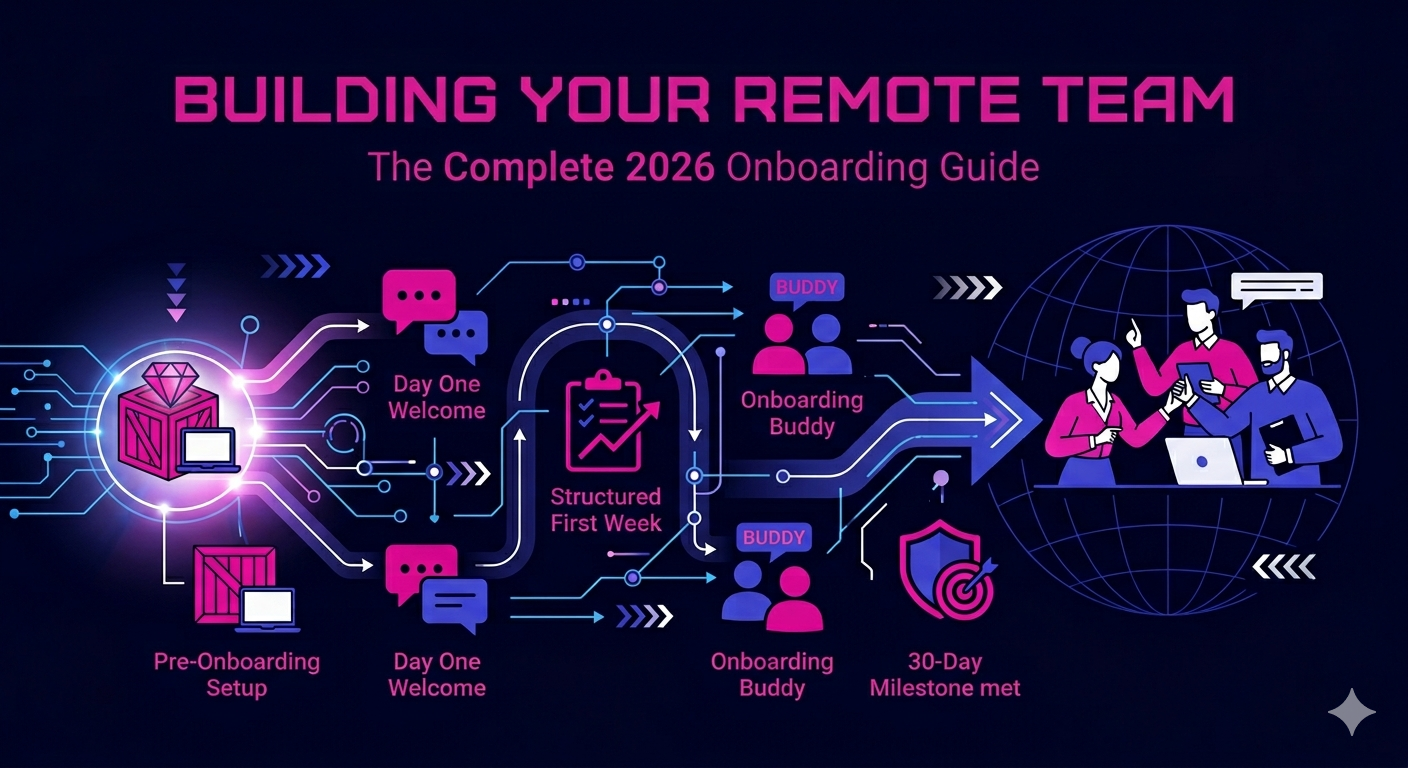
One of the most overlooked onboarding best practices for remote employees is what happens before the new hire officially starts. The pre-onboarding phase sets the tone for the entire experience.
Send a Warm Welcome Before They Start
Do not wait until day one to make contact. Send a personalized welcome message within 24 hours of the offer being accepted. Introduce the new hire to their direct manager and any immediate teammates. Share a brief overview of what to expect in the first week so they arrive with confidence rather than uncertainty.
Set Up All Tools and Access in Advance
- Create accounts and grant access to all platforms before day one
- Send login credentials and setup instructions in a clear, organized document
- Test access to ensure everything works before the new hire needs it
- Ship any required equipment with enough lead time for delivery before start date
Prepare a Structured First Week Schedule
Ambiguity is the enemy of a good remote onboarding experience. Build a detailed schedule for the first five days that includes orientation calls, tool walkthroughs, introductory meetings, and time blocked for self-directed reading and setup. Share this with the new hire before they start.
Day One Best Practices for Remote Employee Onboarding
First impressions set the foundation. Day one onboarding best practices for remote employees center on making the new hire feel welcomed, informed, and connected despite the physical distance.
Start with a Live Welcome Call
Begin day one with a video call that includes the new hire’s direct manager and at least a few team members. Keep it relaxed and conversational. The goal is connection, not information overload. Save the detailed process walkthroughs for later in the week.
Walk Through the Company Culture and Values
Remote employees are especially vulnerable to feeling disconnected from company culture because they are not immersed in an office environment. Dedicate time on day one to sharing your company story, mission, values, and the norms that define how your team works together. This is not a box-ticking exercise. It is foundational to retention and engagement.
Introduce the Communication Norms
- Explain which channels are used for which types of communication
- Set expectations around response times for messages and emails
- Clarify when synchronous calls are expected versus when async updates are preferred
- Share any team-wide communication etiquette that is important to know early
The First 30 Days: Onboarding Best Practices That Build Momentum
The first month is where remote onboarding either delivers or disappoints. The best practices for onboarding remote employees during this period focus on structured support, clear milestones, and consistent feedback.
Assign a Dedicated Onboarding Buddy
Pair every new remote hire with an experienced team member who acts as their go-to resource for the first 30 days. This buddy is not a manager. Their role is to answer informal questions, help the new hire navigate team culture, and flag anything that seems unclear before it becomes a problem. This single practice dramatically improves the remote onboarding experience.
Set 30, 60, and 90-Day Milestones
New remote hires need to know what success looks like at each stage of their onboarding journey. Define specific, measurable milestones for the first 30, 60, and 90 days. Share these in writing and revisit them during check-ins. Clarity around expectations is one of the single most impactful onboarding best practices for remote employees at any level.
Schedule Weekly One-on-One Check-Ins
Weekly one-on-ones between the new hire and their manager are non-negotiable during the first 90 days. These calls should cover progress against milestones, any blockers the new hire is facing, and open space for questions or concerns. Consistent check-ins signal that the employee is valued and supported, which directly impacts retention.
Deliver Role-Specific Training Progressively
- Avoid front-loading all training into the first two days. Spread it across the first three to four weeks.
- Use a mix of written SOPs, recorded video walkthroughs, and live training sessions
- Confirm understanding after each training session with a brief knowledge check or Q and A
- Update training materials based on questions the new hire raises during onboarding
Building Connection and Culture for Remote New Hires
Culture does not happen automatically in a remote environment. It has to be intentionally built. This dimension of onboarding best practices for remote employees is often underestimated, but it plays a significant role in long-term retention and team cohesion.
Create Opportunities for Informal Interaction
- Schedule virtual coffee chats between the new hire and different team members
- Include new hires in team channels where casual conversation happens
- Invite them to any recurring team social events, even if optional
- Recognize their contributions publicly in team channels during the first month
Gather Onboarding Feedback Actively
Ask your new remote hires directly what is working and what is not. A short survey at the end of week one and another at the 30-day mark gives you actionable data to improve your process. This practice also signals to the new hire that their experience matters to the organization.
Onboarding Best Practices for Specific Remote Roles
While the core principles apply broadly, onboarding best practices for remote employees do shift depending on the nature of the role. A remote sales development representative needs different early wins than a virtual assistant or a legal paralegal.
For sales and revenue-focused roles, prioritize early immersion in the product, the ICP, and the tools used for prospecting and outreach. Shadowing calls and listening to recorded demos in the first two weeks accelerates ramp time significantly. If you are scaling your sales function with remote talent, explore how remote executive assistants can support your leadership team during high-growth phases by handling operational load so managers can focus more time on developing new hires.
For support, administrative, and operational roles, invest heavily in SOPs and process documentation. These employees need to understand not just what to do but why each process exists and how it connects to broader business goals.
According to research published by Gallup on transforming remote employee onboarding, only 12 percent of employees strongly agree that their organization does a great job of onboarding new hires. Businesses that close that gap gain a significant retention and performance advantage.
Mistakes to Avoid in Remote Employee Onboarding
- Information overload in week one: Spreading training over several weeks improves retention and reduces overwhelm.
- Skipping culture integration: Remote employees who do not feel connected to their team disengage faster than those in an office.
- Unclear expectations: Without written milestones and KPIs, new remote hires often feel lost and underconfident.
- No feedback loop: Onboarding should be a two-way conversation. Ask new hires what is working and act on their answers.
- Treating remote onboarding as a one-week event: The most effective onboarding programs extend through the full first 90 days.
Build a Remote Team That Performs from Day One
Applying onboarding best practices for remote employees consistently is what separates businesses that struggle with remote hiring from those that scale confidently. When your new hires feel supported, informed, and connected from the start, they produce better work faster and stay longer.
At The Remote Reps, we not only connect businesses with pre-vetted remote professionals but also support clients in structuring the frameworks they need to make those hires successful. Whether you are bringing on your first remote team member or your fiftieth, having the right strategy behind your onboarding process makes all the difference.
Frequently Asked Questions: Onboarding Best Practices for Remote Employees
What are the most important onboarding best practices for remote employees?
The most impactful onboarding best practices for remote employees include pre-onboarding preparation before day one, a structured first week schedule, assigning a dedicated buddy, setting clear 30-60-90 day milestones, holding weekly one-on-one check-ins, and actively gathering feedback throughout the process. Together, these practices reduce time-to-productivity and improve long-term retention.
How long should onboarding last for remote employees?
Effective onboarding best practices for remote employees extend well beyond the first week. The most successful remote onboarding programs are structured across the full first 90 days, with distinct milestones and support touchpoints at the 30 and 60-day marks. A single-week orientation is simply not enough for remote hires to feel fully integrated and productive.
How do you build culture during remote employee onboarding?
Building culture is a core part of onboarding best practices for remote employees. It requires intentional effort, including virtual coffee chats, team introductions, inclusion in social channels, public recognition of early contributions, and explicit sharing of company values and communication norms. Culture does not happen by accident in a remote environment.
What tools support onboarding best practices for remote employees?
Supporting onboarding best practices for remote employees requires a solid tech stack. Essential tools include a project management platform like ClickUp or Asana, a communication tool like Slack, a video conferencing platform like Zoom, a document repository like Notion or Google Workspace, and a dedicated onboarding checklist shared with the new hire before their start date.
How do you measure the success of remote employee onboarding?
Measuring onboarding success is a key part of implementing onboarding best practices for remote employees. Track metrics like time-to-productivity, 90-day retention rates, performance against milestone KPIs, and new hire satisfaction scores gathered through structured surveys at week one and at the 30-day mark. These data points help you refine the process over time.
Why do onboarding best practices for remote employees differ from in-person onboarding?
Remote onboarding lacks the natural orientation that comes from being physically present in an office. This means onboarding best practices for remote employees must be more deliberate about communication, documentation, culture building, and structured support. What happens informally in an office setting needs to be designed intentionally when employees are working from different locations.