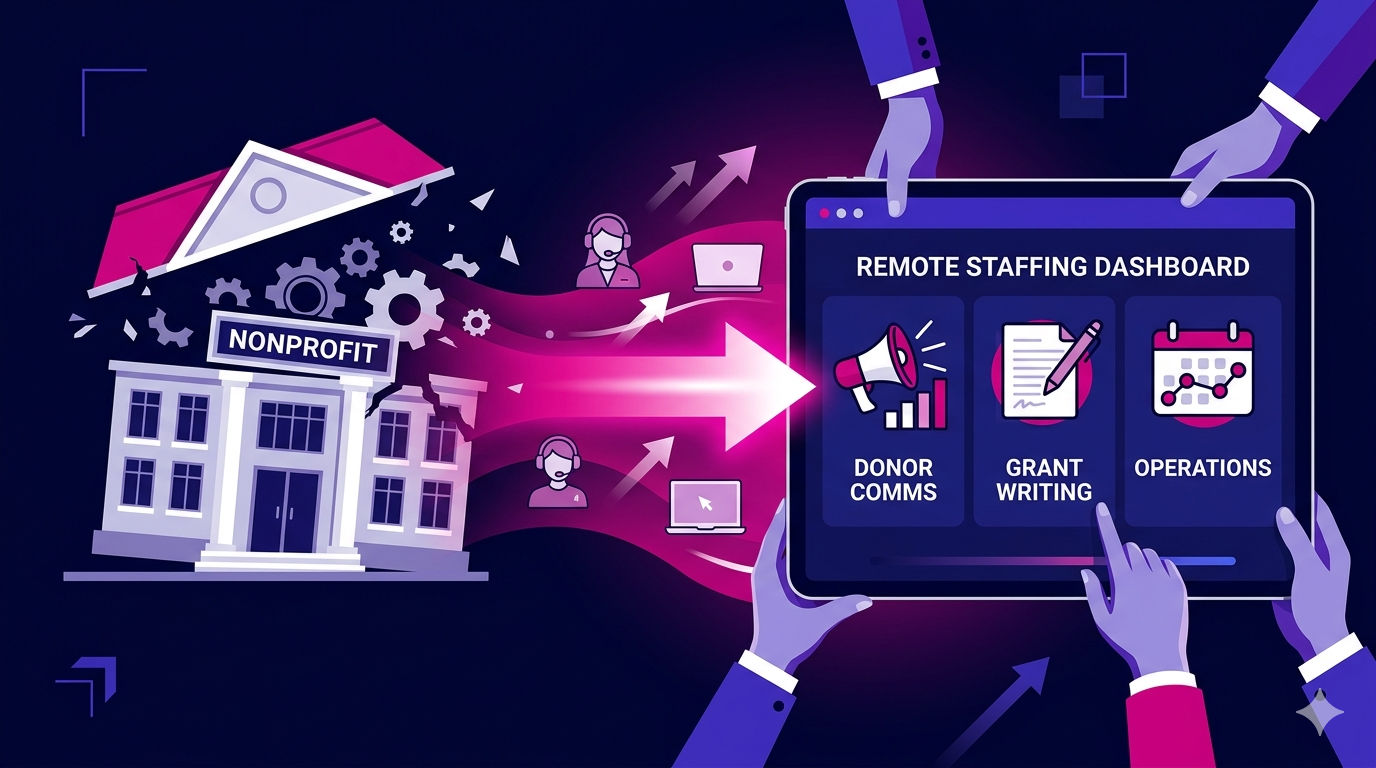
Nonprofits are under constant pressure to do more with less. Every dollar spent on overhead is a dollar not going toward the mission. Yet the work still needs to get done: fundraising coordination, donor communications, social media management, grant writing, administrative support, and program delivery all require skilled people. That is why more nonprofit leaders in 2026 are turning to remote staff for nonprofit organization operations as a way to access talent, reduce costs, and stay focused on what matters most.
This guide covers the full picture: what roles work best as remote positions in a nonprofit context, how to find and vet candidates, how to manage a distributed team effectively, and what results you can realistically expect when you make the shift.
Why Nonprofits Are Embracing Remote Staffing in 2026
The case for remote staffing in the nonprofit sector has never been stronger. Budget constraints, talent shortages in local markets, and the maturity of remote work tools have all converged to make distributed teams not just viable but genuinely advantageous for mission-driven organizations.
Lower Costs Without Lower Quality
The biggest driver is financial. Nonprofit budgets are scrutinized by donors and boards alike. Hiring remote staff for nonprofit organization work, particularly on a part-time or contract basis, allows organizations to access professional-grade talent at a cost that makes sense for constrained budgets. Remote workers do not require office space, equipment stipends, or the full benefits packages that on-site employees typically expect.
A part-time remote communications coordinator, for example, can deliver the same quality of donor outreach and content as a full-time in-office hire at roughly half the annual cost. For nonprofits operating on tight program budgets, that difference is significant.
Access to Mission-Aligned Talent Beyond Your Geography
Many of the most skilled nonprofit professionals are not concentrated in any one city. Grant writers, fundraising strategists, program evaluators, and digital marketers with nonprofit experience are distributed across the country and around the world. When you remove the geographic requirement, you dramatically expand your candidate pool and increase your chances of finding someone who is not just skilled but genuinely committed to your cause.
Flexibility to Scale Around Program Cycles
Nonprofit work is often seasonal or project-driven. Fundraising pushes, annual galas, grant application windows, and campaign launches create spikes in workload that do not justify year-round full-time hires. Remote staffing lets you bring in support when you need it, at the level you need it, without the overhead of permanent headcount.
Which Roles Work Best as Remote Staff for a Nonprofit Organization
Not every nonprofit function translates cleanly to a remote arrangement. Program delivery that requires in-person community presence, for example, stays local. But a large portion of the operational and administrative workload that keeps a nonprofit running is highly compatible with remote work.
Administrative and Operational Support
- Executive assistant support for nonprofit leadership
- Database management and donor record updates in CRMs like Salesforce or Bloomerang
- Scheduling, calendar coordination, and meeting preparation
- Board meeting logistics, minute-taking, and document management
- Grant tracking and reporting coordination
Communications and Marketing
- Social media management and content scheduling
- Email newsletter creation and donor communication
- Website updates and blog content production
- Annual report drafting and editing
- Press release writing and media outreach support
Fundraising and Development Support
- Prospect research for individual and institutional donors
- Grant writing and application management
- Donor acknowledgment letters and stewardship communications
- Crowdfunding campaign coordination and reporting
- Event logistics support for virtual and hybrid fundraisers
Legal and Compliance Support
Nonprofits face regulatory requirements around 990 filings, state charity registrations, and governance documentation. Remote legal support professionals can assist with document preparation, compliance tracking, and board-related filings at a fraction of the cost of traditional legal services.
Explore remote executive assistant services at The Remote Reps to find pre-vetted professionals experienced in supporting nonprofit leaders with operations, communications, and administrative coordination.
How to Find Qualified Remote Staff for Your Nonprofit
Finding the right remote team members for a nonprofit requires a slightly different approach than hiring for a for-profit company. Mission alignment matters. So does the ability to work within the resource constraints that characterize most nonprofits.
Use Vetted Remote Staffing Platforms
Platforms that pre-screen remote candidates for both technical skills and professional reliability save nonprofit hiring managers significant time. Rather than sorting through unvetted applications, you receive candidates who have already been assessed for communication habits, relevant experience, and remote work competency. This is particularly valuable for nonprofits with small or part-time HR capacity.
Look for Nonprofit Sector Experience
Working inside a nonprofit is different from working in a commercial business. The pace, the stakeholder dynamics, the reporting requirements, and the communication style are all distinct. When evaluating candidates for remote staff for nonprofit organization roles, prioritize those who have previous experience with mission-driven organizations, even if their specific title or function was different from the role you are filling.
Assess Mission Fit During the Interview
Remote workers for nonprofits often need to represent your mission in donor communications, social content, and community outreach. Someone who is genuinely aligned with your cause will produce more authentic, more persuasive work. Ask candidates in interviews why your mission resonates with them and listen carefully for specificity. Generic enthusiasm is easy to perform. Real alignment shows up in how someone talks about the work.
Start With a Paid Trial Project
Before committing to a long-term engagement, assign a small, paid project that reflects the actual work you need done. A communications candidate might draft a donor email or a social post series. An administrative candidate might organize a shared drive or prepare a board meeting agenda. Real work samples reveal far more than a resume or portfolio alone.
Managing Remote Staff for Nonprofit Organizations Effectively
Remote team management in a nonprofit context comes with its own nuances. You may have a small leadership team, limited time for supervision, and a culture built around mission and relationships. Here is how to make remote management work within those constraints.
Document Your Processes Before Onboarding
Write down the standard procedures for the tasks you are handing off before your remote hire starts. Even informal documentation, like a short Loom walkthrough or a one-page checklist, dramatically reduces the back-and-forth during onboarding and gives your new remote team member the confidence to work independently faster.
Set Clear Deliverables and Check-In Rhythms
Define what success looks like for each role from day one. What are the weekly deliverables? What metrics matter? How often will you connect? A brief weekly check-in via video call, combined with a shared task list in a tool like Asana or Trello, keeps remote nonprofit staff aligned and accountable without requiring constant oversight.
Integrate Remote Staff Into Your Culture
Mission-driven work depends on people feeling connected to the cause and to each other. Include remote staff in all-staff calls, share impact stories regularly, and treat them as full members of the team even when they are not physically present. Remote workers who feel connected to the mission stay longer, work harder, and advocate more authentically for your organization.
According to the National Council of Nonprofits guidance on remote staff for nonprofit organizations, distributed teams that receive clear expectations and regular communication support achieve productivity and retention rates comparable to in-office teams, often at meaningfully lower total cost.
What to Budget for Remote Nonprofit Staff in 2026
Budget planning for remote staff in the nonprofit sector depends on the role, the hours, and the level of specialization involved. Here are general benchmarks for 2026:
- Remote administrative or virtual assistant support: $18 to $35 per hour for part-time engagements
- Remote communications or social media coordinator: $25 to $50 per hour depending on experience
- Remote grant writer: $40 to $75 per hour or project-based fees ranging from $1,500 to $5,000 per grant application
- Remote fundraising support: $30 to $60 per hour for donor research and development coordination
- Remote legal support: $25 to $55 per hour for document preparation and compliance tracking
These rates reflect part-time and contract arrangements. Compared to the fully loaded cost of full-time in-house staff, remote engagements typically represent cost savings of 35 to 55 percent for nonprofit organizations operating in 2026.
Conclusion: Remote Staffing as a Strategic Tool for Nonprofit Growth
Building a remote team is not just a cost-saving tactic for nonprofits. It is a strategic approach to expanding organizational capacity, reaching better-matched talent, and staying focused on the mission rather than the overhead. When you invest in the right remote staff for nonprofit organization work and set them up with clear processes and genuine culture integration, the impact is real and measurable.
Start by identifying the two or three functions in your organization that consume the most leadership time and follow predictable processes. Build your remote support around those first, then expand as you develop confidence in the model.
Ready to find skilled remote professionals who understand mission-driven work? Browse available remote nonprofit staff at The Remote Reps and connect with vetted candidates ready to support your organization’s goals today.
FAQ: Remote Staff for Nonprofit Organization
What types of roles can be filled by remote staff for a nonprofit organization?
Remote staff for nonprofit organization work can fill a wide range of roles, including administrative assistants, executive support, communications coordinators, social media managers, grant writers, donor relations specialists, fundraising support, legal document assistants, and program coordination staff. Any function that is primarily digital and does not require daily in-person community presence can typically be performed effectively by a remote professional.
Is it cost-effective for small nonprofits to hire remote staff?
Yes, hiring remote staff for nonprofit organization operations is particularly cost-effective for small organizations. Part-time and contract remote arrangements eliminate the need for full-time salaries, benefits, office space, and equipment. Small nonprofits that bring in remote support for communications, administration, or fundraising typically save 35 to 55 percent compared to equivalent in-house staffing costs, allowing more of the budget to flow directly to programs and services.
How do I ensure remote staff for my nonprofit organization stay aligned with our mission?
Mission alignment for remote staff in a nonprofit organization starts in hiring. Ask candidates directly why your cause matters to them and look for genuine, specific answers. During onboarding, share your impact stories, introduce remote staff to beneficiaries and community partners where possible, and include them in organization-wide communications and calls. Regular check-ins that connect day-to-day tasks back to mission outcomes help remote workers feel that their contributions matter beyond the deliverable itself.
What tools help manage remote staff for nonprofit organization work?
Managing remote staff for nonprofit organization operations is straightforward with the right tools. Asana or Trello work well for task assignment and progress tracking. Slack or Microsoft Teams handle daily communication. Zoom or Google Meet support regular video check-ins. Shared Google Drive or Notion spaces work well for documentation and resources. Most of these tools offer nonprofit pricing or free tiers, making them accessible even for organizations with limited technology budgets.
Can remote nonprofit staff handle donor communications and fundraising support?
Absolutely. Donor communications and fundraising support are among the most commonly outsourced functions when nonprofits build remote staff teams. Remote staff for nonprofit organization fundraising can handle donor acknowledgment letters, prospect research, CRM updates, email campaign coordination, and grant application support. The key is selecting candidates with nonprofit development experience and providing them with strong messaging guidelines, donor personas, and clear communication standards from the start.
How long does it take to onboard remote staff for a nonprofit organization?
With well-prepared onboarding materials, most remote staff for nonprofit organization roles reach full productivity within two to four weeks. The first week typically covers system access, tool setup, and mission immersion. Weeks two and three involve taking on initial tasks with close feedback from the supervising team member. By week four, a well-onboarded remote staff member should be handling their core responsibilities independently and communicating proactively about priorities and progress.