
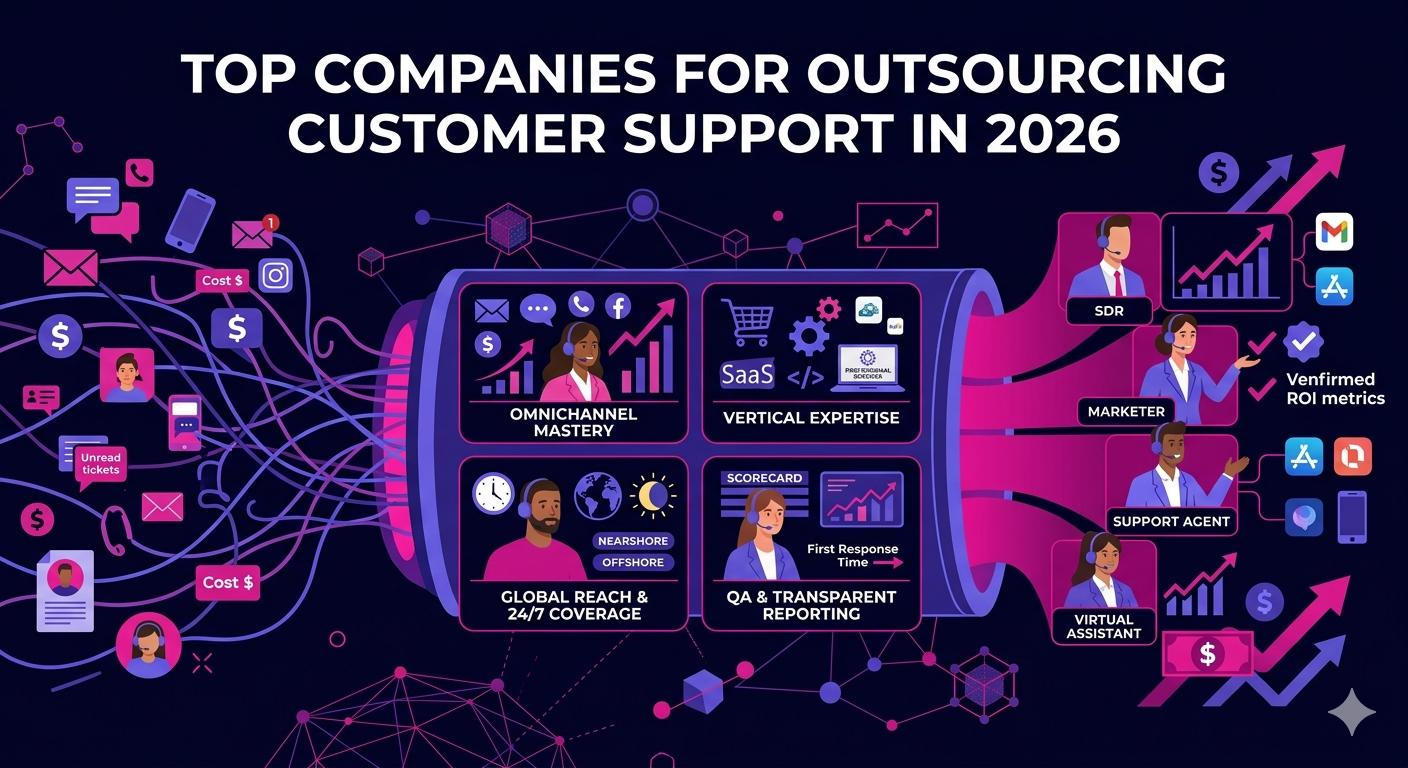
Customer expectations have never been higher. In 2026, buyers expect fast responses, knowledgeable agents, and seamless experiences across every channel. Meeting that bar with a fully in-house team is expensive and operationally demanding. That is why more businesses are partnering with the top companies for outsourcing customer support to deliver consistent, high-quality service without the overhead of building it from scratch.
Whether you run a SaaS company, an e-commerce store, or a professional services firm, this guide will help you identify the right outsourcing partner, understand what separates good providers from great ones, and avoid the most common mistakes businesses make when outsourcing their support function.
Why Businesses Are Turning to Customer Support Outsourcing in 2026
The case for outsourcing customer support has grown stronger each year. Several forces are driving the shift in 2026:
- Rising labor costs: In-house support teams in Western markets are expensive to recruit, train, and retain. Outsourcing delivers equivalent or better talent at significantly lower cost.
- 24/7 coverage demands: Customers expect round-the-clock availability. Building multiple shifts internally is logistically complex. Outsourced teams operating across time zones handle this naturally.
- Scalability needs: Seasonal spikes, product launches, and growth phases create unpredictable support volume. Outsourcing allows businesses to scale capacity up or down without long hiring cycles.
- Focus on core operations: When support is handled externally, internal teams can concentrate on product, sales, and strategy rather than ticket queues.
What to Look for in the Top Companies for Outsourcing Customer Support
Not every outsourcing provider delivers the same results. Before committing to a partner, evaluate them against the criteria that actually predict performance.
Industry and Vertical Experience
A customer support company that has served e-commerce clients for years understands return policies, order tracking issues, and platform integrations in ways a generalist provider simply does not. When evaluating companies for outsourcing customer support, always ask for case studies in your specific industry.
Channel Coverage
Modern customer support spans email, live chat, phone, social media, and SMS. The best outsourcing companies support all of these channels with agents trained for each one. Confirm that the provider covers every channel your customers currently use and any you plan to add.
Quality Assurance Processes
Top-tier customer support outsourcing companies invest in QA. This means call monitoring, CSAT scoring, response time tracking, and regular coaching for agents. Without structured QA, quality drifts and customer experience degrades over time.
Technology and Integration
Your outsourced support team should be able to work inside your existing helpdesk, CRM, or ticketing system. Leading providers have experience with platforms like Zendesk, Freshdesk, Intercom, Salesforce, and HubSpot. Integration capability determines how seamlessly the outsourced team becomes an extension of your operation.
Language and Communication Quality
Strong written and spoken communication is non-negotiable for customer-facing roles. When reviewing providers, request sample interactions, conduct test conversations, and evaluate both tone and accuracy. The top companies for outsourcing customer support maintain rigorous language standards and often offer multilingual capabilities for global customer bases.
Transparency and Reporting
You should never be in the dark about how your outsourced team is performing. Reputable providers offer real-time dashboards, weekly performance reports, and open access to key metrics including first response time, resolution rate, CSAT score, and escalation rate.
Top Categories of Customer Support Outsourcing Companies
The landscape for outsourcing customer support is broad. Here is how the main categories break down in 2026.
Large BPO Firms
Enterprise-grade business process outsourcing companies like Teleperformance, Concentrix, and TTEC handle enormous client volumes and serve global enterprises. They offer extensive infrastructure, multilingual capabilities, and broad channel coverage. However, they are often expensive, slow to onboard, and structured for large contract minimums that make them inaccessible or impractical for small and mid-sized businesses.
Nearshore Outsourcing Providers
Nearshore providers operate in regions geographically close to the client, most commonly Latin America for US companies. They offer strong time zone alignment, high English fluency, and cultural compatibility at significantly lower cost than domestic teams. Nearshore outsourcing has grown sharply in 2026 as businesses seek the quality of domestic support at offshore pricing.
Offshore Customer Support Specialists
Offshore providers in regions like the Philippines, India, and Eastern Europe serve companies that prioritize cost efficiency and 24/7 coverage. The Philippines in particular has a deep talent pool of English-speaking support agents with strong customer service culture. Offshore models work best when paired with strong SOPs, clear escalation paths, and regular QA review.
Specialized Remote Staffing Firms
A growing category in 2026 is the specialized remote staffing firm that places dedicated customer support professionals directly with businesses. Unlike traditional BPOs where agents handle multiple clients simultaneously, specialized staffing firms place agents who work exclusively for your company. This model offers the cost benefits of outsourcing with the focus and accountability of an in-house hire.
If you are looking for a dedicated remote customer support expert who integrates directly with your team and tools, explore the customer support outsourcing services at The Remote Reps to see how their model delivers consistent, personalized service at scale.
How to Evaluate and Compare Customer Support Outsourcing Companies
Once you have identified a shortlist of providers, a structured evaluation process ensures you choose the right partner rather than the most persuasive sales pitch.
Request a Pilot Engagement
The best way to evaluate a customer support outsourcing company is to run a short pilot. A 30 or 60 day trial with a defined scope lets you assess agent quality, response times, and QA processes with real stakes before signing a long-term contract.
Assess Onboarding Depth
Strong providers invest time in learning your product, your brand voice, and your customer base before agents go live. A shallow onboarding process that lasts one or two days is a warning sign. Quality outsourcing companies typically run structured onboarding over one to three weeks.
Evaluate Escalation Protocols
Not every ticket can be handled by a front-line agent. Ask how the provider manages complex escalations, how they route issues to your internal team, and what their SLA expectations are for critical cases. Clear escalation paths protect customer relationships when issues get complicated.
Review Contract Flexibility
Avoid long-term contracts with no exit clauses in the early stages. The best companies for outsourcing customer support offer flexible engagement models that allow you to scale up, scale down, or exit with reasonable notice. Rigid multi-year contracts before performance is proven are a red flag.
Common Mistakes When Choosing Customer Support Outsourcing Partners
Even with a strong shortlist, businesses often undermine their results by making avoidable errors during the selection and onboarding process.
- Selecting on price alone: The lowest-cost provider often produces the highest total cost when poor service drives customer churn. Evaluate value, not just rate.
- No documented SOPs: Outsourced agents cannot represent your brand accurately without detailed standard operating procedures. Build these before the engagement starts.
- Ignoring cultural alignment: Customer support is deeply tied to tone, empathy, and communication style. Cultural misalignment produces technically correct but emotionally flat interactions that frustrate customers.
- No feedback loop: Weekly calls between your internal team and the outsourcing partner are essential. Feedback drives improvement. Without it, quality stagnates.
- Treating outsourcing as a one-time fix: The best customer support outsourcing relationships are long-term partnerships, not short-term cost-cutting measures. Invest in the relationship and the results compound over time.
The Business Case for Outsourcing Customer Support in 2026
The financial and operational argument for outsourcing is compelling. A fully loaded in-house customer support agent in a major US market can cost $55,000 to $75,000 per year including salary, benefits, equipment, and management overhead. A dedicated offshore or nearshore agent through a quality provider typically costs $12,000 to $24,000 per year depending on region and scope.
Beyond cost, outsourced teams can go live faster than internal hires, cover more hours, and scale without the delays of recruitment cycles. For growing businesses managing support volume growth alongside product and sales demands, outsourcing removes a significant operational bottleneck.
For research on how customer support outsourcing impacts satisfaction and retention, Gartner’s customer service and support research on outsourcing companies offers data-driven insights and benchmark comparisons that help businesses build the internal case for outsourcing.
Conclusion: Choosing the Right Partner Among the Top Outsourcing Companies
The market for customer support outsourcing is more mature and more specialized in 2026 than ever before. The top companies for outsourcing customer support are not just answering tickets. They are protecting your brand reputation, driving customer retention, and freeing your internal team to focus on growth.
Define your requirements clearly, evaluate providers on industry experience and QA infrastructure, and choose a partner willing to run a pilot before asking for a long-term commitment. The right outsourcing relationship should feel like an extension of your team, not a vendor you manage from a distance.
Ready to build a dedicated remote customer support team that delivers results from day one? Explore customer support outsourcing options at The Remote Reps and find the right expert for your business.
Frequently Asked Questions About the Top Companies for Outsourcing Customer Support
What should I look for in the top companies for outsourcing customer support?
When evaluating the top companies for outsourcing customer support, focus on six key areas: industry and vertical experience, the channels they support, their quality assurance processes, technology and CRM integration capabilities, language quality standards, and transparency in reporting. Providers that specialize in your industry will understand your customer base and common issues at a much deeper level than generalist BPO firms.
How much do the top companies for outsourcing customer support typically charge?
Pricing varies significantly based on region, agent seniority, and support channel. In 2026, nearshore and offshore providers typically charge between $8 and $20 per hour per agent, or $1,000 to $2,500 per month for a dedicated full-time agent. Large enterprise BPO firms often have higher minimums and longer contracts. Specialized remote staffing firms that place dedicated agents tend to fall in the middle of that range while offering more direct accountability than traditional BPOs.
Are the top companies for outsourcing customer support suitable for small businesses?
Yes, many of the top companies for outsourcing customer support offer models designed for small and mid-sized businesses. Enterprise BPO firms often require large contract minimums that are inaccessible to smaller companies. However, specialized staffing firms and nearshore providers frequently work with businesses of all sizes, offering single-agent placements or small team models that give small businesses access to professional support without the overhead of a full internal team.
How do I transition my support function to one of the top companies for outsourcing customer support?
A successful transition starts with documentation. Before any agent goes live, build detailed SOPs covering common ticket types, escalation paths, brand voice guidelines, and tool access. Work with your chosen provider to run a structured onboarding period of one to three weeks before agents handle live customer interactions. Run a pilot phase with lower-risk ticket types first, then expand scope as quality is confirmed. Maintain a regular feedback loop with weekly calls during the first 90 days.
Can the top companies for outsourcing customer support handle multiple channels?
Yes. The leading customer support outsourcing companies in 2026 are built for omnichannel delivery. This includes email, live chat, phone, social media messaging, SMS, and help center management. When evaluating providers, confirm they have trained agents for each channel you currently use and ask how they manage channel transitions within a single customer interaction. Omnichannel consistency is a key differentiator among the top outsourcing companies.
What is the difference between a BPO and a specialized firm among the top companies for outsourcing customer support?
Large BPO firms manage high-volume operations where agents typically handle multiple clients simultaneously. They offer broad infrastructure but can lack the personalized attention and brand immersion that smaller businesses need. Specialized remote staffing firms place dedicated agents who work exclusively for your company. This model produces stronger brand alignment, more consistent customer interactions, and higher accountability. For most small to mid-sized businesses, a specialized firm offers a better fit than a large enterprise BPO.