
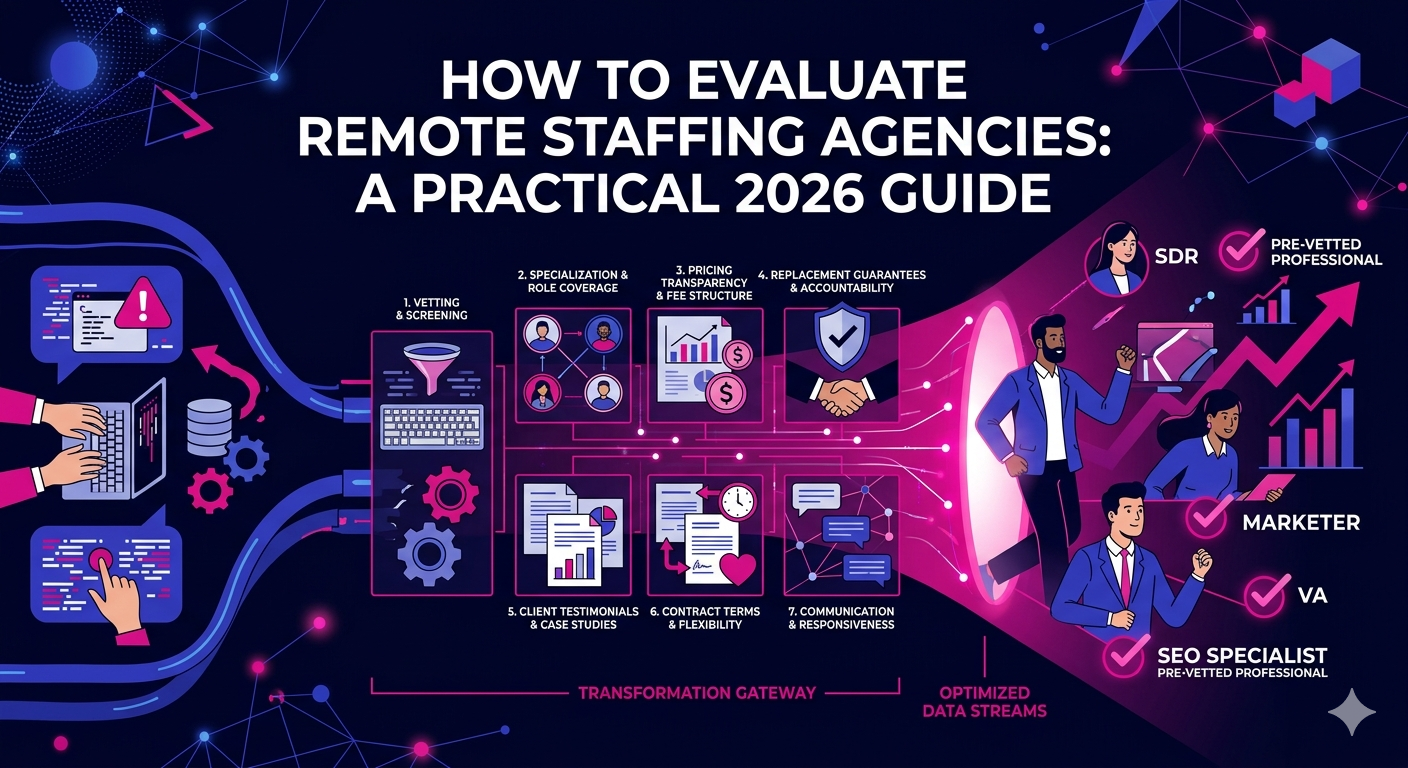
Knowing how to evaluate remote staffing agencies is one of the most important skills a business owner or hiring manager can develop in 2026. The remote talent market has expanded dramatically, and so has the number of agencies claiming to offer the best candidates, the fastest placements, and the lowest fees. Not all of them deliver on those promises. Choosing the wrong agency can cost your business thousands of dollars, weeks of lost productivity, and a string of disappointing hires.
This guide gives you a clear, actionable framework for assessing any remote staffing agency before you sign a contract or pay a single dollar.
Why Evaluating Remote Staffing Agencies Matters More in 2026
The remote work boom has created a crowded staffing landscape. Hundreds of agencies now offer remote talent placement across roles ranging from virtual assistants and sales development reps to legal professionals and digital marketers. The problem is that quality, transparency, and pricing vary enormously across providers.
A poor agency selection leads to:
- Candidates who are not genuinely vetted and misrepresent their skills
- Overpriced contracts with markups of 40% to 70% on the candidate’s actual rate
- Lock-in agreements that make it difficult to exit if results are poor
- Slow turnaround times despite promises of rapid placement
- Little accountability when a placed candidate underperforms
When you know how to evaluate remote staffing agencies properly, you protect your budget, your time, and the quality of your team.
Key Criteria for Evaluating Remote Staffing Agencies
1. Vetting and Screening Standards
The single most important factor when you evaluate remote staffing agencies is how they screen their candidates. Ask every agency you consider these direct questions:
- What is your candidate sourcing process and where do you find talent?
- Do you conduct skills testing, and if so, which tools do you use?
- How do you verify past work experience and references?
- Do you assess candidates for remote work readiness, communication skills, and time zone compatibility?
- What percentage of applicants pass your screening process?
A reputable agency will answer these questions confidently and specifically. Vague answers like “we have a rigorous process” with no supporting detail are a warning sign. Look for agencies that use structured skill assessments, conduct reference checks with previous employers, and evaluate soft skills alongside technical ability.
2. Specialization and Role Coverage
When evaluating remote staffing agencies, consider whether they specialize in the roles you need or take a generalist approach. A generalist agency may list dozens of role categories but lack deep expertise in any of them.
Specialist platforms tend to maintain higher quality standards within their niche because their reputation depends on it. If you are looking for roles in sales, marketing, legal support, or e-commerce, seek out an agency or platform with a demonstrated track record specifically in those areas rather than one that claims to do everything.
3. Pricing Transparency and Fee Structure
One of the clearest signals of how to evaluate remote staffing agencies is whether they are upfront about their pricing. Agencies that hide their markup or refuse to explain how they calculate rates are not operating in your interest.
Questions to ask about pricing:
- What is the candidate’s underlying rate and what is your markup percentage?
- Are there placement fees, onboarding fees, or contract minimums?
- What are the termination or conversion fees if I want to hire the candidate directly?
- Do you charge differently for full-time vs. part-time engagements?
In 2026, the average agency markup on remote talent sits between 30% and 60%. Anything above that range warrants serious scrutiny. Platforms that connect you directly with pre-vetted candidates without acting as a traditional markup-based intermediary often represent significantly better value.
4. Replacement Guarantees and Accountability
Even the best vetting processes occasionally produce a poor fit. How an agency handles that situation tells you a great deal about their professionalism and accountability.
When you evaluate remote staffing agencies, ask:
- Do you offer a replacement guarantee if the hire does not work out?
- What is the replacement timeframe and is there a fee?
- How many replacements are you willing to provide per engagement?
- What is the process for raising a concern about a placed candidate?
A credible agency will stand behind their placements with a clear, written guarantee. Avoid any agency that is evasive about what happens when things go wrong.
5. Client Testimonials and Verifiable Case Studies
Social proof is a powerful tool when assessing remote staffing agencies. Look beyond the testimonials listed on the agency’s own website and seek out independent reviews on third-party platforms such as Google, Clutch, or Trustpilot.
Specific things to look for:
- Reviews that mention specific roles, industries, and outcomes rather than generic praise
- A consistent pattern of positive feedback over time, not just a cluster of recent reviews
- How the agency responds to negative reviews, which reveals their communication culture
- Case studies that include measurable results where possible
You can also ask the agency directly for client references you can contact. Any agency confident in their track record should be willing to provide this.
6. Contract Terms and Flexibility
A critical step in knowing how to evaluate remote staffing agencies is reading the contract carefully before signing. Many agencies bury unfavorable terms in their standard agreements, including:
- Mandatory minimum monthly hours or retainer fees
- Automatic renewal clauses with short cancellation windows
- High conversion fees if you want to hire a placed candidate as a direct employee
- Restrictive non-solicitation clauses that prevent you from hiring candidates independently
Always have a contract reviewed by a legal professional before committing to any agency agreement. Legitimate agencies welcome scrutiny of their terms. Agencies that pressure you to sign quickly without time to review are a red flag.
7. Communication and Responsiveness
The quality of an agency’s communication during the sales process is a reliable preview of what your ongoing experience will be like. Pay attention to:
- How quickly they respond to initial inquiries and follow-up questions
- Whether they assign a dedicated account manager or route you through a generic support queue
- How clearly they explain their process, timeline, and candidate pipeline
- Whether they listen to your specific requirements or push generic candidates
Slow or unclear communication before you become a paying client almost always gets worse once you are locked into a contract.
Red Flags to Watch for When Assessing Remote Staffing Agencies
Beyond the positive criteria above, there are specific warning signs that should prompt you to walk away when you evaluate remote staffing agencies:
- No clear candidate profiles or sample resumes available upfront
- Inability to explain the sourcing and vetting process in concrete terms
- Pressure tactics or limited-time offers that rush your decision
- No verifiable client reviews outside their own website
- Contracts requiring payment before any candidate is reviewed
- Opaque pricing with no clear breakdown of the markup
These patterns appear consistently in lower-quality providers. Protecting yourself means recognizing them early.
A Better Alternative: Pre-Vetted Platforms Without Agency Lock-In
One of the developments reshaping how businesses think about how to evaluate remote staffing agencies in 2026 is the rise of direct-access platforms that do the vetting without the traditional agency overhead.
Rather than paying a 40% to 60% markup to an intermediary, you can access a curated pool of pre-screened remote professionals directly. The Remote Reps operates on this model across a wide range of roles. Whether you need a remote virtual assistant, a remote lead generation expert, or a remote customer support specialist, you get access to vetted candidates without lock-in contracts or opaque pricing.
You can also review what real clients say about the experience at The Remote Reps testimonials page before making any commitment.
For additional context on industry standards and what to expect when comparing staffing partners, the Society for Human Resource Management’s guidance on evaluating staffing agencies provides a useful independent reference point.
Conclusion: Evaluate Before You Commit
Knowing how to evaluate remote staffing agencies is not about being overly cautious. It is about being smart with your resources and protecting your ability to build a genuinely effective remote team. In 2026, you have more options and more information available than ever before. Use the criteria in this guide to assess any agency thoroughly, ask the hard questions, and never sign a contract you have not read in full.
The right remote talent partner will welcome your scrutiny. The wrong one will avoid it. That distinction alone will save you significant time and money.
Ready to see what a transparent, direct-hire approach looks like? Explore The Remote Reps and connect with pre-vetted remote professionals across every major business function, with no hidden fees and no agency lock-in.
Frequently Asked Questions
What is the most important factor when I evaluate remote staffing agencies?
When you evaluate remote staffing agencies, the most important factor is their candidate vetting and screening process. Ask specifically how they source talent, what skills testing they use, how they verify experience, and what percentage of applicants they actually approve. An agency that cannot answer these questions in detail is unlikely to deliver consistent quality.
How do I evaluate remote staffing agencies without paying any fees upfront?
To evaluate remote staffing agencies without financial commitment, request candidate profiles, sample resumes, and client references before signing anything. Most reputable agencies will provide these at no charge during the evaluation stage. Avoid any agency that requires payment before you have reviewed any candidates or verified their process.
What pricing should I expect when I evaluate remote staffing agencies in 2026?
When you evaluate remote staffing agencies in 2026, expect markups ranging from 30% to 60% above the candidate’s base rate. Some agencies also charge placement fees, onboarding fees, or conversion fees. Understanding the full cost structure before you commit is essential. If an agency cannot clearly explain how their pricing works, that is a significant red flag.
How do I evaluate remote staffing agencies for specialized roles like sales or legal support?
To evaluate remote staffing agencies for specialized roles, look for providers that focus specifically on those role categories rather than generalists that list everything. Ask for examples of candidates they have placed in similar roles, request relevant portfolio samples or credentials, and ask how they assess domain-specific skills. Specialist platforms tend to maintain higher standards within their niche than broad generalist agencies.
What contract terms should I watch for when evaluating remote staffing agencies?
When evaluating remote staffing agencies, scrutinize contracts for mandatory minimum hours, automatic renewal clauses, high conversion fees, and non-solicitation provisions. These terms can significantly limit your flexibility and increase your long-term costs. Always have a legal professional review any staffing agreement before signing, and do not allow an agency to pressure you into a quick decision.
Can I evaluate remote staffing agencies against direct-hire platforms as an alternative?
Yes, and in many cases direct-hire platforms compare very favorably. When you evaluate remote staffing agencies against platforms like The Remote Reps, you will often find that pre-vetted direct-access platforms offer equivalent or better candidate quality at significantly lower cost, with no lock-in contracts or opaque markup structures. For businesses that want full control over their hiring at a transparent price, direct-access platforms are worth serious consideration alongside traditional agencies.