When businesses hire remote talent, one of the first questions they ask is: how do remote staffing agencies vet candidates before placing them? The answer goes far beyond a simple resume review. Today’s top remote staffing agencies use layered, multi-step vetting processes that combine technology, human judgment, and domain expertise to filter out underqualified applicants and surface only the best fits.
In this guide, we break down exactly what that process looks like, why it matters for your business, and what sets a rigorous vetting framework apart from a basic job board search.
Why Candidate Vetting Matters More in Remote Hiring
Remote work removes the traditional office-based signals employers rely on, such as punctuality, interpersonal dynamics, and real-time supervision. Because of this, the vetting process for remote candidates must compensate by evaluating qualities that are harder to observe from a distance, including communication clarity, self-management, reliability, and technical competence in an asynchronous environment.
A poor remote hire is also more costly to unwind. Onboarding, tool access, and time invested in a mismatched hire can set a team back weeks. This is precisely why partnering with a staffing agency that has a proven vetting system is one of the highest-leverage decisions a growing business can make.
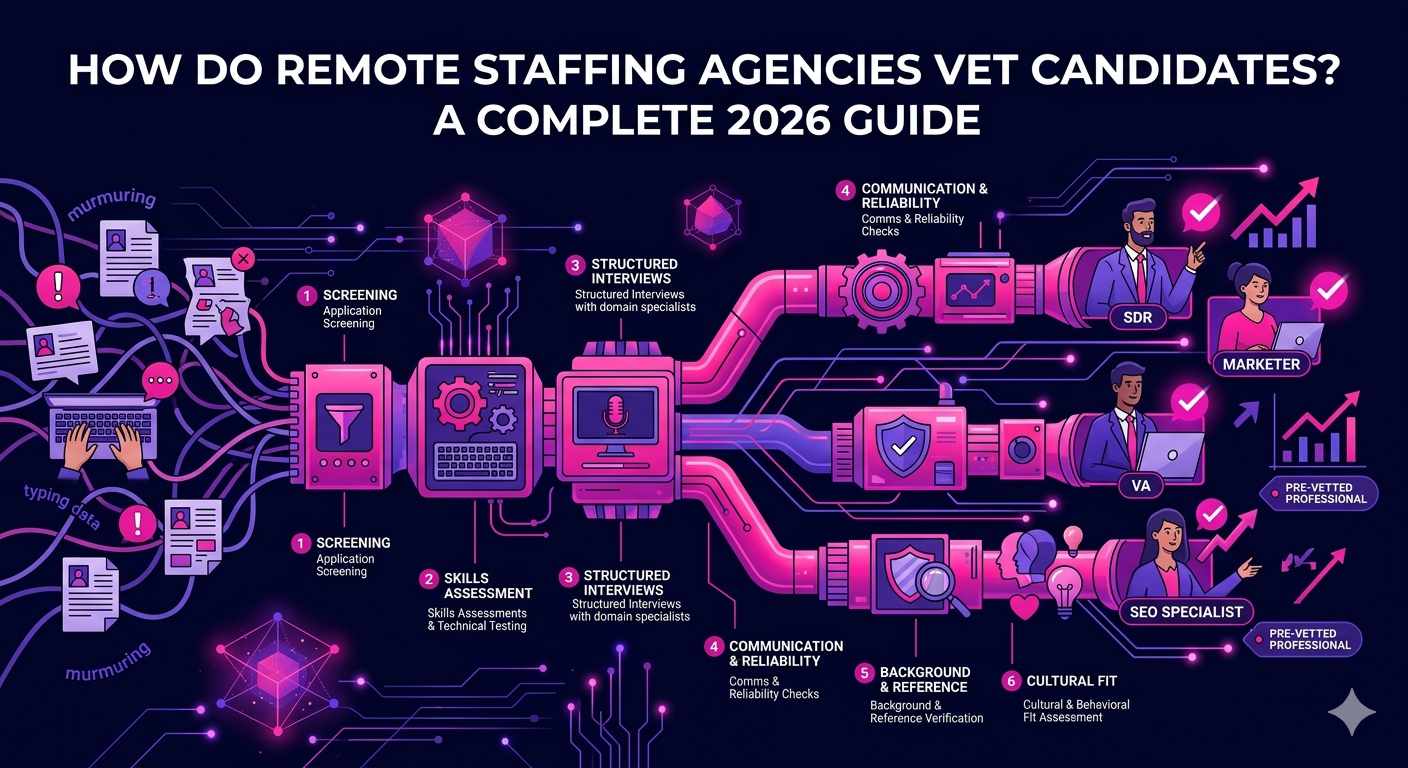
Step-by-Step: How Remote Staffing Agencies Vet Candidates
1. Application Screening and Initial Qualification
The process begins with a structured application review. Agencies typically evaluate candidates on specific criteria relevant to the role, filtering out applicants who do not meet minimum thresholds for experience, tools familiarity, or language proficiency. This stage can eliminate the majority of applicants, ensuring that only relevant profiles move forward.
- Minimum years of relevant experience
- Required tools or platform proficiency (e.g., CRMs, ad platforms, project management software)
- Language and written communication quality in the application itself
- Role-specific certifications or portfolio requirements
2. Skills Assessments and Technical Testing
A defining feature of how remote staffing agencies vet candidates is the use of practical skills tests. Rather than relying on self-reported abilities, candidates are given role-specific assessments that reflect real work scenarios. A copywriter might complete a timed writing sample. A PPC expert might be asked to audit a mock campaign. A virtual assistant might be tested on calendar management and task prioritization.
These assessments provide objective data points that go far beyond what a resume can convey. They reveal how candidates actually perform under realistic conditions.
3. Structured Interviews with Domain Specialists
Candidates who pass skills assessments proceed to structured interviews. Unlike informal conversations, these interviews follow a consistent framework that allows for fair comparison across candidates. Interviews are typically conducted by specialists in the relevant field who can probe technical depth and ask situational questions.
For example, when vetting candidates for remote sales roles, interviewers will explore objection handling, pipeline management methodology, and CRM usage. For digital marketing roles, they assess knowledge of campaign strategy, attribution models, and performance reporting.
4. Communication and Reliability Checks
Remote work depends on clear, prompt, and professional communication. Agencies evaluate this throughout the hiring process itself. How quickly does a candidate respond to messages? Are their written communications well-structured and professional? Do they follow instructions? These behavioral signals predict how a candidate will function in a distributed team environment.
Some agencies also conduct asynchronous video interviews or async task simulations to observe performance in a format that mirrors how remote teams actually operate.
5. Background and Reference Verification
Comprehensive agencies include background verification as a standard part of how they vet remote candidates. This typically covers employment history verification, identity checks, and in some cases, criminal background screening depending on the role and client requirements.
Reference checks add another layer of validation by gathering feedback from former employers or clients about the candidate’s work ethic, output quality, and professional conduct.
6. Cultural and Behavioral Fit Assessment
Technical ability alone does not make a great remote hire. Agencies also assess whether candidates can align with a client’s company culture, values, and working style. This may involve personality assessments, work style evaluations, or situational judgment tests that reveal how a candidate approaches challenges, conflict, and collaboration.
This step is especially important for senior roles or positions that require independent decision-making and direct client communication.
What Sets Top Remote Staffing Agencies Apart
Not every staffing agency puts the same rigor into their process. The best agencies apply industry-specific screening, maintain talent databases of pre-vetted candidates, and continuously refine their assessment frameworks based on placement performance data.
At The Remote Reps, the vetting process is built around delivering pre-screened, high-performance remote sales and marketing professionals who are ready to contribute from day one. Every candidate goes through multiple rounds of evaluation before being presented to a client, significantly reducing the time and risk associated with remote hiring.
Role-Specific Vetting: How It Differs by Position
Sales Development Representatives (SDRs)
Vetting for SDRs focuses on prospecting skills, outreach volume capacity, CRM proficiency, and rejection resilience. Agencies typically simulate cold outreach scenarios and evaluate tone, personalization quality, and follow-up structure.
Digital Marketers and PPC Experts
Candidates are tested on platform knowledge (Google Ads, Meta, LinkedIn), campaign structure, budget management, and analytical reporting. Portfolio reviews and live audits are common components of this vetting stage.
Virtual Assistants and Executive Assistants
Vetting centers on task management speed, communication professionalism, tool literacy, and the ability to handle sensitive information with discretion. Many agencies use timed workflow simulations to measure output quality under pressure.
SEO and Content Specialists
For these roles, agencies review past work samples, test keyword strategy knowledge, and may conduct live audits of websites to evaluate diagnostic and strategic thinking.
Red Flags in a Staffing Agency’s Vetting Process
When evaluating a staffing partner, watch for these warning signs that suggest their vetting process is insufficient:
- No skills assessments or tests before placement
- Candidates presented within hours of your inquiry with no context on their evaluation
- No reference checks or employment history verification
- A one-size-fits-all process that does not vary by role type
- Inability to explain their screening criteria when asked
To understand best practices in remote candidate evaluation, resources like the Society for Human Resource Management’s talent acquisition guidance provide a strong foundation for what rigorous, standards-based vetting looks like.
The Business Impact of Working with a Well-Vetted Talent Pipeline
Businesses that partner with agencies running thorough vetting processes consistently report faster ramp-up times, lower turnover in remote positions, and better team cohesion. The upfront investment in rigorous screening pays dividends throughout the employment relationship.
For growing companies that need to scale their remote teams quickly without sacrificing quality, a pre-vetted talent pool is one of the most valuable resources available. Explore the range of vetted remote professionals available through The Remote Reps to see how this applies to your specific hiring needs.
Conclusion
Understanding how remote staffing agencies vet candidates gives you a meaningful advantage when selecting a staffing partner. The best agencies do not simply forward resumes. They apply structured, multi-stage screening processes that test skills, verify credentials, evaluate communication, and confirm cultural alignment before a candidate ever reaches your inbox.
If you are ready to hire remote professionals who have already passed a rigorous evaluation process, explore The Remote Reps and connect with a team that takes vetting seriously. Your next great remote hire is already screened and waiting.
Frequently Asked Questions
How do remote staffing agencies vet candidates differently than traditional agencies?
Remote staffing agencies vet candidates with a stronger emphasis on asynchronous communication skills, self-management ability, and remote tool proficiency. Traditional agencies often focus more on in-person presentation and local availability. Remote vetting also places greater weight on practical skills testing since there is no opportunity for in-office trial periods.
How long does it take for remote staffing agencies to vet candidates?
The timeline varies by agency and role complexity. Basic vetting processes can take three to five business days, while thorough multi-stage evaluations for specialized roles may take one to two weeks. Agencies with pre-built talent pipelines can often present pre-vetted candidates much faster, sometimes within 24 to 48 hours of receiving a job brief.
What screening steps do remote staffing agencies use to vet candidates?
Most reputable remote staffing agencies vet candidates through a combination of resume screening, skills assessments, structured interviews, communication evaluations, background verification, and reference checks. The exact steps vary by agency and role type, but these core components are standard in any rigorous remote hiring process.
Can I request specific vetting criteria when working with a remote staffing agency?
Yes. Most professional remote staffing agencies allow clients to specify custom screening requirements, such as tool proficiency benchmarks, language standards, industry certifications, or work style preferences. Sharing a detailed job brief and must-have criteria at the start of the engagement helps the agency tailor their vetting process accordingly.
How do remote staffing agencies verify a candidate’s work history and credentials?
Agencies typically verify work history through direct reference checks with previous employers or clients, employment history confirmation, and portfolio or deliverable reviews. Some agencies also use third-party background screening services for identity verification and, where relevant, criminal record checks. Credential verification for certified roles may include contacting issuing bodies directly.
What happens if a vetted candidate placed by a remote staffing agency does not work out?
Most established remote staffing agencies offer a replacement guarantee or trial period. If a placed candidate does not meet performance expectations within an agreed timeframe, the agency will source and vet a replacement candidate at no additional charge. Always clarify the replacement policy before signing a staffing agreement.