
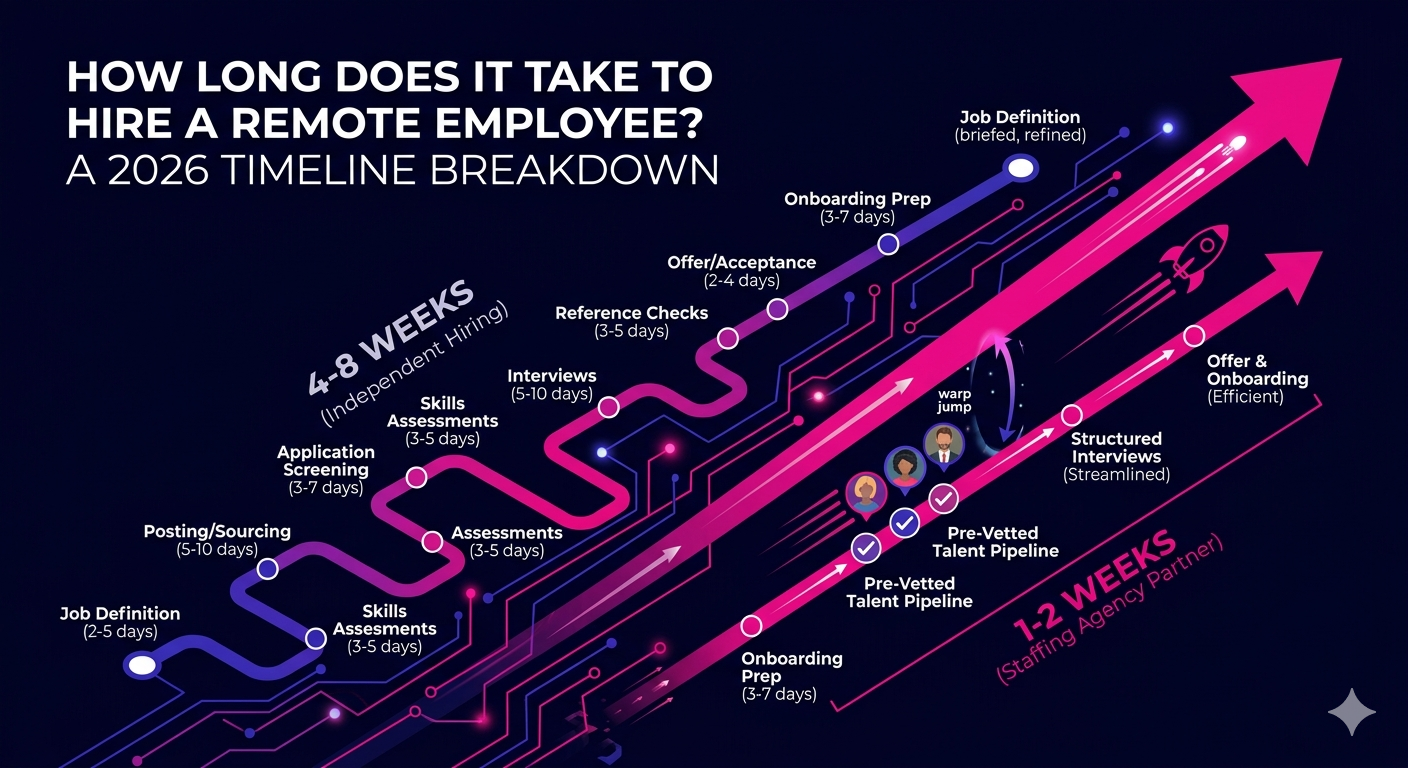
One of the most practical questions business owners and hiring managers face is: how long does it take to hire a remote employee? The answer depends on several variables, including the role type, your hiring method, and how prepared your internal process is. In 2026, the remote hiring landscape has matured significantly, and businesses have more options than ever to accelerate their timelines without compromising on candidate quality.
This guide walks you through a realistic timeline for each stage of the remote hiring process, the factors that slow things down, and the strategies that compress the timeline without cutting corners.
Average Timeline: How Long Does It Take to Hire a Remote Employee?
On average, businesses hiring remotely without a staffing partner can expect the full process to take anywhere from four to eight weeks. This includes job posting, application review, screening, interviews, assessment, reference checks, offer, and onboarding. However, this is a wide range, and many companies experience delays at multiple stages that push timelines even further.
Businesses that work with a specialized remote staffing agency can often compress this timeline to one to two weeks for many role types, particularly when the agency maintains a pre-vetted talent pipeline.
Stage-by-Stage Breakdown of the Remote Hiring Timeline
Stage 1: Job Definition and Brief Preparation (2 to 5 days)
Before any outreach begins, you need a clearly defined job brief. This includes the role title, responsibilities, required skills, performance expectations, compensation range, and working hours. Many companies underestimate this stage, but a vague brief leads to misaligned candidates and wasted screening time. Taking two to five days upfront to sharpen your requirements saves far more time downstream.
Stage 2: Job Posting and Sourcing (5 to 10 days)
If you are posting independently on job boards or LinkedIn, expect to spend at least one to two weeks waiting for a relevant volume of applications. For highly specialized remote roles, the wait can be longer. Sourcing quality candidates proactively rather than waiting for inbound applications can cut this stage down, but requires dedicated recruiter time.
Working with a staffing agency that already has a pool of pre-screened candidates eliminates this stage almost entirely, which is one of the primary reasons businesses choose this route when they need to hire remote employees quickly.
Stage 3: Application Screening (3 to 7 days)
Reviewing applications, filtering out unqualified candidates, and creating a shortlist takes time, especially for popular roles that attract high application volumes. Without a defined scoring rubric, this stage can drag on as reviewers loop back to compare candidates they have already evaluated. Structured screening criteria make this stage significantly more efficient.
Stage 4: Skills Assessments (3 to 5 days)
Remote hiring best practices include role-specific skills testing before interviews. Sending assessments, allowing candidates time to complete them, and then scoring results adds three to five days to the timeline. However, this stage pays for itself by eliminating candidates who look strong on paper but underperform in practice, saving time later in the process.
Stage 5: Interviews (5 to 10 days)
Scheduling and conducting structured interviews across time zones is one of the most common sources of delay in remote hiring. Coordinating availability between hiring managers, department leads, and candidates adds friction. A streamlined interview process with a maximum of two rounds and clear decision criteria keeps this stage to five to seven days in most cases.
Stage 6: Reference and Background Checks (3 to 5 days)
Reference checks for remote employees are especially important since you are extending trust across a distributed relationship. Contacting previous employers, waiting for responses, and verifying employment history typically takes three to five business days. Background screening services can run concurrently with final interview stages to save time.
Stage 7: Offer and Acceptance (2 to 4 days)
Once you have selected your candidate, drafting and sending the offer, allowing negotiation time, and receiving a signed agreement usually takes two to four days. Having your offer letter templates and compensation benchmarks ready in advance prevents unnecessary delays at this stage.
Stage 8: Onboarding Preparation (3 to 7 days)
Onboarding a remote employee requires advance preparation. Tool access, system credentials, communication platform setup, training materials, and a structured first-week plan all need to be in place before the employee starts. Rushing this stage leads to poor early experiences that affect retention and time-to-productivity.
Factors That Affect How Long It Takes to Hire a Remote Employee
Not all remote hires take the same amount of time. Several variables can either compress or extend your timeline significantly.
Role Specialization
The more specialized the role, the longer the search tends to take. Hiring a remote virtual assistant is typically faster than hiring a remote GTM engineer or a remote paralegal. Specialized roles require a smaller qualified candidate pool, more rigorous testing, and more detailed evaluation criteria.
Hiring Method
The biggest single factor in how long it takes to hire a remote employee is whether you use a staffing agency or hire independently. Agencies with pre-vetted talent pipelines can dramatically shorten the timeline. Businesses that hire pre-vetted remote virtual assistants through The Remote Reps, for example, often move from brief to placed candidate within one to two weeks because the sourcing and vetting stages are already done.
Internal Process Readiness
Companies with documented job briefs, assessment templates, interview scorecards, and onboarding checklists move through the hiring process significantly faster than those building from scratch each time. Investing in hiring infrastructure once pays dividends across every future hire.
Decision-Making Speed
Internal approval bottlenecks are one of the most common reasons remote hiring timelines extend beyond initial estimates. Defining who has final hire authority before the search begins eliminates the delays that come from seeking consensus at each stage.
Candidate Market Conditions
In 2026, demand for skilled remote professionals in areas like sales development, paid media, and technical marketing remains high. Top candidates are often evaluating multiple opportunities simultaneously. Slow-moving hiring processes lose strong candidates to faster-moving competitors. Shortening your decision timeline, particularly from final interview to offer, directly improves your acceptance rate.
How to Hire a Remote Employee Faster Without Lowering Standards
- Define your ideal candidate profile before beginning any outreach
- Use structured assessments to filter candidates early rather than relying on resume review alone
- Limit interviews to two rounds with a clear decision framework for each
- Run background checks concurrently with final-stage interviews rather than sequentially
- Prepare offer templates and onboarding materials before the search begins
- Partner with a staffing agency that maintains a pre-vetted talent pipeline for your target role type
For broader guidance on best practices in remote hiring timelines and workforce planning, LinkedIn’s talent acquisition research on how long it takes to hire a remote employee provides useful benchmarking data across industries and role types.
What a Staffing Agency Changes About the Timeline
Working with a remote staffing agency does not just speed up hiring. It also shifts where your time is spent. Instead of investing weeks in sourcing, screening, and testing, your team focuses only on final evaluation and decision-making. The agency handles the first several stages of the process with candidates who have already passed a multi-step vetting framework.
For businesses with active growth targets, this difference can mean the gap between a role being filled in two weeks versus two months. For roles like remote SDRs, digital marketers, or customer support specialists where vacant positions directly affect revenue or service quality, that time difference has a measurable business impact.
If you are weighing your options, reviewing what clients say about their hiring experience with The Remote Reps gives you a concrete picture of what a faster, structured remote hiring process looks like in practice.
Conclusion
So, how long does it take to hire a remote employee? If you are hiring independently with no established process, expect four to eight weeks at minimum. If you are working with a specialized staffing agency that has a pre-vetted talent pool, that timeline can shrink to one to two weeks for many roles. The gap between those two outcomes is largely a function of preparation, process, and the hiring method you choose.
If speed and quality are both priorities for your next remote hire, explore The Remote Reps and connect with a team that has already done the sourcing and vetting work for you. Your next remote employee may be closer than you think.
Frequently Asked Questions
How long does it take to hire a remote employee on average?
On average, hiring a remote employee independently takes four to eight weeks from job posting to accepted offer. Businesses that partner with a remote staffing agency that maintains a pre-vetted talent pipeline can often reduce this to one to two weeks, particularly for roles like virtual assistants, SDRs, digital marketers, and customer support specialists.
What stage takes the longest when hiring a remote employee?
Sourcing and interview scheduling are typically the longest stages in the remote hiring process. Sourcing qualified candidates can take one to two weeks on its own when hiring independently. Interview coordination across time zones adds additional delays. Both of these stages can be significantly compressed when working with a staffing agency that has candidates already screened and ready to interview.
How long does it take to hire a remote employee for a specialized role?
Specialized remote roles such as GTM engineers, paralegals, Amazon marketplace experts, or media buyers typically take longer to fill than generalist roles because the qualified candidate pool is smaller. Independent searches for these roles can take six to ten weeks or longer. A staffing agency with a dedicated pipeline for specialized roles can cut this timeline considerably by presenting pre-vetted candidates from day one.
Does using a staffing agency really reduce how long it takes to hire a remote employee?
Yes, significantly. Staffing agencies handle the most time-intensive stages of the hiring process, including sourcing, initial screening, skills assessments, and background verification. This means clients typically only engage at the final interview and decision stage. For most role types, this compresses the timeline from weeks of independent searching to a few days of focused evaluation.
How long does it take to onboard a remote employee after hiring?
Onboarding a remote employee typically takes one to two weeks to complete if the process is well-prepared in advance. This includes tool access provisioning, communication platform setup, training material review, and structured check-ins during the first week. Companies that prepare onboarding documentation before the hire is confirmed avoid delays and improve time-to-productivity significantly.
What can I do to shorten how long it takes to hire a remote employee?
The most effective steps are to define your candidate profile before searching, use structured assessments early in the funnel, limit interviews to two rounds, run background checks in parallel with final-stage interviews, and prepare your offer and onboarding materials before the search concludes. Partnering with a staffing agency that already has pre-vetted candidates ready is the single biggest lever available for most businesses.