
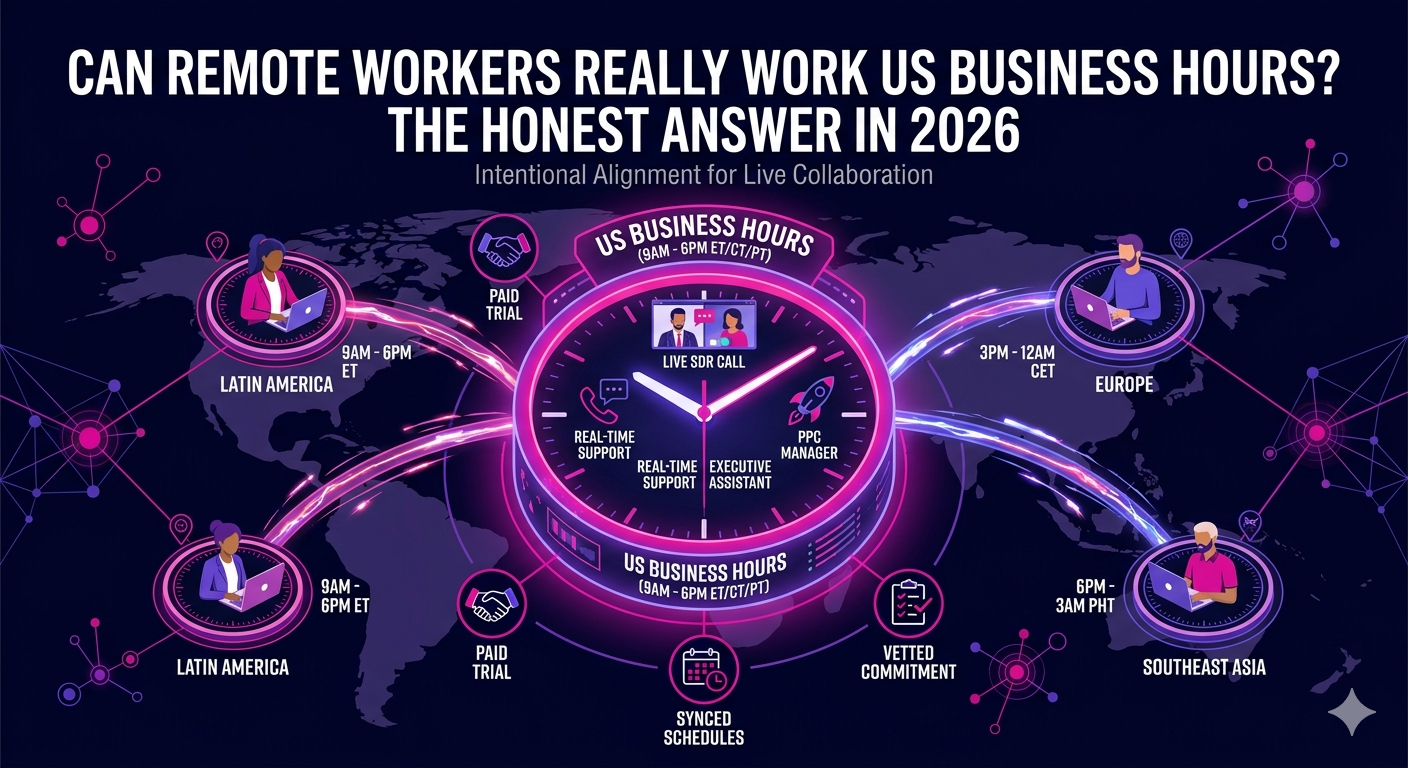
If you have ever considered hiring remote talent, one question almost always comes up: can remote workers really work US business hours? It sounds simple on the surface, but the answer involves time zones, work culture, technology, and the right hiring strategy. In 2026, millions of businesses are successfully operating with fully remote teams aligned to US Eastern, Central, and Pacific time zones. But it does not happen by accident. Here is what you need to know before you hire.
Why US Business Hours Alignment Matters for Remote Teams
For many companies, having their remote workforce available during core US hours is not just a preference, it is a business necessity. Sales calls, client meetings, live support, and real-time collaboration all depend on schedule overlap. When remote workers cannot sync with their US-based counterparts, productivity suffers and deals get delayed.
The good news is that a growing pool of remote professionals specifically seek roles that require US business hours. They have adapted their schedules, invested in the right tools, and built careers around being available when American businesses are open. The question is not whether they can do it, but whether you are hiring the right people.
Which Time Zones Make US Hours Alignment Easiest?
Latin America and the Caribbean
Countries like Colombia, Mexico, Argentina, and Costa Rica sit within one to four hours of US Eastern Time. Workers in these regions can naturally align with 9 AM to 6 PM ET schedules without disrupting their personal lives. This makes Latin America one of the most popular regions for US-aligned remote hiring in 2026.
Eastern Europe and North Africa
With a six to eight hour difference from Eastern Time, professionals in Poland, Romania, Egypt, and Morocco can cover US morning hours during their afternoon and evening. Many experienced remote workers in these regions have built their entire careers around this overlap window.
South and Southeast Asia
India, the Philippines, and Pakistan have large English-speaking remote workforces that routinely take on US-hours roles. While the time difference is significant, a high percentage of remote professionals in these countries specifically target US-aligned jobs and work evening or night shifts as a standard part of their careers.
Can Remote Workers Really Work US Business Hours Without Burning Out?
This is a fair concern. Shifting your sleep schedule or working evenings is not sustainable for everyone. The reality is that sustainability depends heavily on the individual, the role, and the compensation. Here is what makes it work:
- Choice and intentionality: Remote workers who choose US-hours roles understand the commitment upfront. They are not surprised by the schedule.
- Competitive compensation: US-aligned remote roles typically pay above local market rates, which motivates professionals to maintain the schedule.
- Flexibility within the hours: Many US employers allow some flexibility in start and end times as long as core hours overlap, which reduces burnout significantly.
- Strong boundaries: Experienced remote professionals have learned to separate work time from personal time, even when working non-traditional local hours.
Burnout is real, but it is not inevitable. The remote workers who thrive on US schedules are those who actively chose this path and are properly compensated for it.
Tools That Make Real-Time Collaboration Possible Across Time Zones
Technology has largely solved the logistical side of working US business hours from abroad. In 2026, remote teams use a combination of tools to stay connected, accountable, and productive in real time.
Communication and Collaboration
- Slack and Microsoft Teams for instant messaging and quick check-ins
- Zoom and Google Meet for video calls and client meetings
- Notion and Confluence for asynchronous documentation and project tracking
Sales and CRM Tools
- Salesforce and HubSpot for pipeline management during live US hours
- Outreach and Apollo for outbound prospecting aligned to prospect time zones
- Gong and Chorus for call recording and coaching regardless of location
Time and Accountability Tracking
- Hubstaff and Time Doctor for optional time tracking transparency
- Calendly and Google Calendar for scheduling across time zones seamlessly
The infrastructure for US-hours remote work is mature and reliable. Any friction that remains is usually organizational, not technological.
What Types of Remote Roles Work Best on US Business Hours?
Not every remote role requires strict real-time availability, but many do. Here are the positions where US-hours alignment is most important:
- Sales Development Representatives (SDRs): Cold calling and outbound prospecting only work when prospects are at their desks. Hire remote SDRs who work US business hours and you keep your pipeline moving without interruption.
- Customer support specialists: Live chat and phone support require real-time presence during US operating hours.
- Virtual and executive assistants: Scheduling, inbox management, and real-time task support all depend on schedule alignment.
- Account executives and closers: Discovery calls, demos, and contract negotiations happen in real time with prospects.
- PPC and paid media managers: Campaign monitoring, bid adjustments, and client reporting during business hours keep ad spend optimized.
How to Vet Remote Workers for US Hours Commitment Before You Hire
The biggest mistake US companies make is assuming any remote worker can shift to their schedule. Here is how to screen properly:
Ask directly in the job posting
State clearly that the role requires availability during specific US time zone hours. This filters out applicants who are not genuinely willing or able to make the shift.
Test with a paid trial project
Before committing to a full hire, run a one to two week paid trial where the candidate works your actual hours. See how they communicate, meet deadlines, and show up for live calls.
Check their remote work history
Candidates who have previously held US-aligned remote roles are far more reliable than those trying it for the first time. Ask specifically about previous employers and their time zones.
Use a vetted remote staffing platform
Working with a specialized remote staffing service removes much of the guesswork. Platforms like The Remote Reps pre-vet candidates specifically for US-hours availability, English fluency, and role-specific skills, so you skip the screening headaches.
The Real Cost Advantage of US-Hours Remote Workers
Beyond the availability question, there is a compelling financial case for hiring remote workers on US schedules. In 2026, a skilled sales rep or virtual assistant working US hours from Latin America or Eastern Europe typically costs 40 to 60 percent less than a US-based equivalent, without sacrificing quality or availability. For small and mid-sized businesses, this is a significant competitive advantage.
Companies that crack the code on US-aligned remote hiring can build full sales teams, support departments, and marketing functions at a fraction of the domestic cost, with zero compromise on real-time responsiveness.
According to SHRM research on global remote work trends, organizations that invest in intentional time zone alignment see measurably higher team productivity and lower turnover among remote employees compared to those that treat scheduling as an afterthought.
Common Myths About Remote Workers and US Business Hours
Myth 1: Remote workers in other countries do not want to work US hours
False. A significant portion of the global remote workforce actively seeks US-aligned roles because of higher pay, career growth opportunities, and exposure to US business culture.
Myth 2: Communication quality suffers across time zones
Not when the worker is fully aligned to your hours. If a remote professional is available at the same time as your team, the communication experience is nearly identical to having them in the same office.
Myth 3: You need to be a large company to manage remote US-hours teams
Small businesses and solo founders now routinely operate with one to five US-aligned remote hires. The tools and infrastructure exist for businesses of any size.
Conclusion: Yes, Remote Workers Can Really Work US Business Hours
The answer to the question of whether remote workers can really work US business hours is a clear yes, when you hire the right people, set clear expectations, offer competitive compensation, and use the right platforms to source talent. In 2026, US-hours remote hiring is not a workaround. It is a proven strategy used by thousands of growing businesses to build high-performing teams at scale.
If you are ready to hire remote professionals who are already committed to working your hours, explore the full range of vetted talent available at The Remote Reps talent network and start building your US-aligned remote team today.
Frequently Asked Questions
Can remote workers really work US business hours if they live in a very different time zone?
Yes, many remote professionals in regions like Southeast Asia, Eastern Europe, and the Middle East routinely work US business hours by adjusting their personal schedules. Workers who specifically target US-aligned roles understand and accept this requirement from the start, making it a sustainable arrangement when paired with fair compensation.
What is the best way to ensure remote workers actually stick to US business hours?
The most effective approach is to hire candidates with a documented history of US-hours remote work, use a vetted staffing platform that pre-screens for availability, and conduct a paid trial period during which candidates work your actual schedule before a full commitment is made.
Can remote workers really work US business hours and still maintain work-life balance?
Yes, with the right boundaries and compensation. Remote workers who choose US-hours roles typically plan their personal lives around those hours. Offering some flexibility within the core window, for example allowing a 7 AM to 4 PM or 10 AM to 7 PM ET window, also helps workers maintain balance without sacrificing availability.
Which remote roles most commonly require working US business hours?
Roles requiring real-time interaction are the most time zone sensitive. These include SDRs, account executives, customer support agents, virtual assistants, executive assistants, and PPC managers. Roles that are more asynchronous, such as content writers or back-end developers, have more flexibility but can still be aligned to US hours when needed.
Can remote workers really work US business hours on a long-term basis, or is turnover high?
Turnover among US-aligned remote workers is actually quite low when compensation is competitive and the work environment is supportive. Many remote professionals build long-term careers in US-hours roles because the pay premium and professional development opportunities outweigh the schedule adjustment. Proper onboarding, clear communication, and regular check-ins further improve retention.
How do I find remote workers who are already committed to working US business hours?
The most reliable method is to work with a specialized remote staffing service that specifically sources and vets candidates for US-hours roles. This removes the guesswork from screening and gives you access to a pre-qualified talent pool that has already demonstrated the ability and willingness to work on your schedule.