
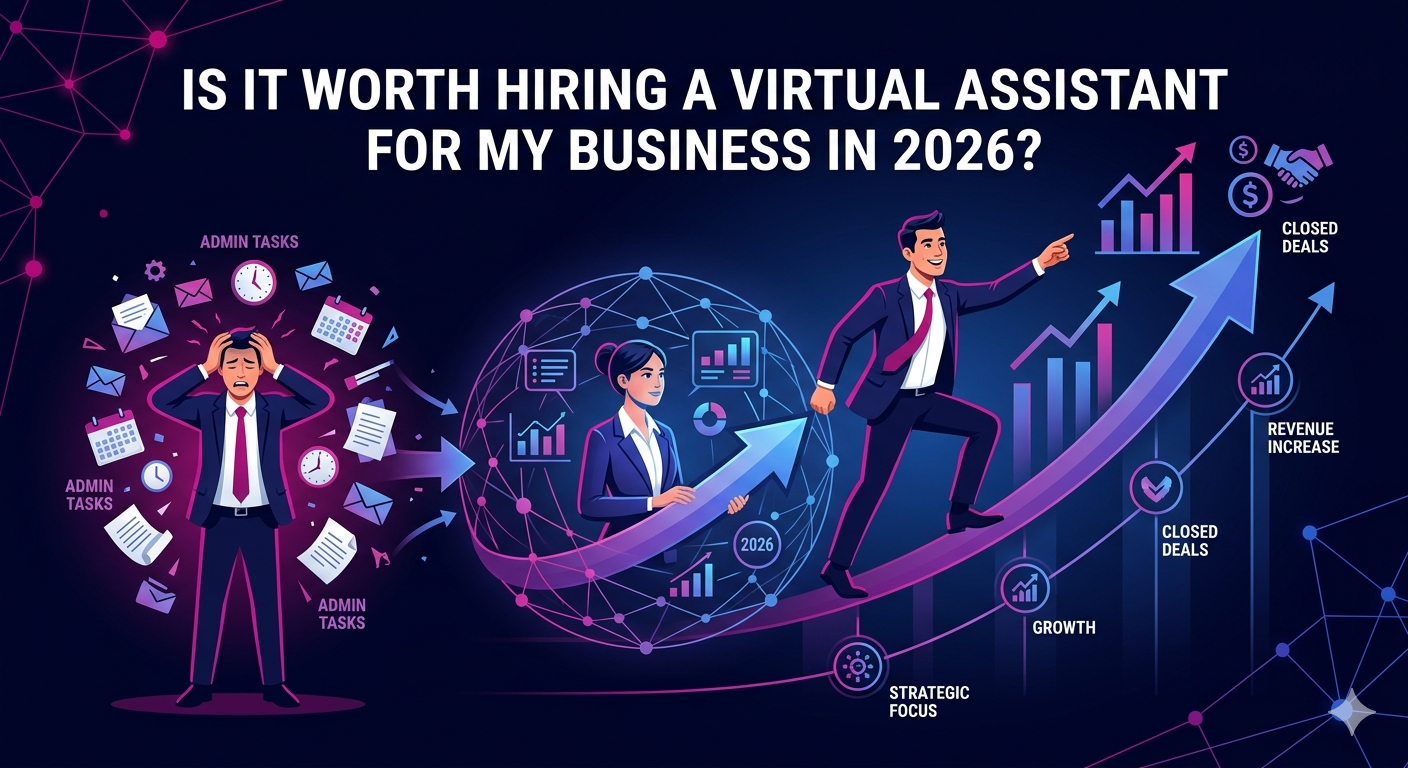
If you have ever caught yourself drowning in emails, scheduling conflicts, and repetitive admin tasks while your core business suffers, you have probably asked: is it worth hiring a virtual assistant for my business? The short answer is yes, for most business owners in 2026, a virtual assistant (VA) is one of the highest-leverage investments you can make. But the longer answer depends on where you are, what you need, and how you plan to work with one.
This guide breaks down the real costs, benefits, and decision points so you can stop guessing and start delegating with confidence.
What Is a Virtual Assistant and What Can They Do?
A virtual assistant is a remote professional who handles tasks that keep your business running but do not necessarily require your personal attention. In 2026, the VA industry has matured significantly. You are no longer limited to basic data entry or inbox management.
Modern VAs can handle a wide range of responsibilities, including:
- Calendar management and appointment scheduling
- Email filtering, drafting, and follow-ups
- Customer support and live chat responses
- Social media posting and community management
- Research, reporting, and data organization
- Lead generation and CRM updates
- Travel booking and expense tracking
- Content coordination and publishing
- E-commerce order management and product listings
The scope has expanded because remote work infrastructure is now far more robust. Cloud-based tools, shared workspaces, and async communication platforms make it easy for a VA to function as a seamless extension of your in-house team.
The Real Cost of Not Hiring a Virtual Assistant
Before evaluating whether hiring a VA is worth it, consider what not hiring one is costing you right now.
Your Time Has a Dollar Value
If you bill at $150 per hour or generate that value through strategic work, spending three hours a day on admin tasks costs your business $450 daily. That is over $9,000 per month in opportunity cost, tasks a skilled VA could handle for a fraction of that amount.
Burnout Kills Productivity
Entrepreneurs and executives who try to do everything themselves face burnout faster than those who delegate. Burnout leads to poor decisions, missed opportunities, and slower growth. A VA acts as a buffer, protecting your mental bandwidth for the work that truly moves the needle.
Mistakes from Overload
When you are stretched thin, errors happen. A missed follow-up email, a forgotten meeting, or a delayed invoice can cost you clients and revenue. A dedicated VA focused on those tasks reduces operational errors significantly.
Is It Worth Hiring a Virtual Assistant for My Business Type?
This question comes up often, and the answer varies slightly by business model.
Solopreneurs and Freelancers
If you are a one-person operation, a part-time VA can free up 10 to 20 hours per week. That is time you can redirect toward client work, business development, or rest. Even a few hours of delegated work per week creates real breathing room.
Small and Medium Businesses
For SMBs with 5 to 50 employees, a VA can fill functional gaps without the overhead of a full-time hire. Need someone to manage your inbox, update your CRM, and handle customer inquiries? A VA covers all three at a cost far below a local employee.
Startups
Startups running lean teams benefit enormously from VAs. Instead of hiring a full-time operations coordinator, a startup can engage a VA for 20 to 30 hours per week, scale up during busy phases, and scale back when needed.
Established Companies Scaling Fast
High-growth companies often use VAs as a rapid-deployment solution while permanent hiring catches up with demand. VAs bridge the gap without slowing momentum.
Cost vs. Value: Breaking Down the Numbers in 2026
One of the most common objections to hiring a VA is cost. But the comparison point matters.
A full-time in-house employee in the United States costs between $50,000 and $80,000 per year in salary alone, before benefits, office space, equipment, and employer taxes. A skilled remote VA working 20 to 40 hours per week typically costs between $800 and $3,000 per month, depending on skill set and region.
That is a significant difference. And because VAs are typically engaged as contractors, you avoid payroll taxes, benefits packages, and the legal complexity of employment relationships.
Beyond raw cost, consider the return. If a VA saves you 15 hours per week and you use that time to close one additional client deal per month, the ROI becomes obvious within the first 30 days.
How to Know You Are Ready to Hire a Virtual Assistant
Not everyone is ready to hire a VA on day one. Here are the clearest signals that the time is right.
- You regularly work past business hours on admin tasks
- Important tasks fall through the cracks more than once a month
- You have a clear list of repeatable, documentable tasks
- You are losing revenue because you are too busy managing operations
- You are considering a full-time hire but cannot yet justify the cost
- Your customer response times are slipping
If three or more of these apply to you, it is worth hiring a virtual assistant for your business sooner rather than later.
What to Look for When Hiring a Virtual Assistant
The quality of your VA hire determines whether you see a positive return or a frustrating experience. Here is what to prioritize.
Relevant Experience in Your Industry
A VA who has worked with e-commerce brands understands Shopify workflows, product listings, and order management. One who has supported law firms understands document handling and scheduling protocols. Relevant experience shortens onboarding time dramatically.
Strong Communication Skills
Because a VA works remotely, communication is everything. Look for someone who responds promptly, writes clearly, and proactively flags issues instead of waiting to be asked.
Tech Proficiency
In 2026, most VA work happens inside tools like Google Workspace, Slack, Notion, HubSpot, Asana, or Trello. Make sure your VA is comfortable in the tools your business already uses or can learn them quickly.
Reliability and Track Record
Testimonials, references, and work history matter. A VA who has consistently delivered for other clients is a much safer bet than one without a documented track record.
If you want to skip the guesswork and connect with pre-vetted remote professionals, explore the virtual assistant services at The Remote Reps, where every candidate is screened for skills, reliability, and communication before you ever meet them.
Specialist vs. General Virtual Assistants
Not all VAs are the same. There are two main categories to consider.
General Virtual Assistants
These are your go-to for administrative tasks: inbox management, scheduling, data entry, research, and basic customer support. They are versatile and cost-effective for business owners who need broad support.
Specialist Virtual Assistants
These VAs bring specific skill sets to the table. Examples include SEO specialists, social media managers, PPC experts, lead generation experts, and executive assistants. They cost more per hour but deliver specialized output that drives measurable business outcomes.
Many business owners start with a general VA and add specialists as their needs grow.
Common Mistakes to Avoid When Hiring a VA
- Hiring without clear task documentation leads to confusion and wasted time
- Micromanaging removes the core benefit of delegation
- Choosing purely on price often means choosing poor quality
- Failing to set expectations around response times and deliverables
- Not investing in a proper onboarding process
The most successful VA relationships are built on clear systems, mutual trust, and consistent feedback loops.
The Bottom Line: Is It Worth It?
For the vast majority of business owners asking whether it is worth hiring a virtual assistant, the answer is a clear yes, provided you hire the right person, onboard them properly, and delegate with intention. The financial savings, time recovered, and operational consistency a good VA provides far outweigh the monthly investment.
In 2026, with remote work infrastructure stronger than ever and a global talent pool at your fingertips, there has never been a better time to make the leap.
Ready to find out what a skilled remote professional can do for your business? Visit The Remote Reps to explore your options and get matched with a qualified virtual assistant today.
Still on the fence? Read Forbes Advisor’s guide on why hiring a virtual assistant is worth it for growing businesses for additional third-party perspective on the value VAs deliver.
Frequently Asked Questions
Is it worth hiring a virtual assistant for a small business with limited budget?
Yes, it is worth hiring a virtual assistant even on a limited budget. Many VAs offer part-time or hourly arrangements starting as low as $10 to $20 per hour for general tasks. The key is identifying your highest-impact tasks and delegating those first to maximize return on a modest investment.
How do I know if it is worth hiring a virtual assistant versus a full-time employee?
If you need flexible support, want to avoid employment overhead, or are not ready to commit to a fixed salary, it is worth hiring a virtual assistant first. Full-time employees make more sense when the workload is consistent, requires on-site presence, or involves managing other staff.
Is it worth hiring a virtual assistant for administrative tasks specifically?
Absolutely. Administrative tasks like email management, scheduling, data entry, and customer follow-ups are among the most commonly delegated responsibilities. Freeing yourself from these tasks alone can recover 10 to 20 hours per week, making it clearly worth hiring a virtual assistant for admin support.
How long does it take to see results after hiring a virtual assistant?
Most business owners notice meaningful time savings within the first two to four weeks. After a proper onboarding period of one to two weeks, a skilled VA should be handling tasks independently with minimal oversight. The question of whether it is worth hiring a virtual assistant often answers itself within the first month.
Is it worth hiring a virtual assistant if I already use automation tools?
Yes. Automation handles repetitive, rule-based tasks well, but it cannot replace human judgment, relationship management, or adaptive problem-solving. A virtual assistant complements your automation stack by handling the exceptions, communications, and tasks that require a human touch. Most businesses benefit from both.
What industries benefit most from hiring a virtual assistant?
Nearly every industry benefits, but those that see the clearest ROI include e-commerce, real estate, legal services, digital marketing agencies, healthcare practices, and consulting firms. If your work involves significant client communication, scheduling, or recurring admin, it is almost certainly worth hiring a virtual assistant regardless of your industry.