
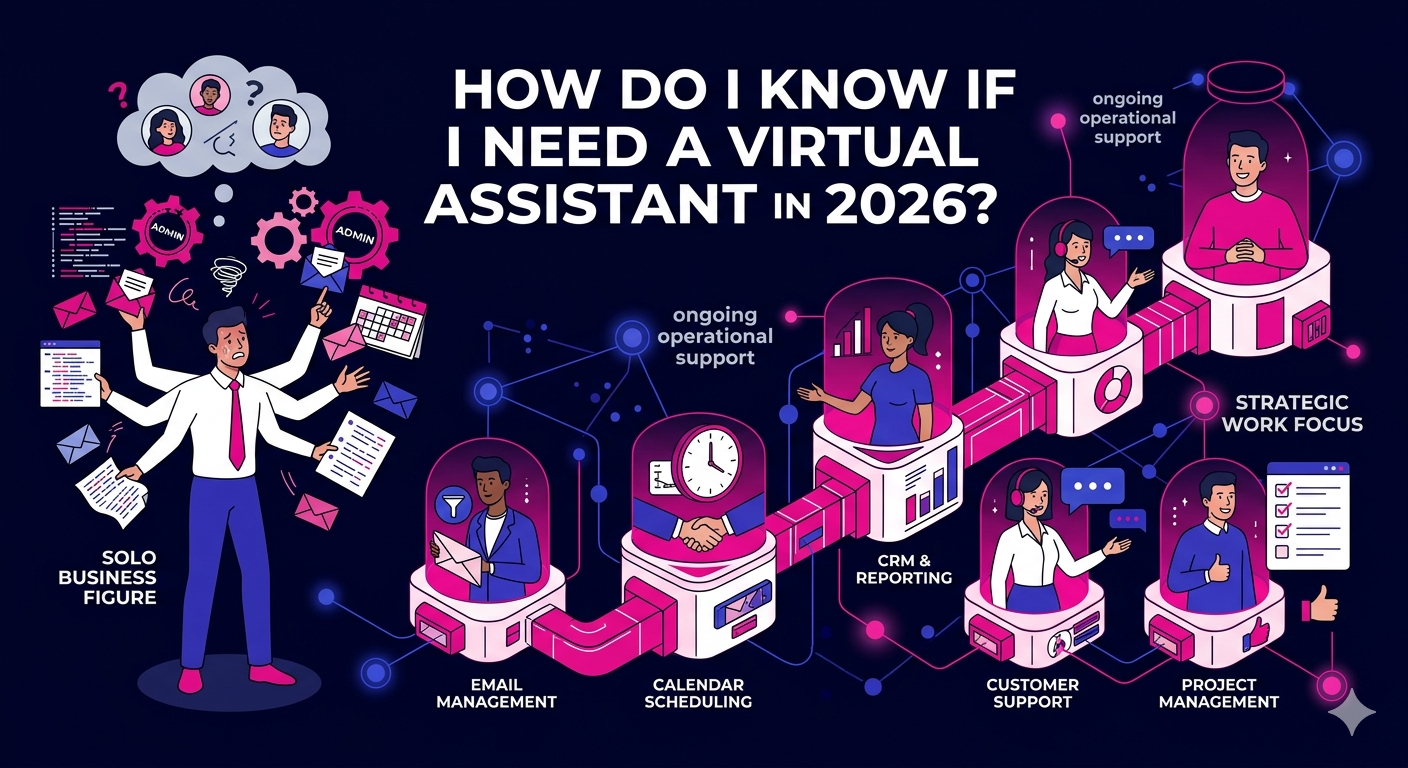
If you have found yourself asking how do I know if I need a virtual assistant, there is a good chance the answer is already yes. That question rarely surfaces when everything is running smoothly. It shows up when your to-do list is out of control, your inbox has become a second job, and your strategic work keeps getting pushed to evenings and weekends.
The challenge is that most business owners and executives wait far too long before making the hire. They convince themselves they can handle it, that things will slow down soon, or that finding the right VA will take more time than it saves. This guide cuts through that hesitation with clear, honest signals that tell you exactly when you need a virtual assistant and how to move forward with confidence.
What a Virtual Assistant Actually Does in 2026
Before identifying whether you need one, it helps to understand what the role actually covers today. A virtual assistant in 2026 is not limited to booking flights or managing a calendar. The modern VA operates across a broad range of business functions.
Common tasks handled by virtual assistants include:
- Email management, filtering, and drafting responses
- Calendar scheduling and appointment coordination
- Customer support and live chat management
- Social media scheduling and community engagement
- Data entry, CRM updates, and reporting
- Research and competitive analysis
- Invoice tracking and basic bookkeeping coordination
- Content coordination, editing, and publishing
- Travel arrangements and logistics
- Project management support and task tracking
Knowing the full scope makes it easier to recognize how many of your daily tasks could be handled by someone else, which directly answers the question of whether you need one.
How Do I Know If I Need a Virtual Assistant: The Clearest Signs
There is no single trigger that tells you the time is right. Instead, look for a pattern of signals that point in the same direction.
You Are Consistently Working Outside Business Hours
If you regularly finish client work during the day and then spend your evenings catching up on admin, that is not a productivity problem. That is a capacity problem. A virtual assistant handles the admin layer so your evenings belong to you again.
Important Tasks Are Falling Through the Cracks
Missing follow-up emails, forgotten invoices, delayed responses to clients, and overlooked scheduling conflicts are not signs of personal failure. They are signs that you are carrying more than one person should carry. When the volume of tasks exceeds your bandwidth, errors become inevitable.
You Are Spending Time on Low-Value Work
Think honestly about how you spend your average workday. If a significant portion goes to tasks that do not require your expertise, your judgment, or your relationships, those tasks are costing you money. Every hour spent on data entry, inbox management, or appointment scheduling is an hour not spent on revenue-generating or strategic activity.
Your Business Growth Has Plateaued
Sometimes the ceiling is not the market. It is your own available hours. If you cannot take on more clients, launch new initiatives, or pursue new opportunities because you are buried in operational tasks, a VA removes that constraint directly.
You Are Considering a Full-Time Hire You Cannot Afford Yet
If you know you need more help but cannot yet justify the cost of a full-time employee, a part-time or hourly virtual assistant bridges that gap. You get real, skilled support without the overhead of employment taxes, benefits, or office space.
Your Response Times to Clients Are Slipping
Slow response times damage client relationships and reputation. If your average reply time has crept from hours to days because you are stretched thin, a VA dedicated to inbox monitoring and response management solves that problem immediately.
How to Audit Your Own Workload
If you are still unsure whether you need a virtual assistant, a simple audit will give you clarity. For one full week, track every task you complete and log how long each one takes. At the end of the week, categorize each task into one of three buckets.
Bucket One: Only You Can Do This
Strategic decisions, client relationship management, creative direction, and leadership conversations fall here. These require your specific expertise, authority, or relationships and cannot be delegated.
Bucket Two: You Can Do This, But Someone Else Could Too
Scheduling, inbox management, research, data entry, and content publishing fall here. These tasks are important and need to be done well, but they do not require your unique skill set. This is your delegation list.
Bucket Three: This Should Not Be Done at All
Sometimes the audit reveals tasks that are busywork or legacy habits that no longer serve the business. These can simply be eliminated.
Add up the time you spend in Bucket Two. Most business owners who do this exercise discover they are spending 10 to 20 hours per week on tasks that qualify for delegation. That is the answer to how do I know if I need a virtual assistant. If Bucket Two adds up to five or more hours per week, a VA is worth it.
Signs You Need a Specialist VA Rather Than a General One
Sometimes the need is not for a generalist but for a VA with a specific skill set. Here are a few scenarios that point toward specialist support.
You Need Help with Customer Support
If customer inquiries, complaints, and support tickets are piling up, a dedicated customer support VA handles the entire function so your customers feel heard and your team stays focused.
You Need Help with Executive-Level Tasks
If you are a C-suite executive who needs someone managing sensitive communications, board prep, and complex scheduling across multiple time zones, an executive assistant VA is the right fit rather than a general VA.
You Need Help with Legal or Compliance Tasks
Law firms and legal departments often need paralegal support, document management, or legal secretarial services that require specific training and discretion.
Whatever your specific need, the right place to start is with a provider that has pre-vetted specialists ready to deploy. Explore the full range of virtual assistant services at The Remote Reps to find the right match for your business requirements in 2026.
Common Objections to Hiring a Virtual Assistant and Why They Do Not Hold Up
I Do Not Have Time to Train Someone
This is the most common objection and the most ironic. The short-term investment in onboarding a VA, typically one to two weeks, pays back within the first month in recovered hours. The alternative is continuing to lose 10 to 20 hours per week indefinitely.
I Am Not Sure I Can Afford It
Compare the cost of a part-time VA, which ranges from $800 to $2,000 per month in 2026 depending on skill level and hours, against the cost of your own time spent on low-value tasks. For most business owners, the math strongly favors hiring.
I Am Worried About Confidentiality
A legitimate concern, but a solvable one. Use non-disclosure agreements, limit access to sensitive systems on a need-to-know basis, and choose a VA through a reputable platform that screens candidates for professionalism and integrity. Risk can be managed without avoiding the hire altogether.
I Have Tried VAs Before and It Did Not Work
A bad VA experience usually comes down to one of three things: poor candidate selection, inadequate onboarding, or unclear task documentation. These are process failures, not proof that VAs do not work. A more structured approach the second time produces very different results.
How to Get Started Once You Know You Need a Virtual Assistant
Once you have identified the need, the steps forward are straightforward.
- Document your Bucket Two tasks with clear instructions for each
- Decide on hours per week and preferred communication style
- Choose between a general VA and a specialist based on your primary needs
- Use a reputable platform that pre-vets candidates to reduce hiring risk
- Set a 30-day onboarding plan with clear milestones and feedback checkpoints
The goal is not perfection on day one. It is a system that improves over time as your VA learns your preferences, your tools, and your business.
For further reading on the business case for delegation, Harvard Business Review’s research on how knowing if you need a virtual assistant connects to effective delegation and executive productivity offers compelling evidence for acting sooner rather than later.
When you are ready to stop wondering and start delegating, visit The Remote Reps to get matched with a vetted virtual assistant who fits your business needs today.
Frequently Asked Questions
How do I know if I need a virtual assistant or a full-time employee?
If your workload is irregular, you need flexible support, or you cannot yet justify a full-time salary and benefits package, a virtual assistant is the smarter starting point. A full-time employee makes sense once the workload is consistent and large enough to fill a complete role. Many business owners start with a VA and convert to a full-time hire as the business grows.
How do I know if I need a virtual assistant for just a few hours a week?
Yes, part-time VA arrangements are common and practical. If your Bucket Two task audit reveals five to ten hours of delegable work per week, a part-time VA at ten to fifteen hours per week typically provides enough capacity to cover those tasks plus handle overflow. You are not required to hire a full-time VA to see meaningful results.
How do I know if I need a virtual assistant versus a project manager?
A virtual assistant handles recurring operational tasks and day-to-day support functions. A project manager oversees specific initiatives with defined timelines, budgets, and team coordination requirements. If your primary pain point is ongoing admin overload, you need a VA. If you are launching a complex new initiative that requires cross-functional coordination, a project manager is the better fit. Some senior VAs can fulfill both roles depending on their background.
How do I know if I need a virtual assistant as a solopreneur?
Solopreneurs often reach the need for a VA earlier than they expect. The clearest signal is when client work and business operations are competing for the same limited hours. If you are turning down new business because you are too busy managing existing operations, a VA directly unlocks growth capacity. Even five to ten hours of support per week can create meaningful breathing room.
How do I know if I need a virtual assistant with specific industry experience?
If your tasks require knowledge of specific tools, terminology, or processes unique to your industry, a specialist VA with relevant experience will outperform a general VA significantly. Legal tasks, e-commerce operations, and technical marketing functions all benefit from a VA who already understands the context rather than learning it from scratch during onboarding.
How do I know if I need a virtual assistant rather than just better systems?
Better systems and a virtual assistant are not mutually exclusive. In fact, the best outcomes come from combining both. Automation handles repetitive rule-based tasks, while a VA handles the judgment-required work, the exceptions, and the human interactions that no system can fully replace. If you have already optimized your systems and are still overwhelmed, that is a clear sign you need a person, not another tool.