
Payroll is one of the largest expenses any business carries, and in 2026 the pressure to manage it smartly has never been greater. If you want to know how to cut hiring costs with offshore talent, you are not alone. Thousands of businesses across the US, UK, Canada, and Australia have already made the shift to offshore and nearshore hiring, and the results are reshaping how companies think about workforce planning. This guide walks you through the full picture so you can act with confidence.
Why Offshore Hiring Has Become a Mainstream Cost Strategy in 2026
Offshore hiring is no longer a shortcut reserved for large corporations outsourcing call centers. In 2026, it is a deliberate talent strategy used by startups, mid-market companies, law firms, ecommerce brands, and agencies of every size. The reasons are straightforward.
Remote work infrastructure has matured. Collaboration tools, secure cloud environments, and async communication workflows have removed most of the friction that once made offshore hiring feel risky. At the same time, talent in markets like the Philippines, Latin America, Eastern Europe, and South Asia has grown significantly more skilled and experienced in serving international clients.
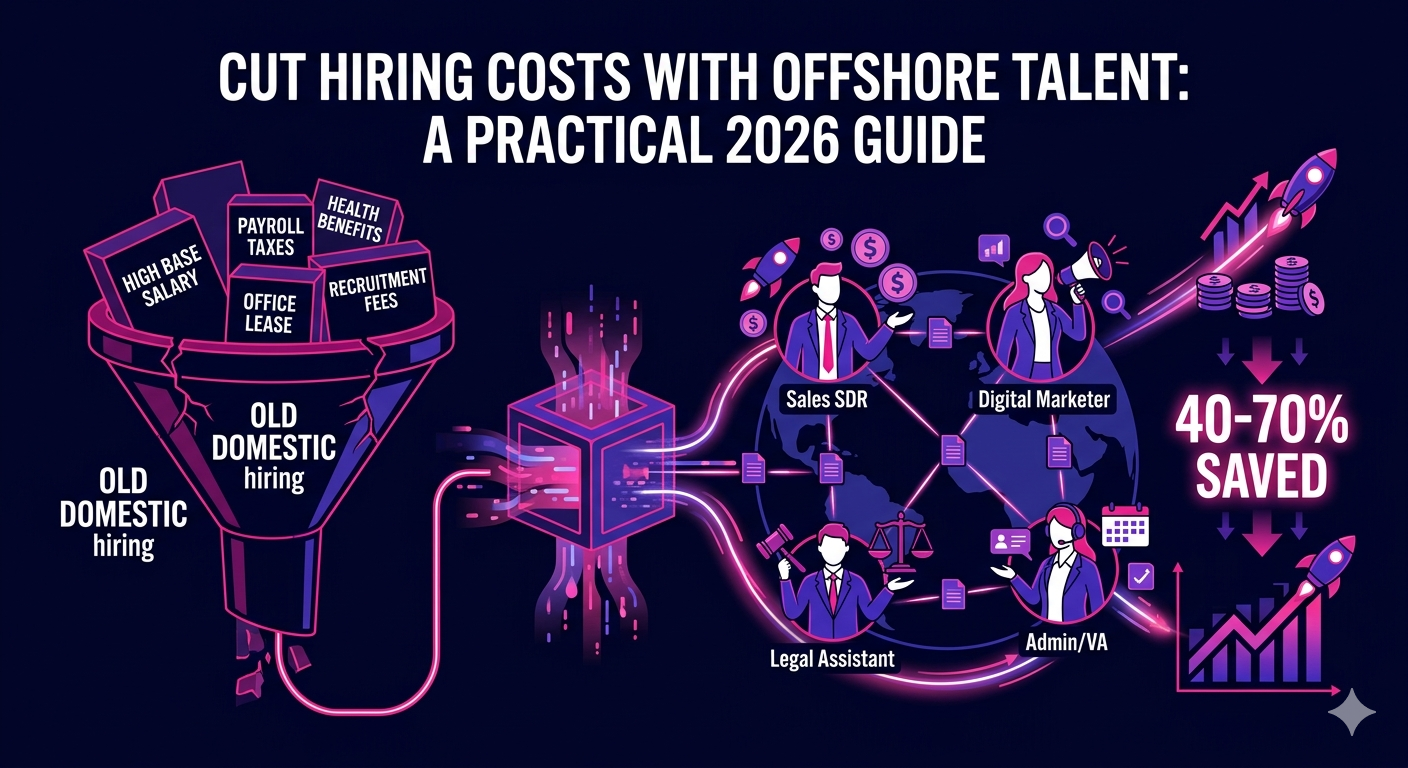
The result is a global labor market where businesses can hire qualified professionals at 40 to 70 percent less than equivalent domestic hires, without sacrificing output quality.
Where the Savings Come From When You Cut Hiring Costs With Offshore Talent
To cut hiring costs with offshore talent effectively, you need to understand exactly where the savings originate. It is not simply about paying a lower hourly rate. The full cost reduction comes from multiple layers.
Lower Base Compensation Rates
In the Philippines, a skilled virtual assistant or customer support specialist earns between $800 and $1,800 per month. In Colombia or Mexico, a digital marketer or SDR earns between $1,200 and $2,500 per month. Compare that to US market rates of $4,000 to $7,000 per month for the same roles, and the gap is substantial even before you account for additional employer costs.
No Domestic Employer Overhead
When you hire offshore through a remote staffing provider, you typically do not carry the employer-of-record obligations associated with domestic staff. That means no payroll taxes, no health insurance contributions, no workers compensation premiums, and no retirement plan matching. These costs add 30 to 40 percent onto every domestic salary you pay.
Reduced Recruitment and Onboarding Costs
Recruiting a full-time employee in the US costs an average of $4,700 per hire according to recent workforce data, and that figure does not include the productivity loss during the vacancy period. Offshore staffing providers handle sourcing, screening, and initial vetting, reducing your recruitment overhead to near zero on individual placements.
No Office or Infrastructure Costs
Offshore hires work remotely by default, which means no desk, no office space, no equipment provisioning, and no facility management costs attributable to that headcount. For companies still leasing office space, this is a meaningful per-head saving.
Which Roles Are Best for Cutting Hiring Costs With Offshore Talent
Not every role is equally suited to an offshore model, but the range of positions that work well is broader than most business owners initially assume.
Sales and Business Development
Sales development representatives, lead generation specialists, and cold email outreach experts are among the most popular offshore roles in 2026. Skilled professionals in these areas are available in English-proficient markets and can operate across time zones to expand your outreach coverage. You can explore offshore lead generation experts at The Remote Reps to see how this works in practice.
Digital Marketing and SEO
SEO specialists, social media managers, PPC experts, and content marketers are roles where offshore talent has demonstrated consistently strong performance. These are output-driven positions where the quality of work is measurable, making it easy to evaluate performance regardless of geography.
Customer Support
Customer support is one of the most established offshore categories. In 2026, businesses are using offshore support teams not just for cost reduction but for round-the-clock coverage that would be prohibitively expensive to staff domestically.
Administrative and Executive Support
Virtual assistants and executive assistants handling scheduling, inbox management, research, data entry, and operational coordination are roles where offshore talent delivers excellent value. These positions benefit from clearly defined workflows and strong communication tools, both of which are standard in 2026.
Legal Support
Legal assistants, paralegals, and legal secretaries represent a growing offshore category, particularly for law firms and legal departments looking to cut operational costs without reducing support capacity. Offshore legal support professionals trained in US law and documentation practices are increasingly available through specialist providers.
A Step-by-Step Approach to Cut Hiring Costs With Offshore Talent
Knowing the theory is one thing. Executing the strategy successfully requires a structured approach. Here is how to do it right in 2026.
Step 1: Audit Your Current Roles and Identify Offshore-Suitable Tasks
Start by listing every role you currently fill or plan to fill. For each one, ask whether the work requires physical presence, local regulatory knowledge that cannot be transferred, or real-time in-person collaboration. Any role that does not require these things is a candidate for offshore hiring.
Step 2: Define Clear Role Requirements and KPIs
Offshore hiring works best when expectations are documented clearly. Before you engage a provider, write a role description that includes daily responsibilities, required tools and software, communication expectations, working hours, and the key performance indicators you will use to measure success.
Step 3: Choose the Right Offshore Market for Each Role
Different offshore markets have different strengths. The Philippines is well-regarded for customer support, administrative roles, and digital marketing. Latin America, particularly Colombia and Mexico, is increasingly competitive for sales roles and technical positions due to time zone alignment with North America. Eastern Europe offers strong technical and analytical talent. Matching the role to the right market improves quality outcomes.
Step 4: Work With a Vetted Remote Staffing Provider
The single most common mistake businesses make when trying to cut hiring costs with offshore talent is sourcing candidates from open freelance platforms without proper vetting. Quality variance on unvetted platforms can be significant. Working with a specialist remote staffing provider that pre-screens candidates and understands your industry dramatically reduces the risk and accelerates placement timelines.
Step 5: Onboard With Structure and Clear Communication Protocols
Successful offshore relationships are built on clear onboarding processes. Invest time in the first two weeks to document workflows, establish communication rhythms, and set expectations around availability and reporting. Teams that onboard well see faster ramp times and better retention.
Real Numbers: How Much Can You Actually Save
Let us put some concrete figures behind the strategy. A business replacing three domestic hires with offshore equivalents in sales support, digital marketing, and customer service could expect the following:
- Domestic cost (3 roles, fully loaded): approximately $240,000 to $285,000 per year
- Offshore equivalent cost (3 roles, full-time): approximately $60,000 to $90,000 per year
- Annual saving: $150,000 to $225,000
Those savings can be reinvested into product development, marketing, or simply improving profitability. For a growing business, that kind of capital reallocation is transformative.
According to research from the Society for Human Resource Management on total rewards and compensation benchmarks, the fully loaded cost of a US employee routinely runs 1.25 to 1.4 times their base salary, reinforcing why businesses looking to cut hiring costs with offshore talent see such significant gains.
Common Concerns About Offshore Hiring and How to Address Them
Will Quality Suffer?
Not if you hire correctly. The key is sourcing from the right markets, using a vetted provider, and setting clear performance expectations from day one. Many businesses report that offshore hires, once onboarded well, match or exceed the output of domestic equivalents.
What About Time Zone Differences?
Time zone differences can actually be an advantage, extending your operational coverage into hours you could not afford to staff domestically. For roles requiring overlap, Latin American markets offer near-full alignment with US business hours.
How Do I Manage Compliance and Contracts?
A reputable offshore staffing provider handles contracts, compliance, and local labor law requirements on their end. You engage the talent through a service agreement rather than as a direct employer, which simplifies your legal and HR obligations considerably.
Start Cutting Your Hiring Costs With Offshore Talent Today
The businesses that moved to offshore hiring in 2024 and 2025 have had two years of savings compounding while their competitors are still paying domestic overhead rates. In 2026, the infrastructure, talent quality, and proven workflows are all in place. There is no meaningful barrier left to getting started. Define your roles, find a trusted provider, and begin redirecting payroll savings toward growth. The strategy works, the numbers are clear, and the sooner you start, the sooner the savings stack up.
Frequently Asked Questions
How do I know which roles are right when I want to cut hiring costs with offshore talent?
Start by identifying roles that do not require physical presence, in-person collaboration, or locally licensed professionals. Administrative support, digital marketing, customer service, sales development, and legal support are all strong candidates for offshore hiring. If the work can be done remotely with clear deliverables and digital communication, it is suitable for an offshore model.
How much can a small business realistically save when cutting hiring costs with offshore talent?
A small business replacing just one or two domestic hires with offshore equivalents can save between $30,000 and $70,000 per role per year when accounting for salary differences, employer taxes, and overhead elimination. For businesses with three or more roles suited to offshore hiring, total annual savings can exceed $150,000.
Is it difficult to manage offshore employees when trying to cut hiring costs with offshore talent?
Managing offshore talent is straightforward when you have clear processes, documented workflows, and regular communication touchpoints. Modern project management and collaboration tools make distance a non-issue for most roles. The businesses that struggle with offshore management are typically those that skip proper onboarding and expectation-setting in the early weeks.
Does cutting hiring costs with offshore talent affect the quality of work delivered?
When you source talent through a specialist provider that screens for skills, communication ability, and relevant experience, quality is consistently strong. The risk of quality issues is primarily associated with hiring from unvetted platforms without proper screening. Using a dedicated remote staffing agency that matches talent to role requirements significantly reduces that risk.
What is the fastest way to get started with cutting hiring costs with offshore talent?
The fastest path is to identify one or two roles where offshore hiring makes sense, write clear job descriptions with defined KPIs, and engage a remote staffing provider to begin the placement process. Many businesses have offshore hires onboarded and productive within two to four weeks of starting the process. Beginning with a single role lets you validate the model before scaling across your team.
Are there legal risks involved when businesses cut hiring costs with offshore talent?
When you hire offshore through a staffing agency or service provider rather than as a direct employer, the legal complexity is minimal. The provider manages local employment law compliance, contracts, and payroll in the talent’s home country. You operate under a service agreement, which carries far fewer employer obligations than a direct hire relationship. Always confirm that your provider has a clear legal structure in the markets where they operate.