
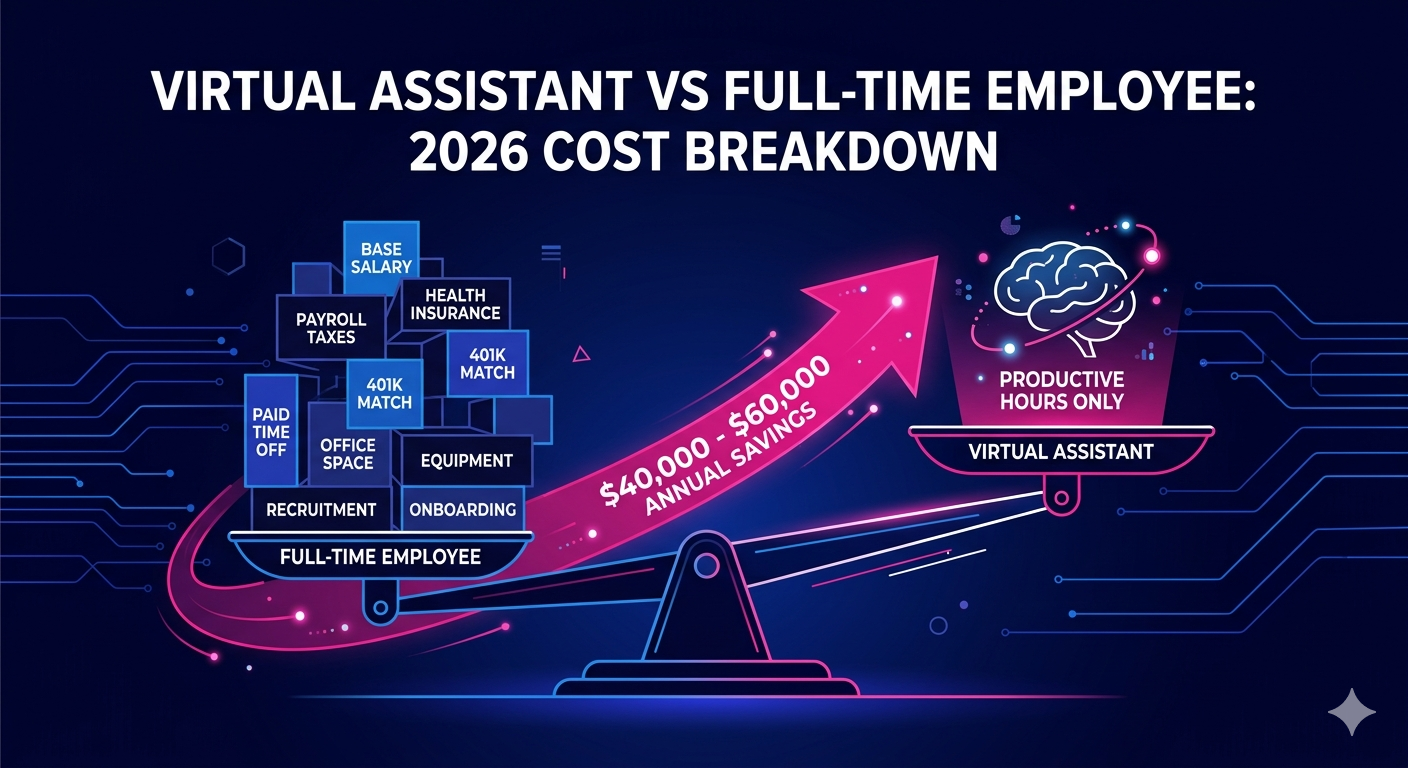
If you are running a growing business in 2026, one question keeps showing up in budget meetings: what is the actual cost of a virtual assistant vs a full time employee? On the surface, hiring a full-time employee feels like the safer, more committed route. But once you start digging into the real numbers, the picture changes dramatically. This guide breaks down every dollar so you can make a smarter hiring decision for your business.
Why the True Cost of Hiring Goes Far Beyond a Salary
Most business owners calculate hiring costs by looking at the base salary alone. That is a mistake that leads to budget surprises down the road. Whether you are comparing a virtual assistant or a full-time employee, you need to account for every layer of cost involved in bringing someone onto your team.
In 2026, the average fully loaded cost of a full-time employee in the United States is significantly higher than their annual salary suggests. And the virtual assistant model has matured to the point where top-tier talent is available at a fraction of that cost, without sacrificing quality.
Breaking Down the Full Cost of a Full-Time Employee
Let us look at what you actually pay when you hire a full-time employee. These figures reflect 2026 market data for a mid-level administrative or marketing role in the US.
Direct Compensation Costs
- Base salary: $45,000 to $65,000 per year for an administrative or marketing role
- Employer payroll taxes (FICA, FUTA, SUTA): approximately 8 to 10% of salary
- Health insurance contribution: $6,000 to $9,000 per year per employee
- Retirement plan contribution (401k match): $1,500 to $3,000 per year
- Paid time off (15 to 20 days annually): $2,600 to $5,000 in lost productivity value
Indirect and Overhead Costs
- Office space and utilities: $5,000 to $15,000 per year per employee in major cities
- Equipment and software licenses: $1,500 to $3,000 per year
- Onboarding and training: $1,200 to $4,000 per new hire
- HR administration and compliance: $500 to $1,500 per year
- Recruitment costs: $3,000 to $7,000 per hire on average
When you add it all up, a full-time employee earning a $55,000 salary typically costs a business between $75,000 and $95,000 per year. That is a 35 to 70 percent premium over the salary number alone.
Breaking Down the Cost of a Virtual Assistant in 2026
The virtual assistant model works differently, and that difference is where the savings live. You pay for productive hours, not benefits, desk space, or downtime.
Typical Virtual Assistant Pricing Structures
- Hourly rate (general VA): $8 to $25 per hour depending on skill level and region
- Hourly rate (specialized VA such as SEO, sales, or executive support): $20 to $50 per hour
- Part-time retainer (20 hours/week): $800 to $2,000 per month
- Full-time equivalent VA (40 hours/week): $1,500 to $4,000 per month
What You Do NOT Pay for With a Virtual Assistant
- No payroll taxes or employer FICA contributions
- No health insurance or benefits packages
- No paid time off, sick days, or holiday pay
- No office space, hardware, or equipment costs
- No long recruitment cycles or agency placement fees
- No severance or termination liability
A full-time virtual assistant through a quality provider can cost between $18,000 and $48,000 per year. Compare that to the $75,000 to $95,000 annual cost of a full-time employee doing the same work, and the math is striking.
If you are ready to explore what skilled remote professionals can do for your business, browse the virtual assistant services at The Remote Reps to see the roles available and the kind of talent you can access.
Side-by-Side Cost Comparison: Virtual Assistant vs Full-Time Employee
Here is a direct comparison for a mid-level administrative or marketing support role working 40 hours per week.
Full-Time Employee (US-Based, 2026 Estimates)
- Base salary: $55,000
- Benefits and taxes: $18,000 to $22,000
- Office and equipment: $7,000 to $12,000
- Recruitment and onboarding: $4,000 to $6,000
- Total annual cost: $84,000 to $95,000
Virtual Assistant (Full-Time Equivalent, 2026 Estimates)
- Monthly retainer: $2,000 to $3,500
- No benefits, taxes, or overhead
- Minimal onboarding cost
- Total annual cost: $24,000 to $42,000
The cost savings range from $40,000 to $60,000 per year for a single role. For businesses running multiple support positions, the compounding effect is significant.
When a Full-Time Employee Makes More Sense
The cost of a virtual assistant vs a full-time employee comparison does not always favor VAs. There are situations where a full-time, in-house hire is the right call.
- The role requires daily in-person presence, such as front desk reception or warehouse management
- The position involves highly sensitive data that requires on-site security infrastructure
- The work involves complex team collaboration that depends on physical proximity
- The role is a senior leadership position where cultural integration is critical
For most administrative, marketing, sales support, customer service, and digital roles, however, a virtual assistant delivers equal or better output at a fraction of the cost.
When a Virtual Assistant Is the Smarter Choice
The virtual assistant model shines in a wide range of business contexts, especially in 2026 where remote work infrastructure is mature and global talent pools are deep.
- Startups and small businesses managing tight payroll budgets
- Companies scaling quickly and needing flexible support without long-term commitments
- Businesses needing specialized skills such as SEO, social media management, or lead generation without full-time overhead
- Teams covering multiple time zones who benefit from extended coverage hours
- Executives who need dedicated support without the cost of a full-time executive assistant
Hidden Costs You Might Be Overlooking
One area where the cost of virtual assistant vs full-time employee comparison gets murky is hidden costs on both sides.
Hidden Costs of Full-Time Employees
- Turnover costs (replacing an employee can cost 50 to 200% of their annual salary)
- Performance management and HR time
- Productivity loss during notice periods and handoffs
- Liability for workplace injuries or claims
Potential Hidden Costs of Virtual Assistants
- Onboarding time if processes are not well documented
- Communication tool subscriptions
- Quality variance if hiring through low-cost freelance marketplaces without vetting
The way to eliminate the VA-side hidden costs is to work with a reputable provider that pre-vets talent and handles the matching process for you. That is exactly where specialized remote staffing agencies earn their value.
You can review client testimonials at The Remote Reps to see how businesses have navigated this transition successfully.
For a broader benchmark on employer costs and compensation data, the Bureau of Labor Statistics Employer Costs for Employee Compensation report provides authoritative figures on what US employers spend beyond base wages.
Making the Right Decision for Your Business
The cost of a virtual assistant vs a full-time employee ultimately comes down to your specific needs, growth stage, and operational model. But the financial case for virtual assistants in 2026 is stronger than ever. With distributed work now standard across industries, there is no longer a meaningful quality gap between a skilled remote hire and an in-person one.
The businesses winning in 2026 are the ones combining a lean core team with a network of specialized remote professionals. They get expertise on demand without carrying the full overhead burden of a traditional workforce.
Frequently Asked Questions
What is the average cost of a virtual assistant vs a full-time employee in 2026?
The average full-time employee in a mid-level role costs a US business between $84,000 and $95,000 per year when you include salary, benefits, taxes, and overhead. The cost of a virtual assistant for the same number of hours typically ranges from $24,000 to $42,000 annually, representing savings of $40,000 to $60,000 per role per year.
Does the cost of a virtual assistant vs a full-time employee vary by industry?
Yes. In high-cost industries like tech and finance, the gap widens because full-time salaries are higher while VA rates remain more stable. In industries with lower average salaries, the percentage savings are still significant but the absolute dollar difference is smaller. Specialized VA roles such as legal assistants or digital marketers may command higher rates but still fall well below full-time equivalent costs.
Are there quality differences that affect the cost of virtual assistant vs full-time employee decisions?
Quality varies based on how you source your virtual assistant. Hiring through a reputable remote staffing agency that pre-vets and matches candidates tends to deliver consistent quality comparable to an in-house hire. The key is working with a provider that understands your industry and role requirements rather than relying on open freelance marketplaces where quality is unpredictable.
How does the cost of a virtual assistant vs a full-time employee change for specialized roles?
For specialized roles such as SEO specialists, PPC experts, sales development representatives, or executive assistants, the cost gap remains significant. A specialist VA may charge $25 to $50 per hour, which still undercuts the fully loaded annual cost of a full-time specialist by 40 to 60 percent. You also gain flexibility to scale hours up or down based on workload.
What are the biggest non-financial factors in the cost of virtual assistant vs full-time employee decisions?
Beyond the dollar comparison, businesses should consider flexibility, speed of hiring, legal simplicity, and access to global talent. Virtual assistants can often be onboarded in days rather than weeks, require no employment contracts or benefits administration, and give you access to a wider talent pool. Full-time employees offer deeper organizational integration and may be preferable for roles that require strong company culture alignment or in-person presence.
How do I get started with a virtual assistant to reduce my hiring costs?
The fastest way to get started is to identify the tasks currently handled by or intended for a full-time hire, then evaluate whether those tasks require physical presence or in-house employment. If they do not, you can engage a remote staffing provider, define your requirements, and have a vetted virtual assistant placed within days. Starting with a part-time engagement lets you test the model before committing to full-time hours.