
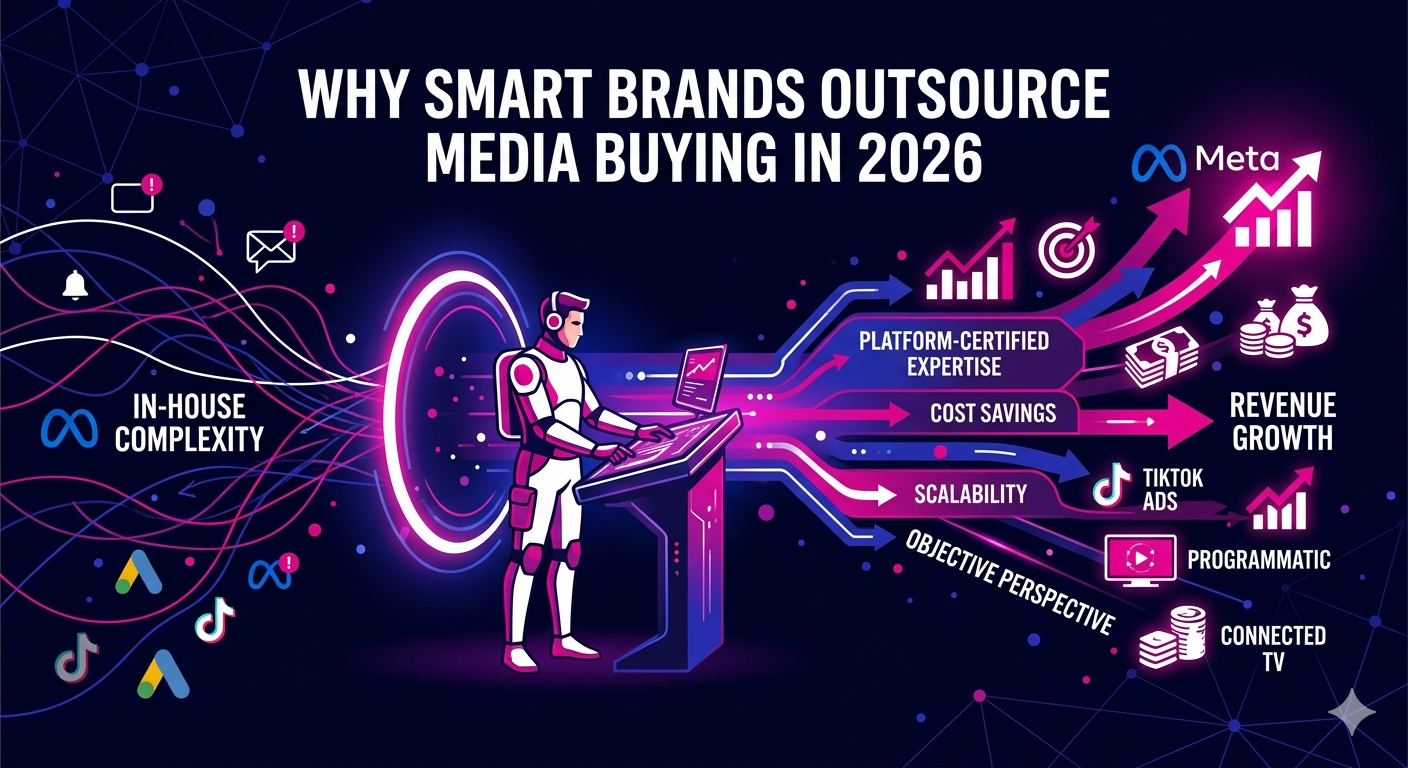
Paid advertising has never been more competitive or more complex. Between rising CPMs, fragmented platforms, and constantly shifting algorithms, managing media buying in-house is a full-time job that most growing businesses simply cannot afford to do well. That is exactly why so many companies are choosing to outsource media buying to dedicated experts who live and breathe ad spend every single day.
If you have been on the fence about handing off your paid media operations, this guide breaks down everything you need to know: what media buying outsourcing actually involves, the real benefits, how to find the right talent, and what to expect when you make the switch.
What Does It Mean to Outsource Media Buying?
Media buying is the process of purchasing advertising space and placements across digital and traditional channels. This includes platforms like Meta Ads, Google Ads, YouTube, TikTok, programmatic display networks, and connected TV. When you outsource media buying, you hire an external expert or a remote specialist to handle this function on your behalf.
This is different from hiring a full-service agency. Outsourcing often means bringing in a dedicated media buyer who works exclusively on your accounts, understands your brand voice, and operates as a remote extension of your team. The result is agency-level expertise at a fraction of the cost.
Who Typically Outsources Media Buying?
- E-commerce brands scaling their paid social and search spend
- SaaS companies running performance-driven acquisition campaigns
- Marketing agencies white-labeling media buying for their clients
- Small to mid-size businesses that cannot justify a full-time in-house buyer
- Startups that need experienced operators without long-term headcount commitments
The Core Benefits of Outsourcing Your Media Buying
1. Access to Platform-Certified Expertise
When you outsource media buying, you are not just delegating a task. You are tapping into specialists who manage multiple accounts across verticals and stay current with every platform update. The best remote media buyers have firsthand knowledge of what is working on Meta and Google right now, in 2026, not what worked two years ago.
They understand audience segmentation, creative testing frameworks, bid strategies, and conversion tracking at a depth that generalist marketers rarely achieve.
2. Significant Cost Savings Over In-House Hires
Hiring a senior media buyer in-house in 2026 can cost anywhere from $80,000 to $130,000 per year in salary alone, before benefits, tools, and training. When you outsource media buying to a vetted remote professional, you access the same skill set at a dramatically lower cost, often on a part-time or project basis.
You also eliminate the overhead tied to onboarding, payroll administration, and platform subscriptions that are often bundled into a remote specialist’s service.
3. Faster Campaign Launch and Iteration
Experienced media buyers can audit your existing campaigns, identify quick wins, and launch new ones fast. There is no ramp-up time for learning the basics. They know exactly how to structure ad accounts, build out testing frameworks, and set up attribution correctly from day one.
4. Scalability Without Structural Overhead
Your ad spend does not stay constant year-round. Seasonal surges, product launches, and promotional windows demand more firepower. Outsourcing gives you the flexibility to scale up or pull back without being locked into headcount decisions that are difficult to reverse.
5. Objective, Data-Driven Perspective
An external media buyer brings a fresh set of eyes to your campaigns. They are not emotionally attached to internal assumptions or legacy setups. They look at the data, identify what is underperforming, and act on it quickly. That objectivity is genuinely valuable when you are too close to your own business to see inefficiencies clearly.
What to Look for When You Outsource Media Buying
Not every media buyer is the same. The difference between a strong hire and a poor one can be tens of thousands of dollars in wasted ad spend. Here is what to prioritize when evaluating candidates or partners.
Platform Depth and Vertical Experience
A media buyer who primarily runs e-commerce campaigns on Meta may not be the right fit for a B2B SaaS brand running LinkedIn and Google campaigns. Always ask for case studies and examples relevant to your business model and advertising channels.
Understanding of Attribution and Tracking
In 2026, privacy changes and cookie deprecation have made accurate attribution harder than ever. Your media buyer must understand first-party data strategies, server-side tracking, and how to read performance signals accurately across platforms with limited visibility.
Creative Collaboration Skills
Paid media performance is increasingly creative-led. The best media buyers do not just manage budgets; they work closely with creative teams to develop winning ad concepts, iterate on hooks, and analyze creative fatigue signals before performance drops.
Transparent Reporting and Communication
You should never be left wondering where your ad spend is going. A quality media buying partner delivers regular performance reports, communicates test results clearly, and flags issues proactively. Establish reporting expectations before you begin.
How The Remote Reps Helps You Outsource Media Buying
Finding a reliable, experienced media buyer on your own is time-consuming and risky. The Remote Reps takes the guesswork out of the process by matching businesses with pre-vetted, specialized remote talent who are ready to deliver from day one.
Whether you need a specialist for Meta Ads, Google Ads, programmatic buying, or a full-funnel paid media strategy, you can find the right fit quickly. Explore the media buyers available through The Remote Reps and start scaling your campaigns with confidence.
If you are also looking to broaden your digital marketing team beyond media buying, The Remote Reps offers specialists in PPC management, SEO, social media, and more. Everything you need to build a high-performing remote marketing operation is in one place.
For additional insight into how outsourcing performance marketing roles has evolved, the Harvard Business Review’s research on outsourcing strategy provides a solid foundation for understanding why specialized external talent outperforms generalists in complex, fast-moving functions like paid media.
Common Mistakes to Avoid When Outsourcing Media Buying
- Hiring based on price alone: The cheapest option often costs you the most in wasted ad spend. Prioritize demonstrated results over hourly rate.
- Not setting clear KPIs upfront: Define your target CPA, ROAS, or CPL before onboarding begins. Ambiguous success metrics lead to misaligned expectations.
- Skipping the onboarding process: Give your media buyer proper access to your brand guidelines, historical data, and audience research. The better informed they are, the faster they perform.
- Failing to maintain creative input: Even the best media buyer cannot succeed with poor creative. Stay involved in the creative process and treat it as a shared responsibility.
- Ignoring reporting cadence: Set weekly or bi-weekly check-ins to review performance, discuss learnings, and align on next steps. Hands-off management does not work in paid media.
Is Outsourcing Media Buying Right for Your Business in 2026?
The honest answer is: it depends on your current situation. If any of the following apply to you, outsourcing is likely the right move.
- Your current campaigns are not hitting ROAS or CPA targets consistently
- You are spending more than $5,000 per month on paid ads without a dedicated expert managing them
- You are preparing to enter a new advertising channel and lack in-house expertise
- Your team is stretched thin and paid media is not receiving the attention it deserves
- You want to test and scale faster than your internal resources allow
In each of these scenarios, the cost of not outsourcing media buying is almost certainly higher than the cost of outsourcing it well.
Conclusion: Take Control of Your Ad Performance
Outsourcing media buying is not a shortcut. It is a strategic decision to bring in the right expertise so your advertising dollars work harder and smarter. In 2026, the brands that scale efficiently are the ones that know when to build internally and when to bring in specialists who do one thing exceptionally well.
If you are ready to stop leaving performance on the table, The Remote Reps connects you with elite media buying talent who can hit the ground running. Explore your options today and see what a focused, experienced media buyer can do for your growth.
Frequently Asked Questions About Outsourcing Media Buying
What does it mean to outsource media buying?
To outsource media buying means hiring an external specialist or remote professional to manage your paid advertising campaigns across platforms like Google, Meta, YouTube, or programmatic networks. Instead of building an in-house team, you bring in dedicated talent to plan, execute, and optimize your ad placements on your behalf.
How much does it cost to outsource media buying in 2026?
The cost to outsource media buying varies depending on experience level, scope of work, and the platforms involved. Remote media buyers typically charge between $1,500 and $6,000 per month depending on ad spend volume and campaign complexity. This is significantly more cost-effective than a full-time in-house hire, which can exceed $100,000 annually when factoring in salary, benefits, and tools.
Is it safe to outsource media buying for a small business?
Yes, outsourcing media buying is a smart move for small businesses that want professional-level campaign management without the overhead of a full-time employee. The key is working with vetted specialists who have a track record in your industry. Platforms like The Remote Reps pre-screen media buyers so you are not starting from scratch in your search.
What platforms can a media buying specialist manage when outsourced?
When you outsource media buying, your specialist can manage campaigns across Google Ads, Meta Ads (Facebook and Instagram), YouTube, TikTok Ads, LinkedIn Ads, programmatic display networks, and connected TV platforms. Many media buyers specialize in one or two platforms, so it is important to match their expertise to your channel mix.
How do I measure success after I outsource media buying?
Success metrics for outsourced media buying typically include return on ad spend (ROAS), cost per acquisition (CPA), click-through rate (CTR), conversion rate, and overall revenue attributed to paid campaigns. You should define these KPIs before onboarding your media buyer and review performance data regularly through shared dashboards or scheduled reporting calls.
How long does it take to see results after outsourcing media buying?
Most experienced media buyers can complete an initial account audit and launch optimized campaigns within the first two weeks. Meaningful performance improvements are typically visible within 30 to 60 days, depending on the budget, the platform’s learning phase requirements, and how much historical data is available. Patience in the first month allows the algorithm to stabilize before drawing conclusions.