
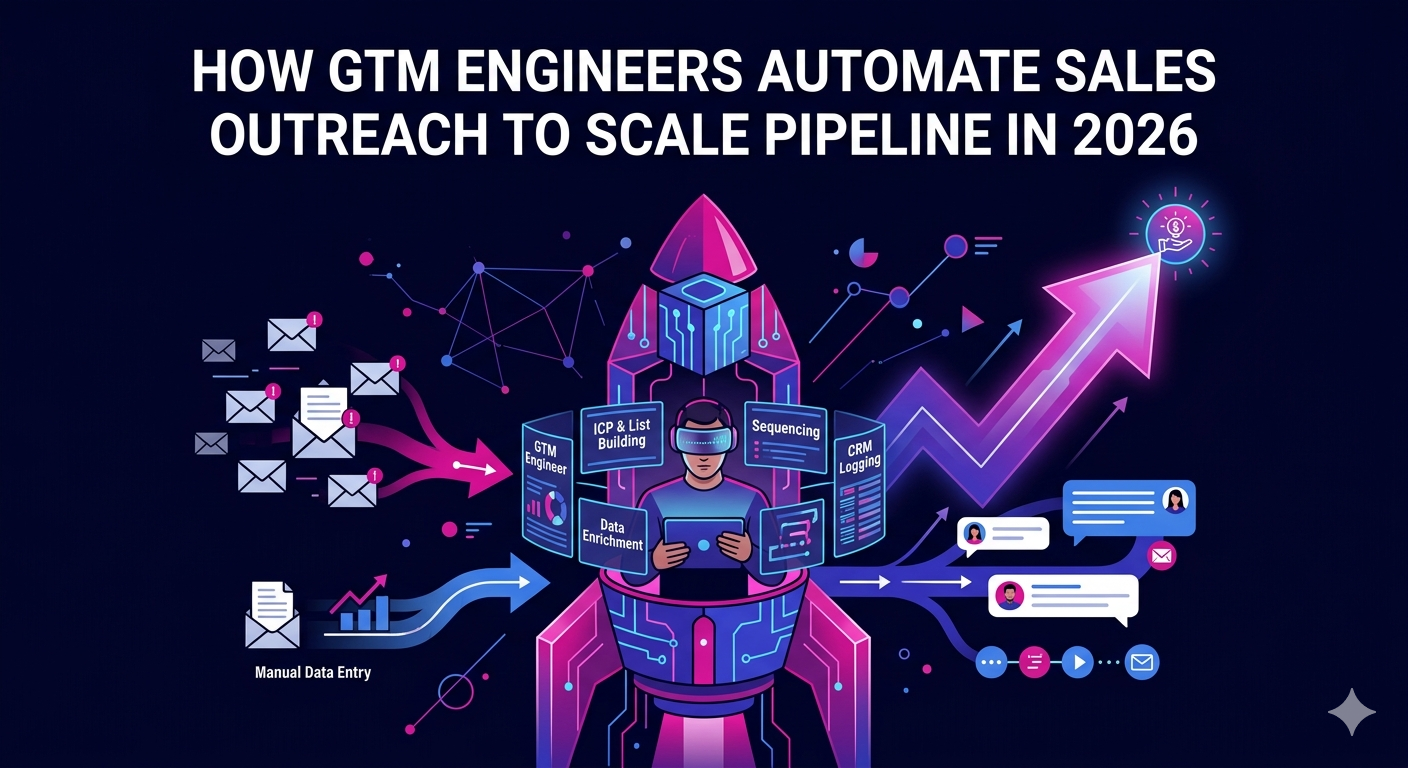
Understanding how GTM engineers automate sales outreach is one of the most valuable things a revenue leader can do in 2026. The companies that are winning right now are not just hiring more salespeople. They are building smarter systems that let a lean team generate more pipeline than a bloated one ever could. And at the center of that shift is the go to market engineer.
This guide covers exactly how GTM engineers automate sales outreach, which tools they use, what the process looks like end to end, and how your team can benefit from this approach right now.
What It Means to Automate Sales Outreach as a GTM Engineer
Before diving into the mechanics, it helps to understand what GTM engineers are actually doing when they automate sales outreach. This is not about blasting generic cold emails at a list of contacts. It is about building intelligent, data-driven systems that identify the right prospects, enrich them with relevant context, trigger personalized outreach at the right moment, and track every interaction automatically.
When GTM engineers automate sales outreach properly, the result is a pipeline engine that runs continuously with minimal manual input. Your SDRs spend less time on research and data entry, and more time on conversations that actually convert.
The Core Components of Automated Sales Outreach
- Targeted prospect list building using enriched, real-time data
- Automated lead scoring and qualification based on ICP criteria
- Multi-channel outreach sequences across email, LinkedIn, and phone
- Personalization at scale using dynamic fields and AI-generated copy variations
- CRM integration to log every touchpoint without manual entry
- Deliverability monitoring to ensure emails land in inboxes, not spam folders
- Performance tracking and iteration based on open, reply, and conversion rates
The Tools GTM Engineers Use to Automate Sales Outreach
The GTM tech stack in 2026 is more powerful than ever. GTM engineers build automated sales outreach systems using a combination of data enrichment platforms, sequencing tools, CRM integrations, and AI-powered personalization engines. Here is a look at the key tools in play.
Clay: The Central Nervous System of Modern Outreach Automation
Clay has become the go-to platform for how GTM engineers automate sales outreach at scale. It allows engineers to pull data from dozens of sources simultaneously, enrich every lead with firmographic, technographic, and intent data, and trigger personalized outreach automatically. A GTM engineer can build a Clay workflow that takes a raw list of target companies and enriches each contact with job title, LinkedIn activity, tech stack, recent news, and funding history, then feeds that enriched data directly into an outreach sequence.
Sequencing and Email Infrastructure Tools
- Instantly and Smartlead: Used for high-volume cold email sending with built-in deliverability optimization and inbox rotation
- Lemlist: Preferred for highly personalized campaigns that include custom images or video thumbnails
- Salesloft and Outreach: Enterprise-grade sequencing platforms that integrate deeply with Salesforce and HubSpot
CRM and Integration Platforms
- HubSpot and Salesforce: The primary CRMs where GTM engineers configure pipelines, lifecycle stages, and automated task creation
- Zapier and Make: Used to connect tools that do not have native integrations, creating automated data flows between platforms
- n8n: An open-source automation platform gaining popularity for complex GTM workflows that require more flexibility
AI and Personalization Layers
In 2026, AI is deeply embedded in how GTM engineers automate sales outreach. Tools like GPT-4 and Claude are used within Clay workflows to generate personalized first lines, summarize a prospect’s recent LinkedIn activity, or write custom value propositions based on a company’s tech stack. This level of personalization at scale was simply not possible a few years ago, and it is a major reason why GTM-engineered outreach outperforms manual prospecting.
The Step-by-Step Process: How GTM Engineers Automate Sales Outreach
To make this concrete, here is the end-to-end workflow a GTM engineer typically builds to automate sales outreach for a B2B company.
Step 1: Define the ICP and Build the Target Universe
Everything starts with a tightly defined Ideal Customer Profile. The GTM engineer works with sales and marketing leadership to identify the firmographic and behavioral signals that indicate a high-fit prospect. This includes company size, industry, technology used, growth signals, job titles of decision-makers, and intent data from sources like G2 or Bombora.
Step 2: Build and Enrich the Lead List Automatically
Using tools like Clay, Apollo, and LinkedIn Sales Navigator, the GTM engineer sets up a workflow that continuously pulls new leads matching the ICP criteria, enriches each contact with additional data, verifies email addresses for deliverability, and scores each lead before it ever enters the outreach queue. This process, which might take an SDR several hours per week manually, runs automatically in the background.
Step 3: Set Up Personalized Multi-Touch Sequences
Once leads are enriched and scored, the GTM engineer builds the outreach sequences. A typical automated sequence in 2026 might look like this:
- Day 1: Personalized cold email referencing a specific trigger (recent funding, new hire, product launch)
- Day 3: LinkedIn connection request with a brief personalized note
- Day 6: Follow-up email with a relevant case study or resource
- Day 10: Second LinkedIn touchpoint or voice message
- Day 14: Final email with a clear and low-friction call to action
Every step is automated, and every message is personalized using the enriched data fields pulled in step two.
Step 4: Configure CRM Integration and Lead Routing
The GTM engineer ensures that every prospect interaction is automatically logged in the CRM. When a prospect replies, a meeting is booked, or a sequence reaches a specific stage, the CRM record is updated automatically. Lead routing rules direct hot leads to the right SDR or AE without any manual handoff required.
Step 5: Monitor Deliverability and Optimize Performance
Automation does not mean set it and forget it. GTM engineers monitor email deliverability metrics daily, rotate sending domains as needed, A/B test subject lines and opening lines, and adjust sequences based on performance data. This continuous optimization loop is what separates a well-engineered outreach system from a campaign that burns out after two weeks.
Want to hire a GTM engineer who can build this kind of system for your team? Explore pre-vetted remote GTM engineers at The Remote Reps and get your outreach automation running faster than you thought possible.
The Results Companies See When GTM Engineers Automate Sales Outreach
The business case for understanding how GTM engineers automate sales outreach becomes clear when you look at the numbers. Companies that invest in a well-built outreach automation system typically see:
- A 40 to 60 percent reduction in manual prospecting time for SDRs
- A 2 to 4x increase in outreach volume without adding headcount
- Improved email deliverability and open rates due to proper infrastructure setup
- Faster pipeline velocity because leads are engaged at the right time with relevant messaging
- Better data quality in the CRM because enrichment and logging happen automatically
According to Forrester’s research on B2B sales automation, companies that implement structured sales automation see meaningful improvements in rep productivity and quota attainment. GTM engineering is the practical application of that research at the team level.
Pairing your GTM engineer with a strong outbound team amplifies these results even further. If you also need experienced outbound reps to work within the system your GTM engineer builds, you can hire remote cold email experts at The Remote Reps who are trained to operate inside automated outreach workflows.
Common Mistakes That Limit Outreach Automation Success
Knowing how GTM engineers automate sales outreach also means knowing what can go wrong. These are the most common pitfalls.
Skipping the ICP Definition Phase
Automation amplifies whatever you feed into it. If your ICP is poorly defined, your automated system will generate a high volume of low-quality outreach that damages your domain reputation and wastes everyone’s time. A GTM engineer should always start by aligning on ICP before building any workflow.
Ignoring Email Infrastructure Setup
Many companies dive straight into sequencing without properly warming up their sending domains, configuring SPF, DKIM, and DMARC records, or setting up inbox rotation. The result is poor deliverability. A GTM engineer treats infrastructure setup as the foundation of everything else.
Over-Automating Without Human Review
The best outreach automation systems include checkpoints where a human reviews outreach before it sends, particularly for high-value accounts. Full automation without any quality control can result in embarrassing errors or tone-deaf messaging that damages your brand.
Conclusion: Why Every Growth Team Needs to Understand This in 2026
The question is no longer whether to automate sales outreach. It is whether your team has the technical expertise to do it properly. Understanding how GTM engineers automate sales outreach gives you the clarity to make the right hiring decision and build a pipeline engine that compounds over time.
The Remote Reps connects growing companies with elite remote GTM engineers who have the skills to build, run, and optimize automated outreach systems from day one. No long hiring cycles. No in-house overhead. Just results.
Post your GTM engineer role today and start building your automated outreach system in 2026.
FAQ: How GTM Engineers Automate Sales Outreach
What does it mean when we say GTM engineers automate sales outreach?
When GTM engineers automate sales outreach, it means they build systems that handle prospecting, data enrichment, sequence triggering, personalization, and CRM logging without requiring manual input for each step. The result is a scalable pipeline engine that runs continuously while your team focuses on high-value conversations.
Which tools do GTM engineers use most often to automate sales outreach?
The most commonly used tools when GTM engineers automate sales outreach include Clay for data enrichment and workflow building, Instantly or Smartlead for cold email sending, HubSpot or Salesforce for CRM integration, and Zapier or Make for connecting tools that do not have native integrations. AI tools like GPT-4 are also widely used for personalization at scale.
How long does it take a GTM engineer to build an automated sales outreach system?
The timeline depends on the complexity of your stack and how clearly your ICP is defined. Most GTM engineers can have a basic automated sales outreach system running within two to four weeks. A more sophisticated, multi-channel system with full CRM integration and AI personalization typically takes four to eight weeks to build and optimize.
Can GTM engineers automate sales outreach for both inbound and outbound motions?
Yes. GTM engineers automate sales outreach across both inbound and outbound motions. For outbound, they build prospecting and cold email workflows. For inbound, they configure lead scoring, automated follow-up sequences, and routing rules that ensure inbound leads are engaged quickly and routed to the right rep based on their profile and behavior.
Will automated sales outreach built by a GTM engineer replace my SDR team?
No. When GTM engineers automate sales outreach, the goal is to make your SDR team more productive, not to replace them. Automation handles the volume and consistency. SDRs handle the conversations, objection handling, and relationship-building that convert prospects into qualified pipeline. The two functions work best together.
How do I know if my company is ready for a GTM engineer to automate sales outreach?
You are ready to hire a GTM engineer to automate sales outreach if your SDRs are spending significant time on manual research and data entry, your email deliverability is inconsistent, your tools are not properly integrated, or you want to scale outbound without scaling headcount proportionally. These are the clearest signals that systems work needs to happen before adding more reps.